Understanding Connotation and Word Tone in Synonyms


Understanding the subtle differences between synonyms is a critical skill for the Upper Level Verbal section. While many words share basic definitions, their connotations-emotional associations, implied judgments, and tonal qualities-vary significantly. Mastering these distinctions allows you to select precise answers in synonym questions and avoid common trap choices that seem superficially correct but carry the wrong emotional weight or contextual application.
1. Connotation: The Emotional Layer of Language
Connotation refers to the implied meaning, emotional association, or cultural judgment attached to a word beyond its literal dictionary definition (denotation). Two words may share the same denotation but evoke entirely different reactions.
- Positive Connotation: Words that suggest approval, admiration, or favorable judgment (e.g., "ambitious," "confident," "thrifty")
- Negative Connotation: Words that imply disapproval, criticism, or unfavorable judgment (e.g., "scheming," "arrogant," "cheap")
- Neutral Connotation: Words that carry minimal emotional weight and remain objective (e.g., "determined," "self-assured," "economical")
1.1 Connotation in Synonym Questions
Upper Level synonym questions frequently test whether you can distinguish between words with similar denotations but different connotative tones. The correct answer must match both the meaning and the emotional register of the stem word.
1.1.1 Common Trap Pattern: Positive/Negative Reversal
- PERSISTENT: (A) stubborn (B) determined (C) obstinate (D) tenacious
- Analysis: "Persistent" carries a positive or neutral tone suggesting admirable dedication. "Stubborn" and "obstinate" are negative synonyms implying unreasonable inflexibility. "Determined" and "tenacious" preserve the positive connotation. The best match depends on contextual shading, but recognizing the negative trap is essential.
1.1.2 Intensity Gradation Traps
Words may share meaning but differ in intensity or degree. Upper Level questions exploit these gradations.
- ANGRY: (A) irritated (B) furious (C) displeased (D) annoyed
- Analysis: "Angry" occupies a moderate intensity level. "Furious" is too intense; "irritated," "displeased," and "annoyed" are too mild. Understanding intensity scales prevents selection of extreme or understated alternatives.
1.2 Tone: Formality, Register, and Context
Tone reflects the formality level, social context, and stylistic register of a word. Words with identical denotations may belong to different tonal registers (formal, informal, colloquial, archaic, technical).
- Formal/Academic: "perspicacious," "erudite," "indigent"
- Neutral/Standard: "insightful," "knowledgeable," "poor"
- Informal/Colloquial: "sharp," "smart," "broke"
1.2.1 Register Matching in Synonym Questions
The correct synonym typically matches the formality register of the stem word. Upper Level questions rarely mix formal academic vocabulary with informal equivalents.
- TERMINATE: (A) end (B) finish (C) cease (D) stop
- Analysis: "Terminate" is formal/technical. "Cease" matches this register most closely. "End," "finish," and "stop" are neutral or slightly informal, making them less precise despite semantic overlap.
2. Systematic Approach to Connotation and Tone Analysis
2.1 Three-Step Evaluation Framework
- Identify the Denotation: Establish the core literal meaning of the stem word without emotional associations.
- Assess the Connotation: Determine whether the word carries positive, negative, or neutral emotional weight. Consider implied judgment or cultural association.
- Evaluate the Tone: Classify the formality level (formal, neutral, informal) and contextual appropriateness (academic, conversational, technical).
2.2 Application to Trap Elimination
Once you've analyzed the stem word, systematically eliminate answer choices that fail any of the three criteria:
- Denotation Mismatch: Words that share no semantic overlap (immediate elimination)
- Connotation Reversal: Words with opposite emotional associations (common Upper Level trap)
- Tone Inconsistency: Words from mismatched formality registers (subtle but decisive trap)
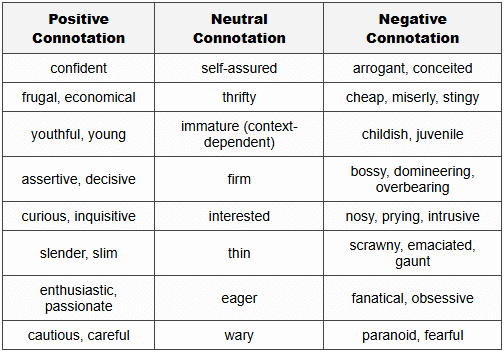
3. High-Frequency Connotation Pairs and Clusters
Certain word groups appear repeatedly in Upper Level questions due to their parallel structures and subtle distinctions. Memorizing these clusters with their connotative differences provides strategic advantage.
3.1 Positive/Negative Synonym Clusters
3.2 Intensity Gradation Series
Understanding words arranged by increasing or decreasing intensity helps identify the precise synonym match.
- Happiness Scale: content → pleased → happy → joyful → ecstatic → euphoric
- Anger Scale: annoyed → irritated → angry → furious → enraged → livid
- Fear Scale: nervous → worried → afraid → frightened → terrified → petrified
- Sadness Scale: disappointed → sad → sorrowful → miserable → despondent → despairing
3.3 Formality Register Gradations
- To Show: demonstrate (formal) → show (neutral) → point out (neutral) → display (formal) → exhibit (formal)
- To Begin: commence (formal) → begin (neutral) → start (neutral) → initiate (formal)
- To End: terminate (formal) → conclude (formal) → end (neutral) → finish (neutral) → cease (formal)
- To Help: assist (formal) → help (neutral) → aid (formal) → facilitate (very formal)
4. Advanced Connotation Distinctions
4.1 Cultural and Contextual Connotations
Some words carry connotations tied to specific contexts, historical associations, or cultural judgments. These are particularly common in Upper Level verbal sections.
- Propaganda vs. Information: Both refer to disseminated messages, but "propaganda" implies manipulative or biased content, while "information" remains neutral.
- Regime vs. Government: "Regime" often suggests authoritarian or oppressive governance; "government" is neutral.
- Clique vs. Group: "Clique" implies exclusivity and social judgment; "group" is neutral.
- Scheme vs. Plan: "Scheme" carries negative connotations of deception; "plan" is neutral or positive.
4.2 Subtle Judgment Words
Certain words embed subtle approvals or criticisms that test advanced vocabulary discrimination:
- Precocious vs. Mature: Both describe advanced development, but "precocious" specifically refers to children developing early (neutral to mildly positive), while "mature" is broadly positive.
- Notorious vs. Famous: "Notorious" implies fame for negative reasons; "famous" is neutral to positive.
- Cunning vs. Clever: "Cunning" suggests deceitfulness; "clever" is positive or neutral.
- Meticulous vs. Picky: "Meticulous" positively connotes careful attention to detail; "picky" negatively implies excessive fussiness.
5. Practice Strategy for Connotation Mastery
5.1 Contextual Substitution Drill
For each synonym pair you encounter, create two sentences-one where the connotation is appropriate and one where it creates tonal discord:
- Example Pair: Economical vs. Cheap
- Appropriate: "Her economical shopping habits allowed her to save for college." (positive context)
- Discord: "Her cheap shopping habits allowed her to save for college." (negative judgment intrudes)
5.2 Connotation Reversal Exercise
Take a sentence with a positively connoted word and substitute its negative counterpart to observe the tonal shift:
- Original: "The detective was persistent in solving the case."
- Reversed: "The detective was stubborn in solving the case." (introduces negative judgment)
5.3 Synonym Discrimination Practice
When studying vocabulary lists, actively group synonyms by connotation rather than definition alone:
- Group Formation: For the stem word "talkative," distinguish: articulate (positive), loquacious (neutral/formal), garrulous (negative), verbose (negative/formal)
- Justification Requirement: Explain why each synonym belongs to its connotative category with specific contextual reasoning
6. Common Upper Level Trap Patterns
6.1 The "Close Enough" Trap
Answer choices that share general semantic territory but fail connotation or tone precision:
- ASTUTE: (A) intelligent (B) clever (C) shrewd (D) smart
- Analysis: "Astute" specifically connotes sharp judgment in practical matters, often with social or strategic insight. "Shrewd" captures this nuance; "intelligent," "clever," and "smart" are too general despite semantic overlap.
6.2 The Intensity Mismatch Trap
Presenting synonyms that are too extreme or too mild relative to the stem word:
- DISLIKE: (A) despise (B) hate (C) detest (D) disapprove
- Analysis: "Dislike" is moderate in intensity. "Despise," "hate," and "detest" are excessively intense. "Disapprove" matches the moderate negative tone most accurately.
6.3 The Formal/Informal Register Trap
Mixing words from different formality levels to test register sensitivity:
- COMMENCE: (A) start (B) begin (C) initiate (D) kick off
- Analysis: "Commence" is highly formal. "Initiate" matches this register. "Start" and "begin" are neutral. "Kick off" is colloquial and inappropriate.
7. Connotation in Analogy and Sentence Completion Contexts
7.1 Maintaining Tonal Consistency in Analogies
When completing analogies, ensure the relationship preserves not just logical structure but also connotative parallelism:
- Example: FRUGAL : WASTEFUL :: careful : ?
- Wrong Approach: Selecting "reckless" (too extreme) or "careless" (insufficient opposition)
- Correct Approach: Match the moderate positive-to-negative intensity shift with "negligent" or "heedless"
7.2 Contextual Tone in Sentence Completions
The surrounding sentence provides tonal clues. A formal academic passage requires formal vocabulary; a narrative about personal experience may accept neutral or slightly informal choices.
- Formal Context: "The scholar's _____ analysis revealed previously unnoticed connections." → "meticulous" (not "picky")
- Negative Context: "Despite his _____ efforts, the project failed." → "persistent" or "tireless" (not "stubborn")
8. Strategic Vocabulary Building for Connotation Mastery
8.1 Nuanced Synonym Sets to Memorize
Focus your vocabulary study on high-frequency connotation clusters that appear in Upper Level questions:
- Praise/Criticism Verbs: commend, extol, laud (positive) vs. criticize, censure, denounce, disparage (negative)
- Skill/Deception Nouns: acumen, expertise, proficiency (positive) vs. duplicity, guile, chicanery (negative)
- Confidence/Arrogance Adjectives: assured, poised, composed (positive) vs. haughty, supercilious, imperious (negative)
8.2 Connotation Annotation Practice
When maintaining a vocabulary notebook, explicitly label each word's connotation alongside its definition:
- Format: Word: Definition | Connotation: Positive/Negative/Neutral | Register: Formal/Neutral/Informal | Example Sentence
- Example: Fastidious: Extremely attentive to detail | Connotation: Neutral to mildly negative (implies excessive fussiness) | Register: Formal | "Her fastidious approach to editing improved the manuscript's quality."
Mastering connotation and tone in synonym questions requires systematic analysis that extends beyond surface-level definitions. By internalizing emotional associations, intensity gradations, and formality registers, you develop the precision necessary to navigate Upper Level verbal traps and select answers that match both meaning and tonal quality. Consistent practice with connotation discrimination, contextual substitution, and strategic vocabulary annotation will elevate your performance on the most challenging synonym questions.
