CBSE Class 6 > Class 6 Notes > Arts (Kriti - 1) > Chapter Notes: Paper Crafts
Chapter Notes: Paper Crafts

Introduction
This chapter introduces students to paper as a versatile artistic medium. It covers three hands-on activities - paper folding, paper cutting, and paper weaving - while connecting these techniques to cultural traditions from Japan and India.Activity 1: Paper Folding (Origami)
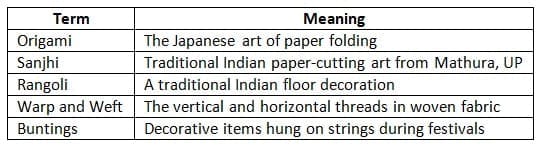
What is Origami?Origami is the Japanese art of folding paper into decorative shapes and figures. It originated in Japan and has since spread worldwide.
The Story of Sadako and the Thousand Paper CranesThis is an important story that connects art with history and peace. Sadako Sasaki was an 11-year-old Japanese girl who fell ill due to radiation from the atomic bombing of Hiroshima in 1945. During her hospital stay, she attempted to fold 1,000 paper cranes, inspired by a legend that doing so would grant a wish. She managed 644 cranes before she passed away. Today, people from around the world send paper cranes to the Children's Peace Monument in Japan, making the paper crane a universal symbol of peace.
Key Takeaway: Origami is not just a craft - it carries cultural, historical, and emotional significance.
Activity 2: Paper Cutting (Sanjhi)
What is Sanjhi?Sanjhi is a traditional Indian paper-cutting art form practiced in Mathura and surrounding areas of Uttar Pradesh. It was originally used to create stencils for rangoli. Today, artists make intricate paper cut-outs in elaborate designs, which are also used to make lanterns and decorations.
Did You Know?
Decorations made of paper, cloth, or plastic hung on strings during festivals are called buntings. These can be made more creative by cutting various shapes and patterns into them.
Safety Reminder: Always handle scissors and sharp tools carefully during paper cutting activities.
Activity 3: Paper Weaving
The Concept of Weaving If you look closely at any piece of cloth, you'll notice it is made of threads that criss-cross each other tightly. This criss-cross pattern is known as warp and weft the warp runs vertically and the weft runs horizontally. Paper weaving recreates this technique using strips of paper instead of thread.How to Do It: Cut a sheet of paper into vertical strips (leaving the top edge intact), then weave horizontal strips of a different colour paper through them in an over-under pattern to create a woven mat.
Extension Activity: Students are encouraged to explore weaving using other natural materials such as cotton, wool, bamboo, jute, palm leaves, or discarded fabric strips.
Summary of Key Terms
Discussion Questions for Class
- What does the story of Sadako teach us about the meaning behind a craft?
- How is Sanjhi connected to Indian culture and festivals?
- Can you think of other everyday materials that could be used for weaving?
Learning Outcomes
By the end of this chapter, students should be able to understand the cultural origins of origami and Sanjhi, attempt basic paper folding, cutting, and weaving, and appreciate how simple materials like paper can be transformed into meaningful art.The document Chapter Notes: Paper Crafts is a part of the Class 6 Course Arts for Class 6 (Kriti - 1).
All you need of Class 6 at this link: Class 6
FAQs on Chapter Notes: Paper Crafts
| 1. What is origami and how is it related to paper folding? |  |
Ans. Origami is the traditional Japanese art of paper folding, which involves transforming a flat sheet of paper into a finished sculpture through folding techniques. It is related to paper folding as it specifically emphasises creating intricate designs and forms solely through folding, without the use of cuts or glue.
| 2. Can you explain the significance of Sanjhi in paper crafts? | |
Ans. Sanjhi is a traditional Indian art form that involves intricate paper cutting to create decorative patterns and designs. This craft is significant because it reflects the cultural heritage of India and is often used in religious and festive decorations, showcasing the skill and creativity of artisans in manipulating paper.
| 3. What are the basic techniques used in paper weaving? | |
Ans. The basic techniques of paper weaving involve cutting strips of paper and interlacing them to create patterns and textures. This can include different methods such as over-and-under weaving, braiding, and layering, which allow for the creation of both functional items and artistic compositions.
| 4. How can paper crafts benefit students in their learning process? | |
Ans. Paper crafts can benefit students by enhancing their fine motor skills, encouraging creativity, and fostering problem-solving abilities. Engaging in activities like origami, Sanjhi, and paper weaving promotes concentration and patience, while also allowing students to express themselves artistically and understand geometric concepts through hands-on experience.
| 5. What materials are typically used for paper crafts in class projects? | |
Ans. Typical materials used for paper crafts in class projects include various types of paper such as construction paper, origami paper, and patterned paper. Additionally, scissors, glue, and decorative elements like markers or paint may be used to enhance the final product, enabling students to explore their creativity while creating their crafts.
About this Document

4.76/5 Rating

Apr 20, 2026 Last updated
Related Exams
Document Description: Chapter Notes: Paper Crafts for Class 6 2026 is part of Arts for Class 6 (Kriti - 1) preparation. The notes and questions for Chapter Notes: Paper Crafts have been prepared according to the Class 6 exam syllabus. Information about Chapter Notes: Paper Crafts covers topics like and Chapter Notes: Paper Crafts Example, for Class 6 2026 Exam. Find important definitions, questions, notes, meanings, examples, exercises and tests below for Chapter Notes: Paper Crafts.
Introduction of Chapter Notes: Paper Crafts in English is available as part of our Arts for Class 6 (Kriti - 1) for Class 6 & Chapter Notes: Paper Crafts in Hindi for Arts for Class 6 (Kriti - 1) course. Download more important topics related with notes, lectures and mock test series for Class 6 Exam by signing up for free. Class 6: Chapter Notes: Paper Crafts
Description
Chapter Notes: Paper Crafts of Arts with clear explanations of key concepts & important topics of the chapter, to help you underst& lessons better & revise quickly, & crack the Class 6 exam.
Information about Chapter Notes: Paper Crafts
In this doc you can find the meaning of Chapter Notes: Paper Crafts defined & explained in the simplest way possible. Besides explaining types of Chapter Notes: Paper Crafts theory, EduRev gives you an ample number of questions to practice Chapter Notes: Paper Crafts tests, examples and also practice Class 6 tests



Related Searches
ppt, video lectures, Extra Questions, Chapter Notes: Paper Crafts, mock tests for examination, Semester Notes, pdf , Previous Year Questions with Solutions, Viva Questions, Sample Paper, past year papers, study material, shortcuts and tricks, Summary, Chapter Notes: Paper Crafts, MCQs, Exam, Important questions, Chapter Notes: Paper Crafts, Free, Objective type Questions, practice quizzes;