Chapter Notes: Seals to Prints

Introduction
This chapter explores the design, purpose, and artistic qualities of seals throughout history. Students will design their own seals, test them on paper and fabric, and connect the process to the traditional textile art of Ajrakh block printing.
What is a Seal?
A seal is a tool used to make an impression or mark on a surface. It can carry a picture/symbol, written text in various scripts, or both together.
Purpose of Seals: Seals give us clues about the lives, routines, social positions, and beliefs of individuals, societies, kingdoms, institutions, and organisations.
Uses of Seals:
- To authenticate documents
- To identify an individual, institution, or authority
- To convey authority or ownership
Examples students may have seen: school principal's rubber stamp, post office seal, government stamps on official documents.
Seals Through History
Seals have been used across different periods of history and civilisations. Historical seals often feature animal motifs, human figures, geometric symbols, and written scripts. Key observation: All historical seals have both a picture symbol and written text in different scripts.
Activities Summary
Activity 1 - Let's Look at Seals
Objective: Observe and analyse seals from everyday life and history.
Discussion Questions:
- What is the image or text on the seal?
- What does the seal convey?
- What are seals used for?
Activity 2 - Field Trip (Post Office)
Objective: Explore real-world use of seals.
Find out: the material used, the postal logo/symbol, and other information on the seal.
Experiment: Place paper over a coin and rub a pencil over it - the coin's design will appear. This technique is called frottage.
Activity 3 - Make Your Own Seal (4 Steps)
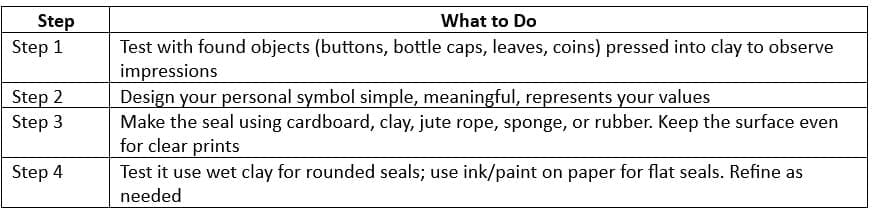
Activity 4 - Printing
Objective: Use your seal like a printing block to create repeating patterns.
How a rubber stamp works: Ink pad → Press seal → Stamp on paper = Printed impression
Hand Block Printing: A carved wooden block with raised patterns is dipped in dye and pressed repeatedly onto fabric to create continuous patterns.
Ajrakh Block Printing - Traditional Connection
- What: A traditional textile printing art form
- Where: Kutchh, Gujarat, India
- How: Skilled artisans use carved wooden blocks to print intricate patterns on cloth using natural dyes
- Significance: It connects the seal-making activity directly to a living Indian craft tradition
Key Terms
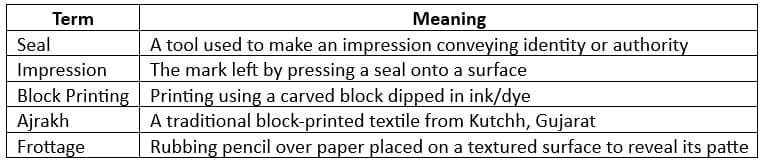
FAQs on Chapter Notes: Seals to Prints
| 1. What is a seal in the context of history? |  |
| 2. How have seals evolved through history? | |
| 3. What is Ajrakh block printing, and how does it relate to seals? | |
| 4. What are some activities associated with learning about seals and block printing? | |
| 5. Why is the study of seals and traditional printing methods important for students? | |