CBSE Class 6 > Class 6 Notes > Arts (Kriti - 1) > Chapter Notes: Melodies of Diversity
Chapter Notes: Melodies of Diversity

Regional Songs of India
India is home to a vast number of languages, traditions, and musical styles. The following songs represent different states and their unique musical heritage.1. Ha Urit Napanghi - Manipuri Song

Key Points:
- Originates from Manipur in Northeast India.
- Depicts a playful, nature-inspired theme involving a bird.
- Clapping is part of the song's performance style.
2. Kuttanadan Punchayile - Vanchipattu (Boat Song)
Vanchipattu refers to traditional boat songs from Kerala, associated with the famous snake boat races held in the backwaters.
Key Points:
- Vanchipattu = Boat songs from Kerala.
- Sung during traditional snake boat races (a cultural festival).
- The rhythm of the song matches the rowing of oars.
- Kuttanad is a low-lying agricultural and waterway region in Kerala.
3. Ei Maatire Moro Mote - Assamese Song

Know Your Musician Bhupen Hazarika:
- Born in Sadiya, Assam (1926).
- Playback singer, lyricist, musician, poet, filmmaker, and educationist.
- Known as Sudha Kontho ("The Voice of Nectar").
- Used music as an instrument of social change.
- Awards: Bharat Ratna, Dadasaheb Phalke Award, Sangeet Natak Akademi Award.
4. Potana J Dariya Ma - Gujarati Song

5. Taari Baanki Re - Garba from Gujarat
Garba is a traditional folk music and dance form from Gujarat, commonly performed during the festival of Navaratri.
About Garba:
- Performed during Navaratri festival.
- Instruments: Dhol, Tabla, Dholak (rhythm); Harmonium, Flute (melody).
- Body percussion includes clapping, stomping, and tapping with dandiya sticks.
- Melodic patterns evoke joy and celebration.
6. Athinthom - Tamil Song

7. Cheluvayya - Kannada Folk Song

Key Points:
- Chitradurga Fort is a historically significant fort in Karnataka.
- The song blends celebration, nature, and cultural pride.
8. O Jind Mahe Bajare - Punjabi Song

9. Kshatriya Kulavatsana - Marathi Song

Devotional Path to the Divine
Indian music is deeply rooted in devotion (Bhakti). Several musical forms are associated with worship and spirituality across different religions.1. Kirtan - Marathi (Abhang)
Sung by Bharat Ratna Pandit Bhimsen Joshi. This composition is by Saint Tukaram, a revered Marathi saint-poet.
About Kirtan:
- A devotional form of music in Hinduism.
- Abhang = a type of devotional poetry/song in Marathi.
- Often performed in temples or religious gatherings.
2. Shabad - Punjabi/Gurmukhi
Shabads are sacred hymns sung in Gurudwaras (Sikh places of worship).
About Shabad:
- Shabad = Sacred word/hymn in Sikhism.
- Sung in Gurudwaras during prayer.
- Promotes faith, peace, and trust in God.
3. Hymns - Christian Devotional Songs
Hymns are devotional songs sung in churches during worship services.
4. Sufi Song - Mo Mina Ma
Sufi music expresses a deep, mystical love for God through poetry and melody. About Sufi Music:
- Originated in Persian/Islamic mystical tradition.
- The Masnavi is a major work of Persian Sufi literature by Rumi.
- Focuses on spiritual unity and love for the divine.
- Qawwali is another popular form of Sufi music.
Quick Summary: Songs at a Glance
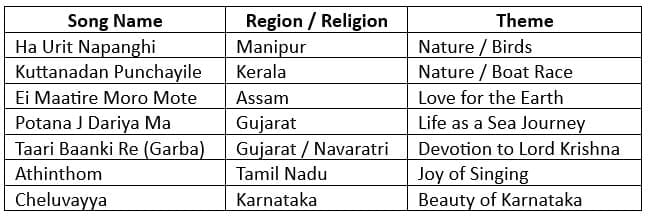
Forms of Indian Music Summary
Indian music can be broadly categorised into:
- Classical Music: Hindustani (North India) and Carnatic (South India).
- Regional / Folk Music: Unique to each state and community (as seen in the songs above).
- Devotional Music: Kirtan, Shabad, Hymns, Qawwali, Bhajan, etc.
Instruments mentioned in this chapter:
- Rhythm: Dhol, Tabla, Dholak, Chenda, Thavil, Chimta.
- Melody: Harmonium, Flute, Pungi.
- Body percussion: Clapping, Stomping, Dandiya sticks (for Garba).
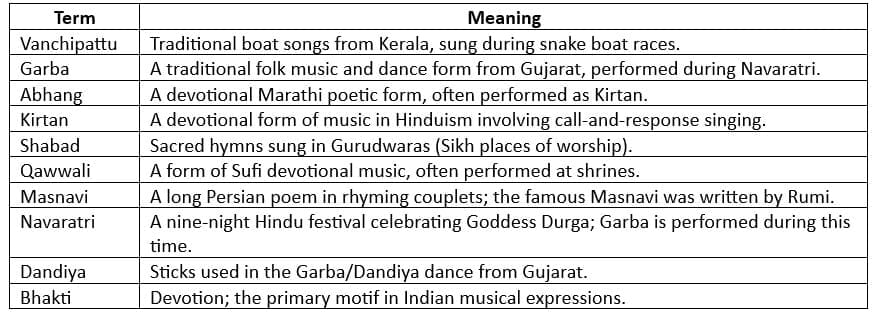
Key Terms & Vocabulary
Revision Questions
- What is Vanchipattu? With which event is it associated?
- Name the instruments used in Garba performances.
- Who was Bhupen Hazarika and why is he important?
- What is the message of the Kirtan sung by Bhimsen Joshi?
- What is a Shabad? Where is it sung?
- Who wrote the Masnavi? What is the central theme of 'The Faithful are One Soul'?
- Name any three forms of devotional music in India.
- What is the significance of learning songs from different regions of India?
The document Chapter Notes: Melodies of Diversity is a part of the Class 6 Course Arts for Class 6 (Kriti - 1).
All you need of Class 6 at this link: Class 6
FAQs on Chapter Notes: Melodies of Diversity
| 1. What are regional songs in India and how do they reflect cultural diversity? |  |
Ans. Regional songs in India are musical expressions that originate from various states and communities across the country. They reflect cultural diversity through their unique languages, themes, and traditional instruments. Each region's songs often convey local stories, folklore, and customs, highlighting the rich tapestry of India's heritage.
| 2. How do devotional songs contribute to the spiritual practices in India? | |
Ans. Devotional songs play a significant role in spiritual practices in India by facilitating connection with the divine. They are often sung during religious ceremonies, rituals, and gatherings to express devotion and seek blessings. The melodies and lyrics are designed to evoke emotions that enhance spiritual experiences and foster a sense of community among participants.
| 3. Can you name some common themes found in Indian devotional songs? | |
Ans. Common themes in Indian devotional songs include love and devotion towards deities, the celebration of festivals, moral teachings, and the glory of nature. Many songs also express feelings of longing and surrender to the divine, encapsulating the spiritual journey of the devotee through rich lyrical content.
| 4. What role do traditional instruments play in the performance of regional songs? | |
Ans. Traditional instruments play a crucial role in the performance of regional songs by providing distinctive sounds that enhance the musical experience. Instruments such as the tabla, harmonium, dholak, and sitar complement the melodic structures and rhythms of the songs, helping to create an authentic cultural atmosphere during performances and rituals.
| 5. How does the diversity of languages in India influence its regional songs? | |
Ans. The diversity of languages in India significantly influences its regional songs by allowing for a variety of lyrical compositions and storytelling styles. Each language carries its own idioms, expressions, and cultural references, which enrich the songs. This linguistic variety ensures that regional songs resonate with the local audience, preserving cultural identity and fostering pride in their heritage.
About this Document

4.90/5 Rating

Apr 29, 2026 Last updated
Related Exams
Document Description: Chapter Notes: Melodies of Diversity for Class 6 2026 is part of Arts for Class 6 (Kriti - 1) preparation. The notes and questions for Chapter Notes: Melodies of Diversity have been prepared according to the Class 6 exam syllabus. Information about Chapter Notes: Melodies of Diversity covers topics like and Chapter Notes: Melodies of Diversity Example, for Class 6 2026 Exam. Find important definitions, questions, notes, meanings, examples, exercises and tests below for Chapter Notes: Melodies of Diversity.
Introduction of Chapter Notes: Melodies of Diversity in English is available as part of our Arts for Class 6 (Kriti - 1) for Class 6 & Chapter Notes: Melodies of Diversity in Hindi for Arts for Class 6 (Kriti - 1) course. Download more important topics related with notes, lectures and mock test series for Class 6 Exam by signing up for free. Class 6: Chapter Notes: Melodies of Diversity
Description
Chapter Notes: Melodies of Diversity of Arts with clear explanations of key concepts & important topics of the chapter, to help you underst& lessons better & revise quickly, & crack the Class 6 exam.
Information about Chapter Notes: Melodies of Diversity
In this doc you can find the meaning of Chapter Notes: Melodies of Diversity defined & explained in the simplest way possible. Besides explaining types of Chapter Notes: Melodies of Diversity theory, EduRev gives you an ample number of questions to practice Chapter Notes: Melodies of Diversity tests, examples and also practice Class 6 tests



Related Searches
Semester Notes, MCQs, mock tests for examination, Objective type Questions, practice quizzes, shortcuts and tricks, Exam, video lectures, Summary, ppt, Chapter Notes: Melodies of Diversity, Extra Questions, Viva Questions, Important questions, Chapter Notes: Melodies of Diversity, Previous Year Questions with Solutions, Chapter Notes: Melodies of Diversity, Sample Paper, Free, study material, pdf , past year papers;