CBSE Class 6 > Class 6 Notes > Arts (Kriti - 1) > Chapter Notes: Stories of Shadows and Strings — Puppetry
Chapter Notes: Stories of Shadows and Strings — Puppetry


Introduction
Puppetry is the art of using inanimate (non-living) figures or representations to create a performance. A puppeteer is the person who controls and gives life to these figures in front of an audience.Key Definition:
- Puppetry: Using inanimate figures through hand movement, strings, or rods to tell stories, entertain, or convey messages.
- Puppeteer: The person who manipulates puppet figures to create a performance.
Types of Puppets
A. Hand Puppetry Finger, Sock, and Glove Puppets
Hand puppetry is the simplest form of puppetry. Your own hand is the basic tool. There are no fixed rules puppets can be as creative as your imagination allows!I. Finger Puppets
- Use paper to create a small cup shape with scissors and glue.
- Wear it on your finger.
- Draw different faces, hands, and legs on the cup.
- Give each character a name and create a story!
- You can also draw your hand on paper and create characters directly.
II. Sock Puppets - Step-by-Step Guide
- Take any sock you have at home.
- Wear it on your hand until it is firm.
- Put an elastic band or rubber band around the four fingers and the separate thumb.
- Alternatively, cut open the mouth area and stick cardboard for a moving mouth.
- Add eyes, tongue, hair, nose and other features as desired.
- Give it a name and create a conversation!
III. Glove Puppets
- Use a glove as the puppet's body.
- Add features like eyes, hair, and a mouth to make a character.
- Each finger can represent a different character in the story.
Class Activity: Create Your Puppet Show!
- Step 1 Create two characters.
- They can be people, animals, or imaginary characters (like aliens, or combinations like a tiger and a ghost).
- Step 2 List out characteristics.
- Give each character a name and an emotion (funny, angry, sad). Decide their style of talking.
- Step 3 Write a simple conversation.
- Recall the three parts of a script. Include a situation and a conflict where the two characters interact.
- Showtime! Present this show to your class or family. You are now a puppeteer!
Stick and Shadow Puppetry
These forms of puppetry require a simple setup and are done in teams of 5-6 students. Each team chooses a story, writes a script with 3-4 characters, and works together to make the puppets.A. Stick Puppets
- Draw and colour pictures of all characters and cut them to shape.
- Find sticks at least 6 inches long twigs, ice-cream sticks, or stiff cardboard strips.
- Glue the character picture to one end of the stick. You hold the other end.
- Create a cardboard frame (rectangle) big enough to fit all your characters.
- Optional: Decorate the frame with background images suited to your script (forest, street, etc.).
B. Shadow Puppets
Shadow puppetry is the next step from stick puppetry. You add a white cloth to the cardboard frame and use a focused torch or light source.Important Tips for Shadow Puppetry:
- The light source must be focused (not spread out) sharpness of shadow depends on this.
- Place the light on a stable surface so it does not move.
- The outline of the character is most important colour and facial features are not visible in shadows.
- The outline alone must communicate who the character is to the audience.
Hand Puppets in India
India has a rich tradition of hand puppetry. Here are three well-known regional styles: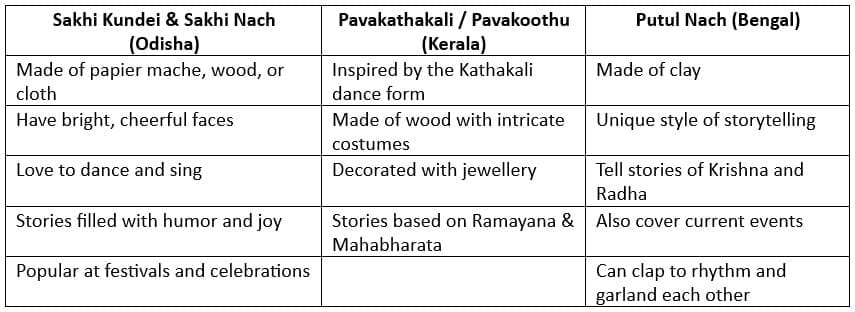
Stick and Shadow Puppets in India
Shadow puppetry has existed in India for more than 2,000 years. The most popular stories narrated are those of Rama and Krishna.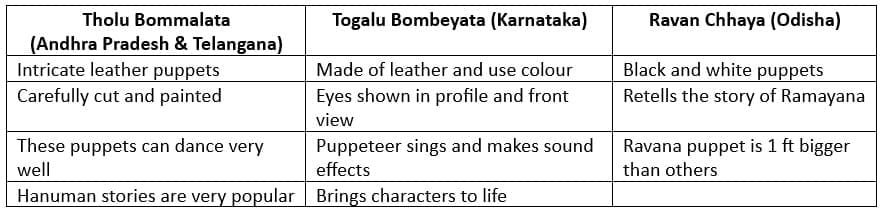
Voice Modulation
Voice modulation means changing your voice to match the feelings and personality of the puppet character you are voicing.Why is it important?
- It makes characters come alive and distinguishes one character from another.
- It is especially critical when one person is voicing two different characters.
- Both characters must sound different from each other AND from the puppeteer's natural voice.
- It applies to all forms: sock puppetry, stick puppetry, and shadow puppetry.
Examples of Voice Modulation:

Puppetry Trivia Did You Know?
- Puppets have been used to tell stories in India for more than 3,000 years! The Bhagavata Purana by Rishi Vyasa describes wooden puppets controlled with strings.
- Indian kings like Krishnadevaraya and Vikramaditya were so fond of puppetry, they had their own special theatres for puppet shows.
- Farmers would relax after a hard day's work by performing and watching puppet shows.
- Puppetry is used today as an effective educational tool to create awareness about values like gender sensitivity and safe/unsafe touch.
- Modern Indian puppetry continues the tradition by incorporating new techniques and technologies.
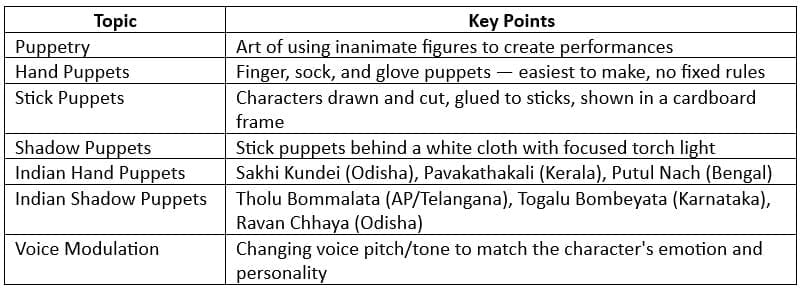
Chapter Summary at a Glance
Revision Questions
Short Answer Questions- What is puppetry? Who is a puppeteer?
- Name three types of hand puppets and briefly describe how to make one of them.
- What materials are needed to perform shadow puppetry?
- Why must the light source be focused and stable during shadow puppetry?
- Name any two traditional Indian puppetry forms and mention the states they belong to.
B. Long Answer Questions
- Describe the step-by-step process of making a sock puppet. What story would you create with it?
- Compare any two regional Indian shadow puppet styles. What makes each one unique?
- Explain what voice modulation is and why it is important in a puppet show. Give two examples of how you would change your voice for different characters.
C. Think and Discuss
- How is a puppet show different from a regular drama or theatre performance?
- Why do you think farmers in ancient India enjoyed puppet shows after work?
- How can puppetry be used to teach values in school? Give an example.
The document Chapter Notes: Stories of Shadows and Strings — Puppetry is a part of the Class 6 Course Arts for Class 6 (Kriti - 1).
All you need of Class 6 at this link: Class 6
FAQs on Chapter Notes: Stories of Shadows and Strings — Puppetry
| 1. What are the different types of puppets mentioned in the article? |  |
Ans. The article discusses various types of puppets, including stick puppets, shadow puppets, and hand puppets. Each type has unique characteristics and methods of operation, contributing to the rich tradition of puppetry.
| 2. How are stick and shadow puppetry defined in the context of the article? | |
Ans. Stick and shadow puppetry are forms of puppetry where puppets are manipulated using sticks or are projected as shadows against a screen. Stick puppets are typically controlled by rods, while shadow puppets create visual stories through light and shadow, often requiring a light source to project the images.
| 3. What is the significance of hand puppets in Indian culture? | |
Ans. Hand puppets hold a significant place in Indian culture as they are used in storytelling and entertainment. These puppets often depict traditional tales and folklore, allowing for cultural expression and the preservation of local narratives through performances.
| 4. How is voice modulation important in puppetry? | |
Ans. Voice modulation is crucial in puppetry as it enhances the performance by giving life to the puppets. By varying pitch, tone, and volume, puppeteers can create distinct characters and convey emotions effectively, making the storytelling more engaging for the audience.
| 5. What key concepts are summarised in the chapter notes of "Stories of Shadows and Strings"? | |
Ans. The chapter notes summarise the essential concepts of different types of puppets, their cultural significance, and techniques such as voice modulation. They highlight how puppetry serves as an artistic medium for storytelling and cultural expression, particularly in India.
About this Document

4.83/5 Rating

Apr 29, 2026 Last updated
Related Exams
Document Description: Chapter Notes: Stories of Shadows and Strings — Puppetry for Class 6 2026 is part of Arts for Class 6 (Kriti - 1) preparation. The notes and questions for Chapter Notes: Stories of Shadows and Strings — Puppetry have been prepared according to the Class 6 exam syllabus. Information about Chapter Notes: Stories of Shadows and Strings — Puppetry covers topics like and Chapter Notes: Stories of Shadows and Strings — Puppetry Example, for Class 6 2026 Exam. Find important definitions, questions, notes, meanings, examples, exercises and tests below for Chapter Notes: Stories of Shadows and Strings — Puppetry.
Introduction of Chapter Notes: Stories of Shadows and Strings — Puppetry in English is available as part of our Arts for Class 6 (Kriti - 1) for Class 6 & Chapter Notes: Stories of Shadows and Strings — Puppetry in Hindi for Arts for Class 6 (Kriti - 1) course. Download more important topics related with notes, lectures and mock test series for Class 6 Exam by signing up for free. Class 6: Chapter Notes: Stories of Shadows and Strings — Puppetry
Description
Chapter Notes: Stories of Shadows & Strings — Puppetry of Arts with clear explanations of key concepts & important topics of the chapter, to help you underst& lessons better & revise quickly, & crack the Class 6 exam.
Information about Chapter Notes: Stories of Shadows and Strings — Puppetry
In this doc you can find the meaning of Chapter Notes: Stories of Shadows and Strings — Puppetry defined & explained in the simplest way possible. Besides explaining types of Chapter Notes: Stories of Shadows and Strings — Puppetry theory, EduRev gives you an ample number of questions to practice Chapter Notes: Stories of Shadows and Strings — Puppetry tests, examples and also practice Class 6 tests



Related Searches
pdf , Exam, Previous Year Questions with Solutions, Objective type Questions, Chapter Notes: Stories of Shadows and Strings — Puppetry, study material, video lectures, mock tests for examination, past year papers, Summary, Chapter Notes: Stories of Shadows and Strings — Puppetry, Extra Questions, Sample Paper, Important questions, practice quizzes, shortcuts and tricks, Free, Viva Questions, MCQs, Chapter Notes: Stories of Shadows and Strings — Puppetry, Semester Notes, ppt;