CBSE Class 6 > Class 6 Notes > Arts (Kriti - 1) > Chapter Notes: Integration of All Art Forms
Chapter Notes: Integration of All Art Forms


Introduction
This is the final chapter of the Kriti-I textbook for Grade 6. Having studied four art forms separately - Visual Arts, Music, Dance, and Theatre - students are now guided to bring them all together in a single integrated activity. The core idea is that art forms do not exist in isolation; they can be woven together to tell stories, express emotions, and create meaningful social change.The Four Art Forms - Quick Recap
Before integration, students should be familiar with these four art forms:- Visual Arts
- Elements: Lines, Shapes, Colours, Textures
- Activities include: making seals, posters, photography, clay and mud art, upcycling materials
- Music
- Elements: Sounds, Rhythms, Emotions, Words
- Activities include: songwriting, composing, using instruments, creating sounds from everyday materials
- Dance
- Elements: Rhythms, Movement, Expressions
- Activities include: folk dances, footwork, hand gestures (mudras), choreography
- Theatre
- Elements: Emotions, Actions, Words (Dialogues)
- Activities include: mask making, puppet shows, script writing, costume design, nukkad natak (street plays)
Integration - Key Concept
Integration means combining elements from all four art forms into a single creative project. The textbook demonstrates this with a story where:- The mystery seal connects to Visual Arts (design and symbolism).
- The indigenous people's dancing connects to Music and Dance (local and regional songs and dances).
- The children's fear, surprise, and dialogue connect to Theatre (emotions and actions).
This shows students how a simple story can contain all four art forms naturally.
Pancha Tattva - The Five Elements of Nature
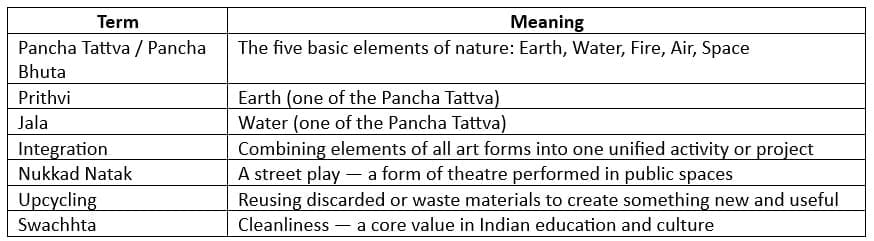
Key Term: Pancha Tattva (also called Pancha Bhuta) refers to the five basic elements of nature: Earth (Prithvi), Water (Jala), Fire (Agni), Air (Vayu), and Space (Akash).The suggested theme for the integration project is 'Earth and Water' from the Pancha Tattva. Students are encouraged to explore environmental issues and connect them to the four art forms creatively.
Examples of topics related to Earth and Water:
- Soil pollution / land degradation
- Water scarcity or quality of drinking water
- Ponds, lakes, rivers and their ecosystems
- Hills, waterfalls, and natural landscapes
- Imagining life without clean water or on polluted land
Individual Activity
Each student individually explores the theme of 'Earth and Water' using all four art forms. They fill in a table mapping the element to each art form:
Group Activity - Instructions
Students work in groups of 10-12. Each group is assigned either 'Earth' (Prithvi) or 'Water' (Jala) as their theme. The game-based group activity works as follows:- Make five sets of chits. Each set contains activities associated with one art form: Theatre, Music, Visual Art, Dance, and Values.
- Divide the class into two or three groups (10-12 students each). Each group chooses either 'Earth' or 'Water' as their area.
- One representative from each group picks one chit from each set, giving the group one activity per art form. The 'Values' chit provides a theme to unite the art forms.
- Each group develops an integrated project using all chosen activities and presents it to the class.
Activity Chits - Reference Table
The following table lists all possible chit activities for each art form: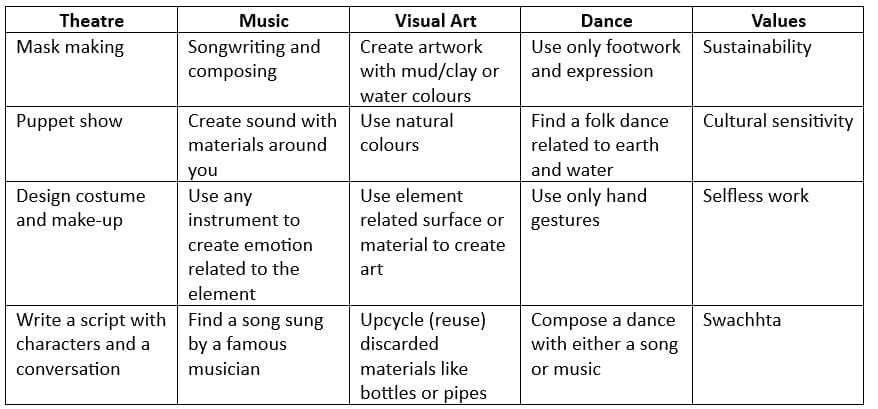
Values Embedded in this Chapter
- Sustainability caring for Earth and natural resources
- Cultural Sensitivity appreciating indigenous communities and folk traditions
- Selfless Work (Seva) using art to serve society
- Swachhta cleanliness and keeping our environment clean
Why Art Integration Matters
The textbook highlights that art is not only a skill to develop - it also has the potential to make social changes and reforms. When students learn about the arts, they develop sensitivity and awareness towards the world around them. They begin to appreciate small things, beauty, and changes in their environment.An integrated art project around themes like Earth and Water helps students:
- Express their ideas, emotions, and concerns creatively
- Develop empathy for environmental issues
- Learn to collaborate and communicate as a team
- Connect traditional knowledge (Pancha Tattva, folk dances, indigenous art) with modern concerns like pollution
Key Terms to Remember
Practice Questions
Short Answer Questions- What are the four art forms discussed in the Kriti-I textbook?
- What are the Pancha Tattva? Name all five elements.
- In the story example, how does the seal connect to Visual Arts?
- What is a nukkad natak? How can it be used to spread awareness?
- What does the word 'Swachhta' mean and how is it related to this chapter?
Long Answer Questions
- Explain with an example how all four art forms can be integrated into a single activity on the theme of water pollution.
- Why does the textbook say that art has the potential to make social changes and reforms? Give two reasons.
- Describe the steps of the group activity in this chapter. What is the role of the 'Values' chit?
Creative / Activity-Based Questions
- Choose any one environmental issue related to 'Earth.' Plan a project that uses theatre, music, dance, and visual art to showcase this issue. Fill in a table to show your plan.
- Write a short story (4-5 sentences) that includes elements of all four art forms.
The document Chapter Notes: Integration of All Art Forms is a part of the Class 6 Course Arts for Class 6 (Kriti - 1).
All you need of Class 6 at this link: Class 6
FAQs on Chapter Notes: Integration of All Art Forms
| 1. What are the Four Art Forms mentioned in the article? |  |
Ans. The Four Art Forms refer to various modes of artistic expression that are typically integrated into educational contexts. They encompass visual arts, performing arts, literary arts, and digital arts. These forms serve as tools for creativity and communication, enriching the learning experience.
| 2. What is the significance of Integration in the context of art forms? | |
Ans. Integration is a key concept that highlights the importance of combining different art forms to enhance understanding and creativity. By integrating these forms, learners can develop a more holistic perspective, encouraging critical thinking and fostering collaboration among various disciplines.
| 3. What does Pancha Tattva represent in the article? | |
Ans. Pancha Tattva, or the Five Elements of Nature, represents the fundamental components that constitute the universe. These elements are earth, water, fire, air, and space. Understanding these elements is essential for appreciating the interconnectedness of nature and its reflection in the arts.
| 4. What activities are suggested in the article for exploring art integration? | |
Ans. The article suggests both individual and group activities aimed at exploring art integration. Individual activities may involve personal creative projects that utilise different art forms, while group activities encourage collaboration, allowing participants to share ideas and create integrated art pieces collectively.
| 5. Why does the article emphasise the importance of art integration in education? | |
Ans. The article emphasises that art integration matters because it fosters a deeper understanding of concepts, enhances creativity, and encourages students to express themselves in diverse ways. By integrating arts into various subjects, students can engage more fully with the material and develop critical life skills.
About this Document

4.72/5 Rating

Apr 29, 2026 Last updated
Related Exams
Document Description: Chapter Notes: Integration of All Art Forms for Class 6 2026 is part of Arts for Class 6 (Kriti - 1) preparation. The notes and questions for Chapter Notes: Integration of All Art Forms have been prepared according to the Class 6 exam syllabus. Information about Chapter Notes: Integration of All Art Forms covers topics like and Chapter Notes: Integration of All Art Forms Example, for Class 6 2026 Exam. Find important definitions, questions, notes, meanings, examples, exercises and tests below for Chapter Notes: Integration of All Art Forms.
Introduction of Chapter Notes: Integration of All Art Forms in English is available as part of our Arts for Class 6 (Kriti - 1) for Class 6 & Chapter Notes: Integration of All Art Forms in Hindi for Arts for Class 6 (Kriti - 1) course. Download more important topics related with notes, lectures and mock test series for Class 6 Exam by signing up for free. Class 6: Chapter Notes: Integration of All Art Forms
Description
Chapter Notes: Integration of All Art Forms of Arts with clear explanations of key concepts & important topics of the chapter, to help you underst& lessons better & revise quickly, & crack the Class 6 exam.
Information about Chapter Notes: Integration of All Art Forms
In this doc you can find the meaning of Chapter Notes: Integration of All Art Forms defined & explained in the simplest way possible. Besides explaining types of Chapter Notes: Integration of All Art Forms theory, EduRev gives you an ample number of questions to practice Chapter Notes: Integration of All Art Forms tests, examples and also practice Class 6 tests
Top Courses for Class 6
Related Searches
pdf , Extra Questions, Semester Notes, Previous Year Questions with Solutions, Exam, Chapter Notes: Integration of All Art Forms, Sample Paper, Chapter Notes: Integration of All Art Forms, Chapter Notes: Integration of All Art Forms, study material, Important questions, ppt, Summary, practice quizzes, mock tests for examination, past year papers, MCQs, Viva Questions, Free, video lectures, shortcuts and tricks, Objective type Questions;