A.P Bhardwaj Summary : Law of Torts


INTRODUCTION
Origin: 'Tort' is derived from the Latin term tortum (to twist) - referring to conduct that is not upright or lawful. In French, 'tort' means a wrong.
Definition: Tort is a civil wrong redressible by an action for unliquidated damages, which is other than a mere breach of contract or breach of trust.
ESSENTIAL ELEMENTS OF TORT
1. Wrongful Act - An act or omission that a person ought not to do, or a failure to do what one ought to do.
2. Legal Damage - Violation of a legal right vested in the plaintiff.
TWO KEY LATIN MAXIMS
Injuria Sine Damnum - Violation of a legal right WITHOUT actual damage. This IS an actionable tort.
- Cases: Ashby v White; Bhim Singh v State of J&K
Damnum Sine Injuria - Actual damage WITHOUT violation of a legal right. This is NOT an actionable tort.
- Case: Gloucester Grammar School
Ashby v White - Plaintiff (a valid voter) was wrongfully prevented from voting by the returning officer. No monetary loss occurred; the candidate he wanted to vote for even won. Held: Plaintiff succeeded - his legal right (franchise) was violated. Classic Injuria Sine Damnum.
Bhim Singh v State of J&K - MLA was wrongfully arrested and not produced before a magistrate within stipulated time. Held: State liable and ordered to pay damages - fundamental rights violated.
Gloucester Grammar School - Defendant (teacher) set up a rival school in the same locality at lower fees, causing students to leave plaintiff's school. Held: No tort - monetary loss occurred but no legal right was violated. Lawful competition is not a tort.
GENERAL DEFENCES TO TORT
1. Volenti Non Fit Injuria
Voluntary assumption of risk - if a person voluntarily exposes themselves to a known risk, they cannot later claim damages for resulting harm.
Hall v Brooklands Auto Racing Club - Spectator at a car race was injured when a racing car rammed the spectator stand. Held: Organisers not liable - plaintiff impliedly accepted the risk by attending.
Exceptions:
- Rescue Cases - If plaintiff voluntarily rescues someone from danger created by the defendant's wrongful act, the defendant cannot use this defence.
Haynes v Harwood - Defendant left a horse carriage unattended; urchins threw stones and the horse bolted. A police constable stopped the horse and was injured. Held: Defendant liable - rescue is an exception; constable's voluntary rescue does not bar his claim.
- Employer cannot use this defence to escape liability for negligence towards employee safety.
2. Inevitable Accident
An unexpected injury arising from an unforeseeable and unavoidable event despite the defendant taking all reasonable care.
Stanley v Powell - Member of a shooting party accidentally shot another member. Held: Not liable - inevitable accident.
Brown v Kendall - While separating fighting dogs, defendant accidentally hit plaintiff's eye with a stick. Held: Not liable - unavoidable accident.
3. Act of God
Harm caused by extraordinary natural forces (storms, floods, earthquakes) without any human intervention.
Two conditions: ① Working of natural forces only ② Occurrence must be extraordinary and not reasonably anticipatable.
4. Private Defence
A person may use reasonable and proportionate force to protect their person or property from an imminent threat.
Two conditions: ① Threat must be immediate ② Force used must be proportionate.
Scott v Shepherd - A threw a lit firecracker in a crowded marketplace near a sweet stall. Stall owner threw it away in self-defence; it injured the plaintiff. Held: Stall owner not liable - acted in private defence.
VICARIOUS LIABILITY
Liability of a person for a tort committed by someone else.
Arises in:
1. Principal & Agent
2. Master & Servant
3. Employer & Independent Contractor
4. State liability
1. Principal & Agent
Key maxim: Qui facit per alium facit per se - the act of the agent is the act of the principal.
State Bank of India v Shyama Devi - Mrs. Shyama Devi handed cash to a bank employee (her husband's friend) for deposit. Employee misappropriated the amount. Held: Bank NOT liable - payment was made to employee in his personal capacity, not in the course of employment.
2. Master & Servant (Respondeat Superior)
If a servant commits a tort in the course of employment, the master is liable alongside the servant.
Conditions: ① Tort committed by a servant ② In the course of employment
When Master IS Liable:
- Fraud - Lloyd v Grace Smith & Co. - Clerk induced client to sign documents transferring property to him. Company held liable.
- Theft - Morris v C.W. Martin & Sons - Fur coat entrusted to dry cleaner stolen by employee. Master liable.
- Mistake - Bayley v Manchester Sheffield Railway - Porter put passenger on wrong train. Railway company liable.
- Negligence - Century Insurance v N. Ireland RTB - Driver lit a cigarette during petrol transfer causing a fire. Master liable.
- Wrongful Delegation - Ricketts v Thomas Tilling Ltd. - Driver asked conductor to drive; conductor injured pedestrian. Master liable.
When Master is NOT Liable:
- Act outside the scope of employment - Beard v London General Omnibus Co. - Conductor acted entirely outside his duties.
- Servant defied express prohibition AND act was outside scope - Twine v Beans Express - driver gave lift to an unauthorised person.
- Servant temporarily lent to another employer who exercises full control - Mersey Docks v Coggins & Griffith.
Important Note on Express Prohibition: If the master forbids a certain act but the servant does it anyway within the scope of employment, the master is STILL liable. Case: Limpus v London General Omnibus - driver raced despite ban; owner held liable.
3. Employer & Independent Contractor
General rule: Employer is NOT liable for torts of an independent contractor.
Exceptions:
- Employer authorises the illegal act.
- Dangers caused on or near a highway - Tarry v Ashton - overhanging lamp fell on pedestrian; employer liable.
- Cases of strict liability (Rylands v Fletcher).
4. Vicarious Liability of the State (Article 300)
State IS liable for torts committed in NON-SOVEREIGN functions. State is NOT liable for torts committed in SOVEREIGN functions.
State of Rajasthan v Vidyawati - Government car driver rashly knocked down plaintiff's husband. Held: State liable - driving a government car is a non-sovereign function.
Kasturilal v State of UP - Police arrested a jeweller; head constable absconded with his seized gold. Held: State NOT liable - policing is a sovereign function.
STRICT LIABILITY & ABSOLUTE LIABILITY
Doctrine of Strict Liability - Rylands v Fletcher
Rylands v Fletcher - Mill owner employed contractor to build a reservoir. Contractor failed to block disused mine shafts. Water flooded neighbour's mine. Held: Mill owner liable - escape of a dangerous thing from land creates strict liability even without personal negligence.
Three Essentials:① Person brought a dangerous thing onto their land ② The dangerous thing escaped from their land ③ It was a non-natural use of land
Exceptions to Strict Liability:
- Act of God
- Consent of plaintiff
- Plaintiff's own fault - Ponting v Noakes - horse strayed into defendant's land and ate poisonous leaves; defendant not liable.
- Act of a third party outside defendant's control
Doctrine of Absolute Liability - M.C. Mehta v Union of India
Developed by the Supreme Court of India - stricter than Rylands v Fletcher with NO exceptions whatsoever, not even Act of God, consent, or act of a third party.
Applies to enterprises dealing with hazardous substances (e.g., Bhopal Gas Tragedy - Union Carbide; Oleum Gas Leak - Sriram Foods).
Compensation must be proportionate to the magnitude of the enterprise and damage caused.
TORTS IN RELATION TO PERSONS
I. Assault
An act that puts another person in reasonable apprehension of an immediate attack. It is a threat or attempt to cause harm, coupled with apparent present ability to carry it out. No physical contact is necessary.
Examples: Advancing towards someone with clenched fists; pointing a loaded or unloaded gun at someone.
II. Battery
Intentional application of physical force to another person without their consent or lawful justification.
Examples: Hitting someone; spitting on someone's face.
III. Defamation
Lowering the reputation of a person in the eyes of right-thinking members of society, through words, gestures, pictures, or caricatures.
Libel - Defamatory statement in permanent/visible form (writing, picture, printing). Defamation addressed to the eyes.
Slander - Defamatory statement by spoken words. Defamation addressed to the ears.
Essentials of Defamation:① Statement must be defamatory. ② Must refer to the plaintiff. ③ Must be published - communicated to a third party.
Defences to Defamation:
- Truth (Justification): A substantially true statement is a complete defence in civil cases.
- Fair Comment: Bona fide comment on a matter of public interest, unless made maliciously.
- Absolute Privilege: No action lies even if false or malicious (e.g., Parliamentary speeches - Article 105(2) of the Constitution).
- Qualified Privilege: Statement made in good faith to protect one's own interest.
IV. Nervous Shock
Recognised as a tortious injury when acute shock from defendant's negligence impairs the plaintiff's bodily functions.
Bourhill v Young - A pregnant fisherwoman witnessed the aftermath of a motorcyclist's accident (blood on road) and suffered nervous shock, delivering a stillborn baby. Held: No compensation - the motorcyclist could not have reasonably foreseen that the fisherwoman would suffer nervous shock; no duty of care owed to her.
V. Negligence
Breach of a legal duty of care resulting in damage to the plaintiff.
Three elements the plaintiff must prove:① Legal duty of care owed by defendant to plaintiff ② Breach of that duty ③ Damage suffered as a result of the breach
Donoghue v Stevenson - Man bought ginger beer for his girlfriend. She found a decomposed snail in the bottle and fell ill. Held: Manufacturer liable - duty of care extends beyond contractual parties to those foreseeably affected.
Wagon Mound Case - Oil negligently spilt from a ship was carried by tide to a wharf where welding sparks ignited it, causing fire. Held: Not liable - the damage (fire from oil carried far away) was not reasonably foreseeable.
Res Ipsa Loquitur - "The thing speaks for itself"Where negligence is so obvious from the facts that the plaintiff need not specifically prove it.
Byrne v Boadle - A barrel of flour fell from an upper floor warehouse onto a pedestrian below. Held: Liable - a barrel cannot roll out of a warehouse without negligence; facts speak for themselves.
Mata Prasad v Union of India - A manned railway level crossing gate was kept open; plaintiff's vehicle collided with a train. Held: Railway liable on res ipsa loquitur.
VI. Nuisance
Unlawful interference with a person's use or enjoyment of land, or of some right connected with it.
Public Nuisance - Act or omission causing common injury, danger or annoyance to the public or a neighbourhood. Case: Soltau v Deheld - chapel bells ringing constantly; court ordered restricted timing.
Private Nuisance - Unauthorised use of one's own property causing damage to another's property. Some actual damage must be proved. Case: Christie v Davey - neighbour deliberately made noise to disturb music teacher's classes; held liable.
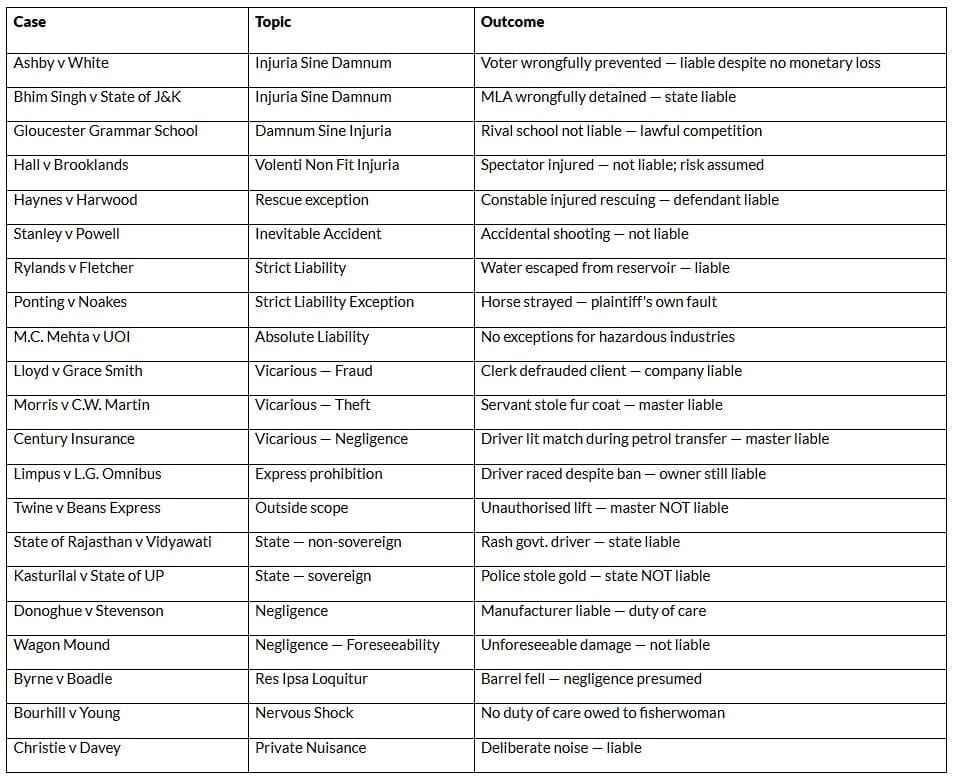
MASTER CASE LAW TABLE
FAQs on A.P Bhardwaj Summary : Law of Torts
| 1. What are the essential elements of a tort? |  |
| 2. What are the two key Latin maxims related to tort law? | |
| 3. What general defences are available in tort law? | |
| 4. What is vicarious liability in tort law? | |
| 5. How do strict liability and absolute liability differ in tort law? | |