A.P Bhardwaj Summary : Criminal Law


INTRODUCTION
Crime is an offence against society. India's criminal law corpus consists of:
- IPC (Indian Penal Code) - defines offences
- CrPC (Criminal Procedure Code) - procedure to bring criminals to book
- Indian Evidence Act - rules of evidence
PROPERTY OFFENCES
A. Theft (Section 378)
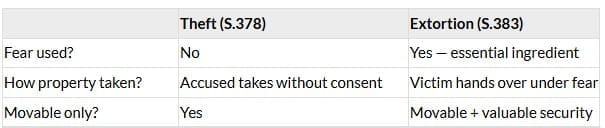
Definition: Whoever intending to take dishonestly any movable property out of the possession of any person without consent, moves that property in order to such taking, commits theft.
5 Key Ingredients:
- Dishonest intention to take
- Movable property
- Out of possession of another
- Without consent
- Moving of the property
Important Rules:
- Theft is complete the moment property is moved - change of mind later does NOT undo it (Illus. h)
- Taking your own property can be theft if done dishonestly (e.g., pawned watch taken without repaying)
- Items attached to earth are NOT movable - become so once severed
- Taking property in good faith believing it to be your own is NOT theft
- A servant entrusted with property who runs away = theft (not breach of trust, as it was in possession)
B. Extortion (Section 383)
Definition: Whoever intentionally puts any person in fear of injury and thereby dishonestly induces delivery of property or valuable security, commits extortion.
Key Ingredients:
- Intentional threat of injury
- Fear must be grave enough to unsettle the mind and override free will
- Dishonest inducement
- Delivery of property/valuable security
Key Distinction: Extortion requires actual delivery of property to the accused. Mere threatening without delivery = Criminal Intimidation (S.503), not extortion.
C. Criminal Misappropriation (Section 403)
Definition: Whoever dishonestly misappropriates or converts to his own use any movable property.
Key Points:
- Possession acquired innocently but retention/use becomes dishonest later
- Misappropriation need not be permanent - even temporary misuse is an offence
- Mere retention is NOT enough - actual appropriation/conversion needed
- Finder of lost property: Not guilty initially, but guilty if owner is known and property is kept
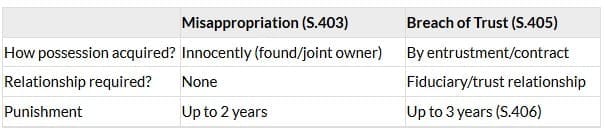
- Punishment: Up to 2 years, or fine, or both
D. Criminal Breach of Trust (Section 405)
Definition: Whoever, being entrusted with property, dishonestly misappropriates or uses/disposes of it in violation of law or contract.
Key Distinction from Misappropriation:
- Misappropriation → possession came innocently (finder/joint owner), no prior relationship
- Breach of Trust → property was entrusted - fiduciary/contractual relationship exists
Critical Test: Was the act done dishonestly? Acting in good faith (even wrongly) is NOT criminal breach of trust - it may only be a civil breach of contract.
E. Cheating (Sections 415-420)
Simple Cheating (S.415 / punishment S.417 = 1 year):
- Deceiving a person fraudulently/dishonestly
- Inducing them to deliver property OR do/omit an act
- Which causes or is likely to cause damage in body, mind, reputation, or property
Cheating with Property Delivery (S.420 - up to 7 years):
- Cheating + actual delivery of property or destruction of valuable security
- More severe because property actually changes hands
Cheating by Personation (S.416):
- Pretending to be another person - real or imaginary
- Examples: fake Civil Service officer, impersonating in exam, posing as deceased person
Difference between S.415 and S.420: If no property passes but only inducement is generated in the mind → S.415. If property is actually delivered → S.420.
OFFENCES RELATING TO MARRIAGE
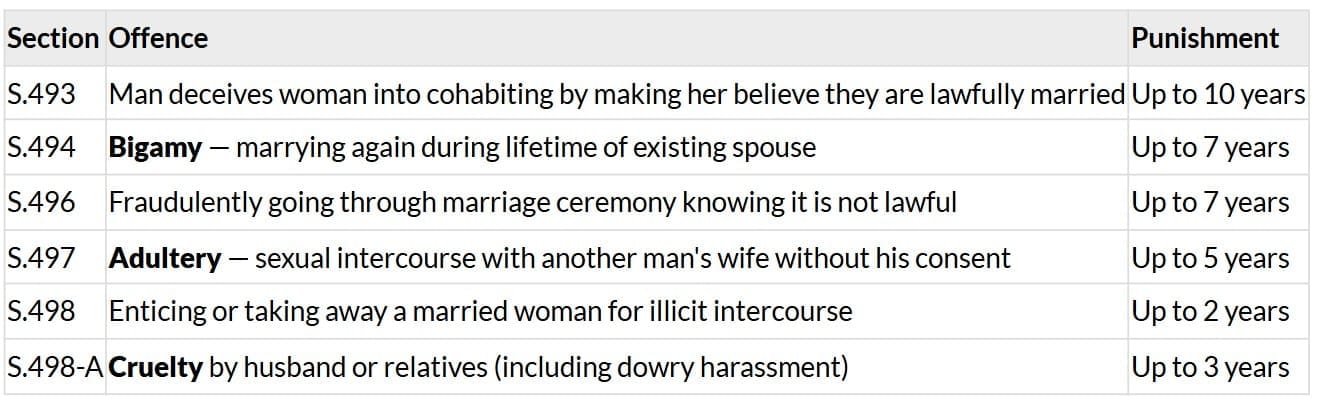
Note on S.494 (Bigamy) Exception: Not an offence if previous spouse has been continually absent for 7 years and not heard of as being alive, provided the second spouse is informed of the real state of facts.
Note on S.497 (Adultery): The wife is NOT punishable as an abettor.
GENERAL EXCEPTIONS
A. Mistake of Fact (Sections 76 & 79)
- Mistake of FACT = valid defence (Ignorantia facti excusat)
- Mistake of LAW = NOT a defence (everyone is presumed to know the law)
- The belief must be reasonable and in good faith
- The believed state of facts, if true, must have justified the act done
When mistake of fact is NO defence: If the fact itself is illegal. You cannot shoot X by mistake (intending to shoot Y) and plead mistake - both acts are crimes.
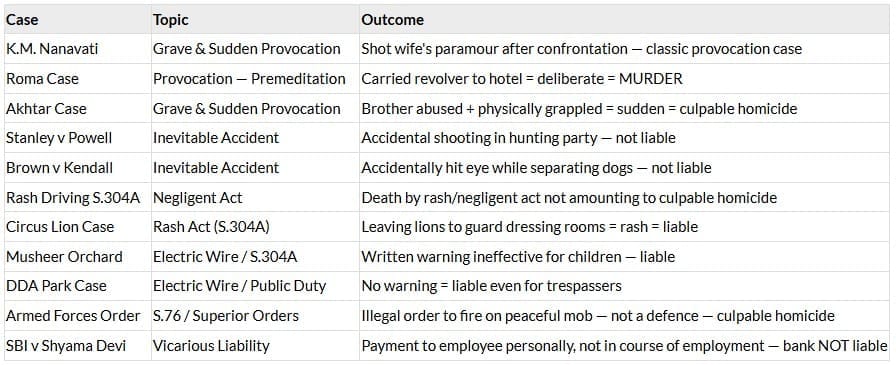
Superior Orders: The maxim respondeat superior has no application in criminal law. Obeying an illegal order from a superior is NOT a valid defence.
B. Unsoundness of Mind (Section 84)
Rule: Nothing is an offence if, at the time of the act, the person was incapable of knowing:
- The nature of the act, OR
- That the act was wrong or contrary to law
Key Principles:
- Unsoundness must exist at the time of the offence - not before or after
- Legal insanity ≠ Medical insanity - courts apply the legal test (impaired cognitive faculties)
- "Moral insanity", eccentricity, or strange behaviour is NOT a defence
- Insane delusion: still guilty if the accused knew the act was wrong
- Includes: idiots (born), lunatics, persons in unconscious state (e.g., sleepwalking), temporarily non compos mentis due to illness
C. Intoxication (Sections 85 & 86)
- S.85: Complete defence ONLY if intoxicant was administered without knowledge or against will of the accused
- S.86: Voluntary intoxication → accused deemed to have the same knowledge as if sober. But no presumption as to intention - intention must be proved from facts
Rule: Voluntary drunkenness is NOT a defence. Test: was the accused incapable of forming the intention to commit the offence?
D. Right of Private Defence (Sections 96-106)
Core Principle (S.96): Nothing is an offence done in the exercise of the right of private defence.
Conditions:
- Threat must be real and immediate (not remote or imaginary)
- Right is protective, not punitive - not meant to punish the aggressor
- Force used must be proportionate to danger
- Right ends when necessity ends - cannot chase a fleeing attacker
- NOT available to aggressors or in a mutual free fight
- NOT available if there is time to seek public authorities
When right extends to causing DEATH (S.100):
- Assault causing reasonable apprehension of death or grievous hurt
- Assault with intent to commit rape / gratify unnatural lust
- Assault with intent to kidnap/abduct
- Assault with intent to wrongfully confine
Private Defence of Property (S.103) - Death justified for:
- Robbery or house-breaking by night
- Mischief by fire to dwelling/property
- Theft/trespass under circumstances reasonably causing apprehension of death/grievous hurt
Four Restrictions under S.99:
- No right against public servant acting in good faith (unless apprehension of death/grievous hurt)
- No right when act is directed by a public servant
- No right when time exists to seek public authority
- Force must not exceed what is necessary
GRAVE & SUDDEN PROVOCATION - DECISION GUIDE
Exception 1 to S.300: Culpable Homicide is NOT murder if the accused, whilst deprived of power of self-control by sudden and grave provocation, causes death.
Provocation is VALID (Culpable Homicide, not Murder) when:
- Killing was truly sudden - no gap for cooling off
- Provocation was grave enough to deprive a reasonable man of self-control
- Mental background from previous acts can be counted (cumulative provocation)
- Example: Catching spouse in act of adultery and immediately reacting
Provocation FAILS (Guilty of Murder) when:
- Accused showed premeditation - e.g., going home to fetch a weapon first
- Significant time gap between provocation and killing (cooling period)
- Accused staged or sought out the confrontation
- Provocation was mere verbal insult without grave cause
- Reaction was to remote or past grievance, not a sudden event
QUICK DISTINCTIONS TABLE

MASTER CASE LAW TABLE
FAQs on A.P Bhardwaj Summary : Criminal Law
| 1. What are property offences? |  |
| 2. What types of offences relate to marriage? | |
| 3. What are general exceptions in criminal law? | |
| 4. How does grave and sudden provocation affect legal decisions? | |
| 5. What is the purpose of a quick distinctions table in legal studies? | |