RS Aggarwal Solutions: Whole Numbers (Exercise 3F)

(i) 0
(ii) 8
(iii) 13
(iv) 15
Solution: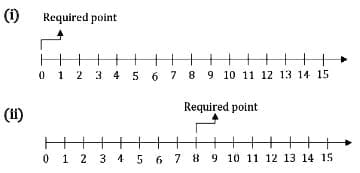
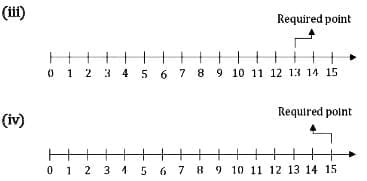
Q2: Use number line to find
(i) 5 + 4
(ii) 6 + 3
(iii) 7 + 1
(iv) 6 + 5
Solution:
(i) Start from 5, move towards right and make 4 jumps of 1 unit each.
∴ 5 + 4 = 9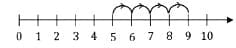
(ii) Start from 6, move towards right and make 3 jumps of 1 unit each.
∴ 6 + 3 = 9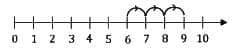
(iii) Start from 7, move towards right and make 1 jump of 1 unit.
∴ 7 + 1 = 8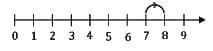
(iv) Start from 6, move towards right and make 5 jumps of 1 unit each.
∴ 6 + 5 = 11

Q3: Use number line to find
(i) 7 - 5
(ii) 9 - 4
(iii) 8 - 1
(iv) 13 - 8
Solution:
(i) Start from 7, move towards left and make 2 jumps of 1 unit each.
∴ 7 - 5 = 2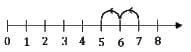
(ii) Start from 9, move towards left and make 4 jumps of 1 unit each.
∴ 9 - 4 = 5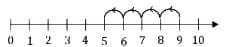
(iii) Start from 13, move towards left and make 8 jumps of 1 unit each.
∴ 13 - 8 = 5
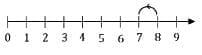
(iv) Start from 13, move towards left and make 8 jumps of 1 unit each.
∴ 13 - 8 = 5
Q4: Use number line to find
(i) 3 × 5
(ii) 4 × 2
(iii) 7 × 3
(iv) 3 × 6
Solution:
(i) Actually 3 × 5 means 5 three times.
Start from 0, move 5 units at a time to the right and make 3 such moves to reach 15.
∴ 3 × 5 = 15
(ii) Actually 4 × 2 means 4 two times.
Start from 0, move 4 units at a time to the right and make 2 such moves to reach 8.
∴ 4 × 2 = 8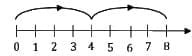
(iii) Actually 7 × 3 means 7 three times.
Start from 0, move 7 units at a time to the right and make 3 such moves to reach 21.
∴ 7 × 3 = 21 (iv) Actually 3 × 6 means 6 three times.
Start from 0, move 6 units at a time to the right and make 3 such moves to reach 18.
∴ 3 × 6 = 18
FAQs on RS Aggarwal Solutions: Whole Numbers (Exercise 3F)
| 1. What are whole numbers? |  |
| 2. How do you perform addition with whole numbers? | |
| 3. What is the significance of the number zero in whole numbers? | |
| 4. Can whole numbers be negative? | |
| 5. How do you subtract whole numbers? | |