RS Aggarwal Solutions: Lines and Angles (Exercise 9A)

Solution 1: 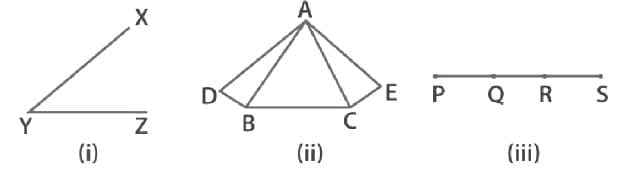 (i) Line segments are \( \overline{XY} \) and \( \overline{YZ} \)
(ii) Line segments are \( \overline{AD} \), \( \overline{AB} \), \( \overline{AC} \), \( \overline{AE} \), \( \overline{DB} \), \( \overline{BC} \) and \( \overline{CE} \)
(iii) Line segments are \( \overline{PQ} \), \( \overline{PR} \), \( \overline{PS} \), \( \overline{QR} \), \( \overline{QS} \) and \( \overline{RS} \)
Solution 2: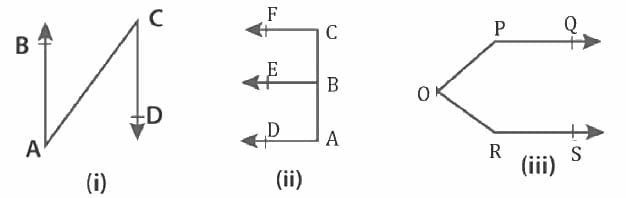 (i) Line segment is \( \overline{AC} \), rays are \( \overline{AB} \) and \( \overline{CD} \)
(ii) Line segments are \( \overline{AB} \), \( \overline{BC} \) and \( \overline{AC} \) and rays are \( \overline{AD} \), \( \overline{BE} \), \( \overline{CF} \)
(iii) line segments are \( \overline{OP} \) and \( \overline{OR} \) and rays are \( \overline{PQ} \) and \( \overline{RS} \).
Solution 3: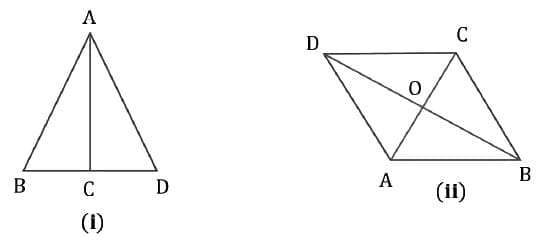
(i) There are six line segments. They are \( \overline{AB} \), \( \overline{AC} \), \(\overline{AD} \), \( \overline{BD} \), \( \overline{DC} \) and \( \overline{BC} \)
(ii) There are ten line segments. They are \( \overline{AB} \), \( \overline{AD} \), \( \overline{BC} \), \( \overline{CD} \), \( \overline{OA} \), \( \overline{OC} \), \( \overline{OB} \), \( \overline{OD} \), \( \overline{AC} \) and \( \overline{BD} \)
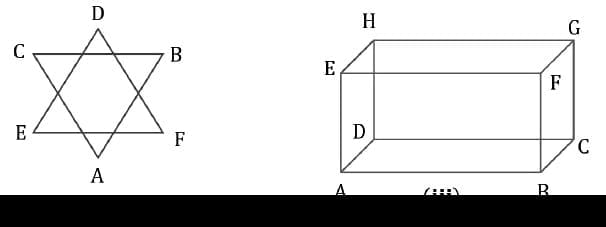
(iii) There are six line segments. They are \( \overline{AB} \), \( \overline{AC} \), \( \overline{CB} \), \(\overline{DE} \), \( \overline{DF} \) and \( \overline{EF} \)
(iv) There are ten line segments. They are \( \overline{AB} \), \( \overline{AD} \), \( \overline{BC} \), \( \overline{CD} \), \( \overline{EF} \), \( \overline{EH} \), \( \overline{FG} \), \(\overline{GH} \), \( \overline{AE} \), \( \overline{BF} \), \( \overline{CG} \) and \( \overline{DH} \)
Solution 4:
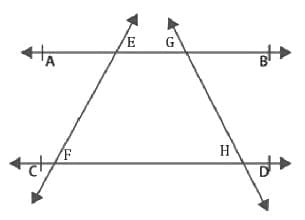 (i) Four line segments are \( \overline{EG} \), \( \overline{EF} \), \( \overline{GH} \) and \( \overline{FH} \).
(ii) Four ray can be \( \overline{EA} \), \( \overline{GB} \), \( \overline{FC} \), and \( \overline{HD} \)
(iii) \( \overline{EF} \), \( \overline{GH} \) are two non-intersecting lines.
Solution 5: The lines drawn through given points A, B, C are as shown below. The names of these lines are AB, BC and AC.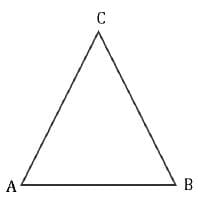
Also, it is clear that three different lines can be drawn.
Solution 6: Three or more points in a plane are said to be collinear if they all lie on the same line. In the figure given above, points A, B, C are collinear points.
(i) We can draw exactly one line passing through three collinear points
(ii) Three collinear points A, B, C determine 3 line segments. They are \( \overline{AB} \), \(\overline{AC} \) and \( \overline{BC} \).
Solution 7:
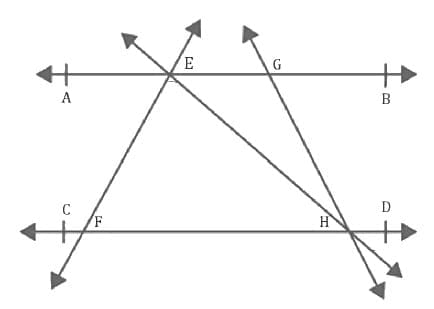 (i) Four pairs of intersecting lines are : (\( \overline{AB} \), \( \overline{EF} \)); (\( \overline{AB} \), \( \overline{GH} \)); (\( \overline{CD} \), \( \overline{EF} \)); (\( \overline{CD} \), \( \overline{GH} \))
(ii) Four collinear points are : A, E, G, B
(iii) Three non-collinear points are : A, E, F
(iv) Three concurrent lines are : (\( \overline{AB} \), \( \overline{EF} \), \( \overline{EH} \))
(v) Three lines whose point of intersection is P are: \( \overline{CD} \), \( \overline{EH} \) and \( \overline{GH} \)
Solution 8:
(i) False
Reason: D does not lie on ray \( \overline{EB} \).
(ii) False
Reason: C does not lie on ray \( \overline{DB} \).
(iii) True.
(iv) True
(v) True
Solution 9:
(i) A line segment has a definite length.
(ii) A ray has one end point.
(iii) A line has no end point.
(iv) A ray has no definite length.
(v) A line cannot be drawn on a paper.
(vi) \( \overline{AB} = \overline{BA} \)
(vii) \( \overline{AB} \neq \overline{BA} \)
(viii)\( \overline{AB} = \overline{BA} \)
Solution 10:
(i) False
Reason: A point does not have any length, breadth or thickness.
(ii) False
Reason: A line segment has a length.
(iii) False
Reason: A ray has infinite length.
(iv) False
Reason: Ray AB has initial point A and is extended endlessly towards B, while ray BA has initial point B and is extended endlessly towards A.
(v) True
(vii) True
Solution 11:
(i) True
(ii) True
(iii) True
(iv) False
Reason: We can draw infinite number of lines pass through a given point.
(v) False.
Reason: Infinite number of rays can be drawn with a given end point.
FAQs on RS Aggarwal Solutions: Lines and Angles (Exercise 9A)
| 1. What are lines and angles in geometry? |  |
| 2. How do we classify angles based on their measures? | |
| 3. What is the relationship between parallel lines and angles? | |
| 4. Can you explain the concept of complementary and supplementary angles? | |
| 5. What is the significance of a transversal in geometry? | |