PIB Summary - 10th March 2026

SOAR (Skilling for AI Readiness) Programme
Why in News?
The Government recently informed Parliament about the implementation and ongoing expansion of the SOAR Programme, a national initiative to build AI literacy and sector-specific AI skills among citizens, learners, and educators.
Relevance for UPSC
- GS Paper III - Science & Technology
- Artificial Intelligence adoption in India
- Emerging technologies and workforce preparedness
- Technology-driven economic transformation
- GS Paper III - Economy
- Skill development for the digital economy
- Human capital formation for Industry 4.0
- Future of work and AI-driven labour markets
What is the SOAR Programme?
About: Launched by the Ministry of Skill Development and Entrepreneurship (MSDE), SOAR is a national skilling initiative delivered through the Skill India Digital Hub (SIDH). It offers online, self-paced courses to promote AI readiness, ensuring wide accessibility without physical training centres.
Key Features
Phase I: Foundational AI Literacy
Four introductory courses to build basic awareness and interest in AI:
- AI to be Aware - Basic concepts and societal applications
- AI to Aspire - Career opportunities in AI-driven sectors
- AI to Acquire - Foundational technical knowledge
- AI for Educators - Integrating AI into classroom teaching
Phase II: Sector-Specific AI Skilling
Expanded to 50 NSQF-aligned AI and AI-application courses across key sectors (healthcare, manufacturing, retail, agriculture, logistics, tourism, etc.).
- 35 of these are micro-credentials with defined credits, notional hours, and clear progression pathways.
Alignment with National Frameworks
- National Skills Qualification Framework (NSQF) - Courses aligned to levels 2-5.5 for progressive competency building and recognised qualifications.
- National Credit Framework (NCrF) - Enables credit accumulation and transfer to formal/higher education, supporting lifelong learning and mobility.
Industry Collaboration
Partners include NASSCOM, Microsoft, CII, and sector skill councils to ensure curricula match industry needs and emerging trends. Examples: AI in manufacturing, logistics, healthcare, agriculture, heritage crafts, and furniture making.
Inclusivity Focus
- Targets rural populations, women, informal workers, and youth.
- Special initiatives: AI for Women, Yuva AI for All.
Impact and Reach (as of early 2026)
- Over 2.3 lakh learners enrolled across SOAR courses (with foundational courses seeing strong uptake).
- High participation in states like Uttar Pradesh, Maharashtra, and Karnataka.
- Certification rates around 13-15% in some foundational courses, indicating scope for better completion support.
Significance
- Builds a future-ready AI workforce for global competitiveness.
- Drives productivity in key sectors via AI adoption.
- Bridges urban-rural digital skill gaps through accessible online learning.
- Promotes lifelong reskilling in fast-evolving tech landscapes.
Challenges
- Digital infrastructure gaps in rural areas.
- Shortage of advanced AI trainers.
- Potential mismatch between curriculum and fast-changing industry needs.
- Limited awareness among citizens and small enterprises.
Way Forward
- Integrate AI into school/university curricula (NEP 2020).
- Expand broadband under Digital India and BharatNet.
- Deepen public-private partnerships for curriculum relevance.
- Build advanced AI research ecosystems in universities.
Conclusion
SOAR is a strategic step toward an AI-ready India, blending digital delivery, industry alignment, and inclusive skilling. Sustained focus on access, quality, and integration will help create a globally competitive workforce.
The Digital Blueprint for Ease of Doing Business (EoDB)
Why in News?
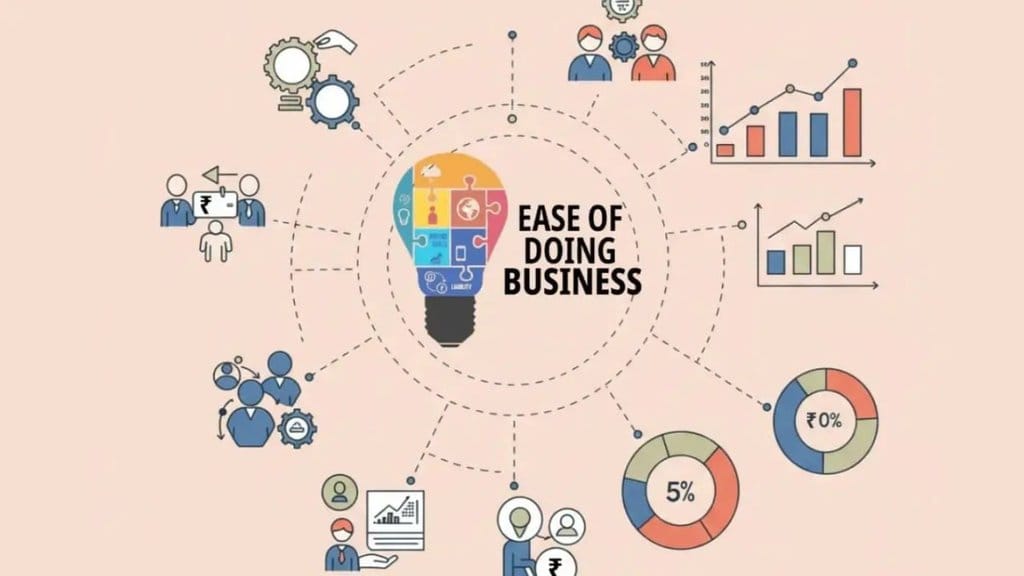
The Government recently highlighted India's digital blueprint for Ease of Doing Business, demonstrating how digital public infrastructure (DPI), integrated platforms, and digital payments have simplified regulations, compliance, and operations.
Relevance for UPSC
- GS Paper III - Indian Economy
- Investment climate
- Business environment reforms
- MSME formalization
- Digital economy
- GS Paper II - Governance
- Digital governance platforms
- Regulatory reforms
- Transparency and accountability
Concept of Ease of Doing Business
EoDB involves simplifying regulations, cutting compliance burdens, and enabling efficient, transparent operations to boost productivity, investment, and growth.
Key Digital Platforms
Business Registration & Compliance
- MCA21 - End-to-end digital corporate services; processed over 3.84 crore filings (2021-2025).
- Udyam Registration Portal - Paperless MSME registration; ~7.71 crore registrations, supporting ~33.97 crore jobs (as of Feb 2026).
- SPICe+ - Single integrated form for incorporation, PAN, TAN, EPFO, ESIC, GST, and bank account.
Integrated Regulatory Platforms
- National Single Window System (NSWS) - Central gateway for approvals; integrates 698 central + 7,435 state approvals; granted >8.29 lakh approvals.
- PARIVESH - Single-window for environmental clearances with AI tools and dashboards.
Taxation & Trade Facilitation
- GSTN - Digital backbone for GST; processed ₹102.91 lakh crore in payments (Jan 2026).
- E-Way Bill - Unified electronic permit; 21% YoY growth (Apr-Dec 2025).
- ICEGATE - Customs interface for electronic filings and real-time resolution.
Digital Trade & Finance
- TReDS - Invoice discounting for MSMEs; proposed mandatory for CPSEs (Budget 2026).
- Trade Connect - Market intelligence for exporters; >19.25 lakh users (Feb 2026).
Logistics & Infrastructure
- PM GatiShakti - Integrates 57 ministries + states; >1,700 data layers; evaluated 352 projects worth ₹16.10 lakh crore.
- National Logistics Portal (Marine) & LDB 2.0 - Real-time tracking and efficiency.
Digital Market Access
- GeM - Government procurement; >₹4 lakh crore orders in FY26 (till Feb).
- ONDC - Open e-commerce network; active in >616 cities.
Supporting DPI
- UPI - 21.70 billion transactions worth ₹28.33 lakh crore (Jan 2026).
- cKYC, API Setu, EntityLocker - Secure data sharing and verification.
Significance
- Enhances transparency, reduces corruption, and builds trust.
- Lowers compliance costs and delays.
- Attracts investment and supports MSME integration into value chains.
Challenges
- Uneven digital access and literacy.
- Cybersecurity threats.
- Interoperability gaps between central/state systems.
- Capacity constraints for MSMEs.
Way Forward
- Expand BharatNet/Digital India for connectivity.
- Strengthen cybersecurity and data protection.
- Improve platform interoperability.
- Build MSME digital literacy through training.
Conclusion
India's digital EoDB framework is a transformative reform leveraging DPI to simplify governance, boost efficiency, and drive growth. Continued investment in infrastructure, security, and coordination will solidify India's position as a competitive global investment hub.
FAQs on PIB Summary - 10th March 2026
| 1. What is the SOAR Programme? |  |
| 2. How does the SOAR Programme contribute to the Ease of Doing Business (EoDB)? | |
| 3. What are the key components of the Digital Blueprint for Ease of Doing Business? | |
| 4. Why is skilling important for AI readiness? | |
| 5. How does the SOAR Programme align with national priorities? | |




