Analogies in SSAT

What Are Analogies
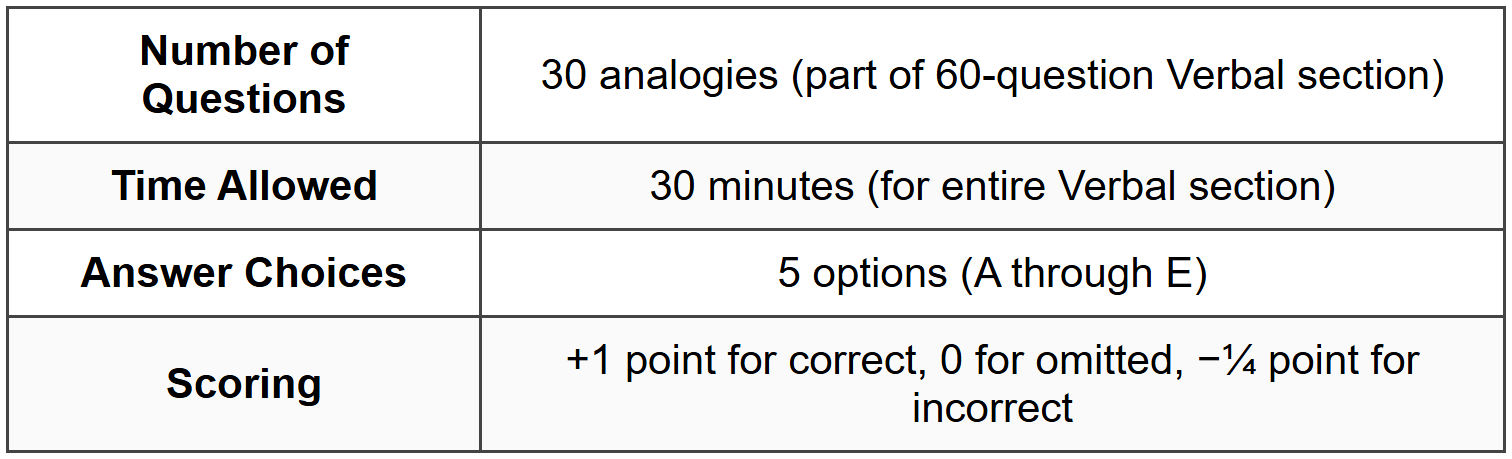
Analogies test your ability to identify relationships between pairs of words. Each question presents you with a pair of words that are related in a specific way. Your task is to select the answer choice that contains a pair of words with the same relationship as the original pair.
KITTEN is to CAT as
- horse is to mare
- puppy is to dog
- cow is to bull
- hen is to rooster
- goose is to flock
The correct answer is B. A kitten is a young cat, just as a puppy is a young dog. Both pairs demonstrate the relationship of a young animal to its adult form. The other choices do not show this same relationship: choice A reverses the relationship, choices C and D show gender relationships rather than age, and choice E shows an individual to a group.
Why Does This Section Exist
The Analogies section measures verbal reasoning ability, which is the capacity to understand relationships between concepts and apply logical thinking to words and their meanings. This skill is essential for academic success across all subjects.
The Analogies section demonstrates your ability to:
- Recognize patterns and relationships between concepts
- Think abstractly and make connections
- Apply vocabulary knowledge in context
- Analyze logical relationships
- Transfer understanding from one situation to another
Section Overview
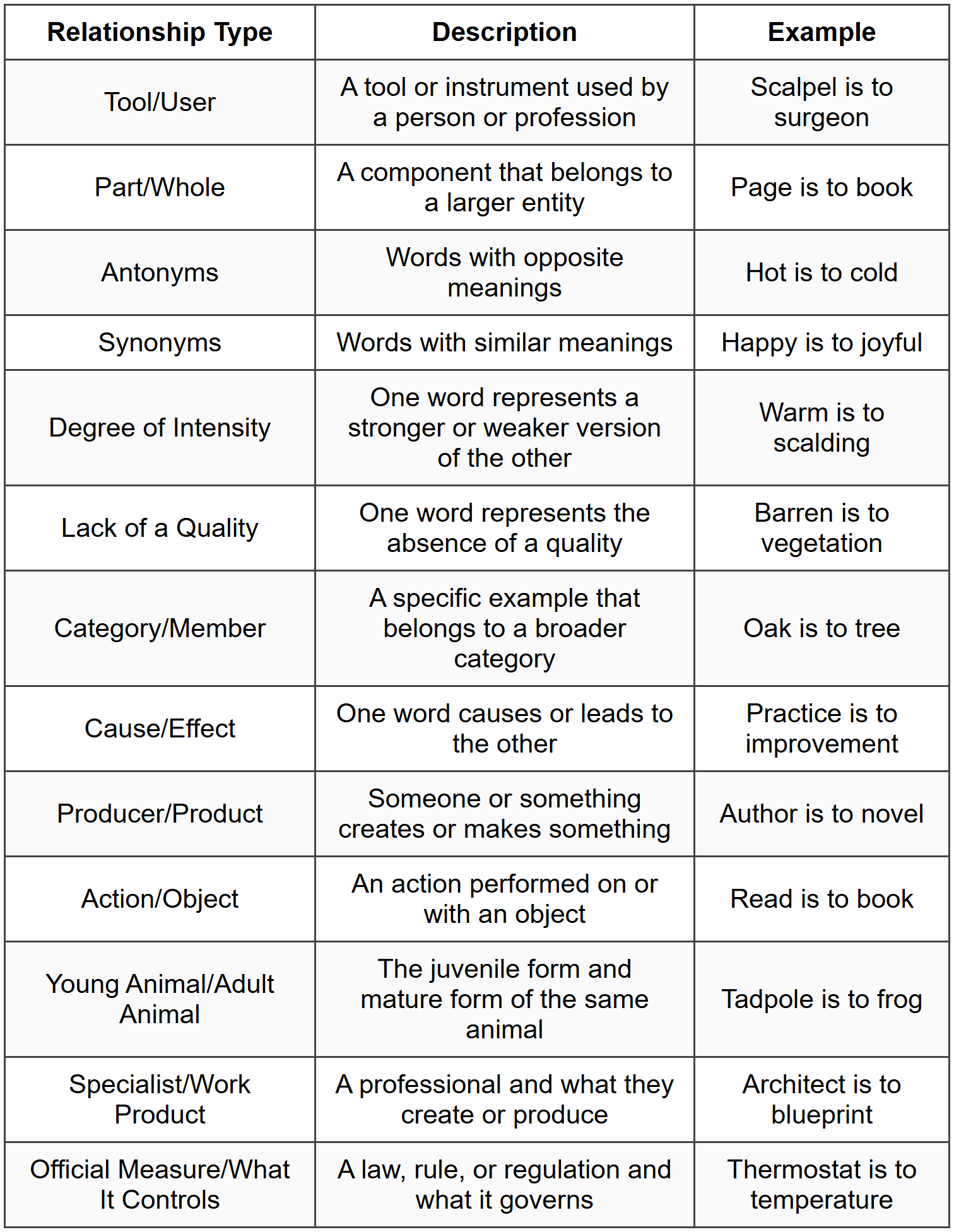
Common Relationship Types
How to Approach Each Question
Step 1: Identify the relationship between the two words in the original pair. Read them carefully and determine how they are connected.
Step 2: State the relationship as a bridge sentence. Create a specific sentence that links the two words, such as "A kitten is a young cat." This sentence should be precise enough to apply to only one answer choice.
Step 3: Eliminate wrong answers by testing your bridge sentence with each answer choice. Only the correct answer will fit the same relationship pattern.
Step 4: Watch out for traps. Some answer choices may seem related to the original words or may reverse the relationship. Make sure the relationship matches exactly, in the same order.
Step 5: Be precise with your bridge sentence. If multiple answer choices seem to work, your bridge sentence is too general. Make it more specific until only one answer remains.
Scoring Strategy
The SSAT applies a -¼ point penalty for each incorrect answer, while omitted questions receive no penalty. This scoring system is designed to discourage random guessing, but strategic guessing can still improve your score.
- If you can eliminate one or more answer choices, you should guess from the remaining options. The probability works in your favor.
- If you can narrow down to two or three choices, you should definitely guess. The expected value is positive.
- If you have no idea and cannot eliminate any choices, it is better to omit the question rather than guess randomly.
Vocabulary Building Tips
- Read widely and in context. Encounter new words in books, articles, and other materials. Pay attention to how words are used in sentences to understand their meanings and connotations.
- Study word roots, prefixes, and suffixes. Many English words share Latin and Greek roots. Learning common roots helps you decode unfamiliar words and understand their meanings.
- Use flashcards strategically. Focus on words you encounter in practice tests and reading materials. Review them regularly and include the definition, a sample sentence, and any related words.
- Notice relationships between words as you learn them. When you encounter a new word, think about its synonyms, antonyms, and other related concepts. This builds the relational thinking skills needed for analogies.
Sample Question Walkthrough
CONDUCTOR is to ORCHESTRA as
- teacher is to student
- captain is to team
- actor is to audience
- singer is to chorus
- pianist is to piano
Step 1: The relationship between conductor and orchestra is that a conductor leads or directs an orchestra.
Step 2: Bridge sentence: "A conductor leads an orchestra." We need to find a pair where the first word leads or directs the second word, which is a group.
Step 3: Testing each choice: A teacher instructs a student (singular, not a group); a captain leads a team (this matches); an actor performs for an audience (not leading them); a singer is part of a chorus (not leading); a pianist plays a piano (not a group).
Step 4: Choice A might seem tempting, but a student is not a group like an orchestra. Choice D reverses the relationship since a singer would be part of a chorus, not its leader.
Step 5: Making the bridge sentence more precise: "A conductor leads a group of musicians called an orchestra." This fits perfectly with "A captain leads a group of players called a team."
The correct answer is B.
Quick Reference Relationship Checklist
- Is one word a tool and the other the person who uses it?
- Is one word a part of the other (part to whole)?
- Do the words have opposite meanings (antonyms)?
- Do the words have similar meanings (synonyms)?
- Does one word represent a more intense version of the other?
- Does one word represent the absence or lack of something?
- Is one word a specific member of a category named by the other?
- Does one word cause or result in the other?
- Does one word produce or create the other?
- Is one word an action performed on the other?
- Do the words represent young and adult forms of the same animal?
- Is one word a specialist who creates the work product named by the other?
- Is one word something that officially measures or controls the other?
This document provides a foundation for understanding SSAT Upper Level Analogies. Success requires consistent vocabulary building, practice with identifying relationships, and careful analytical thinking. Work through practice questions regularly to strengthen your skills.