No Calculator Speed Techniques


No Calculator Speed Techniques
On the SSAT Upper Level, calculators are not permitted in the quantitative sections. This means you must perform all calculations by hand under strict time pressure. While you may already know how to add, subtract, multiply, and divide, knowing the standard algorithms is not enough to work efficiently. This chapter teaches you specialized mental math techniques and strategic shortcuts that allow you to solve problems faster and with fewer written steps, giving you a critical advantage on test day.
Mastering these techniques requires practice, but the investment pays off dramatically. A problem that might take ninety seconds using traditional methods can often be solved in twenty or thirty seconds using the right shortcut. Over the course of a timed section, these savings accumulate to several extra minutes-enough to attempt additional questions or double-check your work.
Multiplication Shortcuts
Multiplying by 5
To multiply any number by 5, multiply by 10 and then divide by 2.
Example: 34 × 5
34 × 10 = 340
340 ÷ 2 = 170
Multiplying by 25
To multiply any number by 25, multiply by 100 and then divide by 4.
Example: 16 × 25
16 × 100 = 1600
1600 ÷ 4 = 400
Multiplying by 11
For two-digit numbers, add the two digits together and place the sum between them. If the sum is greater than 9, carry the 1 to the left digit.
Example: 43 × 11
4 + 3 = 7
Place 7 between 4 and 3: 473
Example with carrying: 67 × 11
6 + 7 = 13
Place 3 between the digits and carry 1: 737
Multiplying by 9
To multiply any single-digit number by 9, use this pattern: the tens digit is one less than the number being multiplied, and the two digits sum to 9.
Example: 7 × 9
Tens digit: 7 - 1 = 6
Ones digit must make the sum 9: 3
Answer: 63
For larger numbers, multiply by 10 and subtract the original number.
Example: 47 × 9
47 × 10 = 470
470 - 47 = 423
Squaring Numbers Ending in 5
To square any two-digit number ending in 5, take the tens digit, multiply it by the next consecutive integer, and append 25 to the result.
Example: 352
Tens digit is 3
3 × 4 = 12
Append 25: 1225
Example: 752
Tens digit is 7
7 × 8 = 56
Append 25: 5625
Multiplying Numbers Close to 100
When multiplying two numbers both near 100, use this method: subtract each number from 100 to find the differences. Subtract either difference from the opposite number to get the first part of the answer, then multiply the two differences together to get the last two digits.
Example: 97 × 96
100 - 97 = 3
100 - 96 = 4
97 - 4 = 93 (or 96 - 3 = 93)
3 × 4 = 12
Answer: 9312
Division Shortcuts
Dividing by 5
To divide by 5, multiply by 2 and then divide by 10.
Example: 340 ÷ 5
340 × 2 = 680
680 ÷ 10 = 68
Dividing by 25
To divide by 25, multiply by 4 and then divide by 100.
Example: 1300 ÷ 25
1300 × 4 = 5200
5200 ÷ 100 = 52
Using Fraction Equivalents
Recognizing that division by certain numbers is equivalent to multiplication by a fraction can speed up calculations significantly.
Dividing by 4 is the same as multiplying by \(\frac{1}{4}\) or finding one-fourth.
Dividing by 8 is the same as multiplying by \(\frac{1}{8}\) or halving three times.
Example: 320 ÷ 8
320 ÷ 2 = 160
160 ÷ 2 = 80
80 ÷ 2 = 40
Addition and Subtraction Shortcuts
Compensating Method
When adding or subtracting numbers close to multiples of 10, 100, or 1000, round to the nearest convenient number and then adjust.
Example: 487 + 298
Round 298 to 300
487 + 300 = 787
Subtract the 2 you added: 787 - 2 = 785
Example: 634 - 197
Round 197 to 200
634 - 200 = 434
Add back the 3 you subtracted too much: 434 + 3 = 437
Left-to-Right Addition
Instead of stacking numbers and adding from right to left, add from left to right mentally for speed.
Example: 256 + 387
200 + 300 = 500
50 + 80 = 130, so 500 + 130 = 630
6 + 7 = 13, so 630 + 13 = 643
Working with Fractions and Decimals
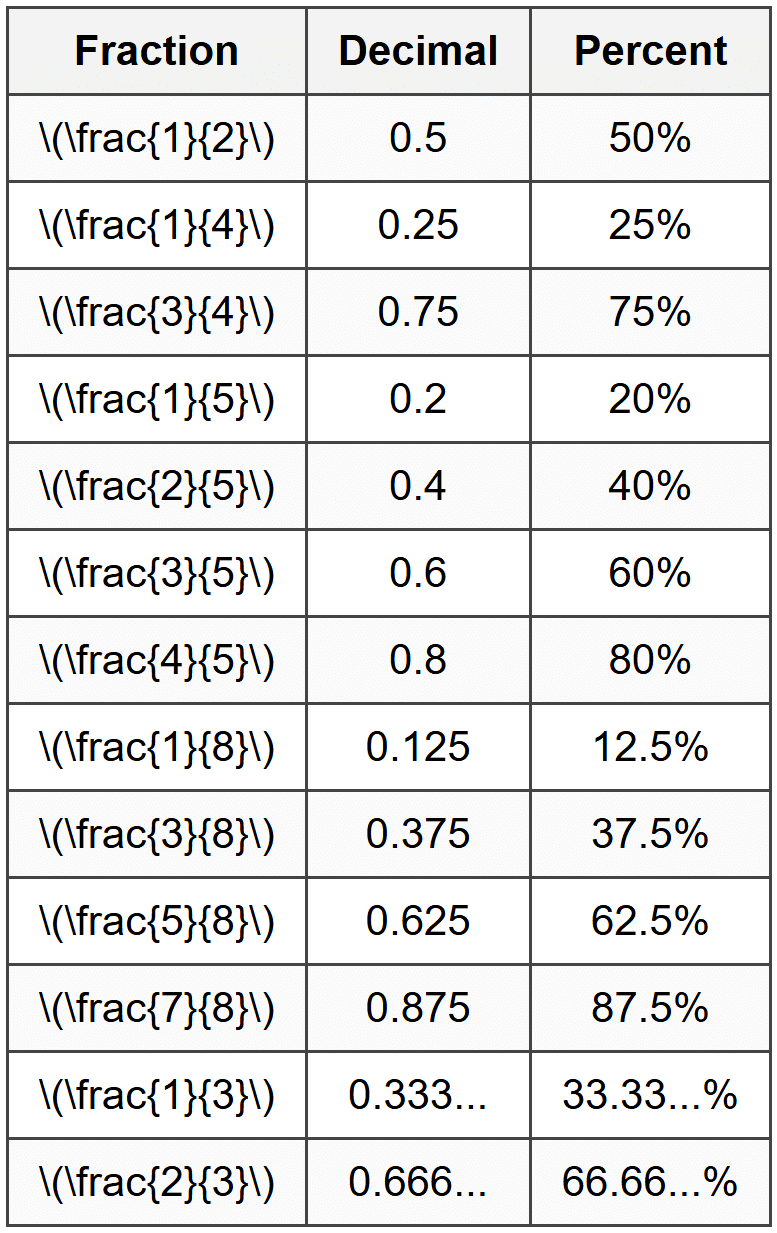
Recognizing Common Fraction-Decimal-Percent Equivalents
Memorizing these equivalents eliminates the need for division:
Multiplying Decimals by Powers of 10
Move the decimal point one place right for each factor of 10.
Example: 3.47 × 100
Move decimal two places right: 347
Dividing Decimals by Powers of 10
Move the decimal point one place left for each factor of 10.
Example: 52.3 ÷ 1000
Move decimal three places left: 0.0523
Percent Calculations Without a Calculator
Finding 10% and Building From There
To find 10% of any number, move the decimal point one place to the left. Use this to build other percentages.
Example: Find 30% of 240
10% of 240 = 24
30% = 3 × 24 = 72
Finding 1% and Scaling
To find 1%, move the decimal point two places left.
Example: Find 7% of 500
1% of 500 = 5
7% = 7 × 5 = 35
Finding 50%, 25%, and 75%
50% is half, 25% is one-fourth, and 75% is three-fourths.
Example: Find 75% of 84
25% of 84 = 84 ÷ 4 = 21
75% = 3 × 21 = 63
Estimation Strategies
Rounding to Simplify
When exact values are not required, or when checking answer choices, round numbers to the nearest ten, hundred, or simple fraction.
Example: Estimate 23 × 49
Round to 20 × 50 = 1000
The actual answer is near 1000 (it is 1127).
Compatible Numbers
Choose numbers that divide evenly or combine neatly to simplify mental arithmetic.
Example: Estimate 627 ÷ 19
Round 627 to 600 and 19 to 20
600 ÷ 20 = 30
The actual answer is near 30 (it is 33).
Strategic Problem Decomposition
Breaking Apart Numbers
Decompose one factor into parts that are easier to work with.
Example: 16 × 35
Think of 16 as 10 + 6
10 × 35 = 350
6 × 35 = 210
350 + 210 = 560
Using the Distributive Property
Apply the distributive property to rewrite multiplication in a more convenient form.
Example: 7 × 98
7 × (100 - 2)
700 - 14 = 686
Worked Examples
Example 1: Multiplication by 25
Problem: Calculate 44 × 25 without a calculator.
Solution:
Multiply by 100 and divide by 4
44 × 100 = 4400
4400 ÷ 4 = 1100
Answer: 1100
Example 2: Squaring a Number Ending in 5
Problem: What is 652?
- 4025
- 4125
- 4225
- 4325
- 4425
Solution:
The tens digit is 6
Multiply 6 by the next integer: 6 × 7 = 42
Append 25: 4225
Answer: C
Example 3: Percent Without a Calculator
Problem: What is 15% of 320?
- 42
- 45
- 48
- 50
- 54
Solution:
10% of 320 = 32
5% is half of 10%, so 5% of 320 = 16
15% = 32 + 16 = 48
Answer: C
Example 4: Using Compensation
Problem: Compute 756 - 298.
- 448
- 458
- 468
- 478
- 488
Solution:
Round 298 to 300
756 - 300 = 456
Add back the 2 extra subtracted: 456 + 2 = 458
Answer: B
Example 5: Multiplying Near 100
Problem: Calculate 98 × 94.
- 9012
- 9112
- 9192
- 9212
- 9312
Solution:
100 - 98 = 2
100 - 94 = 6
98 - 6 = 92 (or 94 - 2 = 92)
2 × 6 = 12
Combine: 9212
Answer: D
Example 6: Division by 5
Problem: What is 475 ÷ 5?
- 85
- 90
- 95
- 100
- 105
Solution:
Multiply by 2: 475 × 2 = 950
Divide by 10: 950 ÷ 10 = 95
Answer: C
Common Mistakes
Forgetting to Adjust After Rounding
When using the compensation method, students often round a number to make arithmetic easier but forget to adjust the final answer. For instance, when computing 543 + 199, rounding 199 to 200 gives 543 + 200 = 743, but you must subtract 1 to get the correct answer of 742.
Misapplying the Squaring Shortcut
The shortcut for squaring numbers ending in 5 only works for two-digit numbers (or can be extended carefully). Students sometimes try to apply it incorrectly to numbers like 105 or 5 itself. For 52, simply compute 25. For 1052, the method requires multiplying 10 × 11 = 110 and appending 25 to get 11025, but this is more complex and should be practiced separately.
Confusing Multiplying and Dividing by Powers of 10
Students sometimes move the decimal point in the wrong direction. Remember: multiplying makes numbers larger, so move the decimal right. Dividing makes numbers smaller, so move the decimal left.
Adding Instead of Carrying When Using the 11 Trick
When multiplying by 11, if the sum of the digits exceeds 9, students occasionally write the two-digit sum directly between the original digits. For example, with 58 × 11, the sum 5 + 8 = 13, and the answer is not 5138 but 638 (carry the 1 to the 5).
Estimating Without Considering Magnitude
Rounding is powerful, but you must round sensibly. Rounding both 48 and 52 to 50 when computing 48 × 52 gives 2500, which is close to the exact answer 2496. But rounding carelessly-such as rounding 48 to 40-introduces significant error.
Tips and Strategies for Test Day
Practice Mental Math Daily
Speed comes from repetition. Dedicate a few minutes each day to mental arithmetic drills. Use flashcards or apps that present rapid-fire problems. Focus on the techniques presented here until they become automatic.
Eliminate Answer Choices by Estimation
Even if you cannot compute an exact answer quickly, estimation often allows you to eliminate three or four answer choices immediately. For example, if a problem asks for 19 × 23 and the answer choices range from 200 to 600, you can estimate 20 × 20 = 400 and eliminate choices far from that value.
Memorize Key Equivalents
Commit the fraction-decimal-percent table to memory. Recognizing that \(\frac{3}{8} = 0.375\) instantly can save ten or fifteen seconds on a problem, and these seconds add up.
Write Minimally but Clearly
You do not need to show all your work on the test, but scratch work should be neat enough that you can follow your own reasoning. Use abbreviations and symbols that make sense to you. Avoid clutter.
Check Answer Choices First
Sometimes the answer choices reveal the level of precision required. If all choices are multiples of 10, you may not need an exact answer. If they are close together, you will need to be precise.
Use the Distributive Property Flexibly
If you see a product like 6 × 47, think of 47 as 50 - 3. Then 6 × 50 = 300 and 6 × 3 = 18, so 300 - 18 = 282. This is faster than traditional multiplication for many students.
Practice With Timed Drills
Set a timer and work through sets of problems using only mental math and minimal scratch work. Track your improvement over time. The goal is not just correctness but speed and confidence.
Practice Questions
1. What is 37 × 11?
- 307
- 370
- 407
- 417
- 470
2. Calculate 852.
- 7025
- 7125
- 7225
- 7325
- 7425
3. What is 20% of 350?
- 60
- 65
- 70
- 75
- 80
4. Compute 1800 ÷ 25.
- 68
- 70
- 72
- 74
- 76
5. What is 96 × 97?
- 9212
- 9312
- 9412
- 9512
- 9612
6. Calculate 534 + 297.
- 821
- 829
- 831
- 839
- 841
7. What is 45% of 200?
- 80
- 85
- 90
- 95
- 100
8. Compute 620 ÷ 5.
- 114
- 120
- 124
- 130
- 134
9. What is 18 × 25?
- 400
- 425
- 450
- 475
- 500
10. Calculate 762 - 398.
- 354
- 360
- 364
- 370
- 374
11. What is 15 × 99?
- 1475
- 1485
- 1495
- 1505
- 1515
12. What is \(\frac{3}{8}\) of 96?
- 32
- 34
- 36
- 38
- 40
13. Compute 552.
- 2925
- 3000
- 3025
- 3125
- 3225
14. What is 12% of 250?
- 25
- 28
- 30
- 32
- 35
15. Calculate 2400 ÷ 25.
- 86
- 88
- 90
- 92
- 96
Answer Key and Solutions
1. Answer: C
37 × 11
Add the digits: 3 + 7 = 10
Place the 0 between 3 and 7, and carry the 1: 407
2. Answer: C
852
Tens digit is 8
8 × 9 = 72
Append 25: 7225
3. Answer: C
20% of 350
10% of 350 = 35
20% = 2 × 35 = 70
4. Answer: C
1800 ÷ 25
Multiply by 4: 1800 × 4 = 7200
Divide by 100: 7200 ÷ 100 = 72
5. Answer: B
96 × 97
100 - 96 = 4
100 - 97 = 3
96 - 3 = 93
4 × 3 = 12
Combine: 9312
6. Answer: C
534 + 297
Round 297 to 300
534 + 300 = 834
Subtract 3: 834 - 3 = 831
7. Answer: C
45% of 200
10% of 200 = 20
40% = 4 × 20 = 80
5% = 10
45% = 80 + 10 = 90
8. Answer: C
620 ÷ 5
Multiply by 2: 620 × 2 = 1240
Divide by 10: 1240 ÷ 10 = 124
9. Answer: C
18 × 25
Multiply by 100: 18 × 100 = 1800
Divide by 4: 1800 ÷ 4 = 450
10. Answer: C
762 - 398
Round 398 to 400
762 - 400 = 362
Add back 2: 362 + 2 = 364
11. Answer: B
15 × 99
15 × 100 = 1500
Subtract 15: 1500 - 15 = 1485
12. Answer: C
\(\frac{3}{8}\) of 96
\(\frac{1}{8}\) of 96 = 12
\(\frac{3}{8}\) = 3 × 12 = 36
13. Answer: C
552
Tens digit is 5
5 × 6 = 30
Append 25: 3025
14. Answer: C
12% of 250
10% of 250 = 25
1% of 250 = 2.5
2% = 5
12% = 25 + 5 = 30
15. Answer: E
2400 ÷ 25
Multiply by 4: 2400 × 4 = 9600
Divide by 100: 9600 ÷ 100 = 96