CAT Preparation for Non-Maths Students


Scoring a 99 percentile in CAT as a non-maths student is not only possible but has been achieved by many students from Humanities, Commerce (without Maths), and Life Sciences backgrounds. The key lies in understanding that CAT does not test advanced mathematics. It tests your ability to apply basic concepts quickly and accurately under time pressure. This guide provides a strategic roadmap to help non-maths students leverage their verbal strengths while building sufficient competence in Quantitative Aptitude (QA) and excelling in Data Interpretation & Logical Reasoning (DILR).
1. Reality Check: How CAT Actually Scores Non-Maths Students
The biggest myth is that CAT is a mathematics olympiad. It is not. Here are the ground realities:
- CAT tests Class 8-10 level mathematics: Nearly 70% of QA questions require only basic school-level concepts. What makes them challenging is the application layer, not advanced theory.
- No calculus, trigonometry, or advanced algebra: Unlike engineering entrance exams, CAT does not test higher mathematics. Most fears are unfounded.
- Historical data: Students from Arts, Commerce, and other non-maths backgrounds have consistently scored 99+ percentiles by following strategic preparation.
- Verbal strength is a real advantage: Non-maths students often excel in Verbal Ability & Reading Comprehension (VARC), which can create a percentile cushion to compensate for moderate QA performance.
- DILR levels the playing field: This section tests logical thinking and data handling, not mathematical prowess. Your background becomes irrelevant here.
Trap Alert: Do not assume you need to score 90+ percentile in QA to get 99 overall. Strategic balance across sections is the real formula.
2. CAT Exam Structure & Scoring Pattern
Understanding the exam structure helps you allocate effort intelligently:
- Total Questions: Approximately 66 questions (varies slightly year to year)
- Three Sections:
- VARC (Verbal Ability & Reading Comprehension): ~24 questions
- DILR (Data Interpretation & Logical Reasoning): ~20 questions
- QA (Quantitative Ability): ~22 questions
- Sectional Time Limit: 40 minutes per section (no switching between sections)
- Marking Scheme: +3 for correct answer, -1 for wrong answer, 0 for unattempted
- Sectional Percentiles: Each section generates a separate percentile. Many top B-schools have sectional cutoffs, so you cannot ignore any section.
- Overall Percentile: Calculated based on total scaled score across all three sections
Key Insight: Because of sectional time limits, you cannot use extra time from VARC to solve QA. This makes section-wise preparation crucial.
3. The 40-40-20 Rule: Prioritising Quant Topics by ROI
Not all QA topics contribute equally to your score. Apply the Return on Investment (ROI) principle:
3.1 High ROI Topics (40% of Your QA Effort)
- Arithmetic: Time & Work, Speed & Distance, Percentages, Profit & Loss, Ratio & Proportion, Averages, Mixtures & Alligations
- Why High ROI: These topics appear in 40-50% of QA questions. They are formula-driven, pattern-based, and highly doable with practice.
- Action: Master these first. Build speed and accuracy here.
3.2 Medium ROI Topics (40% of Your QA Effort)
- Topics: Algebra (equations, inequalities, progressions), Number System (divisibility, remainders, factors), Basic Geometry, Mensuration
- Why Medium ROI: These appear in 30-35% of questions. Some questions are easy, some are time-consuming. Strategic selection is key.
- Action: Learn core concepts well. Practice moderate difficulty problems. Skip very tough variants during the exam.
3.3 Low ROI Topics (20% of Your QA Effort)
- Topics: Advanced Geometry (complex constructions), Permutation & Combination (complex cases), Probability (multi-stage), Logarithms (complex equations)
- Why Low ROI: These form 15-20% of questions and are often time-consuming. Not worth the effort for non-maths students in early stages.
- Action: If time permits in the last 2 months, cover basics. Otherwise, skip these during the exam and focus on high/medium ROI questions.
Strategic Takeaway: Spend 80% of your QA prep time on High and Medium ROI topics. This covers 75-85% of the QA section, which is more than enough for a good sectional percentile.
4. Quant Syllabus Audit: Class 10 Level vs. Actually Hard
Let's break the perception vs reality barrier:
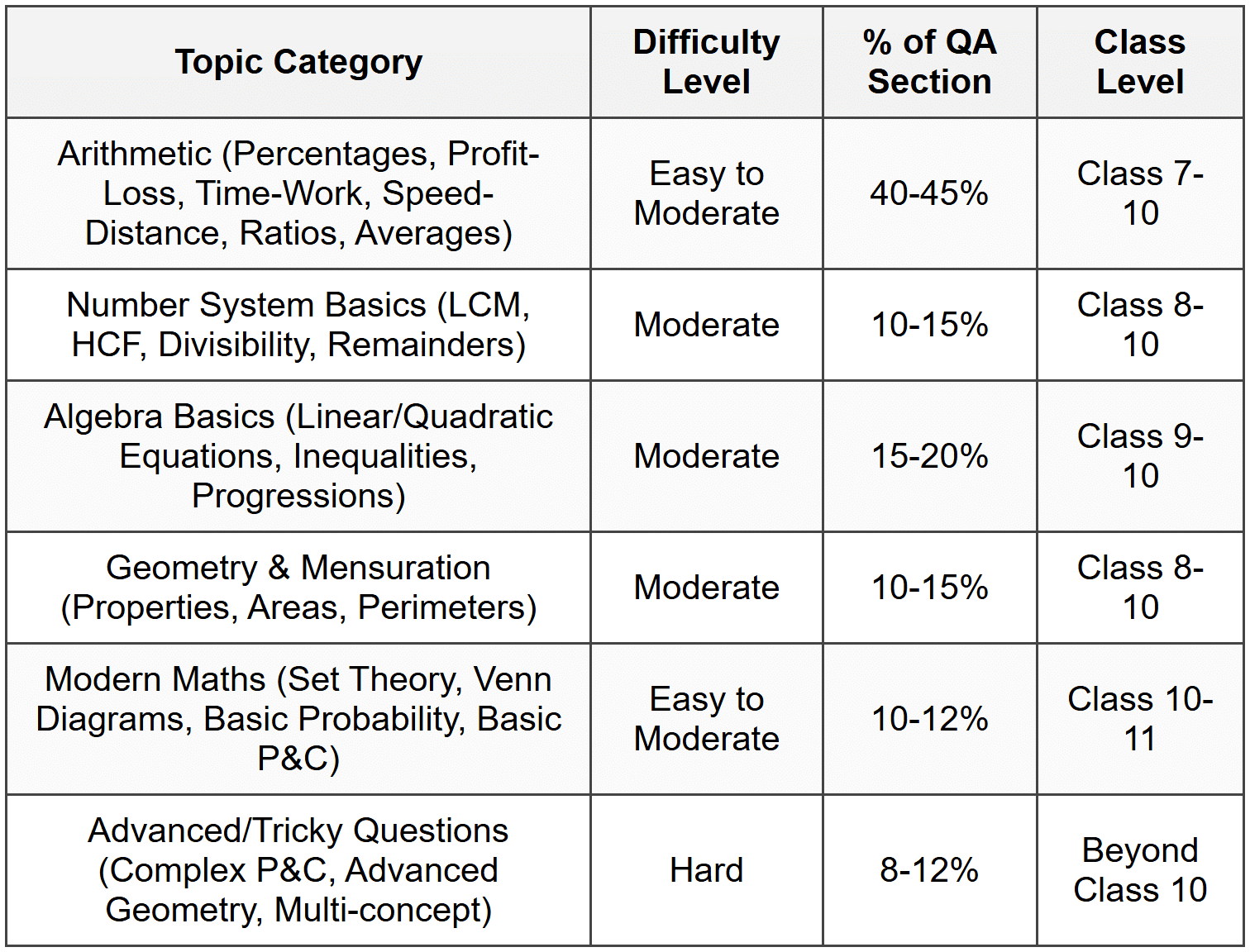
Reality: 70-75% of QA is at or below Class 10 difficulty. The remaining 25-30% can be strategically skipped without hurting your overall percentile significantly.
Trap Alert: Do not waste months trying to master advanced Geometry or complex Permutation & Combination. Focus on breadth in high-ROI areas, not depth in low-ROI areas.
5. Topic-wise Strategy for Quantitative Aptitude
5.1 Arithmetic: The Foundation of Your QA Strategy
Arithmetic should dominate your early preparation. It is the single most important area for non-maths students.
- Core Topics to Master:
- Percentages: Conversions, percentage change, successive percentages
- Profit & Loss: Cost price, selling price, discount, marked price
- Ratio & Proportion: Direct/inverse proportion, ratio chains
- Averages: Weighted averages, average speed
- Time & Work: Individual/combined work, efficiency, man-days
- Speed, Time & Distance: Relative speed, average speed, trains, boats
- Mixtures & Alligations: Mixture problems, replacement, alligation rule
- Why Arithmetic First: These questions are formula-based and follow patterns. With 60-80 hours of focused practice, you can achieve 80-85% accuracy in this cluster.
- Preparation Approach: Learn formula → Solve 50-60 problems per topic → Identify common question types → Build speed through timed practice
- Target: Solve 8-10 Arithmetic questions in the exam with 90%+ accuracy
5.2 Algebra: What to Learn, What to Skip
Algebra in CAT is not about complex derivations. It's about pattern recognition and quick solving.
- Must-Learn Topics:
- Linear Equations: Solving 2-3 variable equations quickly
- Quadratic Equations: Factorization, sum/product of roots, nature of roots
- Inequalities: Linear inequalities, modulus-based inequalities
- Arithmetic & Geometric Progressions: Sum formulas, nth term, common patterns
- Can Skip/Minimize: Complex functions, logarithmic equations (beyond basics), polynomial theory
- Strategy: Focus on substitution-based solving, not algebraic manipulation. CAT rewards quick methods.
- Time Allocation: 20-25 hours across 2-3 weeks
5.3 Geometry & Mensuration: Minimum Viable Preparation
You do not need to become a geometry expert. A minimum viable knowledge base is enough.
- Essential Concepts:
- Triangles: Pythagoras theorem, similar triangles, area formulas
- Circles: Radius, diameter, chord properties, tangent rules
- Quadrilaterals: Properties of square, rectangle, parallelogram, trapezium
- Mensuration: Area and perimeter of 2D shapes, surface area and volume of 3D shapes (cube, cuboid, cylinder, sphere, cone)
- Coordinate Geometry: Distance formula, midpoint, slope basics
- What to Skip: Complex angle bisector theorems, advanced constructions, conic sections
- Preparation Tip: Memorize all standard formulas. Practice 30-40 problems to understand application patterns.
- Exam Strategy: Attempt only straightforward geometry questions. Skip if a question requires complex constructions or multiple steps.
5.4 Number System: Most Feared Topic - Demystified
Number System appears difficult because questions are worded in tricky ways. The underlying concepts are simple.
- Core Concepts:
- Divisibility Rules: For 2, 3, 4, 5, 6, 8, 9, 11
- LCM & HCF: Prime factorization method, relationship between LCM and HCF
- Remainders: Remainder theorem, cyclicity, Chinese remainder patterns
- Factors & Multiples: Number of factors, sum of factors, perfect squares/cubes
- Unit Digits & Last Two Digits: Cyclicity of powers, pattern recognition
- Demystification Strategy: Most Number System questions test pattern recognition, not calculation. Practice 50-60 problems to internalize patterns.
- Time Investment: 15-20 hours is sufficient for solid foundation
- Trap Alert: Do not get stuck trying to solve a Number System question algebraically. Look for patterns, test options, use elimination.
5.5 Modern Maths: Surprisingly Scoring for Non-Maths Students
These topics reward logical thinking more than mathematical background. Non-maths students often find them easier.
- High-Value Topics:
- Set Theory & Venn Diagrams: 2-set, 3-set problems, union, intersection, complements
- Basic Probability: Single-event probability, simple conditional probability, complementary events
- Permutation & Combination (Basic): Arrangement vs selection, factorial basics, simple cases
- Logarithms (Basic): Log properties (product, quotient, power rules), base conversions
- Why Scoring: Questions are formula-based and follow standard templates. With 20-25 hours of practice, you can solve these faster than Algebra or Geometry.
- Strategy: Start Modern Maths in Month 3-4 of preparation. It provides quick wins and boosts confidence.
6. Mental Math & Calculation Speed: How to Build It Fast
Speed matters as much as accuracy in CAT. You need to solve questions quickly to attempt enough in 40 minutes.
6.1 Essential Calculation Techniques
- Percentage to Fraction Conversions: Memorize common conversions (e.g., 12.5% = 1/8, 16.67% = 1/6, 33.33% = 1/3)
- Squares & Cubes: Memorize squares up to 30, cubes up to 20
- Multiplication Shortcuts: Learn Vedic math tricks for multiplying numbers close to 100, multiplying by 11, 25, 125
- Division Shortcuts: Simplify by factoring, use approximation for complex divisions
- Approximation: Round numbers intelligently when exact calculation is not needed (especially in Data Interpretation)
6.2 Daily Practice Routine
- 15 Minutes Daily: Solve 20-30 calculation problems without calculator
- Use Rough Work Smartly: Develop a system for organized rough work during practice. Avoid mental clutter.
- Timed Drills: Set a timer and solve arithmetic problems. Track your speed improvement weekly.
- Mental Math Apps: Use apps or online tools for daily drills on basic operations
Reality Check: Building calculation speed takes 60-90 days of consistent daily practice. Start early.
7. VARC: Converting Verbal Strength into a Percentile Cushion
As a non-maths student, VARC is where you can build a significant percentile advantage. Target: 85-95 percentile in VARC.
7.1 Section Breakdown
- Reading Comprehension (RC): 16-18 questions from 4-5 passages
- Verbal Ability (VA): 6-8 questions (para-jumbles, odd sentence out, para-summary, para-completion)
7.2 Strategy for Non-Maths Students
- Leverage Your Reading Habit: You likely read more than maths students. Use this to build speed and retention.
- RC Preparation:
- Read diverse topics (economics, philosophy, science, history) from quality sources (The Economist, Scientific American, Aeon)
- Practice 2-3 RCs daily. Build speed to 7-8 minutes per passage with questions.
- Focus on understanding author's tone, main idea, and logical structure
- VA Preparation:
- Para-jumbles: Practice identifying topic sentences, logical connectors, and chronological flow
- Odd-One-Out: Look for theme mismatch, not just grammatical differences
- Para-summary: Focus on capturing the essence without over-interpreting
- Target Attempts: 24-26 questions with 75-80% accuracy
- Time Management: Allocate 6-7 minutes per RC passage. Complete all 4 passages. Use remaining time for VA.
Percentile Cushion Logic: If you score 90 percentile in VARC while getting 80 in QA and 85 in DILR, your overall percentile can still cross 99. VARC is your safety net.
8. DILR: Why Your Maths Background Is Irrelevant Here
Data Interpretation & Logical Reasoning is the great equalizer in CAT. Maths background offers no advantage.
8.1 Section Structure
- Format: 4-5 sets, each with 4-5 questions
- Types: Data Interpretation (tables, charts, graphs, caselets), Logical Reasoning (puzzles, seating arrangements, logical sequences, networks)
8.2 Why Non-Maths Students Excel
- Pattern Recognition: DILR tests your ability to spot patterns and relationships, not calculate complex numbers
- Logical Structuring: Many non-maths students (especially from Law, Psychology, Humanities) are trained in structured thinking
- Patience & Persistence: DILR rewards methodical problem-solving, not speed alone
8.3 Preparation Strategy
- Set Selection Skill: The key to DILR is choosing which 3 sets to attempt out of 4-5. Practice identifying doable vs. time-consuming sets in first 2-3 minutes.
- Accuracy Over Attempts: Solving 3 complete sets with 80% accuracy is better than attempting 4 sets with 60% accuracy
- Daily Practice: Solve 1-2 DILR sets daily from Month 1 onwards. Build familiarity with different types.
- Time Tracking: Each set should take 10-13 minutes. Practice within this limit.
Target: Attempt 12-15 questions (3 full sets) with 70-75% accuracy. This can give you 85-90 percentile in DILR.
9. Attempt Strategy: Where to Attack, Where to Let Go
CAT rewards intelligent attempts, not maximum attempts. Negative marking makes accuracy more important than quantity.
9.1 Section-wise Attempt Strategy
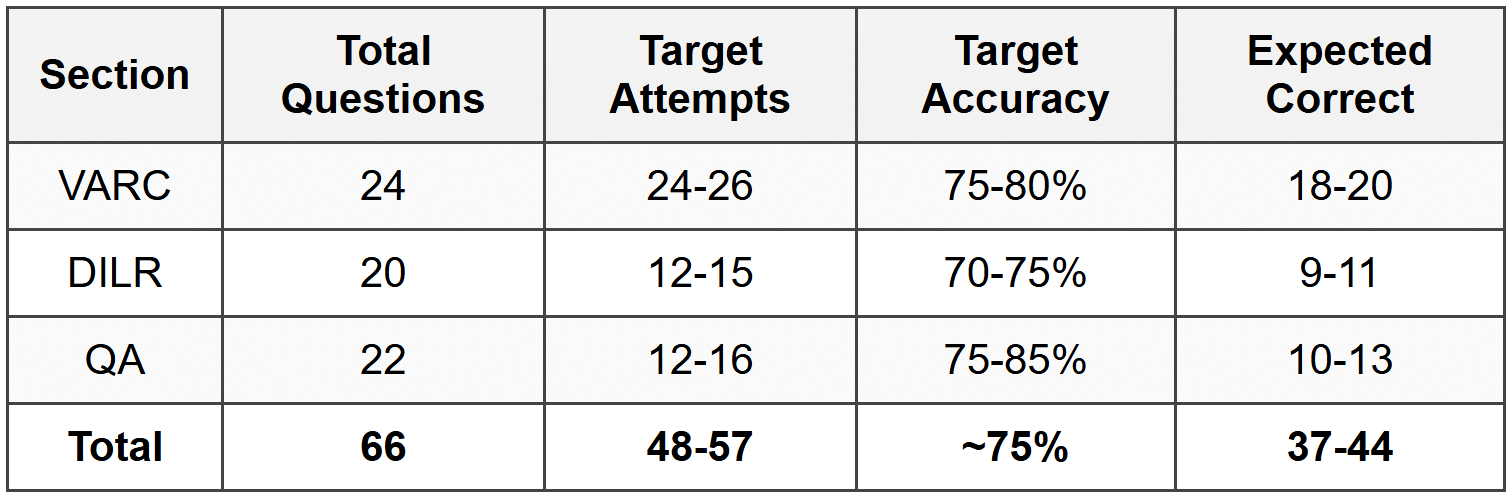
Key Insight: Attempting 48-55 questions with 75-80% accuracy can get you 99 percentile. You do NOT need to attempt all 66 questions.
9.2 Question Selection Within QA
- First Pass (5-7 minutes): Scan all 22 questions. Identify 8-10 easy questions (Arithmetic-heavy, straightforward Number System, simple Algebra). Solve these first.
- Second Pass (20-25 minutes): Attempt moderate difficulty questions. Skip if you cannot see a clear solution path in 60 seconds.
- Third Pass (8-10 minutes): Revisit skipped questions. Attempt if you now see a shortcut. Otherwise, leave them.
- Avoid: Complex Geometry, multi-step P&C, tough word problems that require heavy algebra
9.3 Time Management
- VARC (40 min): 28-30 min for RC (7 min per passage × 4), 10-12 min for VA
- DILR (40 min): 3-5 min for set selection, 30-33 min for solving 3 sets (10-11 min each), 2-3 min for review
- QA (40 min): 5 min for question scanning, 30 min for solving, 5 min for revisiting doubtful questions
Trap Alert: Do not spend more than 2.5-3 minutes on any single question. If stuck, mark for review and move on.
10. Using Mocks Differently as a Non-Maths Student
Mock tests are not just for practice. They are diagnostic tools. Use them strategically.
10.1 When to Start Mocks
- Start after 60% syllabus completion: Do not start full-length mocks before completing Arithmetic, Number System basics, and core VARC prep (around Month 3-4)
- Frequency: 1 mock per week in Month 4-5, 2-3 mocks per week in Month 6
10.2 How to Analyze Mocks as a Non-Maths Student
- Do NOT focus only on percentile: In early mocks, your percentile may be low. That's normal.
- Analyze by Topic: Track which QA topics you are getting wrong repeatedly. Double down on weak areas.
- Accuracy Tracking: Calculate section-wise accuracy. If QA accuracy is below 70%, you are attempting too many questions.
- Set Selection in DILR: Check if you chose the right 3 sets. Learn to identify doable sets faster.
- Time Analysis: Identify if you are spending too much time on difficult questions. Practice letting go.
10.3 Post-Mock Routine
- Immediate Review (1-2 hours): Solve all questions you left or got wrong (except truly advanced ones). Identify shortcuts you missed.
- Error Log: Maintain a notebook of repeated mistakes. Review this weekly.
- Topic Revision: If a particular topic (e.g., Ratio & Proportion) shows consistent errors, revise concepts and solve 20-30 additional problems.
Mindset Shift: Mocks are learning tools, not evaluation tools. A bad mock score in Month 4 is useful feedback, not a failure.
11. Section-wise Percentile Targets That Actually Make Sense
To score 99 overall percentile, you do not need 99 in each section. Strategic balance works.
11.1 Realistic Target Distribution for Non-Maths Students
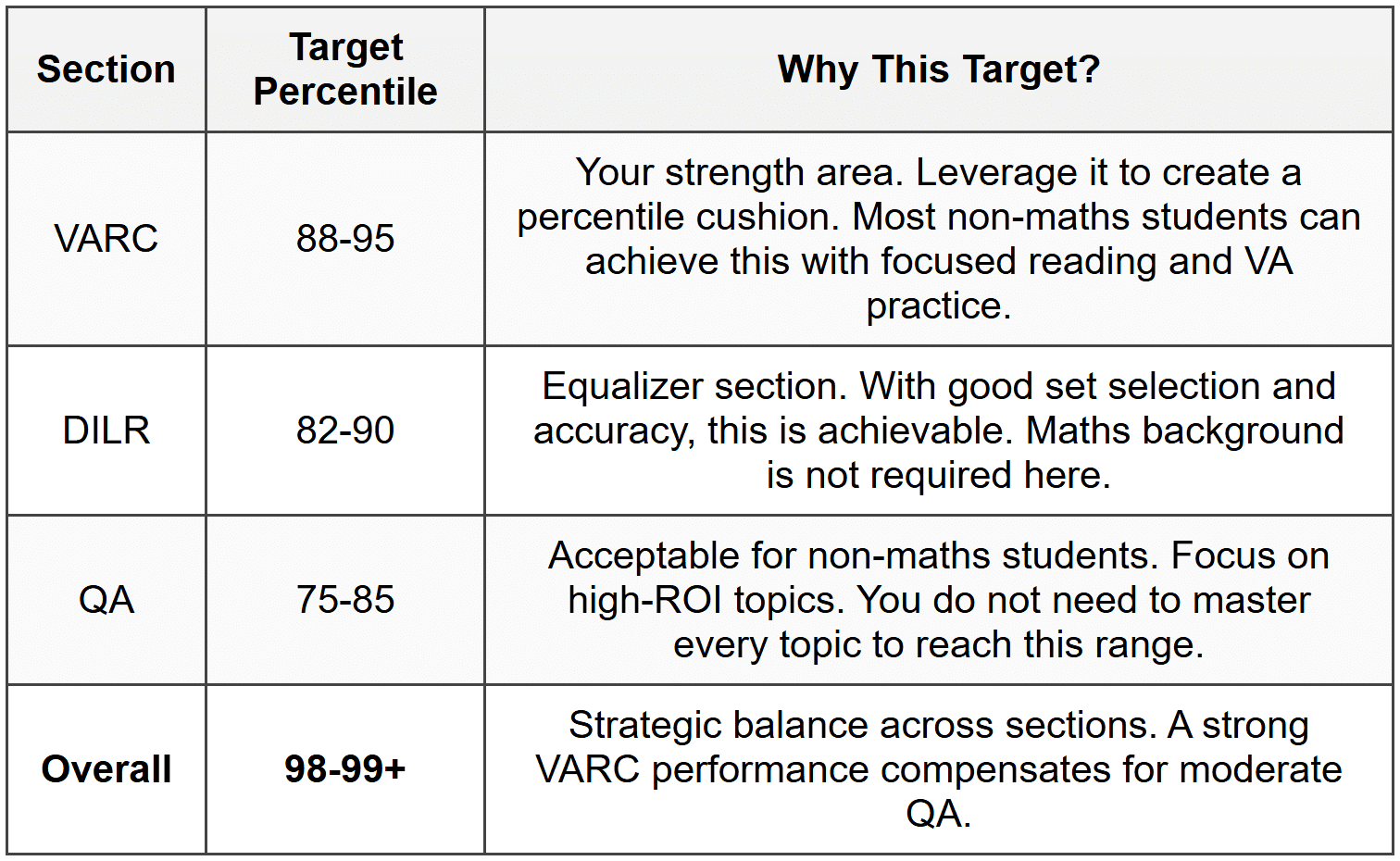
11.2 Understanding Sectional Cutoffs
- IIMs and top B-schools have sectional cutoffs: Typically 70-85 percentile per section for general category
- What This Means: You cannot completely ignore QA. You need to cross the minimum threshold (usually 75-80 percentile).
- Strategy: Ensure you clear sectional cutoffs comfortably. Then focus on maximizing overall score through VARC and DILR.
11.3 Percentile Calculation Reality
- Percentile is relative: It depends on how others perform, not just your raw score
- Sectional difficulty varies: If QA is very tough in a particular year, even 12-13 correct answers can give 80+ percentile
- Your Goal: Build capability to solve 12-16 QA questions with 80% accuracy. The percentile will follow based on exam difficulty.
12. The 6-Month Quant Roadmap for Non-Maths Students
This roadmap assumes you are starting from scratch and have 6 months to prepare. Adjust timelines if you start earlier or later.
12.1 Month 1-2: Foundation Building
Focus Areas:
- Arithmetic Deep Dive: Time & Work, Speed & Distance, Percentages, Profit & Loss, Ratio & Proportion, Averages, Mixtures & Alligations
- Number System Basics: Divisibility, LCM/HCF, Factors, Remainders
- Calculation Speed: Daily 15-min mental math practice
- Parallel Work: Start VARC reading (2-3 RCs daily), basic DILR sets (1 set daily)
Target Hours:
- QA: 40-50 hours (Arithmetic 30 hours, Number System 10-12 hours, Calculation Practice 8-10 hours)
- VARC: 25-30 hours (Reading + RC practice)
- DILR: 15-20 hours (1 set daily)
Milestones:
- Solve 200+ Arithmetic problems
- Achieve 70-75% accuracy in Arithmetic timed tests
- Read 50+ RC passages
12.2 Month 3: Expanding Coverage
Focus Areas:
- Algebra Essentials: Linear equations, Quadratic equations, Inequalities, Progressions
- Geometry & Mensuration Basics: Triangles, Circles, Quadrilaterals, Area/Volume formulas
- Arithmetic Consolidation: Solve mixed Arithmetic problem sets
- Parallel Work: Continue VARC (add VA types like para-jumbles), DILR (increase to 1-2 sets daily)
Target Hours:
- QA: 35-40 hours (Algebra 20 hours, Geometry 12 hours, Arithmetic revision 8 hours)
- VARC: 25-30 hours
- DILR: 20-25 hours
Milestones:
- Solve 80+ Algebra problems
- Memorize all Geometry/Mensuration formulas
- VARC accuracy crosses 70%
12.3 Month 4: Modern Maths & Mock Introduction
Focus Areas:
- Modern Maths: Set Theory, Venn Diagrams, Basic Probability, Basic P&C, Logarithms
- Weak Topic Revision: Identify and strengthen weak areas from Month 1-3
- First Mock Tests: Take 2-3 full-length mocks, analyze thoroughly
- Parallel Work: VARC speed building, DILR set selection practice
Target Hours:
- QA: 30-35 hours (Modern Maths 18 hours, Revision 12 hours, Mocks 5 hours)
- VARC: 25-30 hours
- DILR: 20-25 hours
Milestones:
- Complete all high-ROI and medium-ROI QA topics
- Mock accuracy: 60-65% (acceptable at this stage)
- DILR set selection time reduces to 3-4 minutes
12.4 Month 5: Consolidation & Mock Ramp-up
Focus Areas:
- Topic-wise Consolidation: Solve mixed topic tests for QA
- Mock Tests: Take 4-6 mocks, analyze deeply, revise weak topics immediately after each mock
- Speed Building: Practice solving QA questions in 2-2.5 minutes each
- Parallel Work: VARC accuracy optimization, DILR time management
Target Hours:
- QA: 30-35 hours (Revision 15 hours, Mocks 10 hours, Speed drills 10 hours)
- VARC: 25-30 hours
- DILR: 25-30 hours
Milestones:
- Mock accuracy crosses 70% in each section
- QA percentile in mocks: 70-80 range
- Identify 3-4 most frequent error patterns, work on eliminating them
12.5 Month 6: Peak Performance & Final Prep
Focus Areas:
- Mock Tests: Take 8-12 mocks (2-3 per week), simulate exam day conditions
- Error Log Revision: Review all past mistakes, ensure no repetition
- Formula & Shortcut Revision: Quick daily revision of all formulas, tricks, and patterns
- Attempt Strategy Refinement: Fine-tune question selection and time allocation based on mock performance
- Stress Management: Practice relaxation techniques, maintain regular sleep schedule
Target Hours:
- Mocks + Analysis: 40-50 hours
- Revision: 25-30 hours
- Light topic practice: 10-15 hours
Milestones:
- Mock percentiles stabilize: VARC 85+, DILR 80+, QA 75+, Overall 95+
- Attempt strategy becomes second nature
- Confidence in handling exam pressure
12.6 Parallel Activities Throughout 6 Months
- Daily Calculation Practice: 15 minutes every day without exception
- Reading: 30-45 minutes daily (newspapers, quality magazines, diverse topics)
- DILR Sets: 1-2 sets daily from Month 1 onwards
- Vocabulary (Optional): Learn 5-10 new words daily if you have time, but not a priority
13. Common Mistakes & Trap Alerts for Non-Maths Students
- Mistake 1: Trying to master every QA topic equally
Reality: Focus on high-ROI topics. You do not have time to become an expert in advanced Geometry or P&C. - Mistake 2: Ignoring calculation speed practice
Reality: Even if you know concepts, slow calculation will prevent you from attempting enough questions. Daily 15-minute practice is non-negotiable. - Mistake 3: Starting mocks too early or too late
Reality: Starting before 60% syllabus completion demoralizes you. Starting in the last month leaves no time for improvement. Month 4 is ideal. - Mistake 4: Attempting too many questions in QA
Reality: Quality over quantity. Attempting 18-20 questions with 55% accuracy gives lower score than attempting 14 questions with 80% accuracy due to negative marking. - Mistake 5: Neglecting DILR because "it's logical reasoning"
Reality: DILR requires as much practice as QA. Set selection and time management skills develop only through consistent practice. - Mistake 6: Over-relying on VARC strength alone
Reality: You need to clear sectional cutoffs in QA. Completely ignoring QA will prevent shortlists even if your overall percentile is 99. - Mistake 7: Not maintaining an error log during mock analysis
Reality: Repeating the same mistakes in multiple mocks is the biggest score killer. Documenting and reviewing errors prevents this. - Mistake 8: Studying advanced topics from coaching material without building basics first
Reality: Coaching materials often include advanced problems to cater to all students. As a non-maths student, focus on NCERT Class 8-10 level clarity first, then gradually increase difficulty.
Final Trap Alert: CAT is not about brilliance in mathematics. It is about strategic preparation, disciplined practice, and intelligent attempt strategy during the exam. Non-maths students have every advantage they need - you just need to use them correctly.
Scoring 99 percentile in CAT as a non-maths student is a realistic goal if you follow a structured, strategic approach. Focus on high-ROI Quant topics (especially Arithmetic), leverage your verbal strength in VARC, excel in the equalizer section DILR, and practice intelligent attempt strategy through regular mocks. Remember: you do not need to solve every question or master every topic. You need to solve the right questions with high accuracy. Build calculation speed daily, analyze mocks deeply, and maintain consistent effort over 6 months. With smart preparation, your non-maths background can become irrelevant - and in some sections, even an advantage.
FAQs on CAT Preparation for Non-Maths Students
| 1. How is the CAT scored for non-maths students? |  |
| 2. What is the structure of the CAT exam? | |
| 3. What is the 40-40-20 rule in CAT preparation? | |
| 4. How can non-maths students enhance their calculation speed? | |
| 5. What strategies should non-maths students employ for the DILR section? | |