Mechanical Engineering Exam > Mechanical Engineering Notes > Engineering Mechanics > Full Syllabus Mind Maps: Engineering Mechanics for Mechanical Engineering
Full Syllabus Mind Maps: Engineering Mechanics for Mechanical Engineering


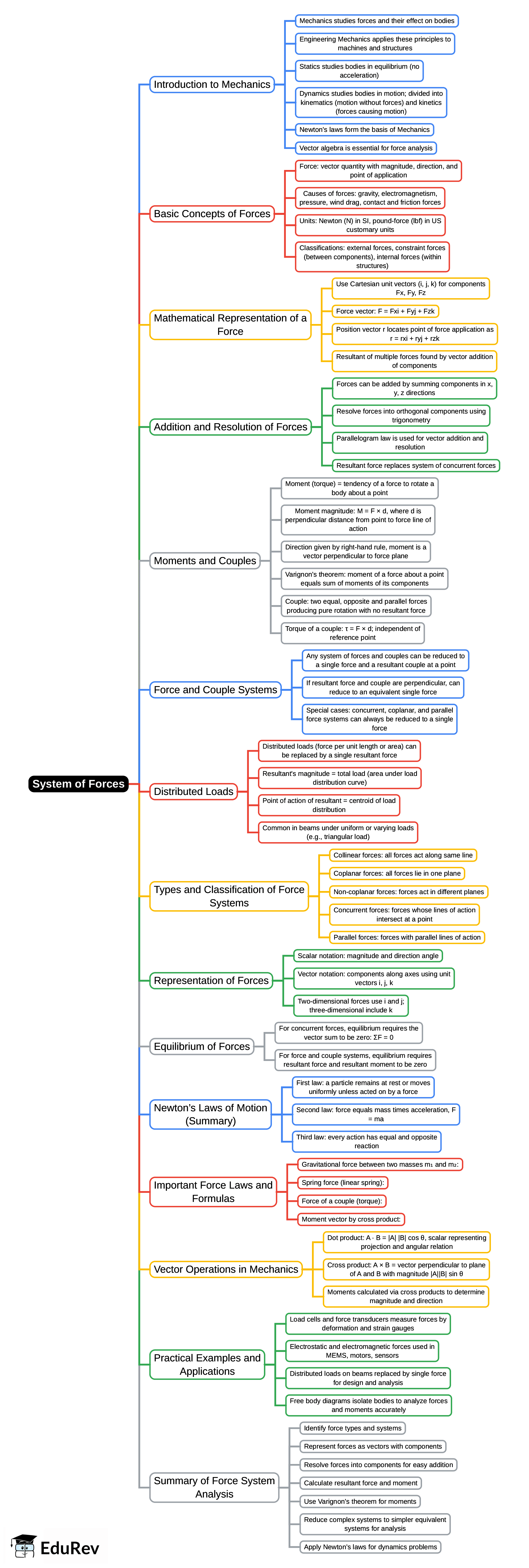
System of Forces
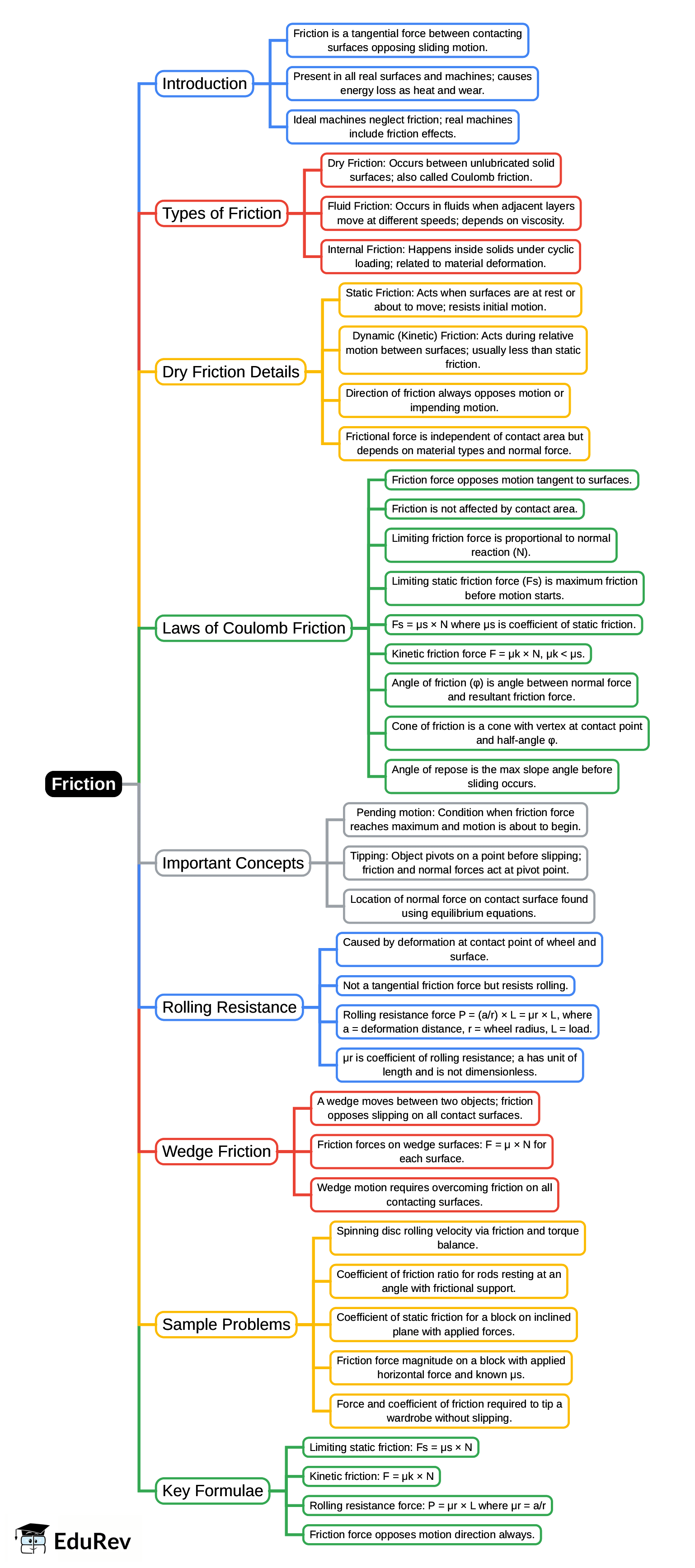
Friction
Kinematics of Point Mass & Rigid Bodies

Work & Energy

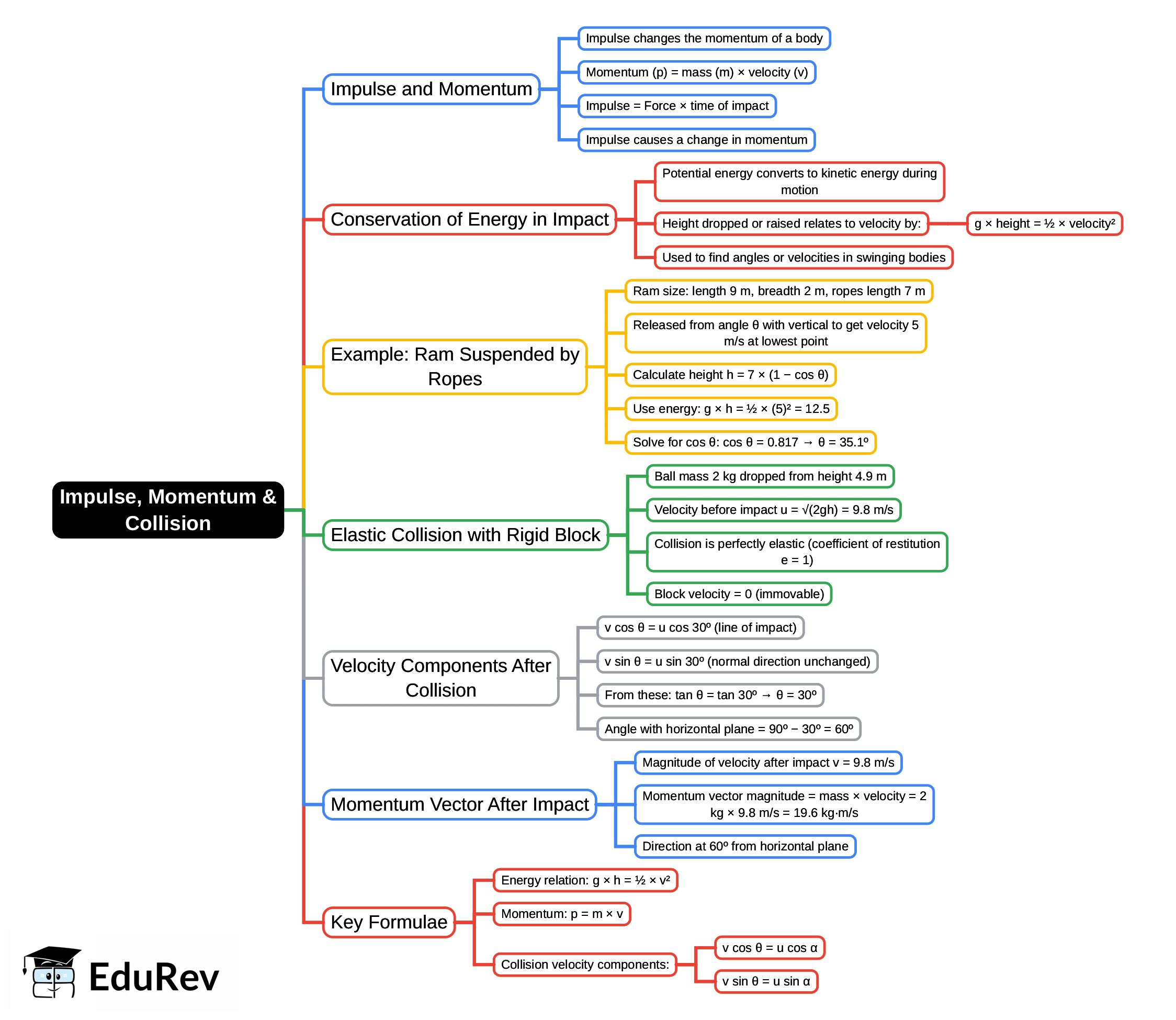
Impulse, Momentum & Collision
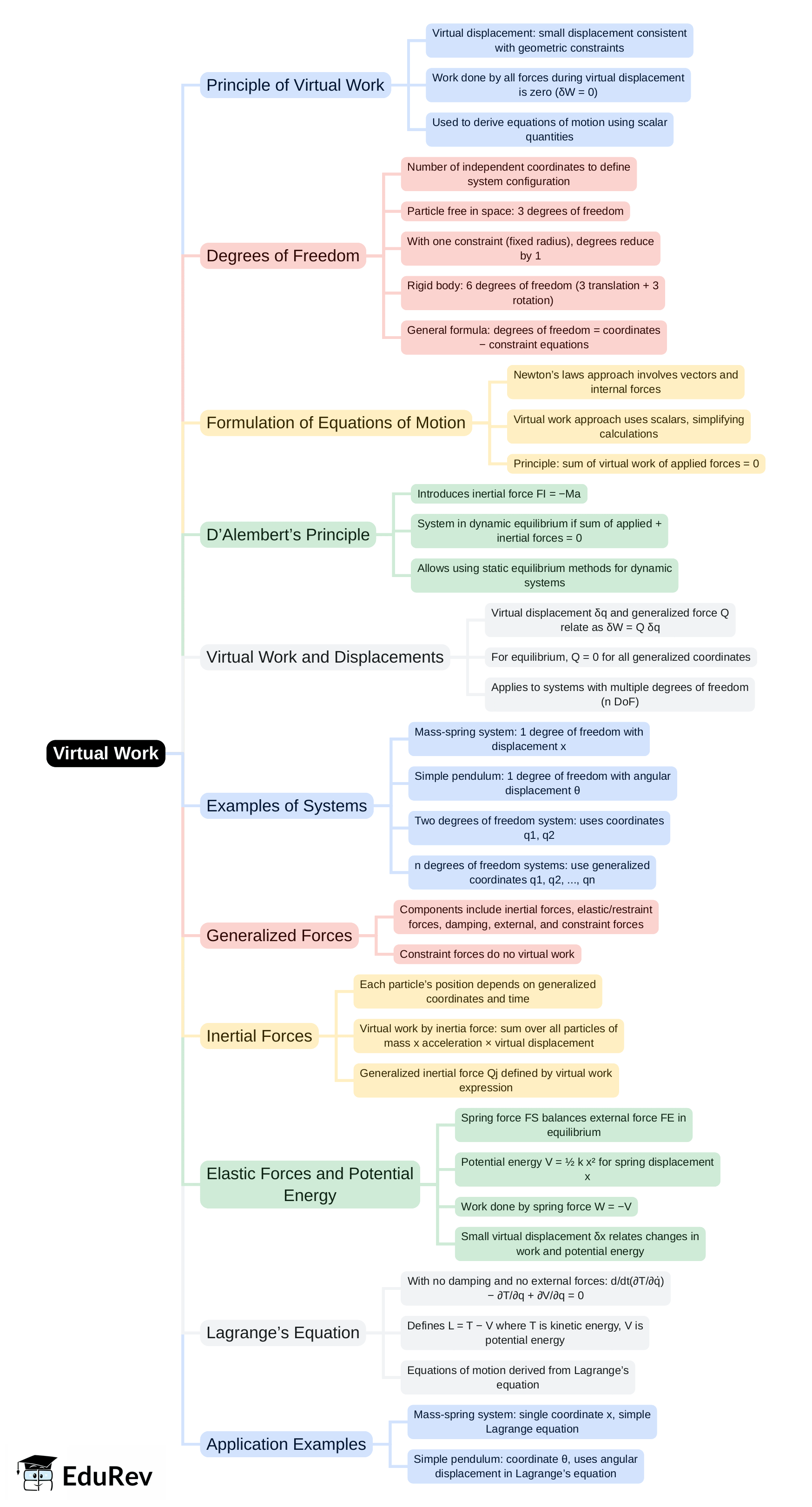
Virtual Work
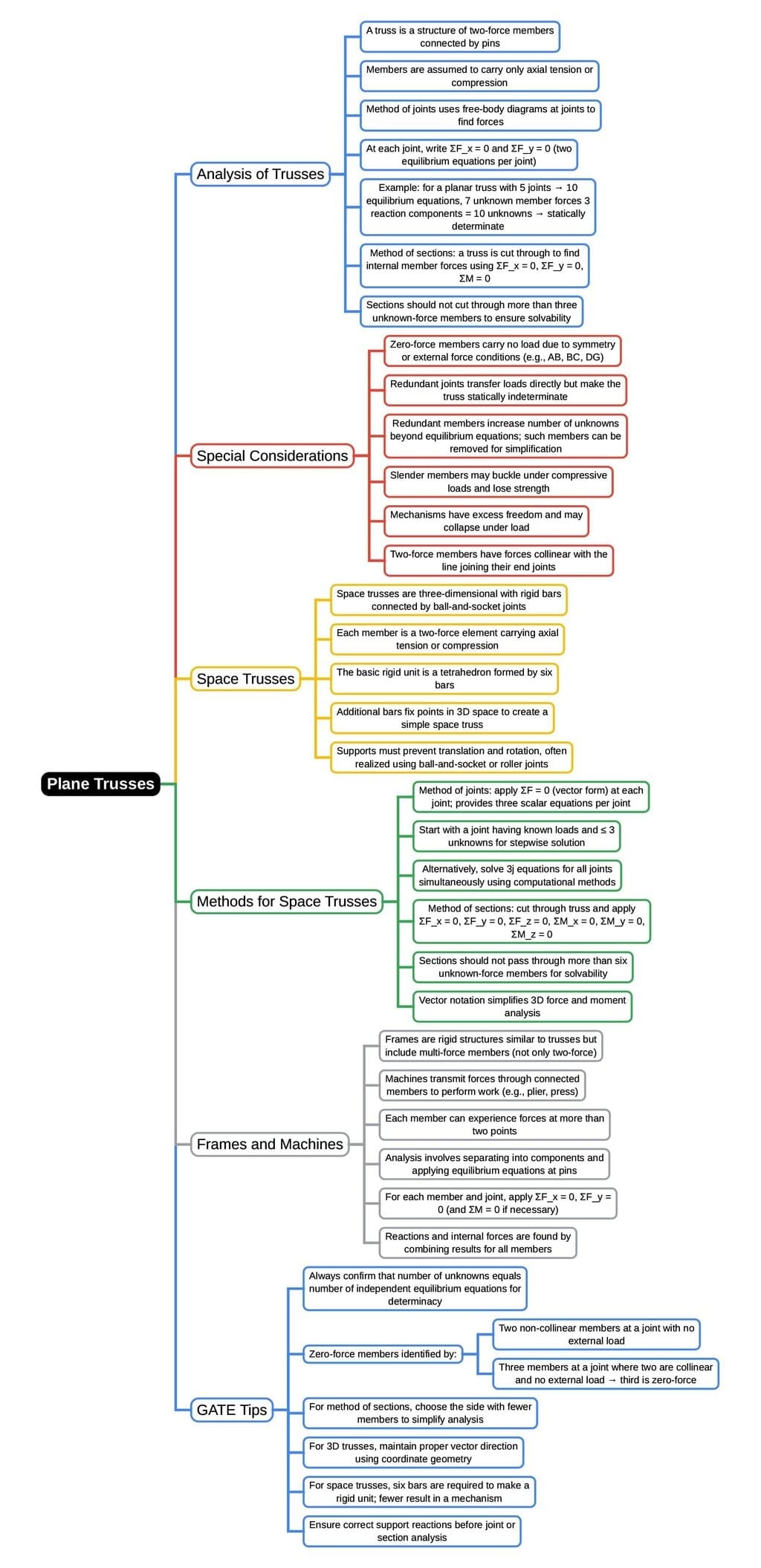
Plane Trusses
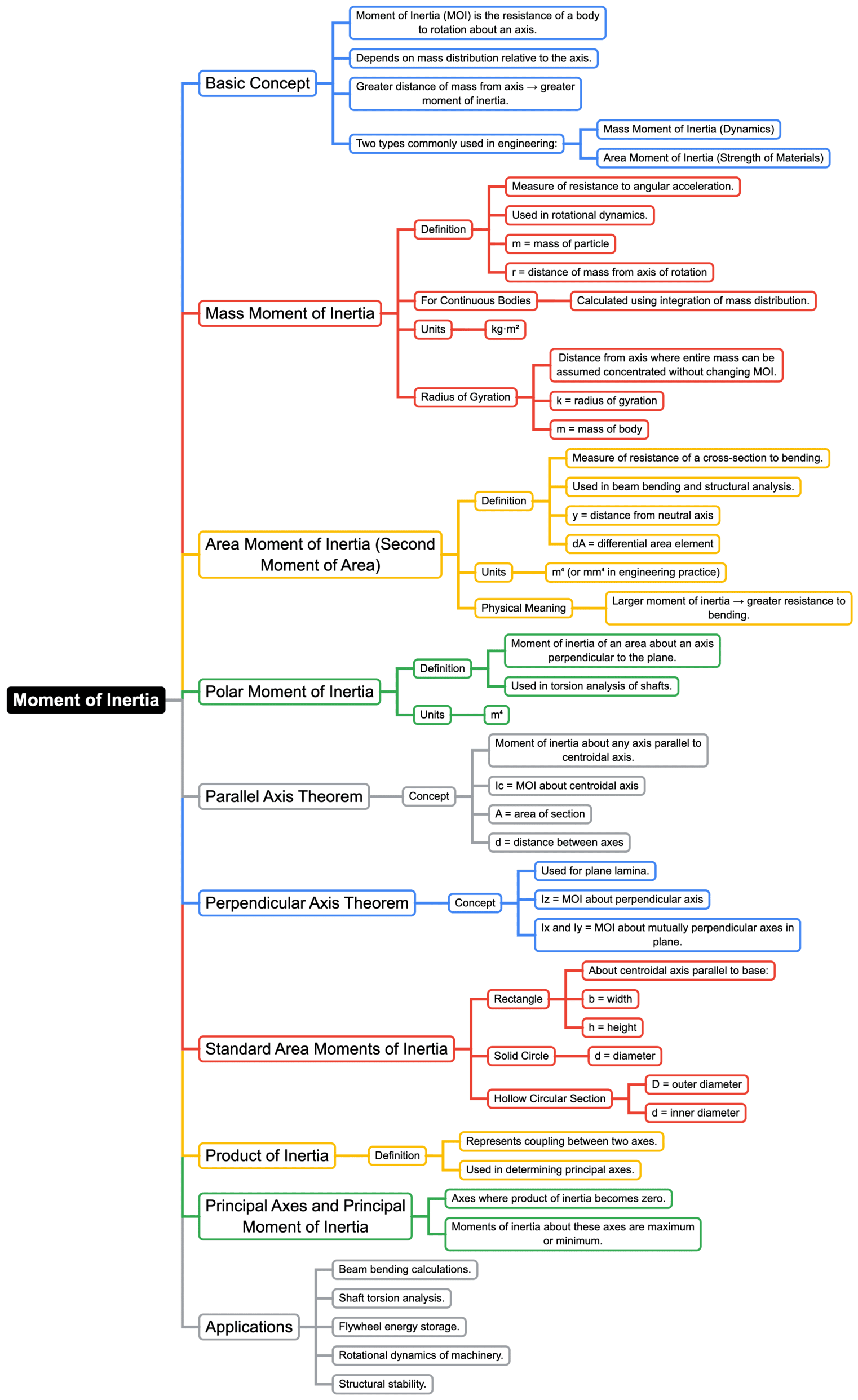
Moment of Inertia (MOI)
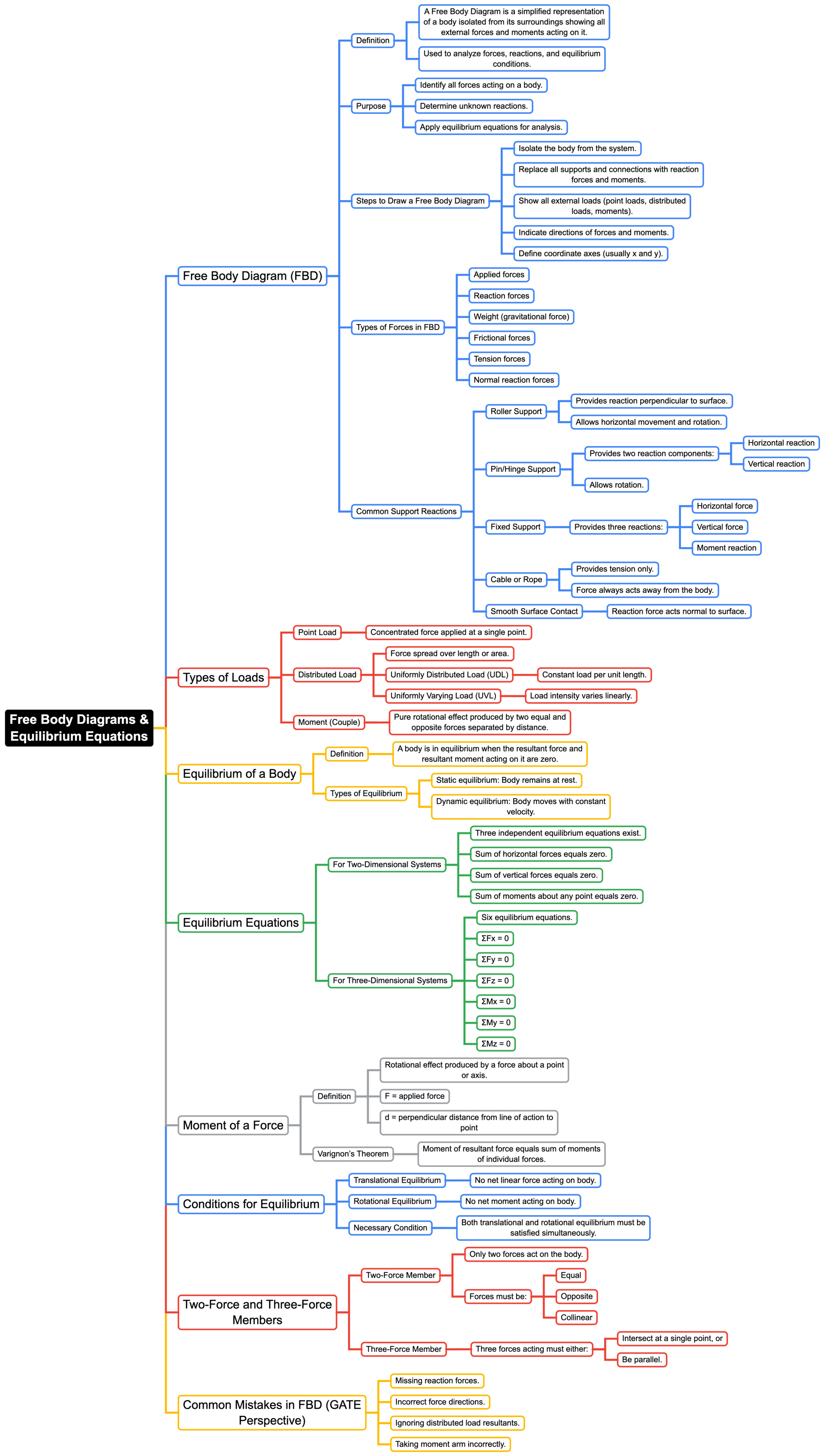
Free Body Diagrams & Equilibrium Equations
The document Full Syllabus Mind Maps: Engineering Mechanics for Mechanical Engineering is a part of the Mechanical Engineering Course Engineering Mechanics for Mechanical Engineering.
All you need of Mechanical Engineering at this link: Mechanical Engineering
FAQs on Full Syllabus Mind Maps: Engineering Mechanics for Mechanical Engineering
| 1. What are the key concepts involved in the system of forces? |  |
Ans. The system of forces refers to the combination of different forces acting on a body. Key concepts include resultant force, equilibrium of forces, and the resolution of forces into components. Understanding the vector nature of forces is crucial, as forces can be added geometrically or algebraically to determine the net effect on an object.
| 2. How does friction affect the motion of objects in engineering mechanics? | |
Ans. Friction is the resistance encountered when two surfaces interact. It plays a critical role in determining the motion of objects, influencing acceleration and deceleration. The coefficient of friction, which can be static or kinetic, is essential for calculating the force of friction that opposes motion. Understanding friction is vital for safe design and operation of mechanical systems.
| 3. What is the significance of free body diagrams in solving equilibrium equations? | |
Ans. Free body diagrams (FBDs) are graphical representations used to visualise the forces acting on a body. They are essential for solving equilibrium equations, as they help identify all external forces, moments, and reactions. By drawing an FBD, engineers can apply Newton's laws to analyse the forces and ensure that the net force and net moment acting on the body are zero, which is a condition for equilibrium.
| 4. Can you explain the concept of moment of inertia (MOI) and its importance? | |
Ans. The moment of inertia (MOI) is a measure of an object's resistance to rotational motion about an axis. It depends on the mass distribution relative to that axis. The MOI is crucial in dynamics, as it affects how much torque is needed for a desired angular acceleration. Understanding MOI is essential for the design of rotating machinery and structural elements, affecting stability and performance.
| 5. What role does the principle of virtual work play in mechanics? | |
Ans. The principle of virtual work states that a system in equilibrium will not perform any work when subjected to a virtual displacement. This principle is useful for analysing structures and mechanisms, allowing engineers to calculate forces and displacements without needing to solve complex equations directly. It simplifies the analysis of systems under constraints and is particularly valuable in the study of rigid body mechanics.
About this Document

4.62/5 Rating

Apr 21, 2026 Last updated
Related Exams
Document Description: Full Syllabus Mind Maps: Engineering Mechanics for Mechanical Engineering for Mechanical Engineering 2026 is part of Engineering Mechanics for Mechanical Engineering preparation. The notes and questions for Full Syllabus Mind Maps: Engineering Mechanics for Mechanical Engineering have been prepared according to the Mechanical Engineering exam syllabus. Information about Full Syllabus Mind Maps: Engineering Mechanics for Mechanical Engineering covers topics like and Full Syllabus Mind Maps: Engineering Mechanics for Mechanical Engineering Example, for Mechanical Engineering 2026 Exam. Find important definitions, questions, notes, meanings, examples, exercises and tests below for Full Syllabus Mind Maps: Engineering Mechanics for Mechanical Engineering.
Introduction of Full Syllabus Mind Maps: Engineering Mechanics for Mechanical Engineering in English is available as part of our Engineering Mechanics for Mechanical Engineering for Mechanical Engineering & Full Syllabus Mind Maps: Engineering Mechanics for Mechanical Engineering in Hindi for Engineering Mechanics for Mechanical Engineering course. Download more important topics related with notes, lectures and mock test series for Mechanical Engineering Exam by signing up for free. Mechanical Engineering: Full Syllabus Mind Maps: Engineering Mechanics for Mechanical Engineering
Description
Full Syllabus Mind Maps: Engineering Mechanics for Mechanical Engineering of Engineering Mechanics provides you one-page visual summary of the chapter covering all the important topics. Download the PDF from EduRev.
Information about Full Syllabus Mind Maps: Engineering Mechanics for Mechanical Engineering
In this doc you can find the meaning of Full Syllabus Mind Maps: Engineering Mechanics for Mechanical Engineering defined & explained in the simplest way possible. Besides explaining types of Full Syllabus Mind Maps: Engineering Mechanics for Mechanical Engineering theory, EduRev gives you an ample number of questions to practice Full Syllabus Mind Maps: Engineering Mechanics for Mechanical Engineering tests, examples and also practice Mechanical Engineering tests
Top Courses for Mechanical Engineering
Related Searches
Previous Year Questions with Solutions, Viva Questions, pdf , Sample Paper, mock tests for examination, ppt, Full Syllabus Mind Maps: Engineering Mechanics for Mechanical Engineering, past year papers, Important questions, video lectures, Semester Notes, Exam, MCQs, study material, practice quizzes, Full Syllabus Mind Maps: Engineering Mechanics for Mechanical Engineering, Objective type Questions, Full Syllabus Mind Maps: Engineering Mechanics for Mechanical Engineering, shortcuts and tricks, Extra Questions, Free, Summary;