Worksheet: Blood Vessels

Section A: Multiple Choice Questions (Q1-5) - 1 mark each
Q1: Which type of blood vessel carries blood away from the heart?
- Veins
- Arteries
- Capillaries
- Blood tubes
Q2: The diagram below shows a cross-section of three different blood vessels labelled A, B and C. Blood vessel A has thick muscular walls. Blood vessel B has very thin walls, only one cell thick. Blood vessel C has thin walls with valves inside. Which blood vessel allows oxygen and nutrients to pass through its walls into body cells?
- Blood vessel A only
- Blood vessel B only
- Blood vessel C only
- Both blood vessels A and B
Q3: Mary cuts her finger while slicing vegetables. Blood flows out of the wound. After a few minutes, the bleeding stops and a clot forms. Which statement best explains why the bleeding stops?
- The heart stops pumping blood to the finger.
- Blood cells stick together to seal the wound.
- The blood vessels completely close up permanently.
- All the blood has already flowed out of the body.
Q4: The diagram shows blood flowing through a blood vessel in the leg. The blood vessel has valves that open and close. Why are valves necessary in veins but not in arteries?
- Veins carry blood at low pressure and valves prevent backflow.
- Arteries carry blood at low pressure and do not need valves.
- Veins have thicker walls that require valves to control blood flow.
- Arteries are located deeper in the body and do not need valves.
Q5: A doctor measures the pulse rate of a patient by feeling the wrist. What is the doctor actually detecting?
- The flow of blood through veins near the skin surface
- The movement of blood cells through capillaries
- The rhythmic expansion of an artery as blood is pumped through it
- The opening and closing of valves in blood vessels
Section B: True / False (Q6-10) - 1 mark each
- Arteries always carry oxygen-rich blood and veins always carry oxygen-poor blood. True / False
- Capillaries have walls that are only one cell thick to allow exchange of materials between blood and body cells. True / False
- Blood flows faster in capillaries than in arteries because capillaries are much narrower. True / False
- The thick muscular walls of arteries help them withstand the high pressure of blood pumped from the heart. True / False
- Veins are located deeper inside the body than arteries to protect them from injury. True / False
Section C: Fill in the Blanks (Q11-13) - 1 mark each
- The smallest blood vessels in the body are called and they connect arteries to veins.
- Blood flows through veins back to the heart at pressure compared to arteries.
- The exchange of oxygen, carbon dioxide and nutrients between blood and body cells takes place through the walls of .
Section D: Structured and Open-Ended Questions (Q14-20)
Q14: State two structural differences between arteries and veins. [2 marks]
Q15: Study the list of blood vessels below:
Aorta
Pulmonary artery
Pulmonary vein
Vena cava
Which one is the odd one out? Explain your answer. [2 marks]
Q16: The table below shows the characteristics of three types of blood vessels.
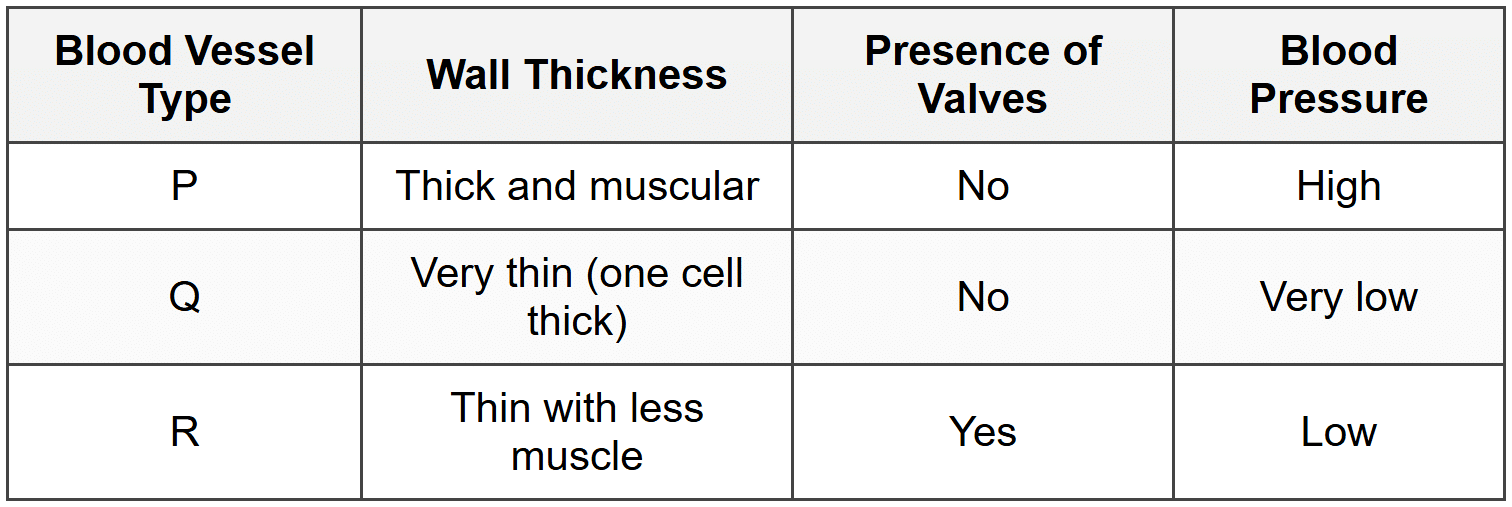
(a) Identify blood vessel type P. [1 mark]
(b) Explain why blood vessel type Q has very thin walls. [1 mark]
Q17: A group of students wants to investigate whether exercise affects pulse rate. They plan to measure the pulse rate of a student before and after running. Suggest one factor the students must keep the same to make this a fair test. [2 marks]
Q18: A person suffers from a condition where the valves in the veins of their legs do not close properly. Suggest what problem this person might experience and give a reason for your answer. [2 marks]
Q19: When a person stands in one position for a very long time without moving, they may feel dizzy or faint. Explain how this is related to the function of blood vessels and the circulatory system. [2 marks]
Q20: The heart pumps blood through arteries to all parts of the body. The blood then flows through capillaries and returns to the heart through veins. Using your knowledge of blood vessels and the circulatory system, explain:
(i) Why arteries need thick muscular walls while capillaries have very thin walls
(ii) How the structure of each type of blood vessel is suited to its function in the circulatory system
[3 marks]
Answer Key
Q1: Which type of blood vessel carries blood away from the heart?
Ans: (2) Arteries
Explanation: Arteries are blood vessels that carry blood away from the heart to all parts of the body. Veins carry blood back to the heart, while capillaries connect arteries to veins.
Q2: The diagram below shows a cross-section of three different blood vessels labelled A, B and C. Blood vessel A has thick muscular walls. Blood vessel B has very thin walls, only one cell thick. Blood vessel C has thin walls with valves inside. Which blood vessel allows oxygen and nutrients to pass through its walls into body cells?
Ans: (2) Blood vessel B only
Explanation: Blood vessel B is a capillary. Its walls are only one cell thick, which allows oxygen and nutrients to pass through easily into body cells. Blood vessel A (artery) and C (vein) have thicker walls that do not allow this exchange.
Q3: Mary cuts her finger while slicing vegetables. Blood flows out of the wound. After a few minutes, the bleeding stops and a clot forms. Which statement best explains why the bleeding stops?
Ans: (2) Blood cells stick together to seal the wound.
Explanation: When a blood vessel is cut, blood cells and platelets stick together to form a clot that seals the wound and stops bleeding. The heart continues to pump blood and blood vessels do not close permanently.
Q4: The diagram shows blood flowing through a blood vessel in the leg. The blood vessel has valves that open and close. Why are valves necessary in veins but not in arteries?
Ans: (1) Veins carry blood at low pressure and valves prevent backflow.
Explanation: Blood in veins flows at low pressure because it is far from the heart's pumping action. Valves prevent blood from flowing backward due to gravity, especially in the legs. Arteries carry blood at high pressure directly from the heart and do not need valves.
Q5: A doctor measures the pulse rate of a patient by feeling the wrist. What is the doctor actually detecting?
Ans: (3) The rhythmic expansion of an artery as blood is pumped through it
Explanation: The pulse is caused by the rhythmic expansion and contraction of artery walls as blood is pumped from the heart. This can be felt where arteries are close to the skin surface, such as at the wrist.
Q6: Arteries always carry oxygen-rich blood and veins always carry oxygen-poor blood.
Ans: False
Explanation: While most arteries carry oxygen-rich blood and most veins carry oxygen-poor blood, the pulmonary artery carries oxygen-poor blood from the heart to the lungs, and the pulmonary vein carries oxygen-rich blood from the lungs to the heart.
Q7: Capillaries have walls that are only one cell thick to allow exchange of materials between blood and body cells.
Ans: True
Explanation: The thin walls of capillaries allow oxygen, nutrients, carbon dioxide and waste products to pass easily between blood and body cells.
Q8: Blood flows faster in capillaries than in arteries because capillaries are much narrower.
Ans: False
Explanation: Blood actually flows slower in capillaries than in arteries. The slow flow allows time for the exchange of materials between blood and body cells.
Q9: The thick muscular walls of arteries help them withstand the high pressure of blood pumped from the heart.
Ans: True
Explanation: Arteries receive blood directly from the heart at high pressure, so they need thick, strong, muscular walls to withstand this pressure without bursting.
Q10: Veins are located deeper inside the body than arteries to protect them from injury.
Ans: False
Explanation: Both arteries and veins are found at various depths in the body. In fact, many veins are located closer to the skin surface than arteries, which is why we can see blue veins through our skin.
Q11: The smallest blood vessels in the body are called and they connect arteries to veins.
Ans: capillaries
Q12: Blood flows through veins back to the heart at pressure compared to arteries.
Ans: low / lower
Q13: The exchange of oxygen, carbon dioxide and nutrients between blood and body cells takes place through the walls of .
Ans: capillaries
Q14: State two structural differences between arteries and veins.
Ans:
Any two of the following:
• Arteries have thick muscular walls while veins have thin walls with less muscle. [1m]
• Veins have valves while arteries do not have valves. [1m]
• Arteries have a smaller internal space (lumen) compared to veins which have a larger lumen. [1m]
(Award 1 mark for each correct structural difference, maximum 2 marks)
Q15: Study the list of blood vessels below: Aorta, Pulmonary artery, Pulmonary vein, Vena cava. Which one is the odd one out? Explain your answer.
Ans:
Pulmonary vein [1m]
It is the only vein that carries oxygen-rich blood / It is the only blood vessel in the list that is a vein carrying oxygenated blood, while the pulmonary artery carries oxygen-poor blood and the aorta carries oxygen-rich blood. [1m]
(Accept: Pulmonary artery is the odd one out because it is the only artery that carries oxygen-poor blood)
Q16: The table below shows the characteristics of three types of blood vessels.
(a) Identify blood vessel type P.
Ans: Artery [1m]
(b) Explain why blood vessel type Q has very thin walls.
Ans: Blood vessel Q is a capillary. It has very thin walls (one cell thick) to allow oxygen, nutrients and other materials to pass through easily / to allow exchange of materials between blood and body cells. [1m]
Q17: A group of students wants to investigate whether exercise affects pulse rate. They plan to measure the pulse rate of a student before and after running. Suggest one factor the students must keep the same to make this a fair test.
Ans:
Any one of the following [1m] with appropriate explanation [1m]:
• The same student should be used for both measurements [1m] because different people may have different pulse rates. [1m]
• The duration/distance of running should be kept the same [1m] because different amounts of exercise will affect pulse rate differently. [1m]
• The time taken to measure pulse rate should be the same [1m] to ensure accurate comparison. [1m]
• The method of measuring pulse rate should be the same [1m] to ensure consistency in measurements. [1m]
Q18: A person suffers from a condition where the valves in the veins of their legs do not close properly. Suggest what problem this person might experience and give a reason for your answer.
Ans:
Problem: Blood may pool/collect in the legs / Swelling of legs / Varicose veins / Poor blood circulation back to the heart [1m]
Reason: When valves do not close properly, blood can flow backward due to gravity instead of flowing upward to the heart / Valves prevent backflow of blood, so faulty valves allow blood to flow back down. [1m]
Q19: When a person stands in one position for a very long time without moving, they may feel dizzy or faint. Explain how this is related to the function of blood vessels and the circulatory system.
Ans:
When standing still for a long time, blood collects/pools in the veins of the legs due to gravity [1m]. Less blood returns to the heart and is pumped to the brain, causing dizziness or fainting due to reduced oxygen supply to the brain / The movement of leg muscles helps push blood up through the veins, so without movement, blood flow back to the heart is reduced. [1m]
Q20: The heart pumps blood through arteries to all parts of the body. The blood then flows through capillaries and returns to the heart through veins. Using your knowledge of blood vessels and the circulatory system, explain: (i) Why arteries need thick muscular walls while capillaries have very thin walls (ii) How the structure of each type of blood vessel is suited to its function in the circulatory system.
Ans:
(i) Arteries need thick muscular walls because they carry blood at high pressure directly from the heart / they need to withstand the high pressure of blood being pumped from the heart without bursting. [1m] Capillaries have very thin walls (one cell thick) to allow oxygen, nutrients, carbon dioxide and waste products to pass through easily between blood and body cells / to allow exchange of materials. [1m]
(ii) Arteries have thick muscular walls to withstand high blood pressure and maintain blood flow. Capillaries have thin walls to allow exchange of materials with body cells. Veins have valves to prevent backflow of blood and ensure blood flows back to the heart despite low pressure / Veins have thin walls and large lumen because blood pressure is low by the time blood reaches veins. [1m]
(Award marks for clear explanation linking structure to function for different blood vessel types. Maximum 3 marks total.)