45 Minute Time Allocation Plan

The HSPT Mathematics section consists of 64 questions to be completed in 45 minutes. This gives you an average of about 42 seconds per question. However, not all questions take the same amount of time, and effective time management is crucial for maximizing your score.
The questions are arranged in two main parts:
- Concepts: 24 questions testing mathematical understanding, problem-solving, and reasoning
- Problem Solving: 40 questions testing arithmetic computation and applied problem-solving
Questions generally increase in difficulty as you progress through each section, though you may encounter easier questions scattered throughout. The HSPT does not penalize incorrect answers, so you should attempt every question.
Key Principle: Time allocation is about balancing speed with accuracy. Spending too long on one difficult question can cost you several easier questions later. Your goal is to answer as many questions correctly as possible within 45 minutes.## 1.1. Breaking Down the 45 Minutes
A strategic approach divides your time based on question difficulty and your personal strengths:
- First pass (30-32 minutes): Answer all questions you can solve quickly and confidently
- Second pass (10-12 minutes): Return to skipped questions and work through moderate-difficulty problems
- Final pass (2-3 minutes): Make educated guesses on remaining questions and verify you've answered every question
This approach ensures you capture all the "easy points" before investing time in harder problems.
How the HSPT Tests Time Management
The HSPT deliberately includes questions that look complex but have shortcuts, and questions that look simple but have traps. Students who rush through without reading carefully make careless errors. Students who get stuck trying to solve every problem perfectly run out of time. The exam rewards those who can:
- Quickly identify which questions deserve more time
- Recognize when to use shortcuts or estimation
- Skip strategically and return later
- Maintain accuracy under time pressure
Different question types require different amounts of time. Recognizing these patterns helps you allocate your time effectively.
## 2.1. Quick Questions (20-30 seconds each)These questions test basic arithmetic, simple conversions, or straightforward pattern recognition:
- Basic arithmetic operations with whole numbers or simple fractions
- Simple percentage calculations (finding 10%, 25%, 50%)
- Evaluating expressions following order of operations with small numbers
- Identifying next terms in simple patterns
- Converting common units (feet to inches, hours to minutes)
- Finding perimeter or area of basic shapes with given dimensions
Strategy: Do these first. They build confidence and bank easy points quickly.
Example: What is the value of 15% of 80?
- 10
- 12
- 15
- 20
Correct Answer: (B)## 2.2. Standard Questions (40-50 seconds each)
Solution:
15% = 15/100
15% of 80 = (15/100) × 80
= (15 × 80)/100
= 1200/100
= 12
Efficient method: 10% of 80 = 8, and 5% of 80 = 4, so 15% = 8 + 4 = 12
Why each wrong answer is a trap:
(A) 10 - student calculated 10% instead of 15%
(C) 15 - student confused the percentage rate with the answer
(D) 20 - student calculated 25% (one quarter) instead of 15%
These form the bulk of the exam and require moderate calculation or reasoning:
- Multi-step word problems involving money, measurement, or rates
- Problems requiring setting up and solving simple equations
- Ratio and proportion problems
- Questions involving fractions, decimals, and percentages with multiple operations
- Geometry problems requiring formulas or angle relationships
- Data interpretation from tables or simple graphs
Strategy: Read carefully, identify what you're solving for, and work systematically. Show minimal work on scratch paper to avoid errors.
Example: A rectangular garden is 24 feet long and 15 feet wide. What is the cost of fencing the entire garden if fencing costs $8 per foot?
- $288
- $312
- $576
- $624
Correct Answer: (D)## 2.3. Complex Questions (60-90 seconds each)
Solution:
First, find the perimeter of the garden:
Perimeter = 2(length + width)
= 2(24 + 15)
= 2(39)
= 78 feet
Then, multiply by the cost per foot:
Cost = 78 × 8
= 624 dollars
Why each wrong answer is a trap:
(A) $288 - student calculated area (24 × 15 = 360) then made an arithmetic error, or calculated perimeter incorrectly as 36 × 8
(B) $312 - student calculated half the perimeter (39 × 8) forgetting to double the sum
(C) $576 - student calculated 72 × 8, possibly adding length and width incorrectly or making an arithmetic error
These questions require deeper reasoning, multiple steps, or unfamiliar contexts:
- Problems combining multiple concepts (ratios with percentages, geometry with algebra)
- Questions requiring working backwards or using logical reasoning
- Problems with unnecessary information that must be filtered out
- Advanced fraction operations or complex percentage problems
- Geometry problems requiring multiple formulas or spatial reasoning
- Number theory problems (prime factorization, divisibility, number properties)
Strategy: If you can't see a clear path to the solution within 10-15 seconds, mark it and move on during your first pass. Return to it when you've banked easier points.
Example: The sum of three consecutive odd numbers is 87. What is the largest of these three numbers?
- 27
- 29
- 31
- 33
Correct Answer: (C)## 3. The Three-Pass Strategy
Solution:
Let the three consecutive odd numbers be n, n + 2, and n + 4
Their sum is: n + (n + 2) + (n + 4) = 87
Combining like terms: 3n + 6 = 87
Subtracting 6 from both sides: 3n = 81
Dividing by 3: n = 27
The three numbers are 27, 29, and 31
The largest is 31
Efficient method: The middle number of three consecutive odds is their average: 87 ÷ 3 = 29, so the numbers are 27, 29, 31
Why each wrong answer is a trap:
(A) 27 - student found the smallest number instead of the largest
(B) 29 - student found the middle number instead of the largest
(D) 33 - student made an arithmetic error or set up the equation incorrectly
The most effective approach to the HSPT Mathematics section involves making three distinct passes through the test. This strategy maximizes your score by ensuring you attempt all the questions you can answer correctly before investing time in difficult ones.
## 3.1. First Pass: Build Your Foundation (30-32 minutes)Goal: Answer 50-55 questions confidently and accurately
During the first pass, work through the test from beginning to end with these rules:
- Read each question carefully but quickly
- If you immediately see how to solve it, work it out
- If you can eliminate at least two answers quickly, make your best guess
- If a question looks time-consuming or you don't see a clear approach within 10 seconds, circle the question number and skip it
- Never spend more than 60 seconds on a single question during this pass
- Fill in your answer sheet as you go to avoid losing time later
Critical Rule: During the first pass, you should be answering questions at a pace of about one every 35-40 seconds on average. If you find yourself stuck, skip immediately. There's no penalty for wrong answers, but there's a huge penalty for running out of time.
How the HSPT Tests Your Skipping Judgment
The HSPT often places a very difficult question early in the section, or an easy question late in the section. Students who try to answer every question in order often spend 3-4 minutes on question 8, then rush through questions 50-64, making careless errors on problems they could have solved correctly with proper time.
## 3.2. Second Pass: Tackle Moderate Challenges (10-12 minutes)Goal: Answer 6-10 more questions using strategic problem-solving
Now return to the questions you skipped. During this pass:
- Focus on questions where you have a strategy, even if it's time-consuming
- Use estimation and answer elimination aggressively
- Look for shortcuts: can you work backwards from the answers? Can you test the middle value first?
- Allocate 60-90 seconds per question
- If you're still stuck after 90 seconds, make your best guess and move on
Example: A store marks up the price of an item by 40%, then offers a 25% discount. If the final price is $63, what was the original price?
- $54
- $60
- $66
- $72
Correct Answer: (B)## 3.3. Third Pass: Finish Strong (2-3 minutes)
Solution:
Let the original price be x
After 40% markup: price = x + 0.40x = 1.40x
After 25% discount: price = 1.40x - 0.25(1.40x) = 1.40x × 0.75 = 1.05x
We know: 1.05x = 63
Therefore: x = 63 ÷ 1.05 = 60
Efficient method (working backwards): Test answer (B): 60 × 1.40 = 84, then 84 × 0.75 = 63 ✓
Why each wrong answer is a trap:
(A) $54 - student incorrectly applied discounts/markups in wrong order or made calculation error
(C) $66 - student found 63 ÷ 0.95 (applying 5% net change) without recognizing the multiplicative effect
(D) $72 - student divided 63 by 0.875 (40% - 25% = 15%, so 0.85), treating markup and discount as additive
Goal: Fill in all remaining bubbles and check for errors
With 2-3 minutes remaining:
- Make educated guesses on any remaining unanswered questions
- Verify every question has an answer marked (no blank bubbles)
- If time permits, quickly check 3-5 questions you felt uncertain about
- Check for bubbling errors (did you skip a line on the answer sheet?)
Guessing Strategy: If you must guess completely, eliminate any obviously incorrect answers first. If you can eliminate even one option, your probability of guessing correctly increases significantly (from 25% to 33%).## 4. Common Time Traps and How to Avoid Them
The HSPT includes several types of questions designed to consume excessive time if you approach them inefficiently. Recognizing these patterns helps you avoid falling behind.
## 4.1. The Calculation TrapWhat it looks like: A question that appears to require extensive arithmetic (large numbers, complex fractions, multiple operations)
Why it's a trap: The HSPT rarely requires difficult manual calculation. If you find yourself doing long division with three-digit numbers, you've likely missed a shortcut or misunderstood the question.
How to avoid it:
- Look for common factors before multiplying or dividing
- Consider whether estimation can eliminate three answer choices
- Check if you can work backwards from the answer choices
- Ask yourself: "Is there a pattern or relationship I'm missing?"
Example: What is the value of \(\frac{48 \times 125}{25 \times 12}\)?
- 16
- 18
- 20
- 24
Correct Answer: (C)## 4.2. The Over-Thinking Trap
Solution:
Rather than multiplying out the numerator and denominator, look for common factors:
\(\frac{48 \times 125}{25 \times 12} = \frac{48}{12} \times \frac{125}{25}\)
= 4 × 5
= 20
Why each wrong answer is a trap:
(A) 16 - student made an arithmetic error in simplification, possibly calculating 48 ÷ 12 = 4 and 100 ÷ 25 = 4
(B) 18 - student made an error in simplifying fractions
(D) 24 - student calculated 48 ÷ 25 = approximately 2, then 2 × 12 = 24, inverting the division
What it looks like: A seemingly simple question that makes you second-guess yourself
Why it's a trap: Students often assume HSPT questions must be complicated, so they over-analyze straightforward problems, wasting time and introducing errors.
How to avoid it:
- Trust your first instinct if the arithmetic is simple
- Don't assume every question has a trick
- Read carefully but don't read hidden meanings into clear language
- If your answer matches an option and your work is sound, move on
What it looks like: A word problem with lots of information, only some of which is needed
Why it's a trap: Students waste time processing and calculating with irrelevant data.
How to avoid it:
- Identify what the question is actually asking before processing all information
- Cross out or ignore information that doesn't relate to the final question
- Focus on the key relationship or operation needed
What it looks like: A difficult problem where you can't find an elegant solution
Why it's a trap: You keep working, convinced there must be a "right way" you're missing, spending 3-4 minutes on one question.
How to avoid it:
- Remember: the goal is the correct answer, not the elegant method
- Testing answer choices is completely valid if it's faster than algebraic solution
- Estimation that eliminates three options is just as valuable as exact calculation
- Set a mental timer: if you haven't made progress in 60 seconds, guess and move on
To stay on track during the test, use these benchmarks. Glance at the clock periodically to ensure you're maintaining appropriate pace:
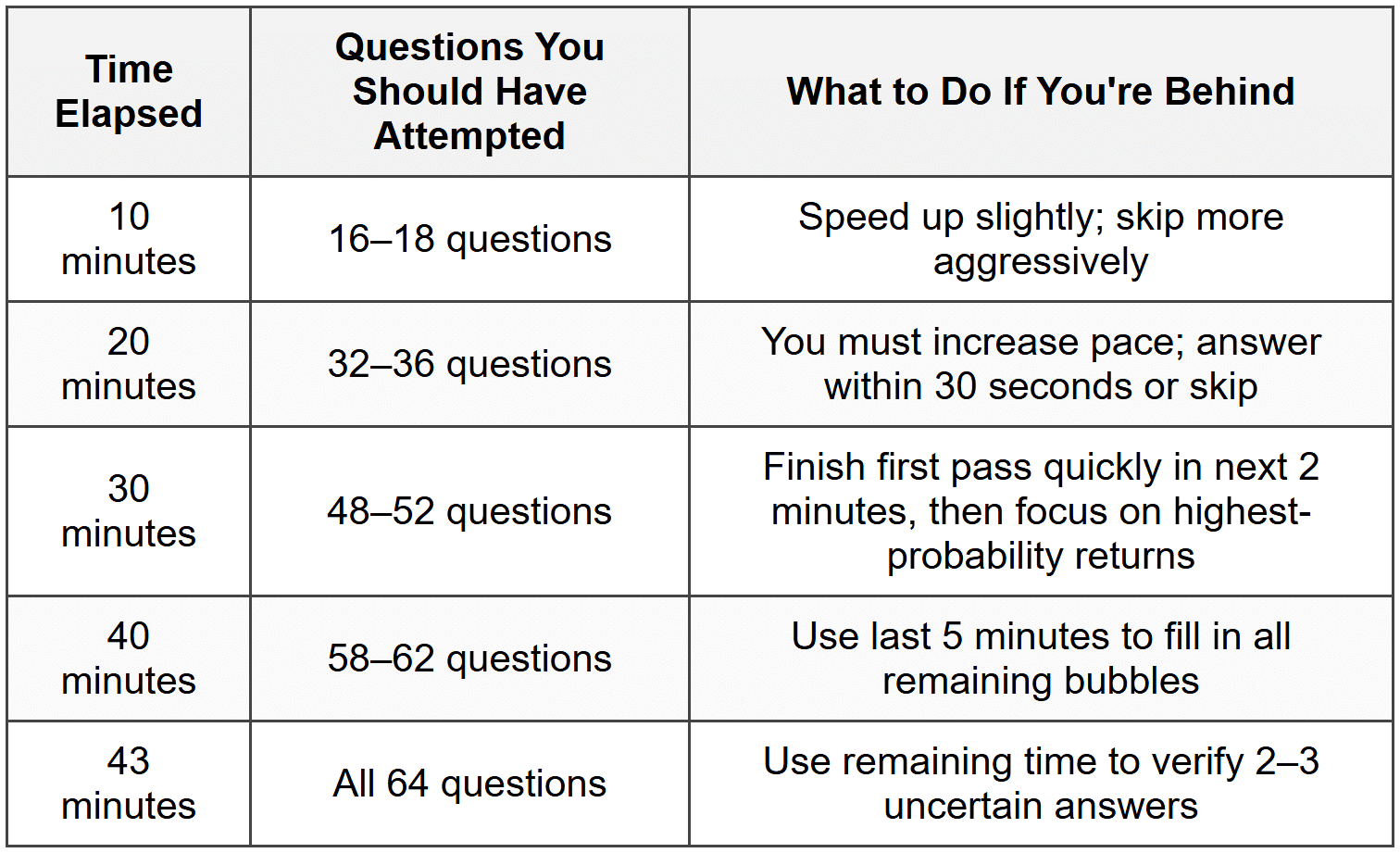
Important: These are guidelines, not rigid rules. Some students work faster on computation and slower on word problems, or vice versa. The key is recognizing your own pace and adjusting to ensure you attempt every question.## 6. Building Speed Without Losing Accuracy
Time management isn't just about moving faster-it's about working efficiently. Here are techniques to build speed while maintaining accuracy:
## 6.1. Mental Math ShortcutsPractice these techniques to reduce calculation time:
- Multiplying by 5: Multiply by 10, then divide by 2 (35 × 5 = 350 ÷ 2 = 175)
- Multiplying by 25: Multiply by 100, then divide by 4 (24 × 25 = 2400 ÷ 4 = 600)
- Percentages: 10% first, then scale (17% of 80: 10% = 8, 5% = 4, 2% = 1.6, so 17% = 8 + 4 + 4 + 1.6 = 13.6, but often rounding or estimation suffices)
- Divisibility: Know tests for 2, 3, 4, 5, 6, 9, 10 to avoid unnecessary long division
- Fraction-decimal equivalents: Memorize 1/2, 1/3, 1/4, 1/5, 1/8, 1/10 and their multiples
Often you can eliminate wrong answers faster than you can calculate the right answer:
- Size estimation: Is the answer bigger or smaller than a benchmark?
- Units check: Does the answer have correct units?
- Reasonableness: If the problem is about age, an answer of 150 is impossible
- Odd/even analysis: Sum of two odd numbers must be even
- Digit patterns: Multiplying numbers ending in 5 by odd numbers gives results ending in 5
Word problems consume time through reading as much as calculation:
- Read the question first (what are you solving for?), then read the setup
- Underline or mentally note key numbers as you read
- Ignore flavor text that doesn't affect the mathematics
- Look for signal words: "difference" (subtract), "product" (multiply), "total" (add), "per" or "each" (divide or multiply)
1. A store is having a sale where everything is 30% off. Sarah buys a jacket originally priced at $85. How much does she pay?
- $25.50
- $55.00
- $59.50
- $63.75
2. What is the value of \(7 + 3 \times 5 - 4 \div 2\)?
- 20
- 23
- 48
- 50
3. A rectangular swimming pool is 30 meters long and 12 meters wide. What is the area of the pool in square meters?
- 42
- 84
- 360
- 720
4. Which of the following numbers is divisible by both 3 and 4?
- 126
- 132
- 138
- 142
5. A recipe calls for 2/3 cup of sugar. If you want to make 1.5 times the recipe, how many cups of sugar do you need?
- 1/2
- 3/4
- 1
- 1 1/4
6. The average of five numbers is 24. Four of the numbers are 18, 22, 26, and 28. What is the fifth number?
- 20
- 24
- 26
- 30
7. A car travels 240 miles in 4 hours. At this rate, how many miles will it travel in 7 hours?
- 360
- 380
- 400
- 420
8. What is 40% of 65?
- 24
- 26
- 28
- 30
9. A number is multiplied by 4, then 12 is added, and the result is 56. What is the number?
- 8
- 11
- 17
- 22
10. The perimeter of a square is 68 inches. What is the length of one side?
- 13 inches
- 15 inches
- 17 inches
- 19 inches
Answer Key: 1(C) 2(A) 3(C) 4(B) 5(C) 6(C) 7(D) 8(B) 9(B) 10(C)