30 Minute Time Allocation Strategy


1. Understanding the Quantitative Section Time Frame
The Quantitative section contains 52 questions and must be completed in 30 minutes. This creates significant time pressure: you have an average of approximately 34 to 35 seconds per question. However, not all questions are equal in difficulty or time requirement.
The section is divided into two distinct question types:
- Quantitative Skills (Questions 1-30): These involve numerical relationships, sequences, comparisons, and pattern recognition
- Problem Solving (Questions 31-52): These are traditional word problems involving arithmetic, geometry, percentages, ratios, and other mathematical applications
The real challenge is not just answering questions correctly, but doing so quickly enough to attempt all 52 questions. Students who spend too long on early questions often run out of time, leaving easier questions unanswered at the end.
HSPT Testing Note: The exam does not penalize guessing. Never leave a question blank. If you're running out of time, quickly fill in remaining answers with your best guess or a consistent letter choice.
2. The Basic Time Allocation Model
A strategic approach divides the 30 minutes based on question type and typical difficulty:
2.1 Recommended Time Splits
For most students, the following allocation works well:
- Questions 1-30 (Quantitative Skills): 12-13 minutes (approximately 24-26 seconds per question)
- Questions 31-52 (Problem Solving): 15-16 minutes (approximately 40-44 seconds per question)
- Review/Buffer Time: 2-3 minutes for checking answers and completing any skipped questions
Why this split? Quantitative Skills questions typically require less reading and often involve pattern recognition or quick calculations. Problem Solving questions require more reading comprehension, translation into mathematical operations, and multi-step calculations.
2.2 The Checkpoint System
To maintain proper pacing, establish time checkpoints throughout the exam:
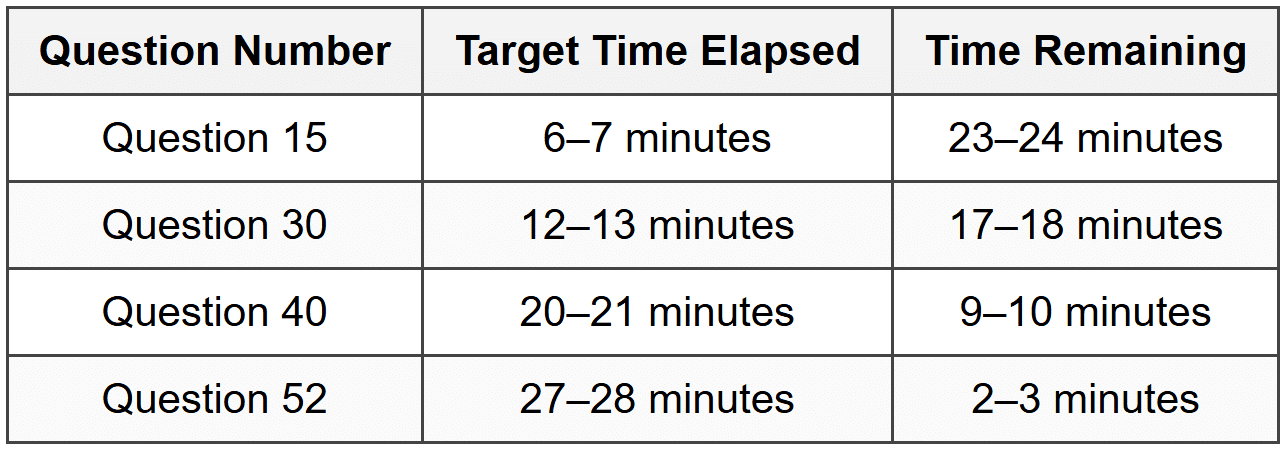
If you find yourself behind at any checkpoint, you need to speed up immediately. This might mean guessing on questions that seem too time-consuming and moving forward.
HSPT Testing Note: Students often lose track of time during the exam. Practice looking at the clock at these specific question numbers so it becomes automatic on test day.
3. The Triage Strategy: Sort, Skip, and Return
Not every question deserves the same amount of time. The triage strategy helps you maximize points by identifying which questions to answer immediately, which to skip temporarily, and which to guess on if time runs out.
3.1 Three-Tier Question Classification
Tier 1 (Quick Wins): Questions you can answer in 20 seconds or less
- Simple arithmetic or pattern recognition
- Questions where you immediately see the approach
- Number comparisons or sequence problems with obvious patterns
Tier 2 (Standard Questions): Questions requiring 30-50 seconds
- Multi-step calculations that are straightforward
- Word problems with clear setups
- Geometry problems with standard formulas
Tier 3 (Time Traps): Questions that would take more than 60 seconds
- Complex multi-step problems with unfamiliar contexts
- Questions where you don't immediately see the approach
- Problems requiring extensive trial and error
3.2 How to Apply Triage in Real Time
As you encounter each question, make a 5-second decision:
- Read the question completely
- Determine if you know how to solve it immediately (Tier 1 or 2)
- If yes, solve it now
- If no, or if it looks time-consuming (Tier 3), lightly mark it in your test booklet and skip to the next question
After completing your first pass through all questions, return to skipped questions with your remaining time. If time is running very short, make educated guesses on any remaining Tier 3 questions.
HSPT Testing Note: Many students waste time staring at a difficult question, thinking "I should be able to solve this." Time pressure requires letting go of perfectionism and moving forward strategically.
Example: Applying the triage strategy
Suppose you're at Question 18 with 19 minutes remaining (you should be at about 24 minutes remaining). You're behind schedule. The next question is a complex word problem about mixing solutions with different concentrations. You read it and don't immediately see how to set it up.
Correct decision: Mark the question in your booklet, make your best guess by eliminating obviously wrong answers, fill in the bubble, and move to Question 19. You cannot afford to spend 90 seconds on this problem when you're already behind.
Wrong decision: Spending 2 minutes working through the problem, getting frustrated, and falling further behind schedule. Even if you get it correct, you've now sacrificed time needed for potentially easier questions later.
4. Question-Level Time Management Techniques
4.1 The 30-Second Rule
If you've been working on a single question for 30 seconds without significant progress, you should strongly consider moving on. Significant progress means:
- You've set up the equation or approach
- You're in the middle of calculation and know the next steps
- You've eliminated at least two answer choices
If you're still trying to understand what the question is asking or how to begin after 30 seconds, it's a Tier 3 question for you right now. Skip it.
4.2 Strategic Calculation Shortcuts
Because calculators are not permitted, you must develop mental math efficiency. The HSPT rewards students who can:
- Recognize when estimation is sufficient instead of exact calculation
- Use answer choices to guide calculation strategy
- Simplify before calculating
- Work backwards from answer choices when appropriate
Example: Strategic estimation vs. exact calculation
Question: A store offers a 15% discount on an item originally priced at $78. What is the sale price?
Full calculation approach (slower):
15% of 78 = 0.15 × 78 = 15 × 78 ÷ 100 = 1170 ÷ 100 = 11.70 Sale price = 78 - 11.70 = $66.30
Strategic shortcut approach (faster):
15% off means paying 85% of original price 85% of 78 = 0.85 × 78 Think: 0.85 × 80 = 68 Since 78 is slightly less than 80, answer is slightly less than 68 Looking at answer choices, $66.30 is the only option close to but less than 68
The strategic approach recognizes that you don't need perfect precision-you need the correct answer choice. If the choices are well-separated (like $56.30, $63.00, $66.30, $71.30), estimation gets you there faster.
HSPT Testing Note: Answer choices are deliberately spaced to reward strategic thinking. If all choices are far apart, exact calculation is usually unnecessary. If choices are close together, you need more precision.
Example: Time management in action
What is the value of \( \frac{17 \times 24}{12} \)?
- 28
- 34
- 38
- 42
Correct Answer: (B)
Solution:
Notice that 24 and 12 share a common factor
\( \frac{17 \times 24}{12} = 17 \times \frac{24}{12} = 17 \times 2 = 34 \)
Time-saving insight: Simplify fractions before multiplying large numbers. Calculating \( 17 \times 24 = 408 \) first, then dividing by 12, takes longer and creates more opportunity for arithmetic errors.
Estimated time: 15-20 seconds with the efficient method, 40-50 seconds if you multiply first then divide
Why each wrong answer is a trap:
(A) 28: Results from incorrectly calculating \( 17 \times 24 \) as 336 instead of 408, then dividing by 12
(C) 38: Results from adding 17 + 24 - 12 instead of performing the correct operations
(D) 42: Results from miscalculating \( 17 \times 2 \) as 42 instead of 34, likely a mental arithmetic error
4.3 Using Answer Choices Strategically
The answer choices provide valuable information that can save time:
- Eliminate impossible answers: If a problem asks for a percentage increase and one choice is negative, eliminate it immediately
- Check reasonableness: If you're calculating the area of a rectangle with sides 12 and 15, and one answer is 27, eliminate it (that's the perimeter divided by 2)
- Work backwards: Sometimes plugging in answer choices is faster than solving algebraically
- Look for patterns: Answer choices often follow patterns that reveal the question's structure
Example: Working backwards from answer choices
A number is multiplied by 3, then 7 is added to the result. The final answer is 28. What was the original number?
- 5
- 7
- 9
- 11
Correct Answer: (B)
Solution (algebraic method):
Let \( n \) be the original number
\( 3n + 7 = 28 \)
\( 3n = 21 \)
\( n = 7 \)
Solution (working backwards-faster under time pressure):
Test (B): If the number is 7, then \( 7 \times 3 = 21 \), and \( 21 + 7 = 28 \). Correct!
Time-saving insight: Testing answer choices starting with (B) or (C) is often faster than setting up and solving an equation, especially when choices are simple numbers.
Estimated time: 10-15 seconds working backwards, 25-30 seconds using algebra
Why each wrong answer is a trap:
(A) 5: Results from solving \( 3n = 28 - 7 \) but making an error in division (15 ÷ 3 miscalculated as 5)
(C) 9: Results from reversing operations: \( (28 - 7) ÷ 3 = 7 \), but student adds instead of subtracts or divides instead of multiplies
(D) 11: Results from solving \( (28 - 7) ÷ 2 \) using wrong multiplier, or miscalculating 21 ÷ 3
5. Managing Mental Fatigue and Maintaining Accuracy
Time pressure naturally creates stress, which increases mental fatigue and arithmetic errors. Strategic management of mental energy is crucial.
5.1 The Write-It-Down Principle
When time is tight, students often try to do everything mentally to save time. This is a mistake. Writing down intermediate steps actually saves time by reducing errors that force you to recalculate.
Write down:
- Key numbers from word problems
- Intermediate calculation results
- Conversions (e.g., 1 hour = 60 minutes)
- Simplified fractions or factored expressions
Do not write down:
- Complete sentence transcriptions from the problem
- Lengthy explanations to yourself
- Every single arithmetic step for simple calculations
HSPT Testing Note: The test booklet has ample margin space for calculations. Students who try to save time by not writing anything down typically make more errors and end up losing time on recalculation.
5.2 The Fresh-Eyes Technique for Checking
If you have 2-3 minutes remaining after completing all questions, resist the urge to review every answer. Instead:
- Review only questions you marked as uncertain
- Recalculate only if you can do so completely-partial rechecking often introduces new errors
- Look for obvious errors: did you accidentally mark (C) when you meant (B)?
- Verify answers to calculation-heavy questions by checking reasonableness, not by repeating the same calculation
Example: Checking reasonableness instead of recalculating
You calculated that a 20% tip on a $45 meal is $11. With 30 seconds left, should you recalculate?
Better approach: Quick reasonableness check-10% of $45 is $4.50, so 20% should be $9.00. Your answer of $11 is wrong. If you have time, recalculate; if not, change to $9.00.
Worse approach: Recalculating \( 45 \times 0.20 \) from scratch under time pressure and potentially making the same error again.
6. Practice-Based Time Calibration
Effective time management requires practice under realistic conditions. During preparation, you must:
6.1 Simulated Full-Length Sections
Take complete 52-question practice sections under strict 30-minute time limits. This builds:
- Physical stamina for maintaining concentration
- Pacing intuition (knowing what 15 minutes "feels like")
- Decision-making speed for triage
- Resilience when encountering difficult questions
After each practice section, analyze:
- Which questions took too long?
- Where did you lose time unnecessarily?
- Did you skip questions appropriately?
- How many questions did you rush through at the end?
6.2 Diagnostic Timing by Question Type
Time yourself on sets of 10 questions by type to identify your personal strengths and weaknesses:
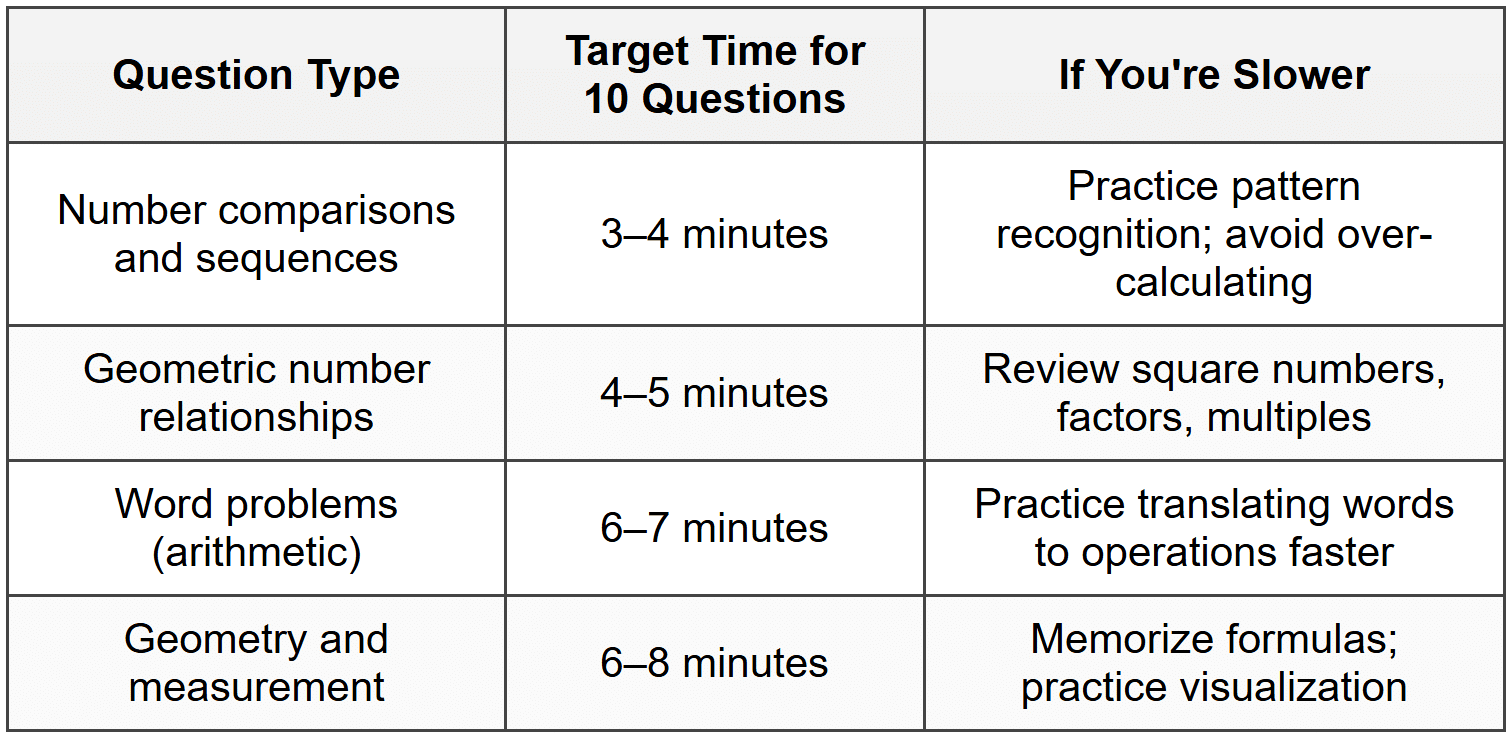
Adjust your personal time allocation based on these diagnostics. If you're consistently fast at sequences but slow at geometry, spend slightly less time on early questions to bank time for later geometric problems.
HSPT Testing Note: Different students have different natural pacing. The checkpoint system should be personalized based on your diagnostic practice. However, everyone must finish all 52 questions within 30 minutes.
Example: Diagnostic timing question (Number Sequences)
What is the next number in this sequence: 2, 6, 12, 20, 30, ?
- 38
- 40
- 42
- 45
Correct Answer: (C)
Solution:
Look at the differences between consecutive terms:
6 - 2 = 4
12 - 6 = 6
20 - 12 = 8
30 - 20 = 10
The differences form the sequence 4, 6, 8, 10, which increases by 2 each time
Next difference should be 12
30 + 12 = 42
Time-saving insight: Sequence problems almost always reward looking at differences or ratios first, not trying to find a formula
Target time: 20-30 seconds
Why each wrong answer is a trap:
(A) 38: Results from incorrectly identifying the pattern as "add 8" from the last step only (30 + 8)
(B) 40: Results from adding 10 again (repeating the last difference) instead of recognizing the pattern of increasing differences
(D) 45: Results from incorrectly identifying the pattern as "add 15" or doubling something incorrectly
7. Emergency Time Protocols
Despite best planning, you may find yourself with 5 minutes left and 15 questions unanswered. You need emergency protocols.
7.1 The 5-Minute Protocol
If you have 5 minutes and 10-15 questions remaining:
- Stop whatever question you're working on immediately
- Scan all remaining questions quickly (5 seconds each)
- Identify 3-5 that look simplest
- Solve only those, spending maximum 45 seconds each
- For all others, make educated guesses by eliminating one or two obviously wrong answers
- Fill in ALL remaining bubbles in the last 30 seconds (never leave blanks)
7.2 The 2-Minute Protocol
If you have 2 minutes and any questions remain:
- Abandon all calculation
- Read each remaining question quickly
- Eliminate obviously wrong answers (wrong magnitude, wrong sign, impossible values)
- Guess from remaining choices
- Fill every bubble-with 1 minute left, just pick a letter and fill all remaining bubbles with it
Statistically, random guessing gives you a 25% chance per question. Educated guessing (eliminating even one wrong answer) raises this to 33% or 50%. Leaving blanks gives you 0%.
HSPT Testing Note: Students emotionally resist "giving up" on problems, even when time is gone. Practice the emergency protocols so you can execute them without hesitation on test day.
Example: Emergency triage decision
You have 3 minutes left and 8 questions remaining. You encounter this question:
The average of five numbers is 24. Four of the numbers are 18, 22, 28, and 30. What is the fifth number?
- 20
- 22
- 24
- 26
Correct Answer: (B)
Solution (under normal time):
Average of 5 numbers = 24, so total sum = \( 24 \times 5 = 120 \)
Sum of four known numbers: \( 18 + 22 + 28 + 30 = 98 \)
Fifth number = \( 120 - 98 = 22 \)
Solution (emergency protocol-45 seconds or less):
Sum must be 120. Quick mental addition: \( 18 + 22 = 40 \), \( 28 + 30 = 58 \), total so far = 98
\( 120 - 98 = 22 \)
Emergency decision: This problem is straightforward with simple numbers. Spend 30-40 seconds solving it. Move on immediately after getting 22.
Why each wrong answer is a trap:
(A) 20: Results from calculation error in addition (getting 100 instead of 98 for the sum, then 120 - 100)
(C) 24: Results from assuming the fifth number equals the average (a common conceptual error)
(D) 26: Results from calculation error (120 - 94 instead of 120 - 98, likely from misadding the four numbers)
8. Common Timing Mistakes and How to Avoid Them
8.1 The Perfectionism Trap
Mistake: Spending extra time verifying an answer you're already confident about, or redoing calculations to be "absolutely sure."
Why it happens: Strong students are used to checking their work in untimed settings. Test anxiety makes them doubt correct answers.
Solution: Trust your first answer if you followed a clear logical process. Move on. Mark it for review if time permits at the end.
8.2 The Sunk Cost Trap
Mistake: Continuing to work on a problem because you've already spent 60 seconds on it and "don't want to waste that time."
Why it happens: Students feel that abandoning a problem means the time was wasted.
Solution: Time already spent is gone. The question is: will spending more time get you the answer? If not, cut your losses and move on.
8.3 The Momentum Loss Trap
Mistake: Getting stuck on question 12, spending 2 minutes on it, and feeling flustered and rushed for the next 10 questions, making careless errors.
Why it happens: A single difficult question creates anxiety that cascades forward.
Solution: Practice emotional reset. After skipping a hard question, take a single deep breath, remind yourself "there are easier questions ahead," and approach the next question fresh.
8.4 The False Speed Trap
Mistake: Racing through easy questions carelessly to "bank time" for later, making arithmetic errors on problems you should get right.
Why it happens: Misunderstanding of time strategy-thinking speed is more important than accuracy on easy questions.
Solution: Work at a controlled, efficient pace on questions you can answer correctly. Speed without accuracy gains nothing. "Fast and right" beats "very fast and wrong."
9. Worked Examples: Time Management in Practice
Example 1: Efficient calculation selection
What is the value of \( 48 \times 25 \)?
- 120
- 600
- 1,200
- 1,800
Correct Answer: (C)
Solution:
Recognize that \( 25 = \frac{100}{4} \)
So \( 48 \times 25 = 48 \times \frac{100}{4} = \frac{48 \times 100}{4} = \frac{4800}{4} = 1200 \)
Alternative recognition: \( 25 \times 4 = 100 \), so \( 25 \times 48 = 25 \times 4 \times 12 = 100 \times 12 = 1200 \)
Time-saving insight: Never multiply 48 × 25 digit by digit. Always use the relationship between 25 and 100. This reduces a 40-second calculation to a 10-second one.
Target time: 10-15 seconds
Why each wrong answer is a trap:
(A) 120: Results from calculating \( 48 + 25 \) and then doubling, or some other operation error
(B) 600: Results from calculating \( 24 \times 25 \) (halving 48 incorrectly) or from \( 48 \times 12.5 \)
(D) 1,800: Results from miscalculating \( \frac{4800}{4} \) or from calculating \( 72 \times 25 \)
Example 2: Strategic answer choice elimination
A rectangular garden has length 18 feet and width 12 feet. What is the area of the garden in square feet?
- 30
- 60
- 180
- 216
Correct Answer: (D)
Solution:
Area of rectangle = length × width
Area = \( 18 \times 12 \)
\( 18 \times 12 = 18 \times 10 + 18 \times 2 = 180 + 36 = 216 \)
Quick elimination strategy: Before calculating, eliminate (A) 30, which is merely the perimeter divided by 2 (\( \frac{2(18+12)}{2} = 30 \)). This is a common trap.
Also eliminate (B) 60, which is the perimeter (\( 2(18+12) = 60 \))-another common trap.
Now you only need to distinguish between (C) 180 and (D) 216
Target time: 20-25 seconds
Why each wrong answer is a trap:
(A) 30: Results from calculating the semi-perimeter (half of perimeter) instead of area
(B) 60: Results from calculating perimeter instead of area-very common error when students confuse formulas
(C) 180: Results from calculating \( 18 \times 10 \) and forgetting to add \( 18 \times 2 \), or from miscalculating \( 18 \times 12 \)
10. Practice Questions
1. Which number is 7 more than the product of 8 and 9?
- 64
- 72
- 79
- 81
2. The temperature was 5°F at 6 AM. By noon it had risen 18 degrees. What was the temperature at noon?
- 13°F
- 18°F
- 23°F
- 28°F
3. What is the value of \( \frac{5}{8} \) of 64?
- 8
- 32
- 40
- 56
4. A book has 240 pages. Jeff has read \( \frac{3}{4} \) of the book. How many pages has he read?
- 60
- 120
- 160
- 180
5. What is the next number in the sequence: 3, 7, 15, 31, 63, ?
- 95
- 115
- 127
- 131
6. The average of four numbers is 15. Three of the numbers are 12, 14, and 16. What is the fourth number?
- 14
- 15
- 16
- 18
7. A square has a perimeter of 36 inches. What is the area of the square in square inches?
- 9
- 18
- 81
- 144
8. Which of the following is closest to the value of \( 49 \times 21 \)?
- 900
- 1,000
- 1,100
- 1,200
9. A store sells pencils at 3 for $0.75. How much would 12 pencils cost?
- $2.25
- $3.00
- $3.50
- $4.00
10. The sum of two numbers is 45 and their difference is 9. What is the larger of the two numbers?
- 18
- 21
- 27
- 36
Answer Key
1. (C) | 2. (C) | 3. (C) | 4. (D) | 5. (C) | 6. (D) | 7. (C) | 8. (B) | 9. (B) | 10. (C)