Worksheet: Diagnostic Math Assessment

Instructions: This diagnostic assessment contains 25 multiple-choice questions divided into four sections of increasing difficulty. Each question has four answer choices labeled A through D. Select the best answer for each question. No calculators are permitted. Show all work on scratch paper as needed. You should spend approximately 30 minutes completing this assessment.
Section A
Q1: What is the value of \(8 + 12 \times 3\)?
(A) 44
(B) 60
(C) 36
(D) 52
Q2: What is \(\frac{3}{8}\) of 64?
(A) 24
(B) 16
(C) 32
(D) 21
Q3: Which of the following is equal to \(5^3\)?
(A) 15
(B) 25
(C) 125
(D) 75
Q4: What is the perimeter of a rectangle with length 9 inches and width 5 inches?
(A) 14 inches
(B) 28 inches
(C) 45 inches
(D) 18 inches
Q5: What is the value of \(|-12|\)?
(A) -12
(B) 0
(C) 12
(D) 24
Q6: Which fraction is equivalent to 0.75?
(A) \(\frac{2}{3}\)
(B) \(\frac{3}{4}\)
(C) \(\frac{7}{10}\)
(D) \(\frac{4}{5}\)
Section B
Q7: A store sells pencils in packs of 12. If a teacher needs 156 pencils, how many packs must she buy?
(A) 12
(B) 13
(C) 14
(D) 15
Q8: The temperature at 6 a.m. was \(-8°\)F. By noon, the temperature had risen 15 degrees. What was the temperature at noon?
(A) 7°F
(B) 23°F
(C) -23°F
(D) -7°F
Q9: A triangle has angles measuring 45° and 65°. What is the measure of the third angle?
(A) 60°
(B) 70°
(C) 80°
(D) 110°
Q10: Sarah bought 4 notebooks for $2.75 each. How much did she spend in total?
(A) $8.00
(B) $10.00
(C) $11.00
(D) $11.50
Q11: What is the next number in the sequence: 3, 7, 11, 15, ...?
(A) 17
(B) 18
(C) 19
(D) 20
Q12: A rectangular garden is 18 feet long and 12 feet wide. What is its area in square feet?
(A) 30
(B) 60
(C) 180
(D) 216
Q13: If \(x + 9 = 23\), what is the value of \(x\)?
(A) 12
(B) 14
(C) 15
(D) 32
Section C
Q14: A bicycle wheel makes 150 complete rotations in traveling 300 feet. How many rotations will it make in traveling 500 feet?
(A) 200
(B) 225
(C) 250
(D) 275
Q15: The average of five numbers is 24. If four of the numbers are 18, 22, 26, and 30, what is the fifth number?
(A) 20
(B) 22
(C) 24
(D) 28
Q16: A square has a perimeter of 48 centimeters. What is the area of the square in square centimeters?
(A) 12
(B) 48
(C) 144
(D) 576
Q17: If \(3x - 7 = 20\), what is the value of \(2x + 5\)?
(A) 18
(B) 19
(C) 21
(D) 23
Q18: A jar contains 45 red marbles and 75 blue marbles. What fraction of the marbles are red?
(A) \(\frac{3}{8}\)
(B) \(\frac{3}{5}\)
(C) \(\frac{5}{8}\)
(D) \(\frac{2}{3}\)
Q19: The price of a jacket was reduced by 20% to $64. What was the original price of the jacket?
(A) $76.80
(B) $80.00
(C) $84.00
(D) $128.00
Section D
Q20: If \(a \star b = 2a + 3b\), what is the value of \(5 \star 4\)?
(A) 20
(B) 22
(C) 23
(D) 26
Q21: A number is multiplied by 4, then 15 is subtracted from the result. If the final answer is 37, what was the original number?
(A) 11
(B) 13
(C) 15
(D) 17
Q22: The sum of three consecutive even integers is 72. What is the largest of these integers?
(A) 22
(B) 24
(C) 26
(D) 28
Q23: A rectangular box has dimensions 6 cm by 8 cm by 10 cm. What is the volume of the box in cubic centimeters?
(A) 240
(B) 360
(C) 480
(D) 520
Q24: If \(\frac{x}{5} = \frac{12}{15}\), what is the value of \(x\)?
(A) 3
(B) 4
(C) 9
(D) 20
Q25: A store marks up the wholesale cost of an item by 60% to set the retail price. If the retail price is $96, what was the wholesale cost?
(A) $36
(B) $40
(C) $60
(D) $64
Answer Key
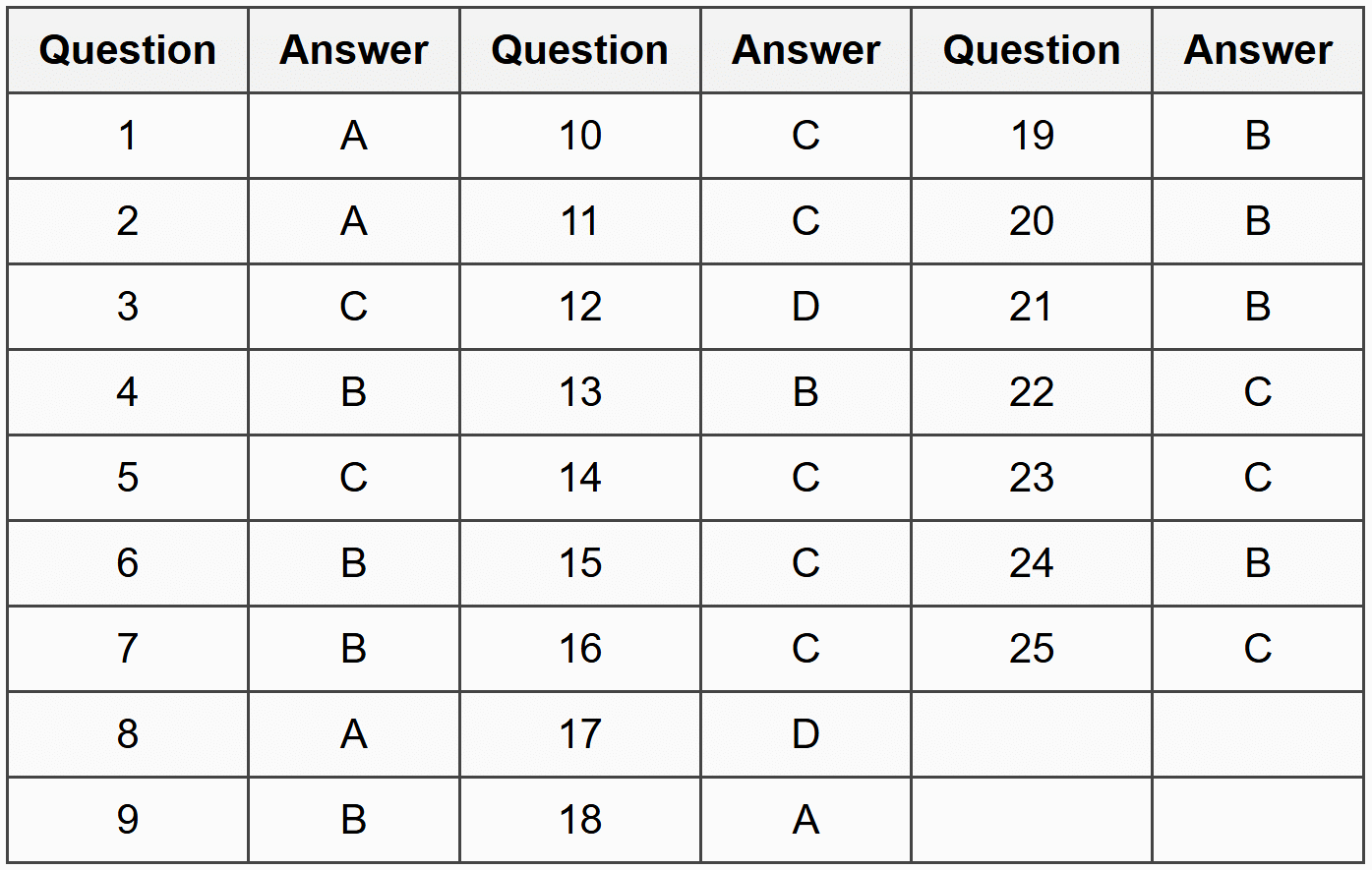
Detailed Explanations
Q1: Ans: A
Explanation: Following the order of operations (PEMDAS), multiplication must be performed before addition. First calculate \(12 \times 3 = 36\). Then add: \(8 + 36 = 44\).
Why other answers are wrong:
(B) 60 results from adding first: \(8 + 12 = 20\), then \(20 \times 3 = 60\) - this violates the order of operations.
(C) 36 results from forgetting to add the 8 after multiplying.
(D) 52 results from an arithmetic error in the final addition.
HSPT Tip: Always remember PEMDAS. When you see mixed operations without parentheses, handle multiplication and division first, then addition and subtraction from left to right.
Q2: Ans: A
Explanation: To find \(\frac{3}{8}\) of 64, multiply: \(\frac{3}{8} \times 64 = \frac{3 \times 64}{8} = \frac{192}{8} = 24\). Alternatively, find \(\frac{1}{8}\) of 64 first: \(64 \div 8 = 8\), then multiply by 3: \(8 \times 3 = 24\).
Why other answers are wrong:
(B) 16 results from calculating \(\frac{1}{4}\) of 64 instead of \(\frac{3}{8}\).
(C) 32 results from calculating \(\frac{1}{2}\) of 64.
(D) 21 results from an arithmetic error in multiplication or division.
HSPT Tip: When finding a fraction "of" a number, always multiply. Simplify before multiplying when possible to make calculations easier.
Q3: Ans: C
Explanation: \(5^3\) means \(5 \times 5 \times 5\). First: \(5 \times 5 = 25\). Then: \(25 \times 5 = 125\).
Why other answers are wrong:
(A) 15 results from multiplying \(5 \times 3\) instead of raising to the power of 3.
(B) 25 results from calculating \(5^2\) instead of \(5^3\).
(D) 75 results from an arithmetic error or confusion with the exponent.
HSPT Tip: Don't confuse exponents with multiplication. The exponent tells you how many times to use the base as a factor, not what to multiply the base by.
Q4: Ans: B
Explanation: Perimeter of a rectangle is \(2 \times \text{length} + 2 \times \text{width}\), or \(2(l + w)\). Using the formula: \(2(9 + 5) = 2(14) = 28\) inches.
Why other answers are wrong:
(A) 14 results from adding length and width once: \(9 + 5 = 14\), forgetting to account for all four sides.
(C) 45 results from calculating the area (\(9 \times 5 = 45\)) instead of the perimeter.
(D) 18 results from doubling only one dimension.
HSPT Tip: Remember that perimeter means going around the entire shape. For rectangles, you need to count both lengths and both widths, so double the sum.
Q5: Ans: C
Explanation: The absolute value of a number is its distance from zero, which is always positive or zero. Therefore, \(|-12| = 12\).
Why other answers are wrong:
(A) -12 results from not understanding that absolute value removes the negative sign.
(B) 0 might come from confusing absolute value with some other operation.
(D) 24 results from doubling instead of taking the absolute value.
HSPT Tip: Absolute value bars make any number inside positive. Think of it as the distance from zero on a number line - distance is never negative.
Q6: Ans: B
Explanation: To convert 0.75 to a fraction, write it as \(\frac{75}{100}\). Simplify by dividing both numerator and denominator by their greatest common factor, 25: \(\frac{75 \div 25}{100 \div 25} = \frac{3}{4}\).
Why other answers are wrong:
(A) \(\frac{2}{3}\) equals approximately 0.667, not 0.75.
(C) \(\frac{7}{10}\) equals 0.7, not 0.75.
(D) \(\frac{4}{5}\) equals 0.8, not 0.75.
HSPT Tip: Recognize common decimal-fraction equivalents: 0.5 = 1/2, 0.25 = 1/4, 0.75 = 3/4. This saves time on the test.
Q7: Ans: B
Explanation: Divide the total pencils needed by the number per pack: \(156 \div 12 = 13\). Since this divides evenly, the teacher needs exactly 13 packs.
Why other answers are wrong:
(A) 12 is not enough - \(12 \times 12 = 144\), which is less than 156.
(C) 14 results from rounding up when not needed, or from a calculation error.
(D) 15 is too many packs for the requirement.
HSPT Tip: For "how many packs/boxes/groups" problems, divide and check if you need to round up. If there's a remainder, you usually need one more. Here, there's no remainder.
Q8: Ans: A
Explanation: Start with \(-8°\)F and add 15 degrees: \(-8 + 15 = 7°\)F. When adding a positive number to a negative number, you move to the right on the number line.
Why other answers are wrong:
(B) 23°F results from adding \(8 + 15\), ignoring the negative sign.
(C) -23°F results from subtracting instead of adding: \(-8 - 15 = -23\).
(D) -7°F results from adding only 1 degree or a miscalculation with signs.
HSPT Tip: "Rose" means add (temperature increased). Think of a number line: starting at -8, moving 15 units to the right lands you at 7.
Q9: Ans: B
Explanation: The sum of angles in any triangle is 180°. Add the two given angles: \(45° + 65° = 110°\). Subtract from 180°: \(180° - 110° = 70°\).
Why other answers are wrong:
(A) 60° results from subtracting incorrectly or averaging the given angles.
(C) 80° might result from arithmetic error in the subtraction.
(D) 110° is the sum of the two given angles, not the third angle.
HSPT Tip: Always remember that triangle angles sum to 180°. Add what you know, then subtract from 180° to find the missing angle.
Q10: Ans: C
Explanation: Multiply the number of notebooks by the price per notebook: \(4 \times \$2.75 = \$11.00\). Calculate as \(4 \times 2 = 8\) and \(4 \times 0.75 = 3\), then \(8 + 3 = 11\).
Why other answers are wrong:
(A) $8.00 results from multiplying \(4 \times 2\) and forgetting the 75 cents.
(B) $10.00 results from rounding $2.75 incorrectly to $2.50.
(D) $11.50 results from an arithmetic error in multiplication.
HSPT Tip: When multiplying by a decimal price, break it into whole dollars and cents separately, then add. Or convert to cents: 4 × 275¢ = 1100¢ = $11.00.
Q11: Ans: C
Explanation: Find the pattern by looking at the differences between consecutive terms: \(7 - 3 = 4\), \(11 - 7 = 4\), \(15 - 11 = 4\). The pattern adds 4 each time. Therefore: \(15 + 4 = 19\).
Why other answers are wrong:
(A) 17 results from adding only 2 instead of 4.
(B) 18 results from adding 3 instead of 4.
(D) 20 results from adding 5 instead of 4.
HSPT Tip: For number sequences, always find the common difference or pattern first. Subtract consecutive terms to find what's being added (or multiplied) each time.
Q12: Ans: D
Explanation: Area of a rectangle is length × width: \(18 \times 12 = 216\) square feet. Calculate: \(18 \times 12 = 18 \times 10 + 18 \times 2 = 180 + 36 = 216\).
Why other answers are wrong:
(A) 30 results from adding the dimensions: \(18 + 12\).
(B) 60 results from calculating the perimeter: \(2(18 + 12) = 60\).
(C) 180 results from multiplying 18 × 10 and forgetting the additional 18 × 2.
HSPT Tip: Don't confuse area (multiply) with perimeter (add and double). Area is always in square units; perimeter is in linear units.
Q13: Ans: B
Explanation: To solve \(x + 9 = 23\), subtract 9 from both sides: \(x = 23 - 9 = 14\).
Why other answers are wrong:
(A) 12 results from subtracting 11 instead of 9, or an arithmetic error.
(C) 15 results from subtracting 8 instead of 9.
(D) 32 results from adding instead of subtracting: \(23 + 9 = 32\).
HSPT Tip: To isolate a variable, do the opposite operation. If 9 is added to x, subtract 9 from both sides. Always check your answer by substituting back.
Q14: Ans: C
Explanation: Set up a proportion: \(\frac{150 \text{ rotations}}{300 \text{ feet}} = \frac{x \text{ rotations}}{500 \text{ feet}}\). Cross-multiply: \(300x = 150 \times 500 = 75000\). Divide: \(x = 75000 \div 300 = 250\). Alternatively, notice that 500 feet is \(\frac{5}{3}\) of 300 feet, so rotations = \(150 \times \frac{5}{3} = 250\).
Why other answers are wrong:
(A) 200 results from incorrect proportion work or assuming simple addition.
(B) 225 results from an error in setting up or solving the proportion.
(D) 275 results from adding an extra amount incorrectly.
HSPT Tip: For proportion problems, set up the ratio carefully with matching units in the same positions. Cross-multiply and solve. Check that your answer makes sense: more distance means more rotations.
Q15: Ans: C
Explanation: If the average of five numbers is 24, then their sum is \(24 \times 5 = 120\). Add the four known numbers: \(18 + 22 + 26 + 30 = 96\). The fifth number is \(120 - 96 = 24\).
Why other answers are wrong:
(A) 20 results from incorrect calculation of the sum or difference.
(B) 22 might come from averaging the four known numbers instead of finding the fifth.
(D) 28 results from an arithmetic error in subtraction.
HSPT Tip: For average problems, remember: Sum = Average × Count. Find the total sum first, then subtract the known values to find the missing value.
Q16: Ans: C
Explanation: If the perimeter of a square is 48 cm, each side is \(48 \div 4 = 12\) cm. The area of a square is side × side: \(12 \times 12 = 144\) square centimeters.
Why other answers are wrong:
(A) 12 is the side length, not the area.
(B) 48 is the perimeter, not the area.
(D) 576 results from squaring 24 instead of 12, or from doubling the perimeter before squaring.
HSPT Tip: For squares, divide perimeter by 4 to get the side length, then square that length to get area. Don't confuse linear measurements with square measurements.
Q17: Ans: D
Explanation: First solve for x: \(3x - 7 = 20\). Add 7 to both sides: \(3x = 27\). Divide by 3: \(x = 9\). Now substitute into \(2x + 5\): \(2(9) + 5 = 18 + 5 = 23\).
Why other answers are wrong:
(A) 18 results from calculating only \(2x\) and forgetting to add 5.
(B) 19 results from using x = 7 instead of x = 9.
(C) 21 results from using x = 8 or making an arithmetic error.
HSPT Tip: Solve for the variable first, then substitute that value into the expression asked for. Work step-by-step and don't try to shortcut unfamiliar expressions.
Q18: Ans: A
Explanation: Total marbles: \(45 + 75 = 120\). The fraction that are red: \(\frac{45}{120}\). Simplify by dividing both by 15: \(\frac{45 \div 15}{120 \div 15} = \frac{3}{8}\).
Why other answers are wrong:
(B) \(\frac{3}{5}\) results from using only the ratio of red to blue (45:75 = 3:5) instead of red to total.
(C) \(\frac{5}{8}\) is the fraction of blue marbles, not red.
(D) \(\frac{2}{3}\) results from an error in simplification or calculation.
HSPT Tip: For "what fraction" problems, make sure you use the correct denominator. "Fraction of the marbles" means part over total, not part over part.
Q19: Ans: B
Explanation: If the price was reduced by 20%, then $64 represents 80% of the original price. Set up the equation: \(0.80 \times \text{original} = 64\). Divide both sides by 0.80: \(\text{original} = 64 \div 0.80 = 80\). The original price was $80.
Why other answers are wrong:
(A) $76.80 results from adding 20% of 64 to 64: \(64 + 12.80 = 76.80\), which is incorrect logic.
(C) $84 results from incorrectly calculating the discount.
(D) $128 results from thinking 64 is 50% of the original, not 80%.
HSPT Tip: When a price is reduced by a percent, the sale price represents what's left (100% - discount%). Set up: (what's left%) × original = sale price.
Q20: Ans: B
Explanation: The operation \(a \star b = 2a + 3b\) is defined. Substitute \(a = 5\) and \(b = 4\): \(5 \star 4 = 2(5) + 3(4) = 10 + 12 = 22\).
Why other answers are wrong:
(A) 20 results from calculating \(2(5) + 2(4)\) instead of \(2(5) + 3(4)\).
(C) 23 results from an arithmetic error in addition.
(D) 26 results from calculating \(3(5) + 2(4)\), reversing the coefficients.
HSPT Tip: For defined operations (symbols like ★), carefully substitute the given values into the definition exactly as shown. Don't assume familiar operation rules apply.
Q21: Ans: B
Explanation: Work backwards. If subtracting 15 gives 37, then before subtraction the result was \(37 + 15 = 52\). If multiplying by 4 gives 52, then the original number was \(52 \div 4 = 13\). To verify: \(13 \times 4 = 52\), and \(52 - 15 = 37\) ✓.
Why other answers are wrong:
(A) 11 gives: \(11 \times 4 - 15 = 44 - 15 = 29\), not 37.
(C) 15 gives: \(15 \times 4 - 15 = 60 - 15 = 45\), not 37.
(D) 17 gives: \(17 \times 4 - 15 = 68 - 15 = 53\), not 37.
HSPT Tip: For "working backwards" problems, reverse the operations in reverse order. If the problem multiplies then subtracts, you add then divide.
Q22: Ans: C
Explanation: Let the three consecutive even integers be \(x\), \(x+2\), and \(x+4\). Their sum is 72: \(x + (x+2) + (x+4) = 72\). Simplify: \(3x + 6 = 72\). Subtract 6: \(3x = 66\). Divide: \(x = 22\). The three integers are 22, 24, and 26. The largest is 26.
Why other answers are wrong:
(A) 22 is the smallest of the three integers, not the largest.
(B) 24 is the middle integer.
(D) 28 would be the largest if we incorrectly found x = 24.
HSPT Tip: For consecutive integer problems, set up one variable and express the others in terms of it. Even integers differ by 2; odd integers also differ by 2.
Q23: Ans: C
Explanation: Volume of a rectangular box is length × width × height: \(6 \times 8 \times 10 = 480\) cubic centimeters. Calculate: \(6 \times 8 = 48\), then \(48 \times 10 = 480\).
Why other answers are wrong:
(A) 240 results from multiplying only two dimensions: \(6 \times 8 \times 5\) or similar error.
(B) 360 results from an arithmetic error in multiplication.
(D) 520 results from adding instead of multiplying one dimension, or arithmetic error.
HSPT Tip: Volume of a rectangular box (or rectangular prism) requires all three dimensions multiplied together. Remember: volume is always in cubic units.
Q24: Ans: B
Explanation: Simplify the right side first: \(\frac{12}{15} = \frac{4}{5}\). Now solve \(\frac{x}{5} = \frac{4}{5}\). Since the denominators are equal, \(x = 4\). Alternatively, cross-multiply: \(15x = 12 \times 5 = 60\), so \(x = 60 \div 15 = 4\).
Why other answers are wrong:
(A) 3 results from incorrectly reducing or solving the proportion.
(C) 9 results from using the unreduced fraction incorrectly.
(D) 20 results from multiplying instead of finding the equivalent value.
HSPT Tip: When solving proportions, either cross-multiply or simplify one side first. If denominators become equal, the numerators must be equal too.
Q25: Ans: C
Explanation: If the wholesale cost is marked up by 60%, the retail price is 160% of wholesale (100% + 60% = 160%). Set up: \(1.60 \times \text{wholesale} = 96\). Divide: \(\text{wholesale} = 96 \div 1.60 = 60\). The wholesale cost was $60.
Why other answers are wrong:
(A) $36 results from subtracting 60% of 96 from 96, which is incorrect logic.
(B) $40 results from using an incorrect percentage relationship.
(D) $64 results from subtracting a fixed $32 instead of working with the percentage.
HSPT Tip: For markup problems, retail = wholesale × (100% + markup%). To find wholesale from retail, divide retail by (1 + markup as decimal). Here: 96 ÷ 1.6 = 60.