UPSC Daily Current Affairs: 2026-03-14


GS3/Science and Technology
Alprazolam Production Bust in Andhra Pradesh
 Why in News?
The Directorate of Revenue Intelligence (DRI) has recently uncovered an illegal facility producing Alprazolam in Andhra Pradesh, highlighting the ongoing issue of drug trafficking in the region.
Key Takeaways
- Alprazolam is classified as a psychotropic substance under the Narcotics, Drugs and Psychotropic Substances (NDPS) Act of 1985.
- This drug is part of the benzodiazepines group, commonly used to treat anxiety disorders.
Additional Details
- Alprazolam: This medication functions as a tranquillizing agent, primarily utilized for treating anxiety disorders, panic disorders, and anxiety related to depression.
- Benzodiazepines: These medications are central nervous system (CNS) depressants that work by enhancing the activity of the neurotransmitter gamma-aminobutyric acid (GABA) in the brain.
- Directorate of Revenue Intelligence (DRI): Established in 1957, the DRI serves as India's apex agency for anti-smuggling intelligence and investigations, focusing on curbing drug trafficking and other illicit trades.
- Functions of DRI: The agency is responsible for detecting and preventing smuggling, including drug trafficking and commercial frauds related to international trade.
- Nodal Ministry: The DRI operates under the Central Board of Indirect Taxes & Customs (CBIC), which is part of the Ministry of Finance, Government of India.
This incident underscores the persistent challenges posed by illegal drug production and trafficking, necessitating continued vigilance and enforcement efforts. The DRI's actions are crucial in combating these issues and ensuring public safety.
GS2/Polity
SC Verdict on OBC Creamy Layer: Key Changes
 Why in News?
The Supreme Court ruled that income alone cannot determine the creamy layer among OBCs and addressed the issue of equivalence between PSU/private sector employees and government employees in this context. Those classified as part of the creamy layer are not eligible for OBC reservation benefits, and the ruling clarifies long-standing uncertainties regarding the criteria used for such classification.
Key Takeaways
- The Supreme Court clarified that salary income cannot solely classify individuals as part of the creamy layer.
- The ruling aims to ensure equality among OBC members, addressing discrimination against those employed in the private sector or PSUs.
Additional Details
- Background of the Case: The Supreme Court delivered its verdict on petitions challenging a 2004 Department of Personnel and Training (DoPT) letter interpreting creamy layer criteria under the 1993 Official Memorandum (OM) on OBC reservations.
- Issue with the 2004 Clarification: The 1993 OM excluded salary and agricultural income from the income/wealth test for determining creamy layer status. The 2004 DoPT letter included salary income of PSU and private sector employees, creating unequal treatment compared to government employees.
- Court's Observation on Equality: The Bench noted that excluding some candidates from reservation based solely on salary income creates artificial distinctions among similarly placed OBC members.
- Ruling Against Discriminatory Treatment: The Court ruled that treating children of PSU or private sector employees differently from government employees constitutes hostile discrimination, violating the constitutional guarantee of equality under Articles 14, 15, and 16.
This ruling will benefit OBC candidates appearing in upcoming examinations, potentially allowing more individuals to claim reservation benefits. It also provides relief to existing candidates in government services whose positions may be revised based on the updated interpretation of the creamy layer criteria.
GS3/Economy
Export of Assam's GI-Tagged Joha Rice
 Why in News?
Recently, India has successfully facilitated the export of 25 metric tonnes of Joha Rice, which is a Geographical Indication (GI) tagged product from Assam, to the United Kingdom and Italy. This marks a significant achievement in promoting indigenous agricultural products on an international scale.
Key Takeaways
- Joha Rice is an indigenous aromatic rice variety known for its unique fragrance and rich taste.
- It was awarded the Geographical Indication (GI) tag in 2017, enhancing its market value.
- The rice is rich in antioxidants, flavonoids, and essential fatty acids.
Additional Details
- About Joha Rice: This rice variety is indigenous to Assam and is typically grown during the Sali/Kharif season. Major varieties include Kola Joha, Keteki Joha, Bokul Joha, and Kunkuni Joha.
- Health Benefits: Joha Rice contains two essential unsaturated fatty acids, linoleic acid (omega-6) and linolenic acid (omega-3), which are vital for maintaining various physiological conditions.
- Geographical Indication (GI) Tag: The GI tag is a sign used for products that have a specific geographical origin and possess qualities due to that origin. The Geographical Indications of Goods (Registration and Protection) Act, 1999, aims to provide better protection for GI products in India. The GI tag is valid for 10 years and can be renewed thereafter.
The export of Joha Rice not only highlights the quality of Assam's agricultural products but also showcases India's efforts in promoting local specialties in the global market.
GS2/International Relations
West Asia War Raises Abandonment Risk for Indian Seafarers
 Why in News?
The ongoing conflict in West Asia has brought to light the increasing dangers faced by commercial sailors, especially Indian seafarers, as tankers and merchant ships navigating the Persian Gulf and Strait of Hormuz are subjected to attacks. Unfortunately, at least three Indian sailors have lost their lives, and experts in the shipping industry are raising alarms about rising instances of abandonment, where shipowners cease to support their crews and vessels.
Key Takeaways
- Indian seafarers, who represent about 15% of the global workforce, are the most affected by abandonment, with 1,125 cases reported in 2025.
- Abandonment occurs when shipowners fail to provide essential support, leaving crews without wages, food, medical care, or means to return home.
- The Flag of Convenience (FOC) system plays a significant role in enabling abandonment by allowing shipowners to evade strict regulations.
Additional Details
- Meaning of Seafarer Abandonment: This term describes a situation where shipowners stop their support for crew members, resulting in sailors being stranded without necessary provisions and assistance.
- Maritime Labour Convention (MLC), 2006: Defines abandonment as the failure of shipowners to fulfill their responsibilities towards crew members.
- Reasons for abandonment include rising operational costs, volatile freight rates, and geopolitical conflicts that lead shipowners to abandon their crews to cut losses.
- Impact of the West Asia Crisis: The ongoing conflict is expected to exacerbate the abandonment risk, as financial strains on shipping companies may lead to increased instances of abandonment.
- Recent incidents, such as the MV Manali case in March 2026, highlight the plight of Indian sailors stranded in conflict zones.
- Regions with Frequent Abandonment Cases: Common areas for abandonment include politically unstable maritime zones like Turkey, UAE, and the Gulf region.
The plight of Indian seafarers is compounded by factors such as the rise of rogue recruitment agents and regulatory weaknesses that allow unrealistic expectations regarding employment in the maritime sector. Organizations like the International Transport Workers' Federation (ITF) provide essential support, and Indian authorities maintain helplines to assist stranded sailors. It is crucial for seafarers to verify the legitimacy of recruitment agents and ensure their contracts are valid to prevent abandonment risks.
GS2/International Relations
The India-Canada Turnaround is About Deliverables
 Why in News?
The visit of Canadian Prime Minister Mark Carney to India represents a pivotal moment in enhancing bilateral relations, particularly following the tensions experienced during Justin Trudeau's administration. This visit emphasized practical outcomes rather than revisiting contentious historical issues, marking a significant shift towards pragmatic diplomacy.
Key Takeaways
- Renewed focus on economic cooperation and critical minerals.
- Development of energy partnerships and strategic diplomacy.
- At least eight agreements signed during Carney's visit.
Additional Details
- Economic Engagement: The renewed engagement arises amidst global geopolitical and economic disruptions, including U.S. pressures regarding supply chains and evolving tariffs. Both countries aim to foster stability and growth while recognizing the need to diversify trade and energy sources.
- Key Agreements: Significant agreements included the Comprehensive Economic Partnership Agreement (CEPA) and a memorandum of understanding under the Australia-Canada-India Technology and Innovation Partnership, aimed at enhancing technological collaboration.
- Critical Minerals: The agreements include a commercial contract for uranium ore supply and an MoU on critical minerals cooperation, crucial for advanced technologies and clean energy systems.
- Energy Cooperation: India's growing energy demand and Canada's resource wealth create opportunities for collaboration, particularly in nuclear energy, aimed at achieving sustainable development goals.
In conclusion, the reset in India-Canada relations signifies a shift towards pragmatic, deliverable-driven cooperation across multiple sectors, including trade, energy, and technology, which is vital for strengthening strategic resilience amidst evolving global challenges.
GS3/Economy
The Fate of the Washington Consensus, Once Talisman
 Why in News?
The Washington Consensus emerged as a dominant framework for economic reform in developing countries during the late twentieth century. Coined by John Williamson in 1989, it comprised ten policy prescriptions endorsed by institutions in Washington as solutions to economic crises, focusing on fiscal discipline, market liberalisation, privatisation, and deregulation. Today, its reputation has shifted from a universal model to a historically specific framework that continues to influence discussions on development and global economic governance.
Key Takeaways
- The Washington Consensus was established during debt crises in Latin America and promoted by institutions like the IMF and World Bank.
- It included ten key policy prescriptions aimed at restoring macroeconomic stability and fostering market-driven growth.
- The Consensus faced significant critiques regarding its rejection of industrial policy and the social consequences of its implementation.
- A post-Washington consensus is emerging, emphasizing the importance of institutional strength and targeted public investments.
Additional Details
- Origins: The Washington Consensus arose during economic turmoil in Latin America, with international institutions advocating for reforms to restore stability.
- Core Principles:The ten policy prescriptions included:
- Fiscal discipline
- Reordering public expenditure
- Tax reform and interest rate liberalisation
- Competitive exchange rates
- Trade liberalisation
- Foreign direct investment liberalisation
- Privatisation of state enterprises
- Deregulation
- Secure property rights
- Critiques: Criticism arose due to the Consensus's lack of support for industrial policy, which limited developing countries' ability to nurture strategic sectors.
- Structural adjustment policies led to social challenges, including weakened public services and increased inequality.
- Political Backlash: By the late 1990s, dissatisfaction grew, culminating in protests against globalisation and the policies of international financial institutions.
- Post-Washington Consensus: The 21st century sees a shift toward recognizing that markets alone cannot guarantee inclusive development, emphasizing the role of government intervention and strategic investment.
In conclusion, while the Washington Consensus once represented a universal approach to development, its limitations have become apparent over time. The rise of a more pragmatic and context-sensitive economic governance approach reflects a growing awareness of the need for diverse strategies tailored to specific national circumstances.
GS3/Economy
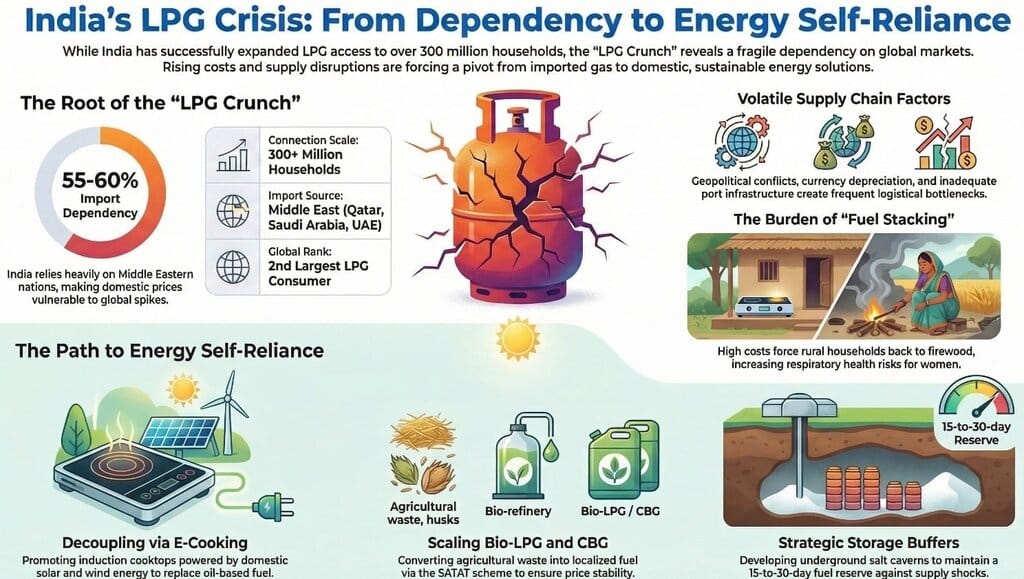
LPG Cylinder - Energy Access, Social Justice and Global Geopolitics
 Why in News?
The Liquefied Petroleum Gas (LPG) cylinder and pressure cooker have emerged as vital elements of modern domestic life in India since the mid-20th century. Access to LPG signifies not only technological advancement and household welfare but also reflects broader social dynamics, including class mobility, gender roles, and public policy. Government initiatives like the Pradhan Mantri Ujjwala Yojana (PMUY) aim to enhance access to clean cooking fuel. However, global geopolitical dynamics, especially tensions in West Asia and disruptions around the Strait of Hormuz, continue to influence LPG supply and affordability in India.
Key Takeaways
- LPG cylinders symbolize modernity and class mobility in Indian society.
- Government initiatives like PMUY work towards providing clean cooking fuel to marginalized communities.
- India's heavy dependence on imported LPG exposes it to geopolitical risks and supply disruptions.
Additional Details
- LPG cylinder as a marker of modernity: Since the 1950s, LPG cylinders have represented economic progress and urban aspirations, often highlighting contrasts with traditional wood-burning stoves that symbolize poverty.
- Welfare implications: PMUY launched in 2016 aims to reduce indoor air pollution and improve women's health by providing connections to clean cooking fuel, enhancing both health and dignity.
- Geopolitical risks: Approximately 90% of India's LPG imports pass through the Strait of Hormuz, making it vulnerable to conflicts in West Asia, which can lead to supply shortages and price volatility.
- Social dimensions: Access to LPG is uneven, with significant disparities based on class and caste. Upper-caste households have higher adoption rates, while marginalized communities face barriers in accessing distribution networks.
- Gender implications: Women are disproportionately burdened by traditional biomass fuel use, facing health risks while often having limited say in household fuel decisions.
- Challenges and solutions: India's reliance on LPG imports necessitates diversification of energy sources and improved infrastructure, especially in remote areas, to ensure equitable access.
The LPG cylinder represents more than a household utility; it symbolizes public health, gender justice, and social mobility in India. While programs like PMUY have made strides in expanding access to clean cooking fuel, structural inequalities and geopolitical vulnerabilities must be addressed to ensure reliable and affordable energy access for all.
GS2/Polity
Menstrual Leave Debate in India
 Why in News?
The recent observations by the Supreme Court regarding the potential implications of mandatory paid menstrual leave have sparked significant debate. The Court noted that such a law might unintentionally hinder women's career advancement and limit their job opportunities.
Key Takeaways
- The Supreme Court discussed the potential negative consequences of mandatory menstrual leave.
- Menstrual leave is currently not mandated by national law in India, but various institutions have introduced their own policies.
- Global practices on menstrual leave vary significantly, with some countries having established formal policies.
Additional Details
- Menstrual Leave: This refers to the leave allotted to women during their menstrual cycle, often due to severe discomfort, such as cramps. It has become a focal point in discussions surrounding gender equality and labor rights.
- In India, while there is no nationwide law, some educational institutions and private companies have adopted menstrual leave policies, reflecting a growing awareness of menstrual health issues.
- Several countries, including Spain, which introduced a law in 2023 allowing 3-5 days of menstrual leave, and Japan, which has had such legislation since 1947, demonstrate varying international approaches to this topic.
- The Supreme Court's observations pointed out that mandatory menstrual leave could affect hiring practices and career progression for women, as employers might perceive them as less reliable.
- The Court emphasized the distinction between voluntary policies that support women in the workforce and the implications of legal mandates that could inadvertently reinforce gender stereotypes.
In conclusion, the ongoing debate on menstrual leave underscores broader issues of gender equality in the workplace. Policymakers are challenged to create a balance between addressing health concerns and ensuring equitable employment opportunities for women.
FAQs on UPSC Daily Current Affairs: 2026-03-14
| 1. What led to the alprazolam production bust in Andhra Pradesh? |  |
| 2. What are the implications of the Supreme Court's verdict on the OBC creamy layer? | |
| 3. Why is Assam's GI-tagged Joha rice important for exports? | |
| 4. How does the West Asia conflict raise abandonment risks for Indian seafarers? | |
| 5. What factors are essential for a successful turnaround in India-Canada relations? | |




