The Science of Sound


1. What Is Sound?
Let's start with something you experience every moment: the world around you is constantly vibrating. When you pluck a guitar string, tap a drum, or sing a note, you're creating vibrations that travel through the air to your ears. That's what sound is-vibrations moving through a medium, usually air.
Think about the last time you felt the bass thump in your chest at a concert or heard the rumble of thunder. That physical sensation is sound energy traveling through the air and even through your body. Sound is fundamentally about energy in motion.
How Sound Travels
When something vibrates-let's say the cone of a speaker-it pushes air molecules near it. These molecules bump into the molecules next to them, which bump into the next ones, and so on. This creates a compression wave that spreads outward in all directions, like ripples on a pond when you drop a stone.
Here's what you need to picture: sound doesn't move air from one place to another permanently. Instead, air molecules vibrate back and forth around their original position, passing energy along. It's like doing "the wave" at a stadium-each person stays in their seat, but the wave travels around the arena.
Try this: place your hand gently on your throat while you hum. You're feeling the vibrations of your vocal cords. Those vibrations are pushing air molecules, creating the sound wave that travels to your own ears and to anyone listening.
Sound Needs a Medium
Sound requires something to travel through-air, water, metal, wood, but not empty space. This is why there's no sound in the vacuum of space (sorry, Star Wars explosions aren't scientifically accurate!). The denser the medium, often the faster sound travels. In air at room temperature, sound moves at about 343 meters per second (or roughly 767 miles per hour). In water, it travels about four times faster, and in steel, even faster still.
2. Frequency and Pitch
Now let's talk about what makes one sound different from another. When you press different keys on a piano, you hear different pitches-some high, some low. The scientific term for what creates pitch is frequency.
Understanding Frequency
Frequency is simply how fast something vibrates-how many complete back-and-forth movements happen in one second. We measure this in Hertz (Hz), named after physicist Heinrich Hertz. One Hertz means one vibration per second.
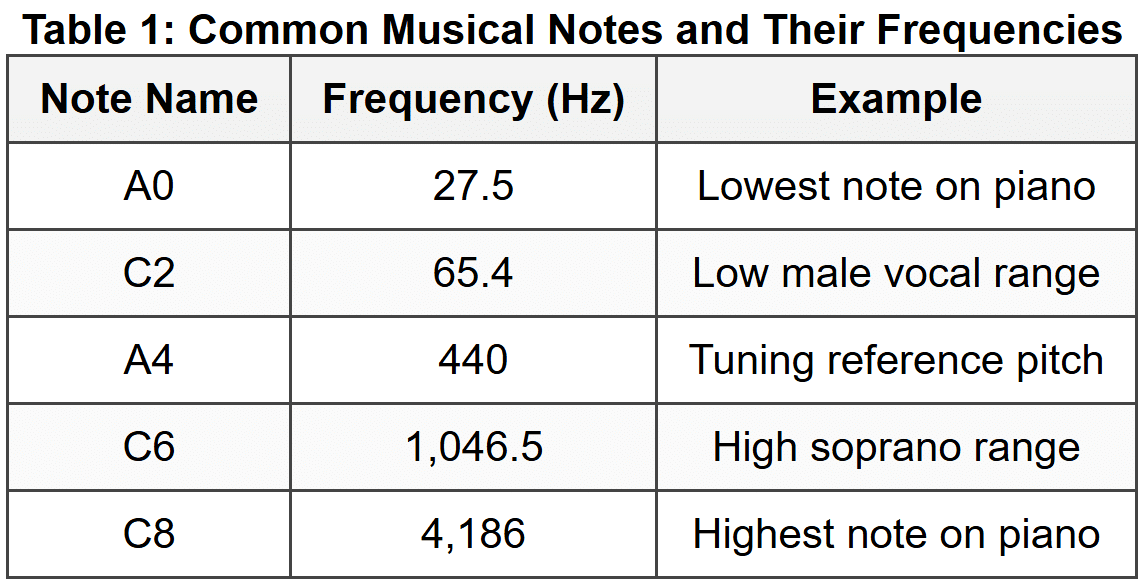
When you play the A above middle C on a piano (the note orchestras use to tune), that string vibrates exactly 440 times per second-we say it has a frequency of 440 Hz. When you play the A one octave higher, the string vibrates at 880 Hz-exactly twice as fast. Your ear perceives this doubling of frequency as an octave.
The higher the frequency, the higher the pitch you hear. The lower the frequency, the lower the pitch.
Try this if you have access to a guitar or any stringed instrument: pluck an open string and listen to the pitch. Now press down halfway along the string's length and pluck again. You've just doubled the frequency by halving the vibrating length, and you should hear a note exactly one octave higher.
The Range of Human Hearing
Healthy young human ears can typically hear frequencies from about 20 Hz to 20,000 Hz (or 20 kHz). The lowest note on a standard 88-key piano is A0 at about 27.5 Hz-a deep rumble. The highest note is C8 at about 4,186 Hz-a piercing ring. Most musical sounds fall comfortably within this range.
Sounds below 20 Hz are called infrasound-elephants use infrasound to communicate over long distances. Sounds above 20 kHz are called ultrasound-bats and dolphins use these for echolocation. As we age, we typically lose the ability to hear the highest frequencies first.
Frequency in Music
Every note you've ever heard has a specific frequency. When Freddie Mercury hits that powerful note in Queen's Bohemian Rhapsody during "For me!" near the end, he's creating a specific pattern of vibrations. When a soprano sings a high C, she's producing a frequency around 1,046 Hz. When a bass singer reaches a low E, he's vibrating his vocal cords at about 82 Hz.
3. Amplitude and Loudness
You've probably noticed that the same note can be played softly or loudly. A whisper and a shout can have the same pitch but very different volumes. This difference comes from amplitude.
What Is Amplitude?
Think back to those air molecules we discussed. When a sound wave travels, the molecules don't just vibrate-they vibrate with different amounts of energy. Amplitude is the measure of how far those molecules move from their resting position. It's the size of the vibration.
Picture a guitar string: when you pluck it gently, it moves a small distance from its rest position. Pluck it hard, and it moves much farther. That larger movement creates a wave with greater amplitude, which your ear perceives as a louder sound. Same pitch, different volume.
Measuring Loudness: Decibels
We measure sound intensity using decibels (dB). This scale is logarithmic, which means each increase of 10 dB represents a sound that's roughly twice as loud to our ears. This can be a bit counterintuitive at first.
Here's a practical reference:
- 0 dB - the threshold of human hearing (the quietest sound a healthy ear can detect)
- 30 dB - a whisper or a quiet library
- 60 dB - normal conversation
- 85 dB - city traffic; prolonged exposure can damage hearing
- 100 dB - a rock concert or a nearby motorcycle
- 120 dB - a jet engine at close range; painful and immediately dangerous
- 140 dB - gunfire or fireworks at close range; can cause instant hearing damage
Think about listening to Pink Floyd's The Dark Side of the Moon on headphones. When the cash register sounds ring out in Money, you can control the amplitude by adjusting the volume. Turn it up, and the amplitude of the sound waves hitting your eardrums increases. The frequency (pitch) of those cash register sounds stays the same-only the amplitude changes.
Dynamic Range in Music
Musicians use the term dynamics to describe variations in loudness. From pianissimo (very soft) to fortissimo (very loud), controlling amplitude is one of the most expressive tools in music. Listen to the opening of Beethoven's Symphony No. 5-those famous four notes ("da-da-da-DUM!") start at a dramatic forte (loud). The amplitude is intentionally large to grab your attention.
Try this: sing or hum a single steady note. Start very quietly and gradually increase to as loud as you comfortably can, then back down to quiet again. You've just demonstrated changing amplitude while keeping frequency constant.
4. Wavelength and the Speed of Sound
When we talk about sound traveling through the air, there's another important property to understand: wavelength. This is closely connected to both frequency and the speed of sound.
What Is Wavelength?
Imagine you could freeze a sound wave in mid-air and measure the physical distance between one compression and the next. That distance is the wavelength, usually represented by the Greek letter lambda (\(\lambda\)).
Here's the beautiful relationship: wavelength, frequency, and the speed of sound are all mathematically connected:
\[ v = f \times \lambda \]
where \(v\) is the speed of sound, \(f\) is frequency, and \(\lambda\) is wavelength.
This means that for a given speed of sound (which is fairly constant in air at a given temperature), if frequency goes up, wavelength must go down, and vice versa. High-pitched sounds have short wavelengths; low-pitched sounds have long wavelengths.
Calculating Wavelength
Let's work through an example. If we take our tuning reference A4 at 440 Hz, and we know sound travels at approximately 343 m/s in air at room temperature, we can find its wavelength:
\[ \lambda = \frac{v}{f} = \frac{343 \text{ m/s}}{440 \text{ Hz}} \approx 0.78 \text{ meters} \]
So the A above middle C has a wavelength of about 78 centimeters, or roughly 2.5 feet. Now think about a much lower note-the lowest A on a piano (A0 at 27.5 Hz):
\[ \lambda = \frac{343 \text{ m/s}}{27.5 \text{ Hz}} \approx 12.5 \text{ meters} \]
That's over 40 feet! This is why low-frequency sounds can travel around obstacles more easily and why you can hear the bass from a car stereo from far away, even when you can't hear the higher-pitched melodies.
Why This Matters in Music
Understanding wavelength helps explain many acoustic phenomena in music. It's why concert halls are designed with specific dimensions, why bass traps are large and thick, and why subwoofers need to be bigger than tweeters. Low frequencies have long wavelengths that require more space and more air movement to produce effectively.
5. Timbre: The Color of Sound
Here's a fascinating question: why does a piano playing middle C sound completely different from a trumpet playing the same note, even though they're both producing 261.6 Hz? The answer is timbre (pronounced "TAM-ber"), sometimes called tone color.
Simple Sounds vs. Complex Sounds
A pure tone-a sound with only one frequency and no other components-is quite rare in nature and music. It sounds like the test tone you might hear during a hearing exam or a simple sine wave from an electronic generator. It's smooth and somewhat bland.
Almost every musical instrument and voice produces complex sounds made up of multiple frequencies happening simultaneously. When you pluck a guitar string, it doesn't just vibrate at one frequency-it vibrates in several different ways at once, creating what we call harmonics or overtones.
The Harmonic Series
Here's how it works: when you play a note on an instrument, you create a fundamental frequency-that's the pitch you actually hear and identify. But layered on top of that fundamental are additional frequencies called harmonics, which are whole-number multiples of the fundamental.
If the fundamental is 100 Hz, the harmonics are:
- 1st harmonic (fundamental): 100 Hz
- 2nd harmonic: 200 Hz (2 × 100)
- 3rd harmonic: 300 Hz (3 × 100)
- 4th harmonic: 400 Hz (4 × 100)
- ...and so on
Every instrument produces these harmonics in different proportions and strengths. A flute emphasizes the fundamental and has relatively few strong harmonics, giving it a pure, clear sound. A saxophone has strong odd-numbered harmonics, creating a reedier, richer tone. A violin has a complex mixture that changes depending on how you bow it.
Timbre is determined by the unique combination and relative strength of harmonics present in a sound.
Recognizing Timbre
Think about the distinctive growl of Jimi Hendrix's guitar in Purple Haze versus the clean, bright tone of the acoustic guitar in Simon & Garfunkel's The Sound of Silence. Same fundamental notes in many cases, completely different timbres. Your brain has learned to recognize these harmonic "fingerprints" instantly-that's how you can identify your friend's voice on the phone within one word.
Try this: if you have access to a piano, press middle C very gently so the hammer just barely touches the string-you'll hear mostly the fundamental. Now strike it firmly-you'll hear a much richer sound with many more harmonics present. Same pitch, different timbre.
The Envelope
Timbre isn't just about which harmonics are present-it's also about how the sound develops over time. This is called the envelope, which musicians often describe in four stages:
- Attack: how quickly the sound reaches its maximum amplitude (a drum has a fast attack; a bowed string has a slower attack)
- Decay: the initial drop in volume after the attack peak
- Sustain: the steady level the sound holds at (if any)
- Release: how the sound fades away when you stop playing
A plucked guitar string has a sharp attack and a gradual decay with no sustain. A held organ note has a slower attack, no real decay, continuous sustain, and instant release when you lift your finger. These differences in envelope are crucial parts of what makes each instrument unique.
6. Resonance and Sympathetic Vibration
Have you ever been in a room when someone hit a particular note and it seemed like the whole room suddenly came alive? Or noticed that when you sing certain notes in the shower, they sound incredibly rich and full? That's resonance at work.
Understanding Resonance
Every object has a natural frequency (or several natural frequencies) at which it "wants" to vibrate. When you apply energy at that specific frequency, the object vibrates with much greater amplitude than it would at other frequencies. This is resonance.
Think of pushing a child on a swing. If you push at random times, the swing doesn't go very high. But if you time your pushes to match the swing's natural back-and-forth rhythm-its natural frequency-each push adds to the motion and the swing goes higher and higher with the same amount of effort. That's mechanical resonance.
In music, resonance is everywhere. The body of an acoustic guitar resonates when the strings vibrate, amplifying the sound and enriching it with the body's own resonant frequencies. That's why the same strings sound completely different on different guitars-each body has its own resonant characteristics.
Sympathetic Vibration
Here's a beautiful phenomenon: sympathetic vibration happens when one vibrating object causes another nearby object to start vibrating without any physical contact, simply through the air.
Try this if you have access to a piano: gently press down the sustain pedal (the right pedal) so all the strings are free to vibrate. Now sing or play a loud note near the piano strings. Stop your sound suddenly and listen carefully-you should hear the piano strings ringing at that same pitch. You've caused sympathetic vibration.
This happens because when you sing a note, the sound waves traveling through the air hit all the piano strings. Most strings don't match that frequency and don't respond much. But the string (or strings) tuned to that exact frequency-or to harmonics of that frequency-resonate and begin vibrating. It's selective resonance through the air.
Resonance in Instruments
Wind instruments like flutes and trumpets use resonance in the column of air inside them. When you blow across a flute's mouthpiece, you create turbulent air that contains many frequencies. The tube of the flute resonates at specific frequencies depending on its length and which holes are covered, amplifying those frequencies while others die away. That's how the instrument selects which pitch you hear.
The human voice works similarly-your vocal cords produce a buzzing sound with many harmonics, and the shape of your throat, mouth, and nasal cavities act as resonant chambers that amplify certain frequencies. That's why your voice sounds different when you have a cold-the resonant properties of your vocal tract have changed.
7. Interference: When Waves Meet
Sound waves don't travel in isolation. In any real listening environment, multiple sound waves are crossing paths constantly. When two or more waves meet, they interact in a phenomenon called interference.
Constructive Interference
When two waves with the same frequency are in phase-meaning their compressions and rarefactions line up-they combine to create a wave with greater amplitude. This is called constructive interference. If you and a friend sing the same note at the same time, you're creating constructive interference, making the sound louder than either of you singing alone.
Destructive Interference
When two waves are out of phase-meaning one wave's compression meets the other wave's rarefaction-they can partially or completely cancel each other out. This is destructive interference. If the waves are exactly equal in amplitude and exactly opposite in phase, they can cancel completely, creating silence. This is the principle behind noise-canceling headphones.
Think about walking around a room while two speakers play the same pure tone. You'll notice spots where the sound seems louder (constructive interference) and spots where it nearly disappears (destructive interference). The waves are reaching your ears with different phase relationships depending on where you stand.
Beats: A Special Case
When two frequencies that are slightly different-say, 440 Hz and 442 Hz-sound together, you hear a pulsing effect called beats. The two waves drift in and out of phase with each other repeatedly, creating alternating constructive and destructive interference. You hear this as a wavering or "wah-wah-wah" sound.
The beat frequency is simply the difference between the two frequencies. In our example, you'd hear 2 beats per second (442 Hz - 440 Hz = 2 Hz).
Musicians use beats when tuning instruments. If you're tuning two guitar strings to the same note and you hear beats, you know they're slightly out of tune. As you adjust the tuning and the frequencies get closer, the beats slow down. When the beats disappear completely, the strings are perfectly in tune.
Beat frequency = |f₁ - f₂|
Try this: if you have access to a piano or keyboard, play two notes that are right next to each other-for example, C and C♯. You'll hear beats very clearly because these notes are close in frequency. Now play C and E (a third apart)-the beats are much faster and blend into the overall sound.
8. Reflection, Absorption, and Diffusion
Every time you listen to music in a room, you're not just hearing the direct sound from the instrument or speaker-you're hearing sound that has bounced off walls, been absorbed by curtains, and scattered by furniture. Understanding how sound interacts with surfaces is crucial to understanding how we actually experience music.
Reflection
When a sound wave hits a hard, smooth surface like a wall or floor, it bounces back, just like light bouncing off a mirror. This is reflection. The angle at which the sound hits the surface equals the angle at which it bounces away (the angle of incidence equals the angle of reflection).
Reflections are what create echo when they're delayed enough that you hear them as separate sounds. Clap your hands in an empty gymnasium and you'll hear multiple reflections bouncing back to you. The same clap in a carpeted, furnished living room produces barely any echo because the sound is absorbed before it can reflect much.
In concert halls, controlled reflections are essential. Early reflections (those that reach your ears within about 50 milliseconds of the direct sound) make music sound fuller and richer. They help musicians hear themselves and each other. Think about singing in the shower-the hard surfaces create many reflections that blend with your voice, making it sound richer and more resonant.
Absorption
Soft, porous materials like curtains, carpets, acoustic foam, and even people absorb sound energy, converting it into tiny amounts of heat. When sound hits these materials, the wave causes the material's fibers to vibrate, and friction turns that vibration energy into heat.
Different materials absorb different frequencies with varying effectiveness. Thick, soft materials generally absorb high frequencies very well-this is why a room with lots of fabric sounds "dead" or "dry." Low frequencies with their long wavelengths require much thicker materials or specialized bass traps to absorb effectively.
Recording studios use absorption strategically. Too much absorption makes recordings sound lifeless; too little creates muddy reflections. The balance is crucial for capturing clear sound.
Diffusion
When sound hits an irregular or complex surface, it scatters in many directions. This is diffusion. Bookshelves, textured walls, and specially designed acoustic panels all diffuse sound. Diffusion is different from absorption-the sound energy isn't removed, just scattered.
Good diffusion prevents harsh reflections without deadening the room. Many modern concert halls incorporate diffusive surfaces to create even sound distribution. When you're in a great-sounding venue, you're experiencing carefully designed combinations of reflection, absorption, and diffusion.
Standing Waves and Room Modes
In enclosed spaces, reflected waves can interfere with themselves in particular patterns called standing waves or room modes. When the dimensions of a room are such that a particular frequency's wavelength fits perfectly between walls (or fits multiple times), that frequency can build up through constructive interference, becoming unnaturally loud.
This is why small rooms often have problems with bass frequencies-certain low notes boom out while others seem weak. Producers and engineers spend considerable time treating studios to minimize these problems.
9. The Doppler Effect
Have you ever noticed how an ambulance siren sounds higher-pitched as it approaches you and lower-pitched as it moves away? This phenomenon is called the Doppler effect, and it demonstrates an important principle about frequency and relative motion.
How the Doppler Effect Works
When a sound source moves toward you, it's essentially "chasing" its own sound waves. Each new wave is emitted from a position slightly closer to you than the previous one, so the waves get compressed together. This compression means more waves reach your ear per second-a higher frequency, or higher pitch.
When the source moves away, the opposite happens. Each new wave starts from a position slightly farther away, so the waves are stretched out. Fewer waves reach your ear per second-a lower frequency, or lower pitch.
The actual frequency of the siren itself hasn't changed at all. The Doppler effect is purely about relative motion between the source and the observer affecting how frequently waves arrive at your ear.
The Doppler Effect in Music
While the Doppler effect isn't typically part of everyday music-making, some composers have used it creatively. Karlheinz Stockhausen's Helicopter String Quartet places musicians in flying helicopters, deliberately using the Doppler effect as part of the composition.
The Doppler effect also explains subtle pitch variations when musicians move while performing. If a vocalist moves their head toward and away from a microphone quickly, the pitch captured can waver slightly-usually too subtle to notice consciously, but it's there.
The Mathematics
The observed frequency (\(f_{\text{observed}}\)) depends on the source frequency (\(f_{\text{source}}\)), the speed of sound (\(v\)), the speed of the observer (\(v_{\text{observer}}\)), and the speed of the source (\(v_{\text{source}}\)):
\[ f_{\text{observed}} = f_{\text{source}} \times \frac{v + v_{\text{observer}}}{v - v_{\text{source}}} \]
When the source moves toward you, \(v_{\text{source}}\) is positive, making the denominator smaller and the observed frequency higher. When moving away, \(v_{\text{source}}\) is negative, increasing the denominator and lowering the observed frequency.
10. Sound in Different Environments
The same piece of music sounds remarkably different depending on where you hear it. A symphony in a concert hall, a rock band in a small club, and headphones deliver vastly different listening experiences, even when playing identical recordings. Let's explore why environment matters so much.
Concert Halls and Reverberation
Reverberation (or "reverb") is the persistence of sound after the source stops, created by thousands of reflections blending together in an enclosed space. Unlike echo, where you can hear distinct repetitions, reverb is a smooth wash of reflected sound.
Great concert halls like Vienna's Musikverein or Boston's Symphony Hall are celebrated for their reverb characteristics. The reverberation time-how long it takes for a sound to decay by 60 decibels-is carefully designed. For orchestral music, ideal reverb times are typically 1.8 to 2.2 seconds. This creates a sense of warmth and spaciousness that makes music feel alive.
Too much reverb makes fast passages muddy and unclear. Too little makes music sound dry and clinical. Different music styles require different reverb characteristics-a jazz club benefits from minimal reverb so you can hear intricate rhythms clearly, while a cathedral's long reverb (often 5-10 seconds) makes Gregorian chant sound heavenly.
Outdoor Sound
Outdoors, sound behaves very differently. Without walls to reflect sound back, it spreads out freely and dissipates quickly. This is why outdoor concerts need powerful amplification systems-the sound keeps traveling away rather than building up through reflections.
The inverse square law governs sound outdoors: when you double your distance from a sound source, the sound level drops by approximately 6 dB. Move from 10 meters to 20 meters away from a stage, and the sound is roughly one-quarter as intense.
Weather affects outdoor sound dramatically. Temperature gradients can bend sound waves, making sound carry farther at night when the ground is cooler than the air above. Wind can push sound waves, making sources upwind harder to hear and downwind sources louder.
Recording Studios
Recording studios aim to control the acoustic environment completely. They typically have short reverberation times and carefully treated surfaces to prevent unwanted reflections and resonances. The goal is to capture "dry" sound that producers can then enhance with artificial reverb and effects during mixing.
Many famous recordings have distinctive acoustic signatures. The drum sound on Led Zeppelin's When the Levee Breaks was recorded in a large stairwell at Headley Grange, using the natural reverb of the space. The Beach Boys' Pet Sounds used creative microphone placement and room acoustics to create intimate, warm recordings.
Headphones and Earbuds
When you listen through headphones, sound travels directly from tiny speakers into your ear canal with almost no interaction with the environment. This creates an unusual listening experience-the sound seems to come from inside your head rather than from sources in the space around you.
This is why many recordings intended for headphone listening use binaural recording techniques or spatial audio processing to simulate the way we naturally hear sound in three-dimensional space. Your brain expects certain subtle cues about sound direction and distance; artificial creation of these cues makes headphone listening feel more natural.
Key Terms
- Absorption
- The process by which sound energy is converted to heat when sound waves encounter soft, porous materials, reducing the sound's intensity.
- Amplitude
- The maximum displacement of air molecules from their rest position in a sound wave; the physical property that determines the loudness of a sound.
- Beat Frequency
- The pulsing or wavering effect heard when two sounds of slightly different frequencies are played simultaneously; the beat frequency equals the difference between the two frequencies.
- Compression Wave
- A wave in which particles of the medium move back and forth parallel to the direction the wave travels, creating alternating regions of compression and rarefaction; sound travels as compression waves.
- Constructive Interference
- The interaction of two waves that are in phase, resulting in a combined wave with greater amplitude than either individual wave.
- Decibel (dB)
- A logarithmic unit used to measure sound intensity or loudness, where an increase of 10 dB represents approximately twice the perceived loudness.
- Destructive Interference
- The interaction of two waves that are out of phase, resulting in a combined wave with reduced amplitude or complete cancellation.
- Diffusion
- The scattering of sound waves in many directions when they encounter irregular or complex surfaces, distributing acoustic energy more evenly throughout a space.
- Doppler Effect
- The change in perceived frequency of a sound when there is relative motion between the sound source and the observer, causing higher pitch when approaching and lower pitch when receding.
- Dynamics
- Variations in the loudness of musical sounds, ranging from very soft (pianissimo) to very loud (fortissimo).
- Envelope
- The shape of a sound's amplitude over time, typically described in four stages: attack, decay, sustain, and release (ADSR).
- Frequency
- The number of complete vibrations or cycles per second in a sound wave, measured in Hertz (Hz); frequency determines the pitch of a sound.
- Fundamental Frequency
- The lowest frequency in a complex sound, typically perceived as the main pitch of a musical note.
- Harmonics
- Frequencies that are whole-number multiples of the fundamental frequency, present in complex musical sounds and contributing to timbre.
- Hertz (Hz)
- The unit of measurement for frequency, representing one complete vibration or cycle per second.
- Infrasound
- Sound frequencies below 20 Hz, below the range of normal human hearing.
- Interference
- The phenomenon that occurs when two or more sound waves meet and combine, resulting in constructive or destructive effects.
- Inverse Square Law
- The principle that sound intensity decreases proportionally to the square of the distance from the source; doubling the distance reduces intensity to one-quarter.
- Pitch
- The perceived highness or lowness of a sound, determined primarily by its frequency.
- Pure Tone
- A sound consisting of a single frequency with no harmonics; represented by a sine wave and rarely found in natural or musical sounds.
- Reflection
- The bouncing of sound waves off a surface, with the angle of incidence equal to the angle of reflection.
- Resonance
- The phenomenon in which an object vibrates with increased amplitude at its natural frequency in response to external vibrations at that same frequency.
- Reverberation
- The persistence of sound in an enclosed space due to multiple reflections from surfaces, creating a smooth decay of sound after the source stops.
- Standing Wave
- A wave pattern that appears stationary, created by the interference of waves traveling in opposite directions; can cause certain frequencies to become unnaturally loud in enclosed spaces.
- Sympathetic Vibration
- The vibration of an object caused by sound waves from another vibrating source, occurring when frequencies match or are harmonically related.
- Timbre
- The characteristic quality or "color" of a sound that distinguishes different instruments or voices producing the same pitch and loudness, determined by the unique combination of harmonics and envelope.
- Ultrasound
- Sound frequencies above 20,000 Hz (20 kHz), above the range of normal human hearing.
- Wavelength
- The physical distance between two consecutive compressions or rarefactions in a sound wave, inversely related to frequency.
FAQs on The Science of Sound
| 1. What is sound? |  |
| 2. How are frequency and pitch related? | |
| 3. What is the difference between amplitude and loudness? | |
| 4. What is timbre, and why is it important in music? | |
| 5. What is the Doppler Effect? | |