Introduction to Musical Notation


1. Why We Write Music Down
Think about the last time someone shared a recipe with you. They probably didn't just describe it in vague terms-they wrote down specific measurements, temperatures, and steps so you could recreate the dish exactly. Music notation works the same way. It's a system that allows musicians to capture sound on paper so that others can recreate it, sometimes centuries later.
Before notation existed, music could only be passed down by memory and imitation. Imagine trying to teach someone Beethoven's Symphony No. 5 just by humming it-you'd lose the details pretty quickly! Notation solves this problem by giving us a visual language for sound.
When you look at a page of music, you're seeing three fundamental pieces of information:
- Pitch: how high or low the notes are
- Duration: how long each note lasts
- Expression: how loud, soft, fast, or slow to play
Let's break down each of these elements and learn how musicians have been communicating sound for over a thousand years.
2. The Staff: Your Musical Canvas
Picture a ladder lying on its side. That's essentially what a staff (or stave) looks like-five horizontal lines with four spaces between them. Every note you write sits either on a line or in a space, and the position tells you which pitch to play.
Here's what you need to know: the higher up on the staff a note sits, the higher the pitch sounds. The lower down, the lower the pitch. It's that simple and that logical.
Try this: sing "Happy Birthday" to yourself. Notice how your voice goes up on "hap-py BIRTH-day" and comes back down on "to you"? If you wrote that melody on a staff, you'd see the notes climb up for "birthday" and descend for "to you." The staff gives you a visual map of melodic movement.
2.1 The Clef: Setting Your Reference Point
Here's the challenge: a staff by itself doesn't tell you which actual pitches those lines and spaces represent. You could be looking at high notes, low notes, or something in between. That's where the clef comes in-it's a symbol placed at the beginning of the staff that assigns specific note names to the lines and spaces.
The two most common clefs you'll encounter are:
- Treble clef (or G clef): Used for higher-pitched instruments and voices like flute, violin, trumpet, and soprano singers. The curly symbol wraps around the second line from the bottom, which represents the note G above middle C.
- Bass clef (or F clef): Used for lower-pitched instruments and voices like cello, bassoon, trombone, and bass singers. The two dots sit on either side of the fourth line from the bottom, which represents the note F below middle C.
When you play piano, you use both clefs simultaneously-the right hand typically reads treble clef, while the left hand reads bass clef. This is why piano music looks like it has two ladders stacked on top of each other, connected by a bracket.
3. Note Names and the Musical Alphabet
Music uses only seven letter names: A, B, C, D, E, F, and G. That's it. After G, the pattern repeats: A, B, C, D, E, F, G, A, B, C, and so on, going higher and higher in pitch. Similarly, it works backward going lower: G, F, E, D, C, B, A, G, F, E, and downward.
This is beautifully simple compared to spoken language, which has 26 letters to remember. The musical alphabet keeps cycling through these same seven letters, creating a spiral of pitches that extends in both directions.
3.1 Reading Notes in Treble Clef
In treble clef, musicians use memory tricks to learn which notes sit on the lines and spaces. Let's start with the lines from bottom to top:
E - G - B - D - F
Many students remember this with the phrase "Every Good Boy Deserves Fruit" (or any variation you prefer).
The spaces spell out a word you already know:
F - A - C - E
That's right-the spaces spell "FACE" from bottom to top. Simple to remember!
3.2 Reading Notes in Bass Clef
Bass clef uses different note positions. The lines from bottom to top are:
G - B - D - F - A
One common memory phrase: "Good Boys Do Fine Always."
The spaces spell out:
A - C - E - G
You can remember this with "All Cows Eat Grass."
When you first learn to read music, you might need to count up or down from a note you know. That's completely normal. With practice, you'll recognize notes instantly, the same way you recognize letters in words without sounding them out.
4. Ledger Lines: Extending Your Range
What happens when you need to write a note that's higher or lower than the staff can show? You can't just keep adding lines forever-the page would become impossible to read.
The solution is ledger lines-short horizontal lines that extend the staff temporarily, just for the notes that need them. Think of them as little extensions you add only when necessary.
One of the most important notes using a ledger line is middle C, which sits on one ledger line below the treble clef staff and one ledger line above the bass clef staff. This note is called "middle" C because it's roughly in the middle of a piano keyboard and serves as a meeting point between the two clefs.
When you see sheet music for piano, middle C is the bridge between what your left and right hands play. The opening of Beethoven's Für Elise features this note prominently-it's that repeated E that quickly drops down to D-sharp and back, hovering around middle C territory.
5. Note Values: Organizing Time
Pitch tells you which key to press or which string to pluck, but duration tells you how long to hold that sound. In music, we organize time using different note shapes, each representing a specific length of sound.
Here's the essential concept: notes are based on a system of proportional relationships. Each note value is either half or double the length of another. Let's build this system from the ground up.
5.1 The Whole Note
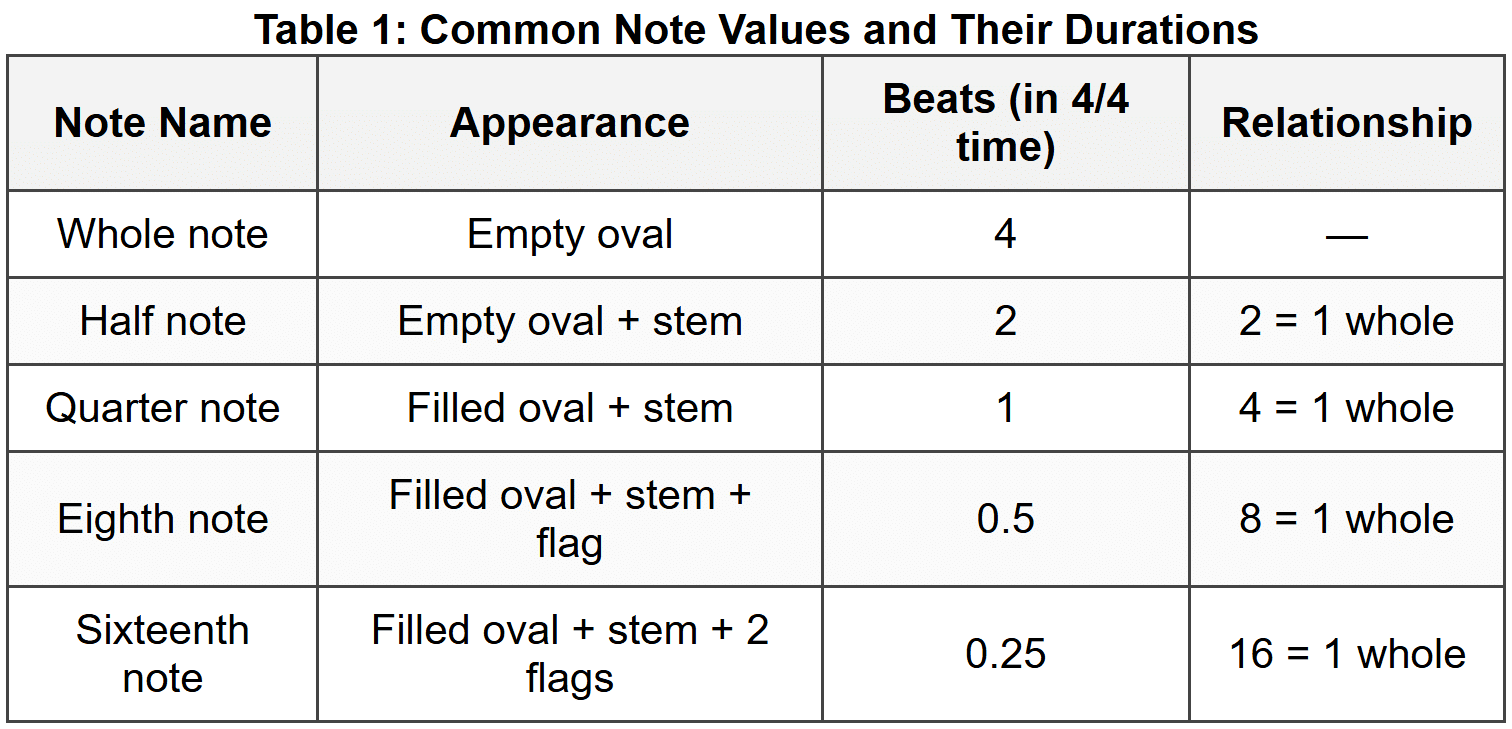
The whole note looks like an empty oval. It gets four beats in the most common meter (more on meter later). Think of it as a full measure of time-a complete breath, a long sustained sound.
If you've heard the opening chord of The Beatles' A Hard Day's Night, that's a whole note kind of moment-a sound that rings out and fills time before anything else happens.
5.2 The Half Note
A half note looks like a whole note but with a stem attached (a vertical line going up or down). As the name suggests, it lasts for half the duration of a whole note-two beats.
Two half notes equal one whole note in duration. You can fit two of them into the same amount of time as one whole note.
5.3 The Quarter Note
A quarter note has a filled-in note head (a solid oval) with a stem. It lasts for one beat-half the duration of a half note and one quarter the duration of a whole note.
Quarter notes are the workhorses of most melodies. The main theme of Beethoven's Symphony No. 5 starts with three eighth notes followed by a longer note, but much of the symphony drives forward on quarter note rhythms-that steady, marching pulse.
Try this: Tap your foot at a steady pace-that's your beat. Each tap is a quarter note. Now clap on every other tap-those are half notes. Hold your hands together for four taps-that's a whole note.
5.4 The Eighth Note and Beyond
As we keep dividing time in half, we get to eighth notes, which last for half a beat each. These notes have a filled-in head, a stem, and a single flag (a curved line attached to the stem). When multiple eighth notes appear in a row, their flags connect into a beam-a horizontal bar linking the stems together, making them easier to read.
Think of the rhythmic "and" you count between beats: "1 and 2 and 3 and 4 and." Each number is a quarter note, and each "and" is an eighth note.
The melody of Twinkle, Twinkle, Little Star starts with quarter notes: "Twin-kle, twin-kle, lit-tle star." But the phrase "up above the world so high" could easily be sung with eighth notes, moving twice as fast.
Continue dividing, and you get:
- Sixteenth notes: one quarter of a beat, with two flags or beams
- Thirty-second notes: one eighth of a beat, with three flags or beams
These faster subdivisions appear frequently in music that requires quick, intricate passages-think of a virtuoso piano piece by Chopin or the rapid guitar work in flamenco music.
5.5 The Relationship Between Note Values
Here's how all these note values relate to each other:
1 whole note = 2 half notes = 4 quarter notes = 8 eighth notes = 16 sixteenth notes
This proportional relationship is crucial. Music notation is essentially mathematics made audible-you're dividing time into precise fractions, and those fractions create rhythm.
6. Rests: The Sound of Silence
Music isn't just about the notes you play-it's also about the notes you don't play. Silence is just as important as sound, and we notate silence using rests.
Every note value has a corresponding rest symbol that represents the same duration of silence:
- Whole rest: a small filled rectangle hanging down from the fourth line, lasting four beats
- Half rest: a small filled rectangle sitting on the third line, lasting two beats
- Quarter rest: a squiggly symbol, lasting one beat
- Eighth rest: similar to a quarter rest but with a flag, lasting half a beat
- Sixteenth rest: like an eighth rest but with two flags, lasting a quarter beat
Listen to the opening of Beethoven's Symphony No. 5 again. After those famous four notes (short-short-short-LONG), there's a rest-a moment of silence that creates dramatic tension before the pattern repeats. That rest is doing crucial musical work. Without it, the intensity would evaporate.
Try this exercise: Clap the rhythm "clap-clap-SILENCE-clap." That silence in the middle is a rest, and you can feel how it shapes the rhythm just as much as the sounds do.
7. Dots and Ties: Extending Duration
Sometimes you need a note to last longer than a standard value but not quite as long as the next size up. Music notation offers two elegant solutions: dots and ties.
7.1 Dotted Notes
When you place a small dot immediately after a note, it adds half of that note's value to its duration.
Let's use a quarter note as an example:
A quarter note = 1 beat
Half of a quarter note = 0.5 beats (an eighth note)
A dotted quarter note = 1 + 0.5 = 1.5 beats
Similarly:
A dotted half note = 2 + 1 = 3 beats
A dotted eighth note = 0.5 + 0.25 = 0.75 beats
A dot adds half the note's original value to itself.
Dotted rhythms create a lilting, uneven feel that's neither perfectly equal nor completely irregular. You hear this frequently in jazz, in baroque music (like many of Bach's compositions), and in marches. The opening melody of America the Beautiful ("O beautiful for spacious skies") uses dotted rhythms-notice how "beau-ti-ful" has that characteristic long-short feel.
7.2 Tied Notes
A tie is a curved line connecting two notes of the same pitch. When you see a tie, you play the first note and hold it through the combined duration of both notes without re-attacking the second one.
For example, if you tie a half note to a quarter note (both on the same line or space), you hold that pitch for 2 + 1 = 3 beats total-the same duration as a dotted half note.
Why use a tie instead of a dotted note? Often it's because the note needs to cross a bar line (the vertical line that divides measures), or because the rhythm is easier to read when shown as separate note values. Ties also allow you to create durations that dots can't, like a quarter note tied to a whole note (5 beats total).
In slow, expressive pieces like Samuel Barber's Adagio for Strings, you'll see ties used extensively to create those long, sustained melodic lines that seem to stretch across multiple measures.
8. Time Signatures: Organizing Beats into Measures
Imagine if a poem had no stanzas, no punctuation, no line breaks-just an endless stream of words. You'd quickly lose your place. Music uses time signatures and measures (or bars) to organize beats into manageable groups, giving music structure and making it easier to read and perform.
A time signature appears at the beginning of a piece, right after the clef. It looks like a fraction-two numbers stacked vertically-though it doesn't function as an actual fraction in the mathematical sense.
8.1 Reading Time Signatures
The top number tells you how many beats are in each measure.
The bottom number tells you what type of note gets one beat.
Let's decode the most common time signature: 4/4, which musicians also call common time.
- Top number (4): There are four beats in each measure
- Bottom number (4): A quarter note gets one beat (think of the bottom 4 as representing a quarter note)
So in 4/4 time, each measure contains beats that add up to four quarter notes' worth of duration. You could have four quarter notes, two half notes, one whole note, eight eighth notes, or any combination that adds up to four beats.
Most popular music, rock, blues, and country are in 4/4 time. Songs like Let It Be by The Beatles, Billie Jean by Michael Jackson, and Sweet Child O' Mine by Guns N' Roses all use 4/4. This time signature feels natural because it matches common walking patterns and body movements-left, right, left, right.
8.2 Other Common Time Signatures
3/4 time has three beats per measure with the quarter note getting one beat. This creates a waltz feel-think of "ONE-two-three, ONE-two-three." The Blue Danube waltz by Johann Strauss II exemplifies this perfectly, as does Norwegian Wood by The Beatles.
2/4 time has two beats per measure, creating a march-like feel. John Philip Sousa's The Stars and Stripes Forever is in 2/4 time-you can feel that strong, binary pulse driving the march forward.
6/8 time works a bit differently. While it has six eighth notes per measure, these are usually felt as two groups of three, creating a lilting, compound feel. Each beat subdivides into three parts rather than two. The melody of We Are the Champions by Queen is in 6/8 time, as is the traditional Irish song Danny Boy.
8.3 Bar Lines and Measures
Bar lines are the thin vertical lines that divide the staff into sections called measures (or bars). Each measure contains the exact number of beats specified by the time signature.
A double bar line (two thin lines) marks the end of a section, while a final bar line (one thin line plus one thick line) signals the end of the piece.
These divisions help performers keep their place, especially when counting long stretches of rest. Instead of counting "1-2-3-4-5-6-7-8-9-10-11-12," you count "1-2-3-4" three times, which is cognitively much easier.
9. Tempo: How Fast to Play
You now know what pitches to play and how long to hold them, but there's still one crucial question: How fast should the beats go?
Tempo determines the speed of the beat-whether those quarter notes fly by quickly or unfold slowly. Composers indicate tempo in two primary ways: with Italian terms and with metronome markings.
9.1 Italian Tempo Terms
For centuries, musicians have used Italian words to describe tempo and character. Here are the most essential terms:
- Largo: very slow and broad
- Adagio: slow and relaxed
- Andante: walking pace, moderately slow
- Moderato: moderate speed
- Allegro: fast and lively
- Presto: very fast
- Prestissimo: as fast as possible
These terms aren't just about speed-they also convey mood and character. Adagio suggests something contemplative and expressive, not just slow. Allegro implies happiness and energy (the word literally means "cheerful" in Italian).
Mozart's Eine kleine Nachtmusik begins with an Allegro movement-bright, quick, energetic. In contrast, the slow movement from Beethoven's Pathétique Sonata is marked Adagio cantabile (slow and song-like), creating a completely different emotional landscape.
9.2 Metronome Markings
While Italian terms give a general sense of tempo, a metronome marking provides precision. You'll see this as a note value followed by an equals sign and a number, like this: ♩ = 120.
This means that the quarter note receives one beat, and there should be 120 of those beats per minute (BPM). If you've ever set a metronome-a device that ticks at precise intervals-you know this creates an exact tempo you can follow.
For context:
♩ = 60 means one beat per second (like a clock ticking)
♩ = 120 means two beats per second
♩ = 90 falls comfortably in between
Modern recording software and digital audio workstations (DAWs) all use BPM as their standard tempo measurement. Many popular songs sit around 120 BPM-that four-on-the-floor dance music pulse. Stayin' Alive by the Bee Gees is approximately 104 BPM, which, interestingly, is the ideal tempo for performing CPR chest compressions.
10. Dynamics: How Loud to Play
Music that stays at one volume level from beginning to end sounds flat and lifeless, like someone speaking in a monotone. Dynamics indicate volume-how loud or soft to play-and they're essential for expressive, emotionally resonant performance.
Like tempo markings, dynamics use Italian abbreviations:
- pp (pianissimo): very soft
- p (piano): soft
- mp (mezzo-piano): moderately soft
- mf (mezzo-forte): moderately loud
- f (forte): loud
- ff (fortissimo): very loud
You can even see fff or ppp for extreme dynamics, though these are less common.
10.1 Gradual Dynamic Changes
Music doesn't just jump from loud to soft-it often transitions gradually. Two symbols indicate these changes:
- Crescendo (cresc. or <): gradually get louder
- Diminuendo or Decrescendo (dim., decresc., or >): gradually get softer
Think about the opening of Ravel's Boléro. The entire piece is essentially one long crescendo-it starts almost inaudibly soft with a single snare drum and builds for nearly 15 minutes until the full orchestra blasts the theme at fff. That gradual increase in volume creates mounting tension and excitement.
In your own playing, dynamics transform notes into music. The exact same melody played softly versus loudly communicates entirely different emotions. Try singing "Happy Birthday" first at a whisper (pp), then at a normal conversational volume (mf), then as loud as you can (ff). The notes don't change, but the meaning absolutely does.
11. Putting It All Together: Reading a Simple Melody
Let's synthesize everything you've learned by walking through how to approach a piece of written music.
When you first look at a score, follow this systematic approach:
- Check the clef: Is it treble or bass? This tells you which pitches the lines and spaces represent.
- Look at the time signature: How many beats per measure? What note value gets one beat?
- Note the tempo marking: How fast should the beats go?
- Observe the dynamic marking: How loud or soft should you start?
- Scan for key signature (sharps or flats at the beginning-we'll cover this in future lessons): This tells you which notes are altered throughout the piece.
Now look at the first measure. Identify each note's pitch by its position on the staff. Determine each note's duration by its shape. Count the beats to make sure the measure adds up correctly according to the time signature.
Let's take a practical example. Imagine you're looking at the beginning of Mary Had a Little Lamb in treble clef, in 4/4 time, marked Moderato, starting at mf.
The melody starts: E - D - C - D - E - E - E (rest)
In notation, you'd see:
First measure: E (quarter note), D (quarter note), C (quarter note), D (quarter note)
Second measure: E (quarter note), E (quarter note), E (half note)
You'd count: "1 - 2 - 3 - 4, 1 - 2 - 3-4"
By following the staff (seeing each note's height), reading the note shapes (determining duration), and respecting the time signature (organizing those durations into measures), you've decoded the notation and can now recreate the melody exactly as written.
12. Why Notation Matters in the Modern World
You might be thinking: "Why learn all this when I can just watch a YouTube tutorial or listen to a recording and figure out a song by ear?"
That's a fair question, and learning by ear is indeed a valuable skill. But notation offers something recordings can't: precision, preservation, and communication across time and space.
When you read notation, you're accessing the composer's exact intentions-not someone's interpretation, not a simplified version, but the actual piece as written. You can learn music from any era, in any style, without needing to hear it first. You can communicate complex musical ideas with other musicians instantly, even if you don't speak the same language.
Professional musicians in orchestras, recording sessions, and theater productions rely on notation every single day. When a film composer writes a score for a Hollywood movie, they're using notation to communicate with dozens or even hundreds of musicians simultaneously. There's simply no other system that works as efficiently.
Even in popular music, many successful songwriters and producers know notation because it speeds up their creative process. Being able to sketch a melody on paper means you won't forget that brilliant idea that came to you at 2 AM.
Think of notation as a superpower. The more fluently you read it, the more music becomes accessible to you. You're joining a tradition that stretches back over a thousand years, connecting you to every musician who has written, read, or performed from these elegant symbols.
Key Terms
- Staff (Stave)
- A set of five horizontal lines and four spaces on which music is written. Each line and space represents a different pitch.
- Clef
- A symbol placed at the beginning of the staff that assigns specific note names to the lines and spaces. The most common are treble clef and bass clef.
- Treble Clef
- A clef used for higher-pitched notes, with the curl wrapping around the G line. Also called the G clef.
- Bass Clef
- A clef used for lower-pitched notes, with dots surrounding the F line. Also called the F clef.
- Pitch
- How high or low a musical sound is. On a staff, higher positions represent higher pitches.
- Duration
- How long a note or rest lasts, shown by the note's shape and any dots or ties attached to it.
- Whole Note
- A note represented by an empty oval that typically receives four beats in common time.
- Half Note
- A note with an empty oval and a stem that typically receives two beats in common time.
- Quarter Note
- A note with a filled oval and a stem that typically receives one beat in common time.
- Eighth Note
- A note with a filled oval, stem, and flag (or beam) that typically receives half a beat in common time.
- Rest
- A symbol indicating a specific duration of silence in music. Every note value has a corresponding rest.
- Dotted Note
- A note with a dot placed immediately after it, which adds half of the note's original value to its duration.
- Tie
- A curved line connecting two notes of the same pitch, indicating that they should be played as one continuous sound for their combined duration.
- Time Signature
- Two numbers at the beginning of a piece showing how many beats are in each measure (top number) and what note value receives one beat (bottom number).
- Measure (Bar)
- A segment of time containing a specific number of beats, defined by the time signature and separated by bar lines.
- Bar Line
- A vertical line on the staff that divides music into measures.
- Tempo
- The speed at which music is performed, often indicated with Italian terms or metronome markings showing beats per minute.
- Dynamics
- Indications of how loud or soft to play music, shown with Italian abbreviations like p (piano/soft) and f (forte/loud).
- Crescendo
- A gradual increase in volume, often shown with the symbol < or the abbreviation "cresc."
- Diminuendo (Decrescendo)
- A gradual decrease in volume, often shown with the symbol > or the abbreviations "dim." or "decresc."
- Ledger Lines
- Short horizontal lines added above or below the staff to extend its range for notes that are too high or too low to fit on the five main lines.
- Middle C
- The C note that sits between the treble and bass staves, written on a ledger line below treble clef or above bass clef. It's roughly in the middle of a piano keyboard.
- Beat
- The basic unit of time in music, a steady pulse that organizes rhythm and serves as the foundation for counting.
- BPM (Beats Per Minute)
- A precise measurement of tempo indicating how many beats occur in one minute.
FAQs on Introduction to Musical Notation
| 1. Why is it important to write music down? |  |
| 2. What is the staff in musical notation? | |
| 3. How do ledger lines function in musical notation? | |
| 4. What are note values and why are they significant? | |
| 5. What role do time signatures play in musical notation? | |