The Musical Alphabet


The Musical Alphabet
1. The Seven Letters That Make All Music
Think about the alphabet you use every day to write words. It has 26 letters, right? Well, music has its own alphabet, and here's the beautiful part: it only has seven letters. Just seven! These letters are:
A B C D E F G
That's it. Every melody you've ever heard-from Happy Birthday to Beethoven's Ode to Joy, from Twinkle Twinkle Little Star to Adele's Hello-is built using combinations and patterns of these seven letters. Let's make this even clearer: sit at a piano or keyboard if you have one nearby. Look at the white keys. If you start at any A and move to the right, playing only white keys, you'll play A, B, C, D, E, F, G, and then... you'll arrive at another A. The pattern repeats.
Unlike the regular alphabet which stops at Z, the musical alphabet is circular. After G, you go right back to A again. Think of it like the days of the week: after Sunday comes Monday again. After G comes A again.
1.1 Moving Forward and Backward
You can move through the musical alphabet in either direction:
- Forward (ascending): A → B → C → D → E → F → G → A → B → C...
- Backward (descending): A → G → F → E → D → C → B → A → G → F...
Try this right now: say the musical alphabet forwards five times without stopping. Then try it backwards. It feels strange at first because you're so used to the regular alphabet, but this is a skill every musician develops. When you read music on a staff or play an instrument, you need to know instantly: "What comes after E?" (F!) or "What comes before C?" (B!).
1.2 Why Only Seven Letters?
You might wonder why music settled on seven letters instead of twelve or twenty. The answer lies in how human ears perceive sound. These seven letters represent the natural notes-the white keys on a piano. They form what we call a diatonic scale, which is the most fundamental pattern in Western music. This pattern sounds complete and balanced to our ears, and it's been the foundation of melody for centuries.
Of course, there are notes between some of these letters (the black keys on a piano-we'll talk about those soon), but the seven-letter alphabet is your home base, your foundation.
2. The Musical Staff and Letter Names
The musical alphabet doesn't just exist in theory-you see it written on a staff, which is that set of five horizontal lines you've probably seen in sheet music. Picture a ladder lying on its side. Each line and each space between the lines represents a different letter from the musical alphabet.
Here's what makes the staff brilliant: notes move up and down the staff exactly as the musical alphabet moves. If a note is on a line representing E, and the next note is in the space directly above it, that space must be F (because F comes after E). If the next note is on the line above that space, it must be G.
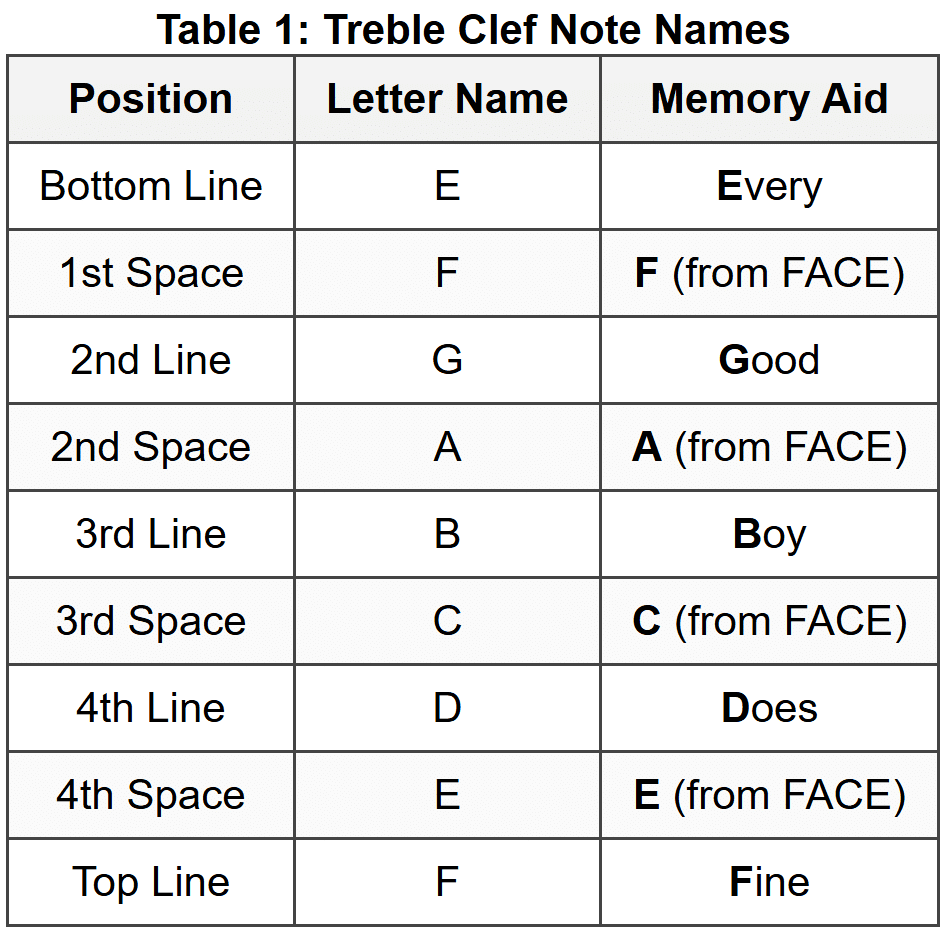
2.1 Treble Clef Letter Names
The treble clef (that fancy symbol that looks like a curly G) is used for higher-pitched notes. Most melodies you sing, and instruments like violin, flute, and the right hand of piano music, are written in treble clef.
In treble clef, the lines from bottom to top are: E G B D F
Musicians remember this with the phrase: "Every Good Boy Does Fine" or "Every Good Bird Does Fly"
The spaces from bottom to top spell a word: F A C E
Easy to remember-it literally spells "face"!
2.2 Bass Clef Letter Names
The bass clef (which looks like a backwards C with two dots) is used for lower-pitched notes. Instruments like cello, bass guitar, trombone, and the left hand of piano music typically use bass clef.
In bass clef, the lines from bottom to top are: G B D F A
Memory phrase: "Good Boys Do Fine Always" or "Good Burritos Don't Fall Apart"
The spaces from bottom to top are: A C E G
Memory phrase: "All Cows Eat Grass" or "All Cars Eat Gas"
Notice something interesting: the top line of bass clef is A, and if you keep going up (to the first space above the staff), you'd get B, then C. Meanwhile, the bottom line of treble clef is E. These two clefs connect to each other-bass clef handles the lower notes, treble clef handles the higher notes, and together they cover the full range of the musical alphabet across different octaves.
3. Sharps and Flats: Filling in the Gaps
Remember when I said the seven letters are the natural notes? Well, between most of these letters, there are additional notes. On a piano, these are the black keys. We call these notes sharps and flats.
Let's make this concrete. Sit at a piano and find any C key (it's the white key immediately to the left of a group of two black keys). Now find the D immediately to the right of that C. Notice there's a black key between C and D. That black key has a name, too-actually, it has two names.
3.1 Understanding Sharps (♯)
A sharp (symbol: ♯) means you raise a note by the smallest distance possible. That smallest distance is called a half step or semitone. When you take any note and move one key to the right on a piano (whether to a black key or white key), you've gone up a sharp.
So if you're at C and you move one key to the right to that black key, you're now at C♯ (we say "C sharp").
Here are all the sharps:
- C♯ (C sharp)
- D♯ (D sharp)
- F♯ (F sharp)
- G♯ (G sharp)
- A♯ (A sharp)
Wait-what about E♯ and B♯? Look at your piano keyboard again. There's no black key between E and F, and no black key between B and C. These pairs of white keys are already just a half step apart, so we don't typically use E♯ or B♯ in basic music theory (though technically E♯ = F and B♯ = C).
3.2 Understanding Flats (♭)
A flat (symbol: ♭) means you lower a note by a half step. When you take any note and move one key to the left on a piano, you've gone down a flat.
That same black key between C and D can be called D♭ (D flat)-because it's one half step below D. So C♯ and D♭ are the same key on the piano, just with different names depending on the musical context.
Here are all the flats:
- D♭ (D flat)
- E♭ (E flat)
- G♭ (G flat)
- A♭ (A flat)
- B♭ (B flat)
Again, we don't typically use C♭ or F♭ in basic contexts (though C♭ = B and F♭ = E).
3.3 Enharmonic Equivalents
When two different note names refer to the same pitch-like C♯ and D♭-we call them enharmonic equivalents. They sound identical but are spelled differently. Think of it like "two" and "too" in English: they sound the same but are written differently depending on context.
Why does music need two names for the same sound? Because of how scales and chords are constructed. In some keys, you'll spell a note as C♯; in others, you'll spell that exact same sound as D♭. The context determines which spelling is correct.
4. The Chromatic Scale: All Twelve Notes
If you include all the natural notes (A B C D E F G) plus all the sharps and flats, you have a total of twelve unique pitches before the pattern repeats. When you play all twelve of these notes in order, you're playing a chromatic scale.
Try this on a piano: start on any C. Play every single key-white and black-moving to the right, until you reach the next C. Count them: you'll play exactly twelve different keys. This is the complete pitch palette available in Western music.
Here's the chromatic scale starting on C, using sharps:
C → C♯ → D → D♯ → E → F → F♯ → G → G♯ → A → A♯ → B → C
Or using flats:
C → D♭ → D → E♭ → E → F → G♭ → G → A♭ → A → B♭ → B → C
You've probably heard chromatic scales in music without realizing it. The famous Jaws theme by John Williams uses a chromatic pattern: E → F → E → F → E → F, slowly creeping up. The suspenseful feeling comes from those half-step movements.
5. Octaves: The Same Letter, Different Height
Here's something that might have puzzled you: if there are only seven letters in the musical alphabet, how can a piano have 88 keys? The answer is octaves.
An octave is the distance from any note to the next occurrence of that same letter name. For example, from one C to the next C is an octave. From one A to the next A is an octave. The word "octave" comes from "octo" meaning eight, because if you count the notes in a major scale from C to the next C, you count eight notes: C-D-E-F-G-A-B-C.
Try this: sing or hum the first two notes of Somewhere Over the Rainbow by Judy Garland. The leap from "Some-" to "-where" is exactly one octave. Same letter name, but one is higher than the other.
5.1 Why Octaves Sound Similar
Here's something fascinating about octaves: when you play two notes an octave apart, they sound remarkably similar, even though one is clearly higher than the other. This is because of physics. The higher note vibrates exactly twice as fast as the lower note.
If a certain C vibrates at 262 Hz (262 vibrations per second), the C one octave higher vibrates at 524 Hz-exactly double. Your brain perceives this 2:1 ratio as "the same note, just higher," which is why we give them the same letter name.
This is why a man and a child can sing Happy Birthday together and sound like they're singing "the same notes" even though they're in different octaves-the letter names match even though the actual pitches are different heights.
5.2 Octave Registers
To distinguish between different octaves, musicians use a numbering system. The C near the middle of the piano keyboard is called C4 (or "middle C"). The C one octave higher is C5, and the C one octave lower is C3.
This system lets musicians communicate precisely. When a composer writes "play A4," every musician knows exactly which A to play-not the low one, not the high one, but the A in the fourth octave.
6. Reading Music: Putting the Alphabet on the Staff
Now let's connect everything. When you read music, you're really just reading the musical alphabet arranged on a staff. The staff tells you two things:
- Which letter: determined by which line or space the note sits on
- Which octave: determined by the clef and how high or low the note is positioned
Let's say you're reading treble clef and you see a note sitting in the bottom space. You remember that in treble clef, the spaces spell FACE from bottom to top, so the bottom space is F. That note is F. If you see a sharp symbol (♯) before it, it's F♯. If you see a flat symbol (♭), it's F♭ (which sounds the same as E).
6.1 Ledger Lines: Going Beyond the Staff
Sometimes notes are too high or too low to fit on the five-line staff. When that happens, we add little extra lines called ledger lines. These work exactly like the regular staff-each line and space still represents the next letter in the musical alphabet.
For example, middle C sits on a ledger line below the treble clef staff. If you know the bottom line of treble clef is E, you can count down: space = D, ledger line = C. This is why learning the musical alphabet backwards is so useful!
6.2 Practice Exercise: Reading Letter Names
If you have any sheet music nearby, try this exercise:
- Find a piece written in treble clef.
- Point to the first note and identify the line or space it's on.
- Say the letter name out loud (use "Every Good Boy Does Fine" for lines and "FACE" for spaces).
- Move to the next note. If it's one line or space higher, say the next letter in the alphabet. If it's one line or space lower, say the previous letter.
- Do this for the first line or phrase of music.
At first this will feel slow and clunky. But with practice, you'll start recognizing patterns and reading letter names as quickly as you read words on this page.
7. The Musical Alphabet in Practice
Let's look at how real, famous melodies use the musical alphabet. This will help you see that these aren't just abstract letters-they're the actual building blocks of songs you know and love.
7.1 Twinkle Twinkle Little Star
This children's song (also the melody of the Alphabet Song and Baa Baa Black Sheep) uses a very simple pattern. In the key of C, the first phrase goes:
C C G G A A G
That's "Twinkle twinkle little star." Notice how it uses only three different letters: C, G, and A. The pattern is symmetric: C appears twice, G appears twice, A appears twice, then G once. Simple, memorable, and built entirely from the musical alphabet.
7.2 Ode to Joy by Beethoven
The famous theme from Beethoven's 9th Symphony, which you've definitely heard even if you don't know classical music, goes like this in the key of D:
E E F G G F E D C C D E E D D
Count the different letters: E, F, G, D, C. Just five letters from the musical alphabet, arranged in a particular rhythm and pattern, create one of the most recognized melodies in Western music.
7.3 Happy Birthday
In the key of C, the first phrase ("Happy birthday to you") goes:
G G A G C B
Again, just a handful of letters: G, A, C, B. The magic isn't in using lots of different notes-it's in how those notes are arranged in time and which ones are emphasized.
Try this right now: if you have any instrument, play these letter names in order. Even if you play them all the same length (ignoring rhythm), you'll recognize the melody. That's the power of the musical alphabet-the letters themselves carry the shape of the tune.
8. Common Questions and Confusions
8.1 Why Don't We Use H?
Some students wonder why the musical alphabet stops at G and doesn't include H through Z. The historical answer is that Western music notation developed from a system used in medieval churches, which labeled notes with the first seven letters of the Latin alphabet. The system worked so well-creating a repeating cycle-that it never needed more letters.
Interestingly, in some countries like Germany, the note we call "B" is called "H," and what we call "B♭" is called "B." This is a historical quirk, but in most of the English-speaking world and in standard international notation, we use A through G.
8.2 Is "Do Re Mi" the Same as "A B C"?
Not exactly. "Do Re Mi Fa Sol La Ti Do" (which you know from The Sound of Music) is a system called solfège or solfeggio. It's a way of singing scales that emphasizes the relationships between notes rather than their absolute letter names.
In fixed do systems, "Do" always means C, "Re" always means D, and so on. But in movable do systems (more common in America), "Do" is whatever note the scale starts on. So in the key of G, "Do" would be G, not C.
The musical alphabet (A B C D E F G) gives you absolute, fixed letter names. Solfège is more flexible and focuses on the sound and function of notes within a scale. Both systems are useful, and many musicians learn both.
8.3 Do I Need to Memorize All the Sharps and Flats?
Yes, eventually. But start with the natural notes first. Make sure you can move forward and backward through A B C D E F G effortlessly. Then learn where the black keys are on a keyboard and what their sharp/flat names are. With a little practice, this becomes automatic-just like knowing the multiplication table or how to spell common words.
Key Terms
- Musical Alphabet
- The seven letters used to name notes in Western music: A, B, C, D, E, F, and G. This sequence repeats in a continuous cycle.
- Natural Notes
- The seven letter names (A through G) without any sharps or flats; represented by the white keys on a piano.
- Staff
- A set of five horizontal lines and four spaces on which musical notes are written. Each line and space represents a different pitch.
- Treble Clef
- A symbol placed at the beginning of a staff to indicate that the notes represent higher pitches. The lines are E, G, B, D, F and the spaces spell F, A, C, E.
- Bass Clef
- A symbol placed at the beginning of a staff to indicate that the notes represent lower pitches. The lines are G, B, D, F, A and the spaces are A, C, E, G.
- Sharp (♯)
- A symbol indicating that a note should be raised by one half step (one piano key to the right).
- Flat (♭)
- A symbol indicating that a note should be lowered by one half step (one piano key to the left).
- Half Step (Semitone)
- The smallest distance between two notes in Western music; the distance from any key on the piano to the very next key (black or white).
- Enharmonic Equivalents
- Two different note names that refer to the same pitch, such as C♯ and D♭.
- Chromatic Scale
- A scale containing all twelve pitches within an octave, including all natural notes plus all sharps and flats, played in sequential half steps.
- Octave
- The interval between one note and the next occurrence of the same letter name, either higher or lower. The higher note vibrates at exactly twice the frequency of the lower note.
- Ledger Lines
- Short horizontal lines added above or below the staff to accommodate notes that are too high or too low to fit on the five standard lines.
- Middle C
- The C note located near the middle of the piano keyboard, designated as C4 in scientific pitch notation; it sits on a ledger line between the treble and bass clefs.
- Solfège
- A system of syllables (Do, Re, Mi, Fa, Sol, La, Ti) used to sing scales and emphasize the relationships between notes in a key.
FAQs on The Musical Alphabet
| 1. What are the seven letters that make up the musical alphabet? |  |
| 2. How does the musical staff relate to the letter names of the musical alphabet? | |
| 3. What are sharps and flats, and how do they fill in the gaps within the musical alphabet? | |
| 4. What is the chromatic scale, and how does it relate to the twelve notes in music? | |
| 5. How can one effectively read music using the musical alphabet? | |