Rests & Silence


1. Why Silence Matters in Music
Think about the last time someone told you a joke. The pause before the punchline? That's what makes it work. Music operates exactly the same way. Silence isn't emptiness-it's one of the most powerful tools a musician has.
Picture yourself listening to Queen's We Will Rock You. What makes that song instantly recognisable? It's not just the stomps and claps-it's the space between them. That silence creates tension, anticipation, and rhythm. Without those gaps, the whole thing would collapse into noise.
In music notation, we use rests to indicate where silence happens and for how long it lasts. Just like notes tell you what to play, rests tell you what not to play. They're equally important, equally precise, and equally essential to making music work.
Let's try something right now. Clap four steady beats, like a clock ticking. Now clap on beats 1 and 3 only, staying silent on beats 2 and 4. Feel that? The silence you just created gave the pattern shape and groove. That's what rests do.
2. Understanding Rest Values
Just like notes have different durations-whole notes, half notes, quarter notes, and so on-rests have matching durations. Every type of note has a corresponding rest symbol that lasts exactly the same length of time.
Here's the fundamental principle: rests occupy time just like notes do. When you see a quarter rest, you're not playing for the same amount of time a quarter note would sound. The beat keeps going; you're just not making sound during that beat.
2.1. The Rest Family
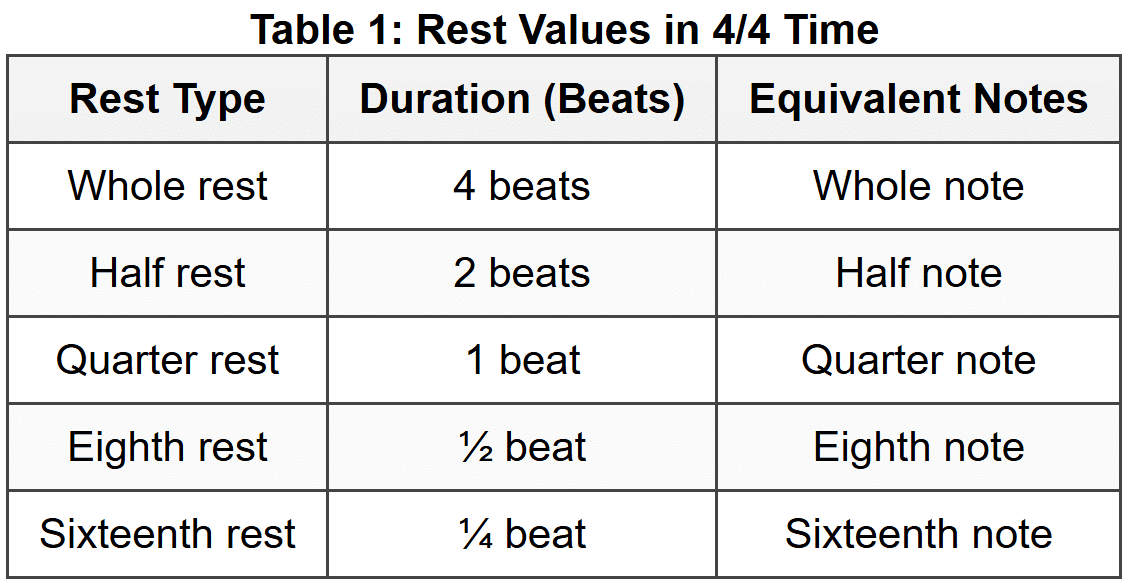
Let's meet each member of the rest family, from longest to shortest:
- Whole rest: Looks like a small filled rectangle hanging down from the fourth line of the staff. It lasts for four beats in 4/4 time-a complete measure of silence. You'll also see it used to indicate a full measure of rest in any time signature.
- Half rest: Looks like a small filled rectangle sitting on top of the third line. It lasts for two beats in 4/4 time.
- Quarter rest: Looks like a squiggly zigzag symbol. It lasts for one beat in 4/4 time. This is probably the rest you'll encounter most often.
- Eighth rest: Looks like the number 7 with a flag. It lasts for half a beat in 4/4 time.
- Sixteenth rest: Looks like an eighth rest but with two flags. It lasts for a quarter of a beat in 4/4 time.
Notice the pattern? Just like with notes, each rest is half the duration of the one before it. A half rest equals two quarter rests. A quarter rest equals two eighth rests. This pattern continues all the way down.
2.2. The Math of Rests
Rests follow the same mathematical relationships as notes. In a measure of 4/4 time, you need beats (or rests, or a combination) that add up to four quarter-note beats.
Here are some equivalent combinations:
1 whole rest = 2 half rests = 4 quarter rests = 8 eighth rests = 16 sixteenth rests
You can mix and match these just like you do with notes. A measure might contain a half note, a quarter rest, and two eighth notes. As long as the total adds up correctly, you're good.
3. Reading and Counting Rests
When you're learning a new piece, you count rests exactly the same way you count notes. The difference is that you don't play anything-but you absolutely must count them.
Let's say you have a measure with a quarter note on beat 1, a quarter rest on beat 2, and quarter notes on beats 3 and 4. You'd count: "1 (play), 2 (silent), 3 (play), 4 (play)." Many musicians say "rest" or "shh" during silent beats to keep the rhythm precise.
Here's a practical exercise you can do right now with clapping:
- Set a steady pulse by tapping your foot: 1, 2, 3, 4, 1, 2, 3, 4...
- Clap on beats 1 and 3 only. You're creating quarter rests on beats 2 and 4.
- Now clap on beat 1, rest on beat 2, clap on beat 3, rest on beat 4.
- Next, try: clap on 1, rest on 2 and 3, clap on 4.
Feel how the silence creates different grooves and patterns? That's the power of placed silence.
3.1. The Challenge of Staying Silent
Here's something interesting: for many beginning musicians, rests are actually harder than notes. When you're playing an instrument, there's a natural tendency to keep going, to fill the space. Stopping requires discipline.
Listen to the opening of Beethoven's Symphony No. 5. You know the famous "da-da-da-DUM" motif. But did you notice there's a rest after that opening gesture? That silence is absolutely critical. It creates drama, suspense, and emphasis. Without it, the whole effect disappears.
When you encounter a rest in music, think of it as an instruction to actively create silence, not passively stop playing. You're still engaged, still counting, still feeling the rhythm-you're just not making sound.
4. Rests in Different Time Signatures
So far, we've been talking about rests in 4/4 time because that's what most Western popular music uses. But rests work in any time signature, and understanding how they adapt is important.
4.1. The Whole Rest Rule
Here's a special rule that trips up a lot of students: in musical notation, a whole rest indicates a full measure of silence, regardless of the time signature. This means:
- In 4/4 time, a whole rest = 4 beats of silence
- In 3/4 time, a whole rest = 3 beats of silence (even though technically that's a dotted half rest's worth)
- In 2/4 time, a whole rest = 2 beats of silence
- In 6/8 time, a whole rest = a full measure (6 eighth notes worth) of silence
This is a notational convention-a shorthand that makes reading music easier. Instead of cluttering a measure with multiple smaller rests, you just write one whole rest to say "don't play anything in this entire measure."
4.2. Rests in 3/4 Time
Think of a waltz-maybe the Blue Danube by Johann Strauss II. That's in 3/4 time: three beats per measure, with the quarter note getting one beat.
In 3/4, your rest options work exactly like they do in 4/4, you just have fewer beats to work with. You might see:
- A whole rest (meaning the full measure is silent)
- A half rest plus a quarter rest (2 + 1 = 3 beats)
- Three quarter rests
- Various combinations of quarter, eighth, and sixteenth rests
4.3. Rests in 6/8 Time
Now we're in compound time territory. In 6/8, you have six eighth notes per measure, usually felt as two groups of three (a "lilting" feel). Think of the song We Are the Champions by Queen or House of the Rising Sun by The Animals.
In 6/8 time, rests commonly appear as:
- A whole rest for a full measure of silence
- A dotted quarter rest (worth three eighth notes-half a measure)
- Quarter rests (worth two eighth notes)
- Eighth rests (worth one eighth note)
The key is to always count in the meter's natural groupings. In 6/8, you'd feel "1-2-3, 4-5-6" and place your rests accordingly.
5. Dotted Rests
Just like notes can be dotted to extend their duration by half, rests can be dotted too. The math works identically:
A dot adds half the original value to a rest.
So a dotted half rest lasts for 3 beats (2 beats + 1 beat). A dotted quarter rest lasts for 1.5 beats (1 beat + 0.5 beat). A dotted eighth rest lasts for three sixteenth notes worth of time.
You'll see dotted rests most commonly in compound meters like 6/8, 9/8, and 12/8, where the dotted quarter rest represents a full beat's worth of silence (three eighth notes).
Try this exercise: tap your foot in 6/8 time (feeling two groups of three: "1-2-3, 4-5-6"). Now clap on beat 1 and rest for beats 2-3-4. That three-eighth-note silence you just created? That's where you'd write a dotted quarter rest.
6. Multiple Measures of Rest
Imagine you're playing in an orchestra, and the piece calls for the violins to be silent for eight consecutive measures. Rather than drawing eight whole rests in a row (which takes up a lot of space and is hard to read), composers use a special symbol: a multi-measure rest.
This looks like a thick horizontal line (or rectangle) placed on the middle line of the staff, with a number above it indicating how many measures to rest. You might see "8" written above the line, meaning "don't play for eight full measures."
When you encounter a multi-measure rest in your music:
- Count carefully, or keep track of where you are by watching the conductor or listening to other instruments
- Stay alert-when those eight measures are up, you need to be ready to come back in on time
- Use the time to prepare for your next entrance: check your fingering, take a breath, get mentally ready
You'll find these frequently in orchestral parts, band arrangements, and any ensemble music where not everyone plays all the time.
7. Rests and Musical Expression
Now let's talk about why rests matter beyond just "not playing." Silence shapes the character, mood, and meaning of music in profound ways.
7.1. Creating Tension and Release
Listen to the beginning of the second movement of Beethoven's Symphony No. 7. There are these sharp, accented chords separated by rests. The rests create tension-you're waiting, wondering what comes next. When the next chord arrives, there's a sense of release.
Composers use rests strategically to build anticipation. Think about a movie soundtrack: the music cuts out right before the monster appears. That silence makes your heart race more than any sound could.
7.2. Defining Rhythm and Groove
In genres like funk, reggae, and Latin music, rests define the entire feel of the music. The guitar part in a reggae song might emphasize the offbeats, with rests on beats 1 and 3. That "chopping" rhythm comes entirely from where the silence is placed.
Listen to James Brown's Funky Drummer or any classic funk track. The drum pattern isn't just about what's played-it's about the precise placement of silence between hits. Those gaps create the pocket, the groove, the feel that makes you want to move.
7.3. Giving Music Space to Breathe
Rests let musical ideas breathe. In jazz, Miles Davis was famous for his use of space. Listen to his solo on So What from the album Kind of Blue. He plays a phrase, then leaves silence. He doesn't rush to fill every moment with notes. The rests make what he does play more powerful and meaningful.
This principle applies to all music-making. When you practice, notice how rests punctuate musical phrases like commas and periods punctuate sentences. They give the listener time to process what they've just heard before moving on to the next idea.
8. Common Mistakes with Rests
Let's address some typical problems students encounter when working with rests, so you can avoid them.
8.1. Rushing Through Rests
The number one mistake: not giving rests their full value. You might think, "There's nothing to play, so I can just skip ahead." Wrong! If a quarter rest should last one full beat, and you only give it half a beat, you've just thrown off the entire rhythm of the piece.
The solution: count rests as carefully as you count notes. Use a metronome when you practice. Physically mark the rests-tap your foot, nod your head, or say "rest" out loud.
8.2. Confusing Whole and Half Rests
These two symbols look similar: both are small rectangles on the staff. Here's how to remember which is which:
The whole rest hangs down from the fourth line like it's heavy and full.
The half rest sits on top of the third line like a hat.
Some students remember it as "whole rest falls down, half rest sits up like a hat on your head."
8.3. Not Preparing During Rests
Rests aren't breaks-they're preparation time. If you have four measures of rest followed by a difficult passage, use those measures to get ready. Position your hands, take a breath (if you're a wind player or singer), mentally rehearse the upcoming notes.
Professional musicians are actively engaged even when they're not playing. Watch any orchestral musician during a rest-they're counting, watching the conductor, and preparing for their next entrance.
9. Practicing with Rests
Here are some practical strategies for mastering rests in your playing:
9.1. The Clapping Method
Before you play a new piece on your instrument, clap the rhythm. When you hit a rest, lift your hands apart but keep them in the air, ready to clap again. This physical gesture helps you feel the duration of the rest while staying engaged with the rhythm.
9.2. Sing or Count Aloud
Sing through the rhythm using counting syllables: "1, 2, rest, 4" or "1-and-2-and-rest-and-4-and." Saying "rest" keeps you locked into the pulse and prevents you from rushing.
For more complex rhythms with eighth and sixteenth rests, you might use: "1-e-and-a, 2-e-and-a" and say "rest" or "shh" precisely where the rests occur.
9.3. Practice in Layers
If a passage has tricky rest placement:
- Step 1: Clap just the notes, ignoring rests initially to get the basic pattern
- Step 2: Add the rests back in, clapping the full rhythm
- Step 3: Play it on your instrument slowly with a metronome
- Step 4: Gradually increase the tempo while maintaining rest precision
9.4. Record Yourself
Use your phone to record yourself playing passages with rests. Listen back. Are the rests the right length? Are they in the right places? Are you maintaining the tempo through the silent moments? Recording reveals timing issues you might not notice while playing.
10. Rests Across Musical Styles
Different musical traditions use rests in characteristic ways. Understanding these patterns helps you interpret music more authentically.
10.1. Classical Music
In classical music, rests often serve structural and expressive functions. Think of the pause before the recapitulation in a sonata form, or the fermata (a hold symbol) placed over a rest in a concerto, where the soloist might take extra time before the next phrase.
Listen to the third movement of Mozart's Symphony No. 40. Notice the rests that punctuate the urgent, running melody. They create drama and forward drive.
10.2. Jazz and Blues
Jazz musicians use rests to create syncopation and swing feel. A rest placed on a strong beat (like beat 1) creates tension and surprise. Blues phrasing often features short musical statements followed by rests-call and response with silence.
Count Basie's big band style was famous for "less is more." The band would hit a punchy figure, then rest while the rhythm section kept swinging. Those gaps were essential to the Basie sound.
10.3. Rock and Pop
In rock music, rests create dynamics and impact. Think of The White Stripes' Seven Nation Army-that iconic bass line is as much about the silence between the notes as the notes themselves.
Power chord riffs often use eighth or sixteenth rests to create a "chugging" rhythmic effect. Listen to Metallica's Master of Puppets for perfect examples of how precise rest placement creates aggressive, driving rhythms.
10.4. Latin and Afro-Cuban Music
In styles like salsa, mambo, and samba, rests define the clave pattern and other foundational rhythms. The montuno piano pattern in salsa uses specific rest placements to lock in with the clave. Missing those rests destroys the groove.
The Brazilian bossa nova style uses syncopated rhythms with strategic rests that create its characteristic lilt. Listen to João Gilberto's guitar playing on The Girl from Ipanema-notice how he uses silence to create the bossa nova feel.
11. Advanced Rest Concepts
11.1. Breath Marks and Caesuras
Sometimes composers want a brief pause that isn't precisely measured. They might use a breath mark (looks like an apostrophe above the staff) to indicate a very short break, or a caesura (two diagonal slashes) to indicate a more significant pause.
These aren't technically rests because they don't have specific measured durations, but they function similarly-they tell you to stop the sound briefly before continuing.
11.2. Rests and Articulation
Rests can be created through articulation as well as notation. When you play staccato (short, detached notes), you're essentially creating tiny rests between each note, even if they're not explicitly written.
Try this: play or sing a simple scale with every note held for its full value (legato). Now play the same scale staccato-each note gets only about half its written value, with an implied rest filling the remaining time. You haven't changed what's written, but you've changed the amount of silence in the music.
11.3. Implied Rests in Lead Sheets
In jazz and popular music, you often see lead sheets-just the melody line with chord symbols above. The rhythm might show a note on beat 1, then nothing until beat 3. That empty space? That's an implied rest, even if no rest symbol is explicitly written.
Experienced musicians learn to "read the space" and understand where silence belongs based on musical context, even when it's not fully notated.
Key Terms
- Rest
- A symbol in musical notation indicating a measured period of silence, with the same time-value precision as notes.
- Whole rest
- A rest symbol that indicates either four beats of silence in 4/4 time or a full measure of rest in any time signature; appears as a filled rectangle hanging from the fourth line of the staff.
- Half rest
- A rest lasting two beats in 4/4 time; appears as a filled rectangle sitting on top of the third line of the staff.
- Quarter rest
- A rest lasting one beat in 4/4 time; appears as a squiggly, zigzag symbol.
- Eighth rest
- A rest lasting half a beat in 4/4 time; appears as a symbol resembling the number 7 with a single flag.
- Sixteenth rest
- A rest lasting one quarter of a beat in 4/4 time; appears similar to an eighth rest but with two flags.
- Dotted rest
- A rest followed by a dot, extending its duration by half of its original value, following the same principle as dotted notes.
- Multi-measure rest
- A thick horizontal line placed on the middle staff line with a number above it, indicating consecutive measures of complete silence.
- Syncopation
- A rhythmic effect created by placing emphasis (or silence) on weak beats or offbeats, often achieved through strategic rest placement.
- Fermata
- A symbol (resembling an eye or curved line with a dot) placed over a note or rest, indicating that it should be held longer than its normal duration, at the performer's or conductor's discretion.
- Caesura
- Two diagonal slashes placed above the staff indicating a complete break or pause in the music, brief but unmeasured.
- Breath mark
- A small mark (resembling an apostrophe) above the staff indicating a very brief, quick pause, often just long enough to take a breath.
- Staccato
- An articulation marking (indicated by a dot above or below a note) instructing the performer to play the note shorter than its full value, creating implied silence between notes.
- Lead sheet
- A form of musical notation common in jazz and popular music containing only the melody line and chord symbols, often with implied rather than explicitly notated rests.
FAQs on Rests & Silence
| 1. Why is silence important in music? |  |
| 2. What are the different values of rests in music? | |
| 3. How do you read and count rests? | |
| 4. How do rests function in different time signatures? | |
| 5. What are common mistakes musicians make with rests? | |