Chord Progressions


1. What Is a Chord Progression?
Think about the last song you listened to. You probably noticed that the music didn't just sit on a single chord forever-it moved. That movement from one chord to another, in a particular order, is what we call a chord progression. It's the harmonic backbone of nearly every piece of music you've ever heard.
Picture this: if a single chord is like a single color, then a chord progression is like watching colors blend and shift across a canvas. Each chord creates an emotion or a feeling, and when you string them together in sequence, you create a journey. That journey might make you feel calm, excited, sad, or uplifted-all depending on which chords you choose and how they're ordered.
Let's try something right now. If you have access to a piano or keyboard, play a C major chord (C-E-G). Hold it for a moment. Now play an F major chord (F-A-C). Then play a G major chord (G-B-D). Finally, come back to C major. You've just played one of the most famous chord progressions in history: I-IV-V-I in the key of C major. You'll find this exact pattern in thousands of songs, from The Beatles' Let It Be to countless folk, rock, and pop tunes.
A chord progression does three main things:
- It creates harmonic motion-the sense that music is going somewhere, not just staying still
- It establishes a tonal center, helping listeners feel which chord is "home"
- It shapes the emotional character of a piece of music
Without chord progressions, music would feel static and lifeless. They're what keep songs moving forward and keep our ears interested.
2. Understanding Roman Numeral Notation
Before we go any further, you need to understand the language musicians use to talk about chord progressions. Instead of saying "C major, F major, G major," we use Roman numerals. This system is incredibly powerful because it lets you describe a progression in any key without having to rename all the chords.
Here's how it works: we number each chord based on which scale degree it's built from. In any major key, you can build a chord on each of the seven notes of the scale. Let's use C major as our example:
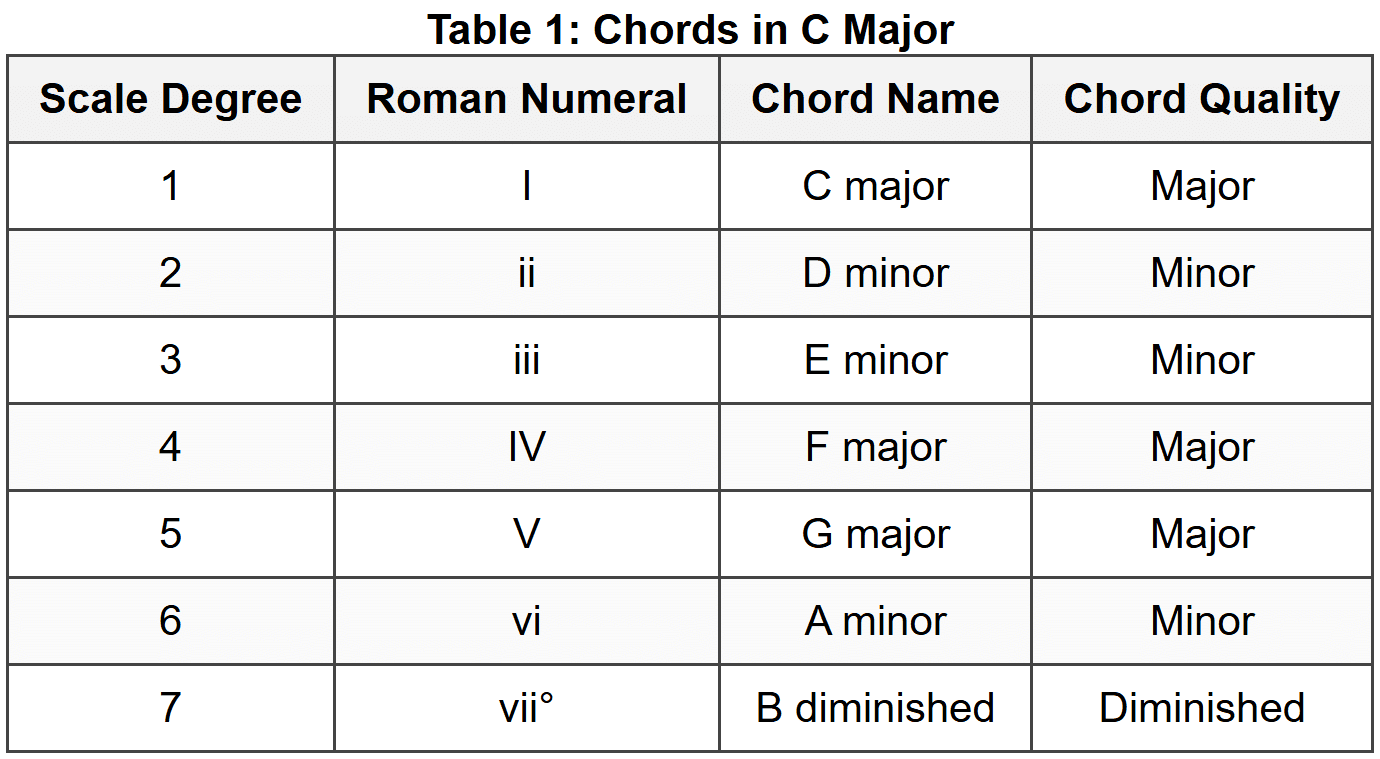
Notice the pattern:
- Uppercase Roman numerals (I, IV, V) indicate major chords
- Lowercase Roman numerals (ii, iii, vi) indicate minor chords
- A degree symbol ° (vii°) indicates a diminished chord
This pattern holds true in every major key. So when someone says "play a I-vi-IV-V progression," you can instantly play it in C major, G major, D major, or any other key-you just build the chords from the corresponding scale degrees.
In any major key: I, IV, and V are major chords; ii, iii, and vi are minor chords; vii° is diminished.
For minor keys, the pattern is different because the natural minor scale has a different structure. We'll explore that later, but for now, focus on understanding how Roman numerals work in major keys-that's where most popular music lives.
3. Common Chord Progressions in Popular Music
Let's get practical. There are certain chord progressions that appear over and over again in music because they simply work. They sound good, they feel natural, and they create emotional responses that listeners love. Let's look at the most common ones you'll encounter.
3.1. The I-V-vi-IV Progression
This is arguably the most popular chord progression of the last few decades. You've heard it countless times, probably without realizing it's the same harmonic structure underneath different melodies. In the key of C major, this progression is: C-G-Am-F.
Here are just a few songs that use this exact progression:
- Journey - Don't Stop Believin'
- The Axis of Awesome - 4 Chords (a comedy song that demonstrates how many hits use this progression)
- Lady Gaga - Poker Face
- James Blunt - You're Beautiful
Why does this progression work so well? The I chord establishes home. The V chord creates tension and wants to resolve. The vi chord (a minor chord) adds emotional depth. The IV chord provides a sense of lifting up before cycling back to I. Together, they create a complete emotional arc that feels satisfying.
3.2. The I-IV-V Progression
This is the grandfather of all rock and roll, blues, and country progressions. In C major: C-F-G. It's simple, direct, and powerful.
You'll hear this in:
- Chuck Berry - Johnny B. Goode
- The Beatles - Twist and Shout
- Wild Thing by The Troggs
- Countless 12-bar blues songs
The I-IV-V progression works because it uses the three primary chords of the key-the chords that contain all seven notes of the major scale. It's harmonically complete, which is why it sounds so solid and grounded.
3.3. The ii-V-I Progression
This progression is the cornerstone of jazz harmony, but you'll find it in classical music, pop, and almost every other genre. In C major: Dm-G-C.
The ii chord has a subdominant function (it prepares the dominant), the V chord creates strong tension, and the I chord provides resolution. This creates one of the most satisfying cadences in all of music theory.
Listen for this in:
- George Gershwin - I Got Rhythm
- The "Sunday" progression in countless jazz standards
- The end of many classical phrases and movements
3.4. The I-vi-IV-V Progression
Also called the "50s progression" or the "doo-wop progression," this sequence was everywhere in the 1950s and early 1960s. In C major: C-Am-F-G.
Classic examples include:
- The Tokens - The Lion Sleeps Tonight
- Ben E. King - Stand By Me
- The Beatles - Let It Be (with slight variations)
The vi chord (Am in C major) adds a touch of melancholy that makes the progression more emotionally rich than a simple I-IV-V.
3.5. The 12-Bar Blues Progression
The blues deserves special mention because it created a progression structure that became a genre unto itself. The standard 12-bar blues follows this pattern (shown in Roman numerals):
I-I-I-I
IV-IV-I-I
V-IV-I-I
In the key of C, that's four bars of C, two bars of F, two bars of C, one bar of G, one bar of F, and two more bars of C. You'll find this exact structure in:
- Robert Johnson - Sweet Home Chicago
- B.B. King - The Thrill Is Gone
- Muddy Waters - Hoochie Coochie Man
Try playing this progression on a guitar or piano, and you'll immediately hear the blues sound emerge-even before you add melody or lyrics.
4. Functional Harmony and Chord Roles
Not all chords in a progression do the same job. In fact, chords have specific functions-roles they play in creating movement and resolution. Understanding these functions will help you hear why certain progressions feel complete and others leave you hanging.
4.1. Tonic Function (I, vi, iii)
The tonic is home base. It's the chord of stability and rest. When you end a song, you almost always end on the tonic chord. The I chord is the strongest tonic, but vi and iii can also function as tonic substitutes because they share notes with the I chord.
Think of the tonic as the place where tension resolves. It's the musical equivalent of coming home after a long journey.
4.2. Dominant Function (V, vii°)
The dominant chord (V) creates tension that wants to resolve to the tonic. This tension comes from the presence of the leading tone-the seventh scale degree that pulls strongly upward to the tonic note.
In C major, the G major chord (V) contains the note B, which is the leading tone. That B wants to resolve up to C, pulling the entire chord progression back to the tonic.
Try this: Play a G major chord and hold it. Really listen to the tension. Now resolve it to C major. Feel that sense of release? That's dominant function in action.
4.3. Subdominant Function (IV, ii)
The subdominant chords (IV and ii) function as preparation. They move away from the tonic and often lead toward the dominant. They create a sense of departure without the intense tension of the dominant chord.
The classic progression I-IV-V-I demonstrates all three functions working together:
- I: Tonic (home)
- IV: Subdominant (moving away)
- V: Dominant (tension)
- I: Tonic (resolution back home)
This creates a complete harmonic journey in just four chords.
5. Cadences: How Progressions Create Endings
A cadence is a harmonic formula that creates a sense of punctuation in music-like a comma, semicolon, or period in writing. Different cadences create different levels of finality or continuation.
5.1. Authentic Cadence (V-I)
This is the strongest, most final-sounding cadence. The dominant chord (V) resolves to the tonic (I), creating a sense of complete closure. You hear this at the end of most classical pieces and pop songs.
There are two types:
- Perfect Authentic Cadence: Both chords are in root position, and the melody ends on the tonic note
- Imperfect Authentic Cadence: One or both chords are inverted, or the melody ends on a different chord tone
Listen to the final chords of Beethoven's Symphony No. 5-those massive V-I cadences create unmistakable finality.
5.2. Plagal Cadence (IV-I)
Often called the "Amen cadence" because it's used at the end of hymns on the word "Amen," this cadence has a softer, more gentle quality than the V-I.
You'll hear this at the very end of The Beatles' Let It Be, after the main V-I resolution. The IV-I adds a final touch of warmth.
5.3. Half Cadence (ends on V)
A half cadence ends on the dominant chord, creating a sense of incompleteness-like a question mark. It makes you wait for resolution.
Try playing a I-IV-V progression and stopping on V. You'll feel the need for that progression to continue. Half cadences are often used in the middle of pieces to keep the music moving forward.
5.4. Deceptive Cadence (V-vi)
This cadence tricks your ear. You expect V to resolve to I, but instead it goes to vi (the relative minor). It creates surprise and prolongs the journey to the final tonic.
A famous example is in the hymn For All the Saints, where several phrases end with V-vi instead of the expected V-I, creating a sense of longing before the final resolution.
6. Creating Movement: Voice Leading in Progressions
When chords move from one to another, the individual notes within those chords-the voices-also move. How smoothly or dramatically those voices move affects how the progression sounds. This is called voice leading.
6.1. Smooth Voice Leading
Good voice leading generally follows these principles:
- Move each voice by the smallest distance possible
- Keep common tones (notes that appear in both chords) in the same voice
- Move voices in contrary or oblique motion when possible, rather than parallel
Let's look at a I-IV progression in C major. If you voice the C major chord as C-E-G and the F major chord as C-F-A, notice that the C stays exactly where it is (it's in both chords). The E moves up by one step to F, and the G moves up by one step to A. That's smooth voice leading.
6.2. Voice Leading and Chord Inversions
Using chord inversions-playing chords with notes other than the root in the bass-can create even smoother voice leading. Instead of jumping from C major (C-E-G) to F major (F-A-C) with the bass jumping up a fourth, you might use F major in first inversion (A-C-F), so the bass only moves from C to A-a much smaller leap.
Classical composers spent enormous energy perfecting voice leading. Listen to a Bach chorale and notice how each individual voice (soprano, alto, tenor, bass) creates its own smooth melodic line while simultaneously contributing to the harmony.
7. Modal Progressions and Borrowed Chords
So far, we've focused on progressions built from the major scale. But what if you want to create a different mood or color? This is where modes and borrowed chords come in.
7.1. Modal Progressions
A mode is a type of scale that creates a different flavor than the standard major or minor scales. Each mode emphasizes different scale degrees and creates different emotional qualities.
For example, the Dorian mode is like a natural minor scale but with a raised sixth degree. A progression built in D Dorian might use Dm-G-Dm (i-IV-i in Dorian), which sounds minor but brighter than a natural minor progression. You hear this in Santana's Oye Como Va.
The Mixolydian mode is like a major scale with a lowered seventh. Many rock songs use Mixolydian progressions, like The Beatles' Norwegian Wood, which uses a progression that emphasizes the ♭VII chord characteristic of Mixolydian.
7.2. Borrowed Chords
Sometimes you want to borrow a chord from a parallel key-usually from the parallel minor. In C major, you might borrow the ♭VI chord (A♭ major) from C minor. This creates a darker, richer sound.
The Beatles were masters of borrowed chords. In While My Guitar Gently Weeps, they use several chords borrowed from the parallel minor key, creating a melancholic quality.
8. Progressions in Minor Keys
Minor key progressions have their own character and common patterns. The most important thing to understand is that minor keys use three different forms of the minor scale: natural minor, harmonic minor, and melodic minor. This affects which chords are available.
8.1. Natural Minor Progressions
Using only notes from the natural minor scale, you get these chords (using A minor as an example):
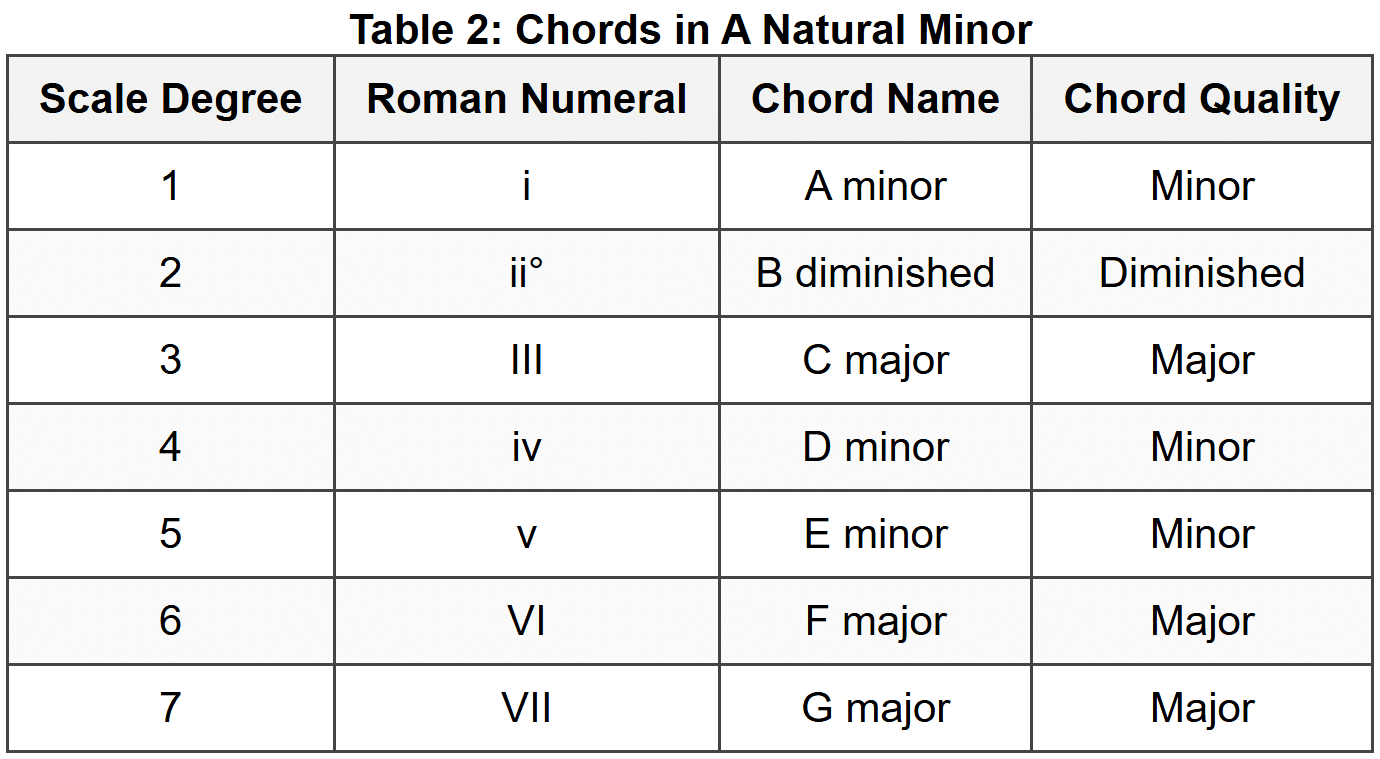
A common natural minor progression is i-VII-VI-VII, which in A minor would be Am-G-F-G. You hear this in many folk songs and rock tunes.
8.2. Harmonic Minor and the V Chord
The problem with natural minor is that the v chord (E minor in A minor) doesn't create strong tension. To fix this, composers raise the seventh scale degree, creating the harmonic minor scale. This changes the v chord into a major V chord (E major in A minor), which has a strong leading tone.
The progression i-iv-V-i (Am-Dm-E-Am) is the minor key equivalent of I-IV-V-I, and it's just as fundamental. You'll hear it throughout classical music, flamenco, and many other styles.
9. Creating Emotional Impact with Chord Choice
Different chord progressions create different emotions. Let's explore how specific choices affect the feeling of music.
9.1. Major vs. Minor Progressions
Major progressions generally sound bright, happy, or triumphant. Think of Queen's We Are the Champions or Katrina and the Waves' Walking on Sunshine.
Minor progressions tend to sound sad, mysterious, or serious. Listen to R.E.M.'s Losing My Religion or Samuel Barber's Adagio for Strings.
But context matters enormously. A minor progression played quickly with a strong beat can sound energetic and exciting (like many rock songs in minor keys), while a major progression played slowly can sound contemplative or even melancholic.
9.2. Unexpected Chord Changes
Sometimes the most powerful emotional moments come from chords that surprise the ear. When Radiohead's Creep moves from G major to B major (a I to III progression, which is unusual in major keys), the unexpected jump creates the unsettled feeling that matches the lyrics perfectly.
The deceptive cadence (V-vi) we discussed earlier is another way to create emotional impact through surprise.
9.3. Rate of Harmonic Change
How quickly chords change also affects emotion. Fast chord changes create energy and momentum. Slow changes create spaciousness and contemplation. Compare the rapid chord changes in Vivaldi's Spring from The Four Seasons with the glacially slow harmonic rhythm of much ambient music.
10. Building Your Own Progressions
Now that you understand how progressions work, let's talk about creating your own. You don't need to reinvent the wheel-many great songs use the same progressions. What matters is what you do with melody, rhythm, and arrangement on top of that harmonic foundation.
10.1. Start with Function
Begin by thinking about harmonic function. You'll usually want:
- A tonic chord to establish home
- Some movement away from tonic (subdominant function)
- Some tension (dominant function)
- A return to tonic or continued motion
Even a simple I-IV-V-I follows this arc perfectly.
10.2. Experiment with Different Patterns
Try these approaches:
- Take a progression you know and change one chord
- Reverse a familiar progression (IV-I-V-vi instead of I-V-vi-IV)
- Use inversions to create smoother bass lines
- Add a minor chord where you'd expect major, or vice versa
10.3. Listen Actively
The best way to build your progression vocabulary is to analyze songs you love. When you hear a song that moves you, try to figure out what chords are being used. Many websites and apps can help you identify chords, but training your ear to hear them directly is even more valuable.
Start simple. Pick a song with just three or four chords and work out the progression by ear. Then move to more complex examples.
11. Advanced Concepts: Extensions and Substitutions
Once you're comfortable with basic triads and progressions, you can add more sophisticated colors through chord extensions and chord substitutions.
11.1. Seventh Chords
Adding a seventh to a chord creates a richer, more complex sound. The most important seventh chords are:
- Major seventh (Cmaj7: C-E-G-B) - sounds dreamy, sophisticated
- Dominant seventh (G7: G-B-D-F) - adds extra tension to the dominant chord
- Minor seventh (Dm7: D-F-A-C) - adds warmth to minor chords
Jazz progressions almost always use seventh chords instead of plain triads. The progression Dm7-G7-Cmaj7 is the jazz version of ii-V-I.
11.2. Chord Substitutions
You can often substitute chords that share similar functions or notes. For example:
- Use vi instead of I (they share two notes)
- Use ii instead of IV (both have subdominant function)
- Use iii instead of I (in certain contexts)
In jazz, the tritone substitution is particularly important: you can replace any dominant chord with another dominant chord a tritone away. Instead of G7 resolving to C, you could use D♭7 resolving to C. This creates a distinctive sound used throughout jazz and sophisticated pop music.
11.3. Extended Chords
Beyond sevenths, you can add ninths, elevenths, and thirteenths to chords. A Cmaj9 chord (C-E-G-B-D) has a lush, full sound that's common in R&B, soul, and jazz. Steely Dan built their entire sound around these kinds of extended harmonies.
12. Progressions Across Musical Styles
Different musical genres tend to favor certain progressions and harmonic approaches.
12.1. Classical Music
Classical music typically uses functional harmony very strictly, with clear tonic-dominant relationships. The ii-V-I progression is fundamental. Composers like Mozart and Haydn built entire movements around elaborations of I-IV-V-I.
12.2. Jazz
Jazz harmony is built on the ii-V-I progression but adds complexity through extended chords, altered chords, and frequent key changes. A jazz standard might have dozens of chord changes in just 32 bars, each one a variation or extension of basic functional harmony.
12.3. Blues and Rock
Blues relies heavily on the 12-bar blues form and dominant seventh chords. Rock music often uses power chords (root and fifth only) and modal progressions, especially in harder styles. The I-♭VII-IV progression is very common in rock.
12.4. Pop Music
Contemporary pop music often uses four-chord loops that repeat throughout the entire song. The I-V-vi-IV progression (and its variants) dominates the charts. Pop producers focus more on production, rhythm, and melody than harmonic complexity.
12.5. Electronic and Ambient Music
Electronic music sometimes uses very slow harmonic rhythm with progressions that change every eight or sixteen bars. Ambient music might stay on a single chord or use very subtle changes, creating atmosphere rather than traditional harmonic motion.
Key Terms
- Chord Progression
- A sequence of chords played in a specific order, forming the harmonic foundation of a piece of music.
- Roman Numeral Notation
- A system of labeling chords based on their scale degree, using uppercase numerals for major chords, lowercase for minor chords, and ° for diminished chords.
- Tonic
- The home chord or note of a key; the chord built on the first scale degree (I in major, i in minor), representing stability and resolution.
- Dominant
- The chord built on the fifth scale degree (V), which creates tension that wants to resolve to the tonic.
- Subdominant
- The chord built on the fourth scale degree (IV), which moves away from tonic and typically leads toward the dominant.
- Leading Tone
- The seventh scale degree, which is a half step below the tonic and has a strong tendency to resolve upward to it.
- Cadence
- A harmonic formula that creates a sense of punctuation or ending in music, similar to punctuation marks in writing.
- Authentic Cadence
- A cadence that moves from V to I, creating a strong sense of resolution and finality.
- Plagal Cadence
- A cadence that moves from IV to I, creating a gentler, softer resolution; also called the "Amen cadence."
- Half Cadence
- A cadence that ends on the dominant chord (V), creating a sense of incompleteness that requires continuation.
- Deceptive Cadence
- A cadence where the dominant (V) resolves to vi instead of the expected I, creating surprise and prolonging resolution.
- Voice Leading
- The smooth, logical movement of individual notes (voices) from one chord to the next in a progression.
- Chord Inversion
- A rearrangement of a chord's notes so that a note other than the root appears in the bass.
- Mode
- A type of scale based on different patterns of whole and half steps, each creating a distinct tonal character.
- Borrowed Chord
- A chord taken from a parallel key (usually the parallel minor) and used in a major key progression to add color and variety.
- Natural Minor
- A minor scale with the pattern of whole and half steps: W-H-W-W-H-W-W; contains no raised notes.
- Harmonic Minor
- A minor scale with a raised seventh scale degree, creating a stronger dominant chord with a leading tone.
- Functional Harmony
- A system of harmony in which chords have specific roles (tonic, dominant, subdominant) that create patterns of tension and resolution.
- Seventh Chord
- A chord consisting of four notes: a root, third, fifth, and seventh stacked in thirds.
- Dominant Seventh
- A major chord with an added minor seventh (e.g., G-B-D-F), creating strong tension that wants to resolve to the tonic.
- Chord Substitution
- The practice of replacing one chord with another that has a similar function or sound, adding variety to a progression.
- 12-Bar Blues
- A specific chord progression structure spanning twelve measures, fundamental to blues music: four bars of I, two bars of IV, two bars of I, one bar of V, one bar of IV, two bars of I.
- Harmonic Rhythm
- The rate at which chords change in a piece of music; fast harmonic rhythm means frequent chord changes, slow means infrequent changes.
- Extended Chord
- A chord that includes notes beyond the seventh, such as ninths, elevenths, or thirteenths, creating richer, more complex harmonies.
- Primary Chords
- The three most important chords in a key: I, IV, and V in major; i, iv, and V in minor. Together they contain all the notes of the scale.
FAQs on Chord Progressions
| 1. What is a chord progression? |  |
| 2. How is Roman numeral notation used in chord progressions? | |
| 3. What are some common chord progressions found in popular music? | |
| 4. What roles do chords play in functional harmony? | |
| 5. How do cadences contribute to chord progressions? | |