Using a Metronome Effectively


1. What a Metronome Actually Does (and Why You Need One)
Picture this: you're learning a song, maybe Sweet Child O' Mine by Guns N' Roses or a Bach minuet, and at first it sounds decent. But when you try to play along with the recording, everything falls apart. You speed up in the easy parts, slow down in the tricky bits, and by the end you're completely out of sync. This is where a metronome comes in.
A metronome is simply a device that produces a steady, repeating click at a specific speed. Think of it as your personal timekeeper-an absolutely consistent pulse that never speeds up when it gets excited or slows down when it gets tired. Unlike a human drummer or conductor, it's perfectly mechanical in its timing, which makes it both incredibly useful and, let's be honest, sometimes frustrating.
The speed of a metronome is measured in beats per minute (BPM). When you set a metronome to 60 BPM, it clicks exactly 60 times in one minute-one click per second. At 120 BPM, it clicks twice per second. Most music you hear on the radio sits somewhere between 60 and 180 BPM, though tempos can go much slower or faster.
Here's what you need to understand: the metronome doesn't make you musical. It makes you accurate. And accuracy is the foundation on which you build expression, feeling, and interpretation. You can't effectively rush for excitement or slow down for drama if you don't have a solid sense of steady time to begin with.
1.1 Common Misconceptions About Metronomes
Let's clear up a few things right away:
- Myth: "Using a metronome makes your playing robotic and lifeless." Reality: The metronome teaches you where the beat is so you can choose when to play slightly ahead, behind, or right on it-that's what creates groove and feel.
- Myth: "Professional musicians don't use metronomes." Reality: Recording studios worldwide use click tracks (electronic metronomes) for nearly every session. Even live performers practice with metronomes extensively.
- Myth: "I should only use a metronome when I'm learning something new." Reality: Even pieces you've mastered benefit from metronome practice to maintain consistency and explore different tempos.
2. Setting Up Your Metronome for Success
Before you can use a metronome effectively, you need to set it up properly. Whether you're using a traditional mechanical device, a digital metronome, or a smartphone app, the principles are the same.
2.1 Choosing the Right Starting Tempo
This is where most people go wrong. They set the metronome to the final performance tempo of a piece and then wonder why they can't play it. Here's the truth: the right tempo is the one where you can play the passage accurately without tension or mistakes.
Let's say you're learning the opening riff of Smoke on the Water by Deep Purple, which is typically performed around 112 BPM. If you're just starting, you might need to practice it at 60 BPM. That might feel painfully slow, and that's okay. Slow practice builds the neural pathways that allow fast playing later.
Try this right now: Take any passage you're working on. Start your metronome at 60 BPM. Can you play every note cleanly, with good tone, and with no hesitations? If yes, increase by 4-8 BPM. If no, stay at 60 or even drop to 50. There's no shame in slow practice-there's only effective and ineffective practice.
2.2 Understanding Time Signatures and Beat Subdivision
Most metronomes allow you to set not just the tempo but also the time signature. When you set your metronome to 4/4 time, it typically makes the first click of every four beats slightly louder or higher-pitched. This downbeat emphasis helps you feel where measure boundaries are.
Here's what different settings mean:
- 4/4 time: Four beats per measure, with emphasis on beat 1 (the vast majority of pop, rock, and classical music)
- 3/4 time: Three beats per measure, with emphasis on beat 1 (waltzes, like The Blue Danube by Johann Strauss II)
- 6/8 time: Six beats per measure, usually felt as two groups of three (many Irish jigs and songs like We Are the Champions by Queen)
For most practice sessions, especially when you're working on technical passages, you can leave the metronome in simple mode where every click sounds the same. The emphasis is helpful when you're working on full pieces or practicing with a specific musical context in mind.
2.3 Volume and Placement
Your metronome should be loud enough to hear clearly, but not so loud that it drowns out your playing. If you're using headphones, place the metronome in only one ear so you can hear your instrument naturally with the other. If you're using a speaker, place the metronome slightly behind you or to the side-not directly in front where it will interfere with your perception of your own sound.
3. Progressive Practice Techniques with the Metronome
Now we get to the heart of effective metronome use. Simply playing along with a click doesn't automatically improve your timing. You need deliberate strategies that target specific aspects of rhythmic accuracy.
3.1 The 5-Perfect-Times Rule
Here's a powerful practice protocol that builds genuine consistency:
At any given tempo, play the passage perfectly five consecutive times before increasing the speed. If you make even a tiny mistake on the fourth repetition, you start the count over at one.
This sounds simple, but it's surprisingly challenging. It forces you to achieve real mastery at each tempo level before moving on. When you finally do increase the tempo, you'll find the new speed much more manageable because your muscle memory and timing precision are solid.
Let's say you're working on a scale. Start at 60 BPM, one note per click. Play it perfectly five times. Then increase to 66 BPM. Five perfect times. Then 72 BPM. You might be able to practice this for only 15 minutes before your concentration fades, and that's fine. This is high-quality, focused practice.
3.2 Subdivision Practice
This technique addresses a common problem: people can play along with the clicks but fall apart in between them. The solution is to practice with subdivisions-the smaller note values between the beats.
Set your metronome to a comfortable tempo, say 80 BPM. Now instead of playing one note per click, play two notes per click. This means you're playing eighth notes while the metronome provides the quarter note pulse. Your job is to place the second note exactly halfway between the clicks.
Try this exercise right now if you have an instrument nearby:
- Set metronome to 60 BPM
- Clap on every click for four measures (get comfortable with the pulse)
- Now clap twice for every click-once with the click, once exactly between clicks
- The challenge: make your off-beat claps just as steady and even as your on-beat ones
This subdivision practice is essential for passages with sixteenth notes, triplets, or any rhythm more complex than steady quarter notes. Many classical works by composers like Mozart or Chopin, and contemporary songs like Superstition by Stevie Wonder (with its intricate sixteenth-note hi-hat pattern), require this kind of subdivision accuracy.
3.3 The "Disappearing Click" Method
One limitation of always practicing with a metronome is that you can become dependent on it-you follow the click rather than truly internalizing the tempo. The disappearing click method solves this problem.
Here's how it works:
- Play your passage with the metronome for one time through
- On the repeat, turn off the metronome (or mute it) for two measures, then turn it back on
- Did you stay in time? Were you ahead or behind when the click returned?
- Gradually increase the silent portions-four measures, eight measures, eventually entire sections
This technique develops your internal clock-your ability to maintain a steady tempo without external help. This is what separates competent players from great ones. Listen to drummers like Steve Gadd or classical pianists like Mitsuko Uchida-their time is so solid you could set a watch by it, not because they're always practicing with a metronome, but because they've internalized tempo through thousands of hours of mindful practice.
3.4 The Tempo Ladder Approach
Sometimes you need to bridge a large gap between your current tempo and your goal tempo. The tempo ladder breaks this journey into manageable steps.
Let's say you need to play a passage at 144 BPM but can currently only manage 100 BPM. Here's your ladder:
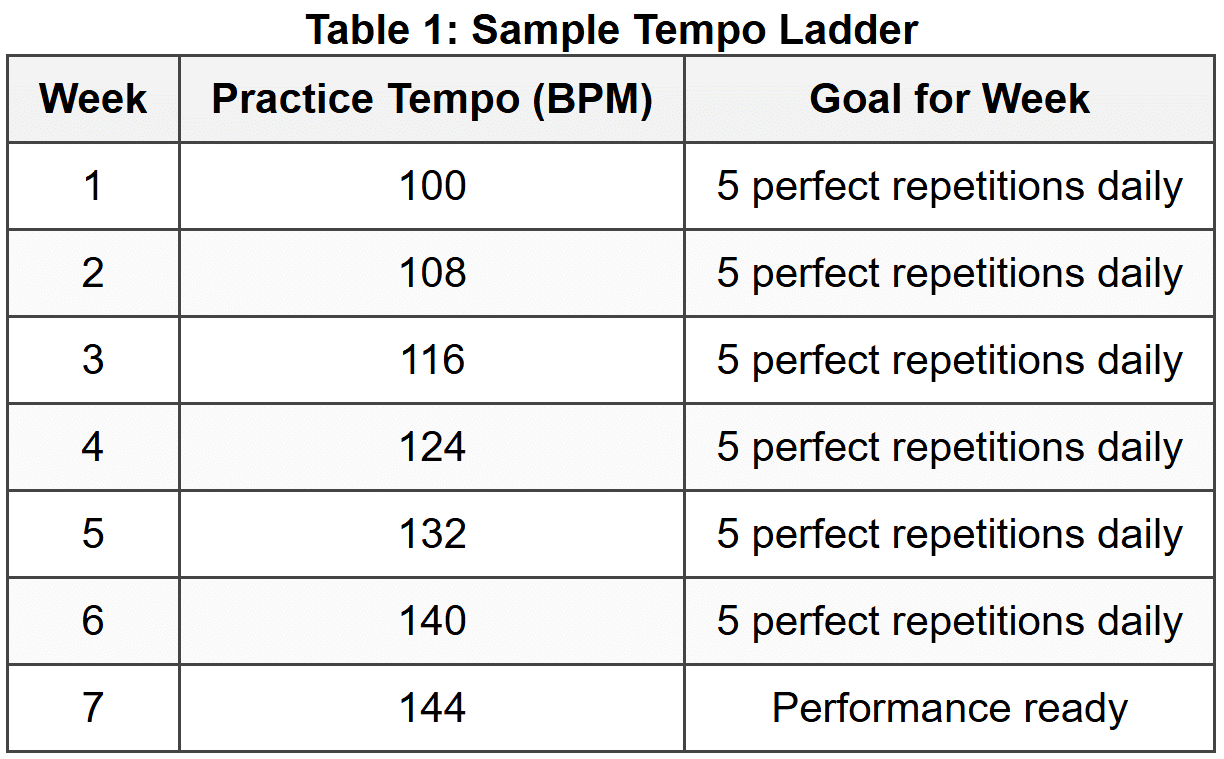
Notice the increases aren't equal-they're approximately 8 BPM each week. Some teachers prefer percentage increases (about 5-8% per step), while others use fixed increments. The key is consistency and patience. Rushing through tempo increases leads to sloppy technique that has to be unlearned later.
4. Working with Different Note Values and Rhythmic Patterns
Not all musical passages move in simple quarter notes. Let's explore how to use the metronome when dealing with more complex rhythmic situations.
4.1 Triplets and Compound Meter
Triplets divide each beat into three equal parts instead of two. Think of the word "tri-pl-et" said evenly-that's the rhythm. You hear this constantly in blues and jazz, like in the shuffle feel of Pride and Joy by Stevie Ray Vaughan.
When practicing triplets with a metronome, you have two options:
- Option 1: Set the metronome to click on each main beat and play three notes per click
- Option 2: Set the metronome to a faster tempo that clicks on each triplet subdivision
For example, if you're working on triplet eighth notes at 80 BPM:
- Option 1: Metronome at 80 BPM, you play three notes per click
- Option 2: Metronome at 240 BPM (80 × 3), you play one note per click
Most musicians find Option 1 more musical because it maintains the sense of the underlying pulse. Option 2 is useful when you're first learning to space triplets evenly, but it can feel mechanical for long practice sessions.
4.2 Syncopation and Off-Beat Patterns
Syncopation-placing emphasis on normally weak beats or between beats-is what makes music groove. Listen to the opening of Superstition by Stevie Wonder or the main riff of Rosanna by Toto. These rhythms land in the spaces between the obvious beats.
The metronome is invaluable for mastering syncopation because it gives you the reference grid. Try this exercise:
- Set your metronome to 80 BPM
- Clap on beats 1 and 3 only (leaving 2 and 4 silent)
- Now clap on beats 2 and 4 only (the "backbeat"-this should feel like most pop and rock music)
- Now clap just before beat 2 and just before beat 4 (this is syncopation)
That last one is tricky, right? That's because your internal sense of where beats 2 and 4 are must be crystal clear before you can intentionally play just ahead of them. The metronome develops this clarity.
4.3 Polyrhythms and Cross-Rhythms
When you're ready for an advanced challenge, try practicing polyrhythms with the metronome. A polyrhythm is when two different rhythmic patterns happen simultaneously, like three against two (common in African music and works by composers like Brahms) or four against three.
To practice three-against-two:
- Set metronome to 60 BPM
- Tap three evenly-spaced notes with your right hand across two clicks (triplets at the half-note level)
- Tap two evenly-spaced notes with your left hand (one on each click)
- The patterns: Right hand = "1-2-3, 1-2-3" while Left hand = "1---2---"
This is genuinely difficult and might take weeks to master. But the metronome gives you the steady framework that makes it possible to hear when your two hands align correctly.
5. Troubleshooting Common Metronome Challenges
Even with good technique, you'll encounter specific problems when working with a metronome. Let's address the most common ones.
5.1 "I Keep Rushing or Dragging"
If you consistently play ahead of the beat (rushing) or behind it (dragging), first identify which one is your tendency. Record yourself playing with the metronome, then listen back. Most people are surprised by what they hear.
For rushers:
- Focus on the release of each note, not just the attack-many rushers think about starting the next note before finishing the current one
- Practice deliberately playing slightly behind the beat in practice (you'll probably land right on it)
- Work at slower tempos with more space between notes
For draggers:
- Check your physical tension-dragging often comes from trying too hard or using inefficient technique
- Practice with subdivisions so you're always thinking ahead to the next note
- Use brighter, more articulated attacks to help your notes speak on time
5.2 "The Metronome Throws Off My Rhythm"
This usually means you're trying to follow the metronome with your conscious mind instead of feeling it as a pulse. The metronome should fade into the background of your awareness, like the rhythm section in a band.
Try this reframe: Don't play to the metronome. Play with the metronome. You're not a follower; you're an equal partner in creating the pulse. Sometimes try playing slightly louder than the metronome so your brain prioritizes your own sound.
5.3 "I Can't Hear the Clicks in Fast Passages"
When you're playing rapid notes, the metronome clicks can get lost in the texture. This is actually a sign you're ready to move to larger beat divisions. If you're practicing sixteenth notes at 120 BPM (8 notes per click), try setting the metronome to only click on beats 1 and 3, or only on beat 1 of each measure.
This forces you to internalize the subdivisions rather than relying on hearing every single beat. Jazz musicians often practice this way-setting the metronome to click only on beats 2 and 4 (the "jazz ride pattern") rather than on every quarter note.
5.4 "Different Parts of My Piece Need Different Tempos"
Many pieces, especially in classical and contemporary music, include tempo changes (rubato, ritardando, accelerando). You might wonder how to practice these with a metronome.
The answer: practice each section at its own steady tempo first. Don't add the tempo changes until each section is solid. Then, practice the transitions between sections without the metronome, but check your end tempo by starting the metronome again to see if you've drifted.
For example, in Clair de Lune by Debussy, there are numerous tempo fluctuations. Practice the opening section at a steady 72 BPM until it's secure. Practice the faster middle section at 88 BPM. Only then add the gradual transitions between these tempos.
6. Beyond Basic Practice: Advanced Metronome Applications
Once you're comfortable with fundamental metronome use, these advanced techniques will take your timing precision to a professional level.
6.1 Metric Modulation and Tempo Relationships
Metric modulation is when the duration of a note value in one tempo becomes a different note value in a new tempo. This sounds abstract, but you hear it in many contemporary pieces and in the work of composers like Elliott Carter.
Here's a practical example: You're playing eighth notes at 120 BPM. Each eighth note is exactly 0.25 seconds long. Now you want those eighth notes to become quarter notes in a new tempo. Simple math: 120 BPM ÷ 2 = 60 BPM in the new section.
Practice this with a metronome by:
- Playing eighth notes at 120 BPM for four measures
- Changing the metronome to 60 BPM
- Continuing with the same physical rhythm (it's now quarter notes)
Your hand moves at exactly the same speed; only the relationship to the click changes. This develops sophisticated tempo awareness used in complex classical pieces and progressive rock like the works of bands such as Tool or Dream Theater.
6.2 Odd Meters and Asymmetrical Patterns
Most Western music uses even meters-time signatures where beats group in twos, threes, or fours. But music from the Balkans, parts of India, and contemporary classical and jazz often uses odd meters like 5/4, 7/8, or 11/8.
A famous example is Take Five by Dave Brubeck, which is in 5/4 time. Each measure has five quarter note beats, typically felt as a group of three plus a group of two: "1-2-3, 1-2" or sometimes "1-2, 1-2-3."
To practice odd meters with a metronome:
- Set the time signature appropriately (if your metronome allows it)
- Count out loud with the groupings: "1-2-3, 1-2" for 5/4
- Clap or tap the pattern until it feels natural
- Then play your musical passage within that framework
Another example: Money by Pink Floyd uses 7/4 time in the verses, felt as "1-2-3-4, 1-2-3." The metronome keeps you honest-without it, you might unconsciously add or drop a beat to make the meter feel more regular.
6.3 Building Ensemble Skills with a Click Track
If you play in a band or ensemble, practice recording yourself playing along with a metronome click track. This simulates the studio recording experience where click tracks are standard.
Modern recording software makes this easy. Set up a click track in a simple program like GarageBand or Audacity, record yourself playing along, then listen back critically. Can you hear any places where you drift from the click? This is exactly what studio engineers and producers listen for.
Professional musicians in Nashville, Los Angeles, and London recording sessions are hired partly because of their ability to lock in perfectly with a click track while still playing musically and expressively. If you aspire to session work or professional recording, this skill is non-negotiable.
7. Integrating Musicality with Mechanical Precision
Here's the part that matters most: the metronome is a tool for developing timing accuracy, but music is not a mechanical exercise. Your ultimate goal is to play with rhythmic confidence that allows you to be expressive, not robotic.
7.1 The Concept of "Playing in the Pocket"
Professional musicians talk about playing "in the pocket"-a groove so solid that the time feel is unmistakable but not stiff. Think of the drumming on Billie Jean by Michael Jackson or the bass line in Come Together by The Beatles. These parts are incredibly steady but feel alive, not mechanical.
The metronome teaches you where the exact center of the beat is. Once you know that, you can choose to play slightly ahead (which creates urgency and energy), slightly behind (which creates laid-back coolness), or right on top (which creates power and drive). But you can only make these musical choices if you know where "on time" actually is.
Try this: Play a simple groove or phrase exactly on the click for four measures. Then play it for four measures where you intentionally place each note a tiny bit late. Then four measures a tiny bit early. Record all three versions and listen back. You'll hear how different they feel, even though the notes are identical. This is the art behind the science.
7.2 When to Practice Without the Metronome
Yes, there are times to put the metronome away. Here's when:
- When exploring a new piece: Let your musical intuition guide your first read-through. Feel where the natural phrases breathe.
- When working on expression: After a passage is rhythmically solid, practice it with rubato, dynamics, and interpretive freedom.
- When performing: In most performance contexts (except studio recording), you won't have a click track. Your performance should come from internalized pulse, not external timekeeping.
- When your ears need rest: If you've been practicing with a click for 45 minutes straight, take a break. Mental fatigue leads to diminishing returns.
Think of the metronome like training wheels on a bicycle. They help you develop balance and confidence, but eventually you need to ride without them. The difference is that even professional cyclists might occasionally use training equipment to work on specific skills-and similarly, professional musicians return to the metronome regularly to maintain their timing precision.
7.3 Listening to Great Time Feel in Recorded Music
One of the best ways to develop your time feel is to listen analytically to musicians known for superb rhythm. Here are some suggestions across genres:
- Jazz: Listen to Tony Williams on Miles Smiles by Miles Davis-his ride cymbal is like a metronome, but it swings
- Rock: Listen to John Bonham's drums on Led Zeppelin II-powerful and precise without being stiff
- Classical: Listen to András Schiff playing Bach's Goldberg Variations-the pulse is clear even in the slowest variations
- Funk: Listen to anything by James Brown's band or Parliament-Funkadelic-the "one" is so strong you could set a watch by it
- Electronic: Listen to Daft Punk's Random Access Memories-even though much of it was performed by live musicians, the time feel is extraordinarily tight
As you listen, try tapping along with the pulse. Notice how the time feel is both perfectly steady and completely human. That's your goal.
8. Creating a Long-Term Metronome Practice Routine
To make lasting improvements in your timing, you need a consistent approach over weeks and months, not just sporadic metronome use.
8.1 Daily Rhythm Fundamentals
Consider dedicating the first 10 minutes of every practice session to pure rhythmic work with the metronome. Here's a sample routine:
- Minutes 1-2: Play quarter notes at 60 BPM (warm up your internal clock)
- Minutes 3-4: Play eighth notes at 60 BPM (2 notes per click)
- Minutes 5-6: Play triplets at 60 BPM (3 notes per click)
- Minutes 7-8: Play sixteenth notes at 60 BPM (4 notes per click)
- Minutes 9-10: Play syncopated rhythms or patterns from your current repertoire
This might seem basic, but it's the musical equivalent of an athlete doing foundational conditioning. Professional orchestral musicians often start their day with exactly this kind of routine, using scales or technical exercises as the vehicle for rhythmic precision.
8.2 Tracking Your Progress
Keep a practice journal that tracks your maximum reliable tempo for key passages. Every week or two, test yourself to see if you can bump up by 4-8 BPM. Your journal might look like this:
Passage: Bach Prelude in C Major, measure 1-8
Jan 15: Clean at 80 BPM
Jan 22: Clean at 88 BPM
Jan 29: Clean at 92 BPM
Feb 5: Clean at 100 BPM (goal tempo reached!)
This documentation does two things: it shows you concrete progress (which is motivating) and it prevents you from practicing ineffectively at tempos you're not ready for.
8.3 Seasonal Goals and Plateau Periods
Understand that progress isn't always linear. You might improve 20 BPM in three weeks, then struggle to add 4 BPM over the next two weeks. This is normal. Your brain and muscles are consolidating skills during these plateau periods.
When you hit a plateau:
- Stay at the current tempo for a full week, focusing on tone quality and relaxation
- Practice the passage in different rhythmic patterns (dotted rhythms, reverse dotted, triplets)
- Record yourself and listen for any technical inefficiencies that might be limiting your speed
- Take a few days completely away from that passage, then return to it fresh
Often, you'll find that after a short break, you can suddenly play at a tempo that was impossible before. This is your neurology doing its work while you rest.
Key Terms
- Beats Per Minute (BPM)
- The measurement of tempo indicating how many beats occur in one minute. A metronome set to 60 BPM produces one click per second.
- Click Track
- An electronic metronome used in recording studios to keep all musicians synchronized during a session. Also called a "click."
- Downbeat
- The first beat of a measure, typically the strongest emphasis point in the metric cycle. In 4/4 time, this is beat one.
- Internal Clock
- A musician's internalized sense of steady tempo that allows them to maintain consistent timing without external reference.
- Metric Modulation
- A technique where a note value in one tempo becomes a different note value in a new tempo, creating a mathematical relationship between two different speeds.
- Playing in the Pocket
- A term describing rhythmically accurate playing that feels natural and grooves well, with strong but not mechanical time feel.
- Rubato
- An expressive musical technique involving flexible, free tempo-speeding up and slowing down for artistic effect. The Italian word means "robbed time."
- Subdivision
- The smaller rhythmic values that exist between the main beats. For example, eighth notes are subdivisions of quarter note beats.
- Syncopation
- Rhythmic emphasis on beats or parts of beats that are normally weak or unaccented, creating a sense of rhythmic surprise or forward momentum.
- Tempo
- The speed or pace of music, usually measured in beats per minute. Tempo can range from very slow (largo, around 40-60 BPM) to very fast (presto, around 168-200 BPM).
- Time Signature
- The notation indicating how many beats are in each measure and what note value receives one beat. Written as a fraction-like symbol such as 4/4, 3/4, or 6/8.
- Triplet
- A group of three notes played in the time normally occupied by two notes of the same value. Divides a beat into three equal parts instead of two.
FAQs on Using a Metronome Effectively
| 1. What is the primary function of a metronome in music practice? |  |
| 2. How can I set up my metronome for successful practice? | |
| 3. What are some progressive practice techniques that can be used with a metronome? | |
| 4. How can I effectively work with different note values and rhythmic patterns using a metronome? | |
| 5. What common challenges may arise when using a metronome, and how can they be resolved? | |