Seventh Chords


1. What Makes a Seventh Chord Different
You've probably heard plenty of triads in your life-they're the basic three-note chords that form the backbone of almost all popular music. Think of the opening chords of The Beatles' Let It Be or the strumming pattern in Tracy Chapman's Fast Car. These are triads: root, third, and fifth stacked together.
Now imagine adding one more note on top. That's exactly what a seventh chord is: a triad with an additional note stacked a seventh above the root. This extra note transforms the sound completely. Where triads feel stable and complete, seventh chords bring colour, tension, and sophistication. They create movement-they want to resolve somewhere. They make music feel richer, jazzier, more complex.
Let's make this concrete. If you build a C major triad, you have C-E-G. Now add a B on top, and you've got C-E-G-B. That's a C major seventh chord. Play these notes on a piano or guitar, and you'll immediately hear a dreamy, lush quality-think of the opening piano chords in Alicia Keys' No One or the smooth sound of any classic jazz ballad.
A seventh chord = a triad + a note that's a seventh interval above the root
The "seventh" name comes from counting interval steps from the root note. From C up to B is seven letter names: C(1)-D(2)-E(3)-F(4)-G(5)-A(6)-B(7). That B is the seventh, and it completes the chord.
2. The Four Main Types of Seventh Chords
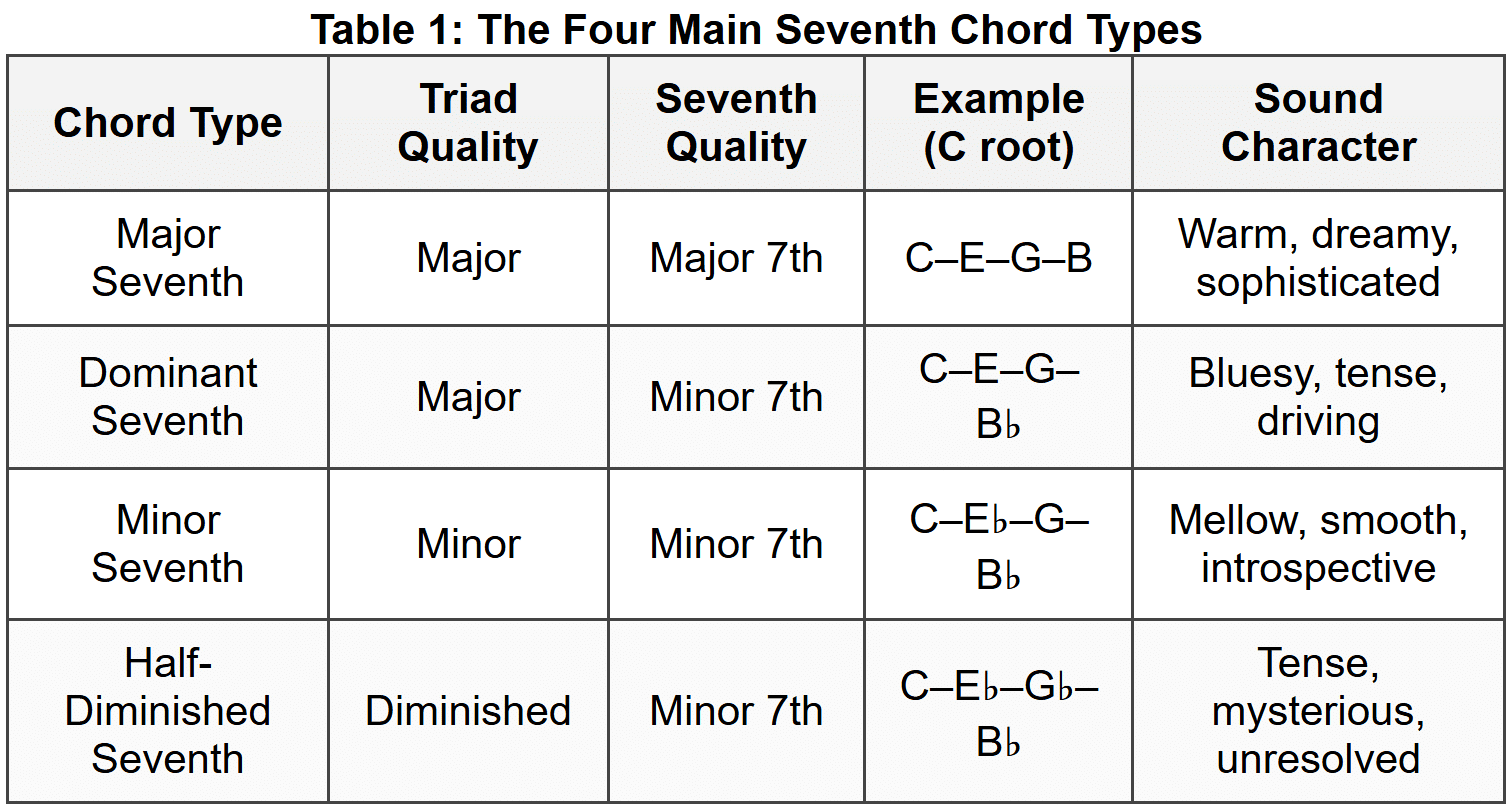
Not all seventh chords sound the same. Depending on which type of triad you start with and which type of seventh you add, you get different flavours. There are four essential types you need to know, and each has its own personality and role in music.
2.1. Major Seventh Chord
Start with a major triad and add a major seventh above the root. In C, that's C-E-G-B. This chord sounds warm, dreamy, and sophisticated. It's everywhere in jazz, R&B, and soul music.
Listen to the opening chord of Isn't She Lovely by Stevie Wonder-that's a major seventh. Or the verse chords in Frank Sinatra's Fly Me to the Moon. These chords don't scream for resolution; they luxuriate in their sound.
Formula: Root + Major 3rd + Perfect 5th + Major 7th
Interval structure from the root: Major 3rd, Perfect 5th, Major 7th
Example: C major 7 = C-E-G-B
2.2. Dominant Seventh Chord
Take a major triad but add a minor seventh instead. In C, that's C-E-G-B♭. This is the workhorse of tonal harmony-the chord that creates tension and demands resolution. It sounds bluesy, driving, and urgent.
The dominant seventh is the backbone of the blues. Listen to the opening riff of Chuck Berry's Johnny B. Goode-those are dominant seventh chords. Or the famous turnaround in a twelve-bar blues progression. This chord is restless; it wants to move to a resolution chord, usually a perfect fourth above (C7 wants to resolve to F, or G7 wants to resolve to C).
Formula: Root + Major 3rd + Perfect 5th + Minor 7th
Interval structure from the root: Major 3rd, Perfect 5th, Minor 7th
Example: C dominant 7 (C7) = C-E-G-B♭
2.3. Minor Seventh Chord
Build a minor triad and add a minor seventh. In C, that's C-E♭-G-B♭. This chord sounds mellow, introspective, and smooth. It's softer than the dominant seventh and less bright than the major seventh.
You hear minor seventh chords constantly in jazz and funk. The verse of So What by Miles Davis is built almost entirely on minor seventh chords. The intro to Daft Punk's Get Lucky uses minor seventh chords to create that smooth, groovy feel.
Formula: Root + Minor 3rd + Perfect 5th + Minor 7th
Interval structure from the root: Minor 3rd, Perfect 5th, Minor 7th
Example: C minor 7 (Cm7) = C-E♭-G-B♭
2.4. Half-Diminished Seventh Chord
Start with a diminished triad (root, minor third, diminished fifth) and add a minor seventh. In C, that's C-E♭-G♭-B♭. This chord sounds tense, ambiguous, and unresolved-even more so than the dominant seventh.
The half-diminished seventh often appears in minor keys and in jazz harmony. It's the chord that gives film noir soundtracks their mysterious edge. You'll hear it in the bridge of My Funny Valentine or in the harmonic progressions of Radiohead's more adventurous songs.
Formula: Root + Minor 3rd + Diminished 5th + Minor 7th
Interval structure from the root: Minor 3rd, Diminished 5th, Minor 7th
Example: C half-diminished 7 (Cø7 or Cm7♭5) = C-E♭-G♭-B♭
There's also a fully diminished seventh chord (diminished triad + diminished seventh), which we'll touch on shortly, but these four types are your foundation.
3. Building Seventh Chords from Any Root
Let's get practical. You can build any of these seventh chords from any root note, as long as you follow the interval formulas. Think of it like a recipe: the intervals are your ingredients, and the root is your starting point.
3.1. Using Interval Stacking
The most reliable method is to stack intervals upward from the root. Let's build a G dominant seventh chord:
- Start with G as the root.
- Add a major third above G: count up four half-steps (semitones) to get B.
- Add a perfect fifth above G: count up seven half-steps to get D.
- Add a minor seventh above G: count up ten half-steps to get F.
Result: G7 = G-B-D-F. Try playing this on a piano. You'll recognize it instantly-it's the chord that wants to resolve to C major.
3.2. Using Scale Degrees
Another approach is to think in terms of scale degrees. If you know the major scale of your root note, you can pick out the right notes:
- Major seventh chord: 1-3-5-7 of the major scale
- Dominant seventh chord: 1-3-5-♭7 (lower the 7th by a half-step)
- Minor seventh chord: 1-♭3-5-♭7 (lower the 3rd and 7th)
- Half-diminished seventh chord: 1-♭3-♭5-♭7 (lower the 3rd, 5th, and 7th)
For example, let's build an A minor seventh chord. The A major scale is A-B-C♯-D-E-F♯-G♯. For Am7, we want 1-♭3-5-♭7:
- 1 = A
- ♭3 = C (C♯ lowered by a half-step)
- 5 = E
- ♭7 = G (G♯ lowered by a half-step)
Result: Am7 = A-C-E-G.
3.3. Try This Exercise
Pick a root note-let's say D. Now build all four types of seventh chords starting on D:
- D major 7: D-F♯-A-C♯
- D dominant 7 (D7): D-F♯-A-C
- D minor 7 (Dm7): D-F-A-C
- D half-diminished 7 (Dø7): D-F-A♭-C
If you have an instrument nearby, play each one and listen to how they differ. Notice how the character changes completely with just one or two altered notes.
4. Seventh Chords in Harmonic Progressions
Seventh chords aren't just pretty sounds-they have functional roles in harmony. They drive progressions forward, create tension and release, and establish tonal centers.
4.1. The Dominant Seventh and Resolution
The most important functional seventh chord is the dominant seventh. In any major or minor key, the chord built on the fifth scale degree (the dominant) naturally wants to resolve to the tonic (the first scale degree).
In the key of C major, the dominant is G. A G7 chord (G-B-D-F) contains two notes that create powerful tension:
- The B (the major third of G7) is the leading tone of C major-it wants to rise to C.
- The F (the minor seventh of G7) wants to fall to E, the third of the C chord.
This double pull creates irresistible forward motion. Listen to almost any Beatles song-Let It Be, Hey Jude, I Want to Hold Your Hand-and you'll hear G7 resolving to C major over and over again.
The dominant seventh chord is the engine of tonal harmony. It creates tension that can only be satisfied by resolution to the tonic.
4.2. The II-V-I Progression
In jazz and sophisticated pop music, one progression rules them all: II-V-I. In the key of C major, that's:
- Dm7 (the II chord, a minor seventh)
- G7 (the V chord, a dominant seventh)
- Cmaj7 (the I chord, a major seventh)
This progression is the DNA of jazz standards. You'll hear it in Autumn Leaves, Fly Me to the Moon, All the Things You Are, and countless others. The minor seventh on II sets up the dominant seventh on V, which resolves beautifully to the major seventh on I.
Try playing or singing this progression slowly: Dm7 → G7 → Cmaj7. Notice how each chord leads inevitably to the next. That's the magic of seventh chord progressions.
4.3. Diatonic Seventh Chords
You can build a seventh chord on every degree of the major scale. These are called diatonic seventh chords, and each has a specific quality:
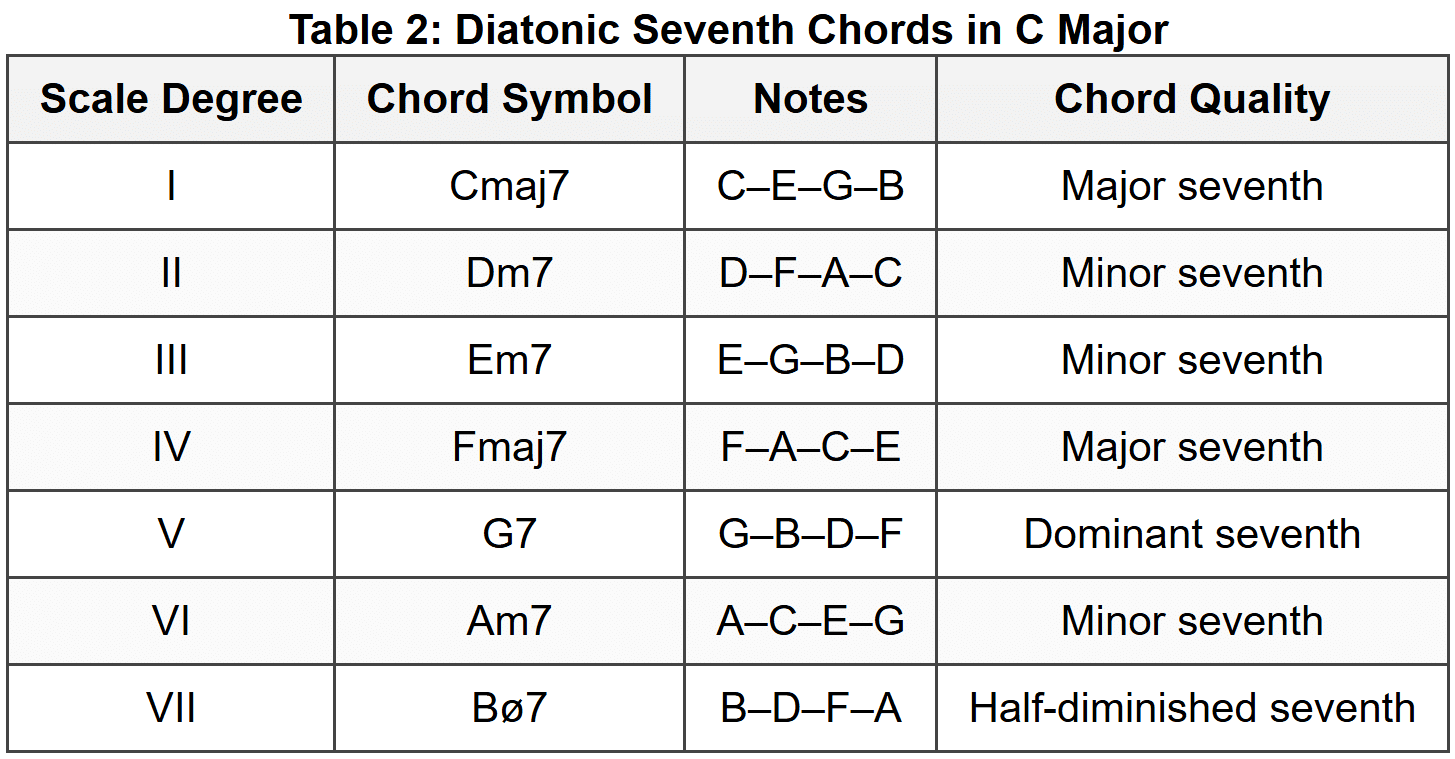
Notice the pattern: major seventh chords appear on I and IV, minor seventh chords on II, III, and VI, a dominant seventh on V, and a half-diminished seventh on VII. This pattern is the same in every major key-just transpose the root notes.
Understanding this pattern allows you to harmonize melodies with seventh chords, reharmonize existing songs, and compose richer progressions.
5. Inversions of Seventh Chords
Just like triads, seventh chords can be inverted-you can rearrange which note appears in the bass. Since a seventh chord has four notes, it has three possible inversions plus the root position.
5.1. Root Position
The root is in the bass. For Cmaj7, the notes from bottom to top are C-E-G-B. This is the most stable, clear sound.
5.2. First Inversion
The third is in the bass. For Cmaj7, that's E-G-B-C. The sound is lighter and more open, often used for smoother bass lines.
5.3. Second Inversion
The fifth is in the bass. For Cmaj7, that's G-B-C-E. This inversion can sound ambiguous or transitional-useful for voice leading.
5.4. Third Inversion
The seventh is in the bass. For Cmaj7, that's B-C-E-G. This is the most unstable inversion, often used to create tension or drive toward a resolution.
Inversions are crucial for creating smooth, singable bass lines. Instead of the bass jumping around awkwardly, you can use inversions to make stepwise or small-interval motion. Listen to the bass line in God Only Knows by The Beach Boys or any Bach chorale-inversions are everywhere.
6. Voice Leading with Seventh Chords
When you move from one seventh chord to another, you want each individual note (each "voice") to move as smoothly as possible. This is called voice leading, and it's what separates clunky chord progressions from elegant, flowing ones.
6.1. Common Tones
If two chords share a note, keep that note in the same voice. For example, moving from Cmaj7 (C-E-G-B) to Fmaj7 (F-A-C-E):
- C is common to both-keep it stationary.
- E is common to both-keep it stationary.
- G moves to F (down a step).
- B moves to A (down a step).
This creates smooth, connected motion rather than four voices all jumping around.
6.2. Stepwise Motion
When notes do need to move, aim for stepwise motion (moving by a second) rather than leaps. In the classic II-V-I progression (Dm7 → G7 → Cmaj7), look at how efficiently the voices can move:
- Dm7: D-F-A-C
- G7: D-F-G-B (only two notes move, both by step)
- Cmaj7: C-E-G-B (two notes stay, two move by step)
This minimal motion creates a seamless, professional sound. You hear this in jazz piano voicings, in string quartet writing, and in sophisticated pop arrangements.
7. Diminished Seventh Chords
We've mentioned the half-diminished seventh, but there's another important diminished chord: the fully diminished seventh. Build a diminished triad and add a diminished seventh (which is enharmonically the same as a major sixth). In C, that's C-E♭-G♭-B♭♭ (which sounds the same as A).
This chord has a unique property: it's symmetrical. Every interval between adjacent notes is a minor third (three half-steps). This means a diminished seventh chord can function in multiple keys simultaneously. Cdim7, E♭dim7, G♭dim7, and Adim7 all contain the exact same notes-just rearranged.
The fully diminished seventh sounds spooky, tense, and dramatic. You hear it in horror film scores, in moments of suspense, and as a passing chord in jazz and classical music. Listen to the bridge of Michelle by The Beatles or the chord progressions in many Chopin nocturnes.
Formula: Root + Minor 3rd + Diminished 5th + Diminished 7th
Example: Cdim7 = C-E♭-G♭-A (or B♭♭)
8. Chord Symbols and Notation
When you see seventh chords written in lead sheets or chord charts, they use specific symbols. Let's decode them:
- Cmaj7 or CΔ7 or CM7 = C major seventh (C-E-G-B)
- C7 = C dominant seventh (C-E-G-B♭)
- Cm7 or C-7 = C minor seventh (C-E♭-G-B♭)
- Cø7 or Cm7♭5 = C half-diminished seventh (C-E♭-G♭-B♭)
- Cdim7 or C°7 = C fully diminished seventh (C-E♭-G♭-A)
Sometimes you'll see additional numbers or symbols indicating inversions or added notes, but these are your basics. Once you know these, you can read and play from almost any jazz or pop chart.
9. Seventh Chords in Different Styles
Let's connect all this theory to real music you can listen to right now.
9.1. Jazz
Seventh chords are the default in jazz. Triads sound too plain, too simple. Listen to any recording by Miles Davis, John Coltrane, Bill Evans, or Ella Fitzgerald, and you'll hear seventh chords in nearly every measure. The standard Autumn Leaves uses almost exclusively seventh chords throughout.
9.2. Blues
The dominant seventh is king in blues. A twelve-bar blues in the key of C uses C7, F7, and G7 as its core chords. Listen to B.B. King's The Thrill Is Gone or Muddy Waters' Hoochie Coochie Man-dominant sevenths everywhere, creating that gritty, bluesy edge.
9.3. R&B and Soul
Major seventh and minor seventh chords give R&B its smooth, lush sound. Listen to D'Angelo's Untitled (How Does It Feel), Erykah Badu's On & On, or any Marvin Gaye ballad. Those warm, rich harmonies come from sophisticated use of seventh chords.
9.4. Classical
In classical music, the dominant seventh has been essential since the Baroque era. Bach, Mozart, Beethoven-they all used the V7 to I resolution constantly. Listen to the final cadence of almost any classical piece, and you'll hear it. The half-diminished seventh appears frequently in Romantic-era music-Chopin, Brahms, and Wagner used it to create ambiguity and longing.
9.5. Pop and Rock
Pop and rock use seventh chords more selectively, but when they do, it's powerful. The Beatles were masters: Something uses major sevenths, A Day in the Life features dominant sevenths. Radiohead's Karma Police and Coldplay's The Scientist both use seventh chords to add emotional depth.
10. Practical Application and Exercises
Now it's time to get these chords into your ears and fingers.
10.1. Listening Exercise
Listen to the opening 30 seconds of each of these songs and identify the seventh chord quality you hear:
- Fly Me to the Moon by Frank Sinatra (major sevenths)
- Isn't She Lovely by Stevie Wonder (major sevenths)
- Sweet Home Chicago by Robert Johnson (dominant sevenths)
- So What by Miles Davis (minor sevenths)
Don't just hear them as chords-notice how they feel. What mood does each create?
10.2. Playing Exercise
If you play piano or guitar, learn to play these four seventh chords in the key of C:
- Cmaj7
- C7
- Cm7
- Cø7
Play them one after another, slowly. Listen to the character of each. Then try the same exercise starting on G, then on F, then on D. Build the muscle memory and the ear training simultaneously.
10.3. Progression Exercise
Play a simple II-V-I progression in C major using seventh chords:
Dm7 → G7 → Cmaj7
Now try it in other keys:
- In G major: Am7 → D7 → Gmaj7
- In F major: Gm7 → C7 → Fmaj7
This is one progression you can use in hundreds of musical contexts. Master it, and you've unlocked a huge chunk of jazz and sophisticated pop harmony.
11. Extended and Altered Seventh Chords
Once you're comfortable with basic seventh chords, you can explore extensions and alterations. These add even more colour and complexity.
11.1. Ninth Chords
Add a note a ninth above the root (which is the same as a second, just an octave higher). A C9 chord is C-E-G-B♭-D. This is a dominant seventh with an added ninth. You hear ninth chords in jazz, funk, and gospel constantly-listen to Herbie Hancock's Chameleon or any James Brown tune.
11.2. Eleventh and Thirteenth Chords
Keep stacking thirds and you get eleventh chords (add an F to C9, giving C-E-G-B♭-D-F) and thirteenth chords (add an A, giving C-E-G-B♭-D-F-A). These chords are dense and colourful, often used in jazz and Brazilian music.
11.3. Altered Chords
You can also alter the fifth or ninth by raising or lowering it by a half-step. A C7♯5 chord is C-E-G♯-B♭. A C7♭9 is C-E-G-B♭-D♭. These altered chords create dissonance and tension, perfect for moments of drama or instability. You hear them in bebop jazz and in film scores.
Key Terms
- Seventh Chord
- A four-note chord consisting of a triad plus a note a seventh interval above the root.
- Major Seventh Chord
- A major triad with a major seventh added (e.g., C-E-G-B); sounds warm and sophisticated.
- Dominant Seventh Chord
- A major triad with a minor seventh added (e.g., C-E-G-B♭); creates tension and drives toward resolution.
- Minor Seventh Chord
- A minor triad with a minor seventh added (e.g., C-E♭-G-B♭); sounds mellow and smooth.
- Half-Diminished Seventh Chord
- A diminished triad with a minor seventh added (e.g., C-E♭-G♭-B♭); sounds tense and ambiguous.
- Fully Diminished Seventh Chord
- A diminished triad with a diminished seventh added (e.g., C-E♭-G♭-A); symmetrical and dramatic sounding.
- Diatonic Seventh Chords
- The set of seventh chords built on each degree of a major or minor scale, using only notes from that scale.
- Inversion
- A rearrangement of a chord's notes so that a note other than the root appears in the bass.
- Voice Leading
- The smooth, logical movement of individual notes (voices) from one chord to the next, often emphasizing stepwise motion and common tones.
- II-V-I Progression
- A fundamental chord progression in jazz and tonal music, moving from the supertonic (II) to the dominant (V) to the tonic (I), typically using seventh chords.
- Common Tone
- A note that appears in two consecutive chords, typically held in the same voice to create smooth voice leading.
- Extensions
- Notes added to seventh chords beyond the seventh, such as ninths, elevenths, and thirteenths, creating richer harmonic color.
- Altered Chord
- A chord in which one or more notes (typically the fifth or ninth) are raised or lowered by a half-step to create additional tension or colour.
FAQs on Seventh Chords
| 1. What distinguishes a seventh chord from other chords? |  |
| 2. What are the four main types of seventh chords? | |
| 3. How can seventh chords be built from any root? | |
| 4. What role do seventh chords play in harmonic progressions? | |
| 5. What are the inversions of seventh chords and their significance? | |