Coaching, Consulting & Online Courses


Introduction to Coaching, Consulting & Online Courses
As an influencer builds their personal brand and gains followers, one of the most lucrative ways to monetize that audience is by offering coaching, consulting, or online courses. These monetization methods rely on your expertise, credibility, and the trust you've built with your audience. Unlike sponsored posts or affiliate marketing, these revenue streams are directly controlled by you and can generate substantial, recurring income.
This section will guide you through understanding each monetization method, how to set them up, and best practices for success.
Understanding Coaching as a Monetization Strategy
What is Coaching?
Coaching is a one-on-one or small group service where you provide personalized guidance, support, and accountability to help clients achieve specific goals. As an influencer, you leverage your expertise and personal brand to attract clients who want individualized attention and customized advice.
Coaching typically involves:
- Regular scheduled sessions (weekly, biweekly, or monthly)
- Direct interaction via video calls, phone calls, or in-person meetings
- Personalized action plans tailored to each client's needs
- Ongoing support and accountability check-ins
Types of Coaching Services
Influencers can offer various types of coaching depending on their niche:
- Business Coaching: Helping entrepreneurs grow their businesses, develop strategies, or overcome specific challenges
- Life Coaching: Supporting clients in personal development, goal-setting, or lifestyle changes
- Fitness Coaching: Providing personalized workout plans, nutrition guidance, and motivation
- Career Coaching: Assisting professionals with job transitions, skill development, or career advancement
- Social Media Coaching: Teaching others how to grow their own following and personal brand
Pricing Your Coaching Services
Pricing depends on several factors:
- Your level of expertise and credentials
- The transformation or results you deliver
- Time commitment per client
- Your audience size and engagement level
- Market rates in your niche
Example: A fitness influencer with 50,000 followers might charge $200-500 per month for one-on-one coaching with weekly sessions, while a business influencer with proven results might charge $1,000-5,000+ per month.
Setting Up Your Coaching Business
- Define your coaching offer: Be specific about what clients will receive, the duration, and expected outcomes
- Create a simple application process: Use forms to screen potential clients and ensure they're a good fit
- Set up scheduling systems: Use tools like Calendly or Acuity Scheduling to manage appointments
- Establish payment systems: Accept payments through PayPal, Stripe, or specialized coaching platforms
- Prepare coaching materials: Develop worksheets, templates, and resources to support your sessions
Understanding Consulting as a Monetization Strategy
What is Consulting?
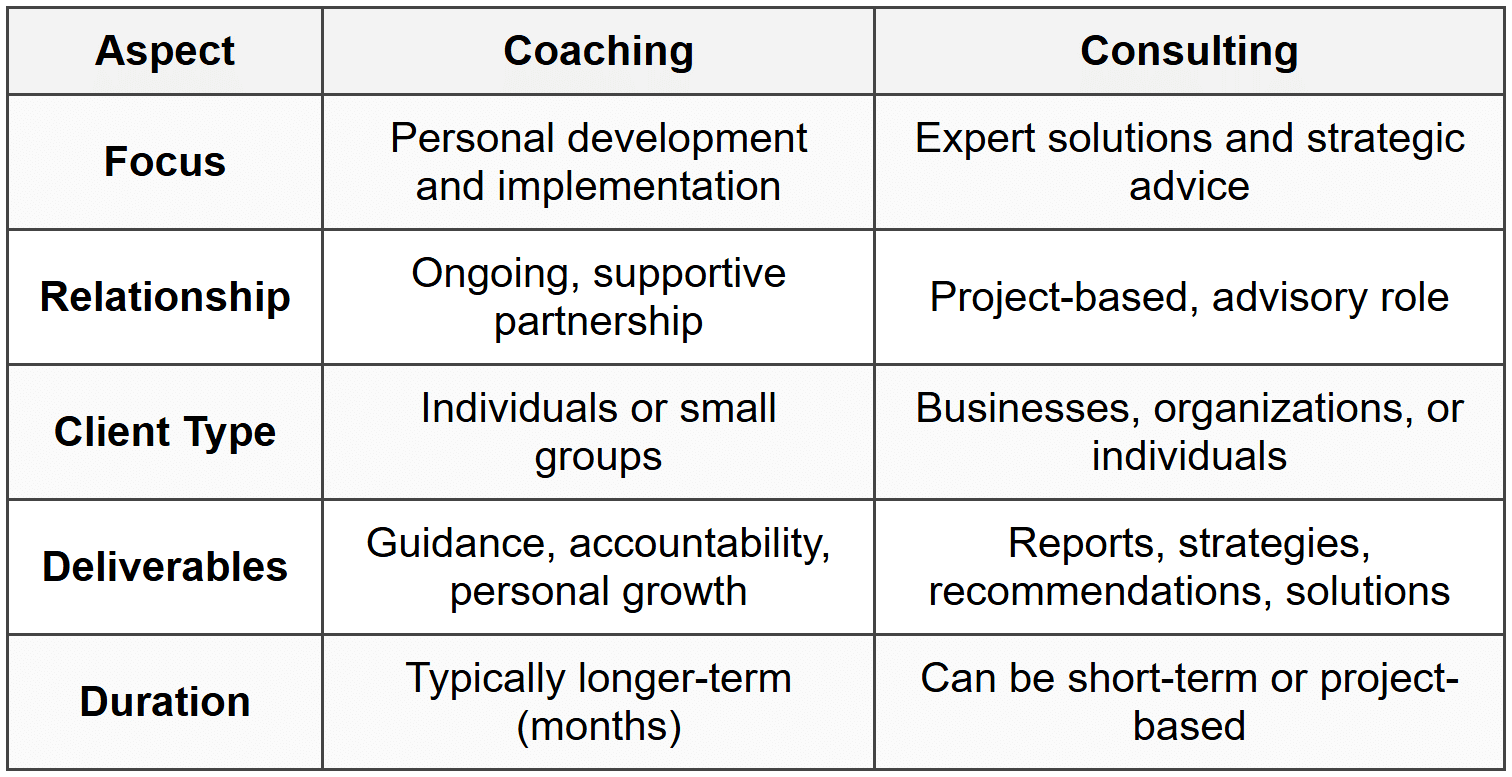
Consulting is a professional service where you provide expert advice, strategic recommendations, and solutions to businesses or individuals facing specific challenges. Unlike coaching (which focuses on personal development and implementation), consulting is more specialized and often project-based.
Consulting typically involves:
- Analyzing a client's current situation or problem
- Providing expert recommendations and strategic plans
- Delivering actionable solutions based on your specialized knowledge
- May include implementation support or hands-on work
Types of Consulting Services
Influencers can offer consulting in their area of expertise:
- Social Media Consulting: Auditing accounts, developing content strategies, advising on platform algorithms
- Brand Consulting: Helping businesses develop their brand identity, messaging, or positioning
- Marketing Consulting: Creating marketing strategies, campaign planning, or audience analysis
- Content Consulting: Advising on content creation, storytelling, or content calendars
- Influencer Strategy Consulting: Teaching brands how to work with influencers effectively
Differences Between Coaching and Consulting
Pricing Your Consulting Services
Consulting typically commands higher rates than coaching due to specialized expertise:
- Hourly rates: $100-$500+ per hour depending on expertise and niche
- Project-based fees: $2,000-$20,000+ for complete projects or audits
- Retainer agreements: Monthly fees of $3,000-$10,000+ for ongoing advisory services
Example: A social media influencer with expertise in Instagram growth might offer a comprehensive audit and 3-month strategy for $5,000, while an hourly consultation might cost $250 per hour.
Setting Up Your Consulting Business
- Package your expertise: Create clear consulting packages with defined deliverables
- Develop case studies: Document your results and successes to attract clients
- Create proposal templates: Prepare professional proposals that outline scope, timeline, and costs
- Establish contracts: Use clear agreements that protect both you and your clients
- Build a portfolio: Showcase your work, testimonials, and measurable results
Understanding Online Courses as a Monetization Strategy
What are Online Courses?
Online courses are pre-recorded educational programs that teach specific skills, knowledge, or processes to students. They allow you to package your expertise once and sell it repeatedly to unlimited students, creating a scalable income stream that doesn't require ongoing one-on-one time.
Online courses typically include:
- Video lessons organized into modules or chapters
- Downloadable resources like worksheets, templates, or guides
- Quizzes or assessments to test understanding
- Community access or student support (optional)
- Lifetime or time-limited access to content
Benefits of Creating Online Courses
- Scalability: Create content once, sell to thousands of students
- Passive income potential: Earn money while you sleep
- Time leverage: No limit to how many students you can serve simultaneously
- Authority building: Positions you as an expert in your field
- Global reach: Students can access your content from anywhere
- Lower price point: More accessible to your audience than one-on-one services
Types of Online Courses
Influencers can create various course formats:
- Mini-courses: Short courses (1-3 hours) focusing on a specific skill, typically priced $27-$97
- Signature courses: Comprehensive programs (10-30+ hours) covering a complete system or transformation, priced $200-$2,000+
- Membership programs: Ongoing access to new content released regularly, priced $20-$200 per month
- Masterclasses: Single in-depth sessions (1-2 hours) on a specialized topic, priced $47-$297
- Certification programs: Advanced training that includes credentials, priced $500-$5,000+
Choosing Your Course Topic
Select a course topic based on:
- Your expertise: What do you know deeply and have proven results in?
- Audience needs: What questions does your audience frequently ask?
- Transformation potential: What specific problem can you solve or result can you deliver?
- Market demand: Is there a willing market for this knowledge?
- Your passion: Are you excited to teach this topic?
Example: A food influencer who frequently gets asked "how do you take such beautiful food photos?" might create a course called "Food Photography Mastery: From Phone to Professional."
Steps to Create Your First Online Course
- Validate your idea: Survey your audience or pre-sell the course to confirm interest
- Outline your curriculum: Break down your topic into logical modules and lessons
- Create your content: Record video lessons, design slides, and prepare downloadable resources
- Choose a platform: Select where you'll host your course (more on this below)
- Set up your course: Upload content, organize modules, and configure settings
- Price your course: Determine pricing based on value, market rates, and your brand
- Create a sales page: Design a compelling page that explains the course benefits and outcomes
- Launch and promote: Announce to your audience using email, social media, and other channels
- Gather feedback: Collect student testimonials and improve your course based on feedback
Course Hosting Platforms
Choose from various platforms to host and sell your course:
- Teachable: User-friendly platform with built-in payment processing and customizable branding
- Kajabi: All-in-one platform including course hosting, email marketing, and sales funnels
- Thinkific: Flexible platform with free tier option and extensive customization
- Podia: Simple platform for courses, memberships, and digital downloads
- Udemy: Marketplace with built-in audience but lower control over pricing and branding
- Your own website: Using WordPress plugins like LearnDash or LifterLMS for complete control
Pricing Your Online Course
Course pricing depends on several factors:
- Value and transformation: The bigger the result, the higher the price
- Course length and depth: More comprehensive courses typically cost more
- Your brand authority: Established influencers can charge premium prices
- Market competition: Research what similar courses cost
- Target audience income level: Price appropriately for who you serve
- Support included: Courses with community access or Q&A sessions can charge more
Common pricing tiers:
- Entry-level courses: $27-$97
- Mid-tier courses: $200-$500
- Premium courses: $500-$2,000
- High-ticket programs: $2,000-$10,000+
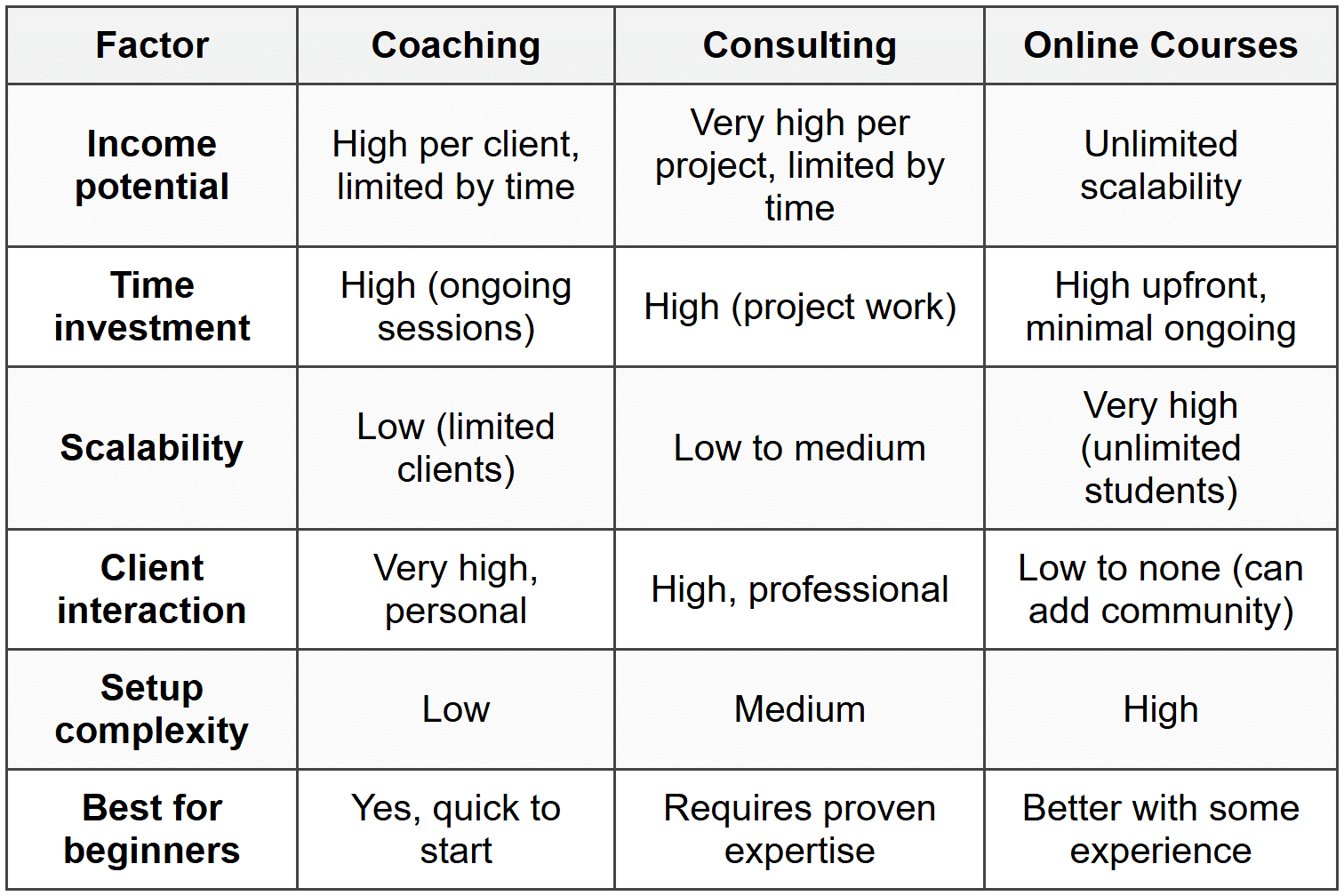
Comparing Coaching, Consulting, and Online Courses
Which Option is Right for You?
Combining Multiple Revenue Streams
Many successful influencers use a value ladder approach, offering multiple products at different price points:
- Entry level: Free content (social media posts, blog articles) to attract audience
- Low-ticket: Mini-course or e-book ($27-$97) to build trust
- Mid-ticket: Comprehensive online course ($200-$500) for deeper learning
- High-ticket: Group coaching program ($1,000-$3,000) for personalized support
- Premium: One-on-one coaching or consulting ($3,000-$10,000+) for transformation
Example: A productivity influencer might offer free tips on Instagram, a $47 time management course, a $997 productivity mastery program, and $5,000 one-on-one executive coaching.
Building Trust and Credibility
Why Trust Matters
Before anyone invests in your coaching, consulting, or courses, they need to trust that you can deliver results. As an influencer, your personal brand is your primary asset, and trust is the currency that converts followers into paying clients.
Ways to Build Credibility
- Share your own results: Document your journey and showcase your achievements
- Feature client testimonials: Display reviews, success stories, and before-after transformations
- Provide free value: Consistently share helpful content that demonstrates your expertise
- Show your process: Give behind-the-scenes looks at how you achieve results
- Be transparent: Share both successes and failures to build authentic connection
- Obtain certifications: Earn relevant credentials in your field when applicable
- Collaborate with other experts: Association with established authorities boosts your credibility
- Publish case studies: Document detailed examples of client transformations
Establishing Yourself as an Expert
Position yourself as the go-to authority in your niche by:
- Consistently creating high-quality educational content
- Speaking at events, webinars, or podcasts
- Publishing articles on respected platforms
- Engaging thoughtfully in community discussions
- Staying current with industry trends and research
Marketing Your Services and Courses
Promoting to Your Existing Audience
Your current followers are your warmest leads. Market to them through:
- Social media announcements: Create excitement with countdown posts, teasers, and launch content
- Email marketing: Build an email list and send targeted campaigns about your offerings
- Stories and live videos: Use Instagram Stories, Facebook Live, or YouTube Live to connect directly
- Free webinars: Host educational sessions that naturally lead to your paid offerings
- Content marketing: Create blog posts, videos, or podcasts that address problems your services solve
Creating Compelling Offers
Structure your offers to maximize conversions:
- Clear transformation: Communicate exactly what clients will achieve
- Specific outcomes: List tangible results, not just features
- Address objections: Answer common concerns like "Will this work for me?" or "What if I'm too busy?"
- Scarcity or urgency: Use limited enrollment periods or bonuses to encourage action
- Money-back guarantee: Reduce risk with satisfaction guarantees when appropriate
- Payment plans: Make higher-priced offerings accessible with installment options
Launch Strategies
Consider these proven launch approaches:
- Evergreen: Course or service available continuously with automated marketing
- Live launch: Open enrollment for limited periods (e.g., once per quarter) with intensive promotion
- Beta launch: Initial offering at discounted rate in exchange for feedback and testimonials
- Waitlist strategy: Build anticipation by collecting interested prospects before official launch
Delivering Exceptional Value
Setting Client Expectations
Clearly communicate from the start:
- What clients will receive and when
- What's required from them (time commitment, participation, etc.)
- How communication will work (response times, office hours, etc.)
- Boundaries around your availability
- Refund or cancellation policies
Creating Great Student/Client Experiences
- Onboarding process: Welcome new clients with clear next steps and orientation materials
- Regular check-ins: Maintain consistent communication and accountability
- Quality materials: Provide professional, well-organized resources
- Celebrate wins: Acknowledge progress and successes along the way
- Request feedback: Continuously improve based on client input
- Over-deliver: Provide bonus resources, unexpected value, or extra support
Gathering and Using Testimonials
Social proof is critical for attracting new clients:
- Request testimonials at natural completion points
- Ask specific questions about results, experiences, and transformations
- Encourage video testimonials when possible (more powerful than text)
- Get permission to use testimonials in marketing materials
- Feature diverse testimonials that address different pain points
Legal and Professional Considerations
Essential Legal Protection
Protect yourself and your business with:
- Contracts or terms of service: Clear agreements outlining services, payment terms, and responsibilities
- Disclaimers: Appropriate disclaimers about results, especially in health, finance, or legal-adjacent niches
- Privacy policy: Required when collecting student/client information
- Refund policy: Clear terms about refunds or cancellations
- Business structure: Consider forming an LLC or other entity for liability protection
Ethical Considerations
Maintain ethical standards by:
- Only teaching what you genuinely know and have experience with
- Being honest about what results clients can expect
- Not making exaggerated income claims or promises
- Respecting client confidentiality
- Staying within your scope of expertise
- Referring clients to other professionals when appropriate
Tax and Financial Considerations
Manage your finances properly:
- Track all income and expenses
- Set aside money for taxes (typically 25-30% for self-employed individuals)
- Consider working with an accountant familiar with online businesses
- Understand sales tax requirements for your location and digital products
- Keep business and personal finances separate
Scaling Your Business
From One-on-One to One-to-Many
As demand grows, scale your business by:
- Group programs: Coach multiple clients simultaneously at a lower per-person rate
- Self-paced courses: Reduce your time involvement while serving more students
- Membership sites: Create recurring revenue with ongoing content delivery
- Licensing your content: Allow others to teach your curriculum
- Team expansion: Hire support staff, coaches, or specialists
Automating and Systematizing
Increase efficiency with:
- Email automation for onboarding, follow-ups, and marketing
- Templates for common client needs or questions
- Recorded responses to frequently asked questions
- Standard operating procedures for repetitive tasks
- Project management tools to track client progress
Building a Signature Program
Create your flagship offering that becomes known as "your thing":
- Unique methodology or framework with a memorable name
- Proven system that delivers consistent results
- Strong brand identity and positioning
- Premium pricing that reflects the transformation
- Waiting list or competitive application process
Common Mistakes to Avoid
When Starting Coaching or Consulting
- Underpricing your services: Don't undervalue your expertise out of fear
- Taking on too many clients: Quality decreases when you're overextended
- No clear boundaries: Without limits, clients will consume all your time
- Skipping contracts: Always use written agreements to prevent misunderstandings
- Working with wrong-fit clients: Not everyone is a good match for your services
When Creating Online Courses
- Making it too long: Students prefer focused, actionable content over hours of information
- Not validating the idea first: Create what your audience wants, not just what you want to teach
- Poor production quality: While perfection isn't necessary, audio and video should be clear
- No support or community: Consider how you'll help students succeed
- Launching without marketing plan: Build anticipation and have a promotional strategy ready
Measuring Success
Key Metrics to Track
Monitor your business performance through:
- Revenue: Total income from all coaching, consulting, and course sales
- Conversion rate: Percentage of audience that becomes paying clients/students
- Client satisfaction: Reviews, testimonials, and retention rates
- Course completion rate: Percentage of students who finish your course
- Client results: Tangible outcomes and transformations achieved
- Time investment: Hours spent per dollar earned
- Referral rate: How many clients come from word-of-mouth
Continuous Improvement
Regularly enhance your offerings by:
- Surveying clients and students for feedback
- Updating course content based on new information or student questions
- Testing different pricing strategies
- Improving your sales and marketing messaging
- Investing in your own education and skill development
Getting Started: Action Steps
Your First Steps
To begin monetizing through coaching, consulting, or courses:
- Assess your expertise: Identify what you know deeply and what problems you can solve
- Research your audience: Survey followers about their biggest challenges and needs
- Choose your starting point: Decide whether to begin with coaching, consulting, or a course
- Create a simple offer: Start with one clear, focused service or product
- Set up basic systems: Establish payment processing, scheduling, and communication tools
- Market to your audience: Announce your offering through your existing channels
- Deliver exceptional results: Focus on client success to build testimonials
- Gather feedback and iterate: Improve based on real client experiences
- Scale gradually: Once you've proven success, expand your offerings strategically
Starting Small vs. Going Big
You don't need to create a massive course or coaching program immediately. Consider these starting approaches:
- Beta group: Offer your first program to 5-10 people at a discount for feedback
- One-time workshop: Host a paid workshop or masterclass to test interest
- Mini consulting package: Offer a specific, limited-scope service
- Simple digital product: Create an e-book or template bundle before a full course
Starting small allows you to refine your approach, build confidence, and create testimonials before scaling to larger offerings.
Summary
Coaching, consulting, and online courses represent powerful monetization strategies for influencers who have built trust and expertise with their audience. Each approach offers unique benefits:
- Coaching provides personalized, high-touch support with deep client relationships
- Consulting offers expert advisory services at premium rates for specialized problems
- Online courses create scalable, passive income by teaching your expertise to unlimited students
Success in these areas requires building credibility, creating compelling offers, delivering exceptional value, and continuously improving based on client feedback. Many influencers combine multiple approaches to create a diversified income stream that serves audiences at various price points and engagement levels.
The key is to start with what aligns with your strengths, your audience's needs, and your business goals-then expand strategically as you gain experience and testimonials.