Marketing vs Sales vs Advertising (Key Differences)


Introduction
Marketing, sales, and advertising are three closely related but distinct business functions. Many people use these terms interchangeably, but each serves a different purpose and involves different activities. Understanding the differences between these three concepts is essential for anyone studying marketing or entering the business world.
In this study guide, you will learn what each term means, how they differ from one another, and how they work together to help a business succeed.
What is Marketing?
Marketing is the overall process of identifying customer needs, creating products or services to meet those needs, and delivering value to customers while achieving business goals. It is a broad function that encompasses research, planning, product development, pricing, distribution, promotion, and customer relationship management.
Key Characteristics of Marketing
- Strategic and long-term: Marketing focuses on building lasting relationships with customers and establishing a strong brand presence over time.
- Customer-focused: Marketing begins with understanding what customers want and need.
- Comprehensive: Marketing includes multiple activities such as market research, product design, pricing strategies, distribution channels, promotion, and post-sale service.
- Value creation: Marketing aims to create value for both customers and the business.
Main Functions of Marketing
- Market Research: Gathering information about customer needs, preferences, competitors, and market trends.
- Product Development: Creating products or services that meet customer needs.
- Pricing: Determining the right price for products or services.
- Distribution: Deciding how products will reach customers (online, retail stores, wholesalers, etc.).
- Promotion: Communicating with customers through advertising, public relations, social media, and other channels.
- Customer Service: Maintaining relationships with customers after the sale.
Example of Marketing
A smartphone company conducts market research to understand what features young professionals want in a phone. Based on this research, they develop a new model with a high-quality camera and long battery life. They price it competitively, distribute it through online and retail channels, promote it through social media campaigns and advertisements, and offer excellent customer support after purchase. All of these activities together constitute marketing.
What is Sales?
Sales is the process of directly interacting with potential customers to persuade them to purchase a product or service. It involves personal communication, negotiation, and closing deals. Sales is a subset of marketing and focuses specifically on converting prospects into paying customers.
Key Characteristics of Sales
- Tactical and short-term: Sales focuses on achieving immediate results and meeting sales targets within specific time periods.
- Transaction-focused: The primary goal is to close deals and generate revenue.
- Direct interaction: Sales typically involves one-on-one or direct communication between salespeople and potential customers.
- Persuasive: Sales activities aim to convince customers to make a purchase decision.
Main Functions of Sales
- Prospecting: Identifying potential customers who might be interested in the product or service.
- Qualifying leads: Determining which prospects are most likely to buy.
- Presenting: Demonstrating the product or service and explaining its benefits.
- Handling objections: Addressing customer concerns and doubts.
- Closing: Finalizing the sale and getting the customer to commit to the purchase.
- Follow-up: Maintaining contact with customers to ensure satisfaction and encourage repeat purchases.
- Paid communication: Advertising requires payment to media outlets for space or time to display messages.
- Non-personal: Advertising communicates with a large audience rather than individual customers.
- One-way communication: Advertising sends messages to audiences without immediate interactive feedback.
- Controlled messaging: The advertiser has complete control over the content, timing, and placement of the message.
- Mass reach: Advertising can reach large numbers of people simultaneously.
- Creating awareness: Informing the public about a product, service, or brand.
- Building brand image: Shaping how consumers perceive a brand.
- Generating interest: Capturing attention and creating desire for a product or service.
- Driving action: Encouraging consumers to make a purchase or take a specific action.
- Reminding customers: Keeping the brand or product in the minds of consumers.
- Traditional media: Television, radio, newspapers, magazines, billboards
- Digital media: Websites, social media platforms, search engines, mobile apps, email
- Out-of-home: Posters, transit advertising, digital screens in public spaces
- Marketing: The broadest concept, encompassing all activities involved in bringing a product from concept to customer and beyond.
- Sales: A subset of marketing focused specifically on closing transactions and generating revenue.
- Advertising: A subset of marketing and one tool within the promotional mix, focused on paid mass communication.
- Marketing: To identify customer needs, create value, build relationships, and achieve long-term business success.
- Sales: To convert prospects into customers and generate immediate revenue.
- Advertising: To create awareness, build brand image, and influence consumer attitudes and behaviors through paid messages.
- Marketing: Long-term strategic planning and relationship building.
- Sales: Short-term tactical focus on achieving immediate targets.
- Advertising: Can be both short-term (campaign-based) and long-term (brand building).
- Marketing: Uses multiple communication channels and methods to engage with customers.
- Sales: Involves direct, personal, two-way communication between salespeople and customers.
- Advertising: Involves one-way, non-personal, mass communication through paid media.
- Marketing: Engages customers at all stages of their journey, from awareness to loyalty.
- Sales: Focuses on direct interaction with prospects who are considering making a purchase.
- Advertising: Reaches customers without direct interaction, presenting messages to broad audiences.
- Marketing: Measured through metrics such as brand awareness, customer satisfaction, market share, customer lifetime value, and overall business growth.
- Sales: Measured through revenue generated, number of deals closed, conversion rates, and achievement of sales quotas.
- Advertising: Measured through reach, impressions, click-through rates, brand recall, and return on advertising spend.
- Marketing sets the foundation: Marketing research identifies target customers and their needs. Marketing strategy determines what products to offer, at what price, and through which channels.
- Advertising creates awareness: Advertising campaigns, as part of the marketing promotional strategy, introduce the product to potential customers and create interest.
- Sales closes the deal: Sales teams interact with interested prospects, answer questions, overcome objections, and finalize transactions.
- Marketing maintains relationships: After the sale, marketing continues with customer service, loyalty programs, and ongoing communication to encourage repeat business.
- Marketing: Conducts research to understand what local residents want in a gym. Based on findings, they design affordable membership packages, decide on convenient locations, and plan a comprehensive launch strategy.
- Advertising: Creates and runs television commercials, social media ads, and billboards to announce the opening and highlight special introductory offers.
- Sales: Sales representatives at the gym greet visitors, give tours, explain membership options, answer questions, and sign up new members.
- Career clarity: Knowing the differences helps you choose the right career path based on your interests and strengths.
- Strategic thinking: Understanding how these functions work together enables better business planning and strategy development.
- Resource allocation: Businesses must allocate budgets appropriately across marketing, sales, and advertising to maximize results.
- Communication: Clear terminology prevents confusion in business discussions and ensures everyone is on the same page.
- Performance evaluation: Each function requires different metrics for success, and understanding these differences ensures accurate assessment.
Example of Sales
A car dealership salesperson greets a customer who visits the showroom. The salesperson asks questions to understand the customer's needs, shows them different car models, offers a test drive, discusses financing options, addresses concerns about price, and works to close the deal by getting the customer to sign a purchase agreement. This direct interaction and persuasion process is sales.
What is Advertising?
Advertising is a specific form of communication used to promote products, services, or brands to a target audience. It involves creating paid messages and placing them in various media channels such as television, radio, newspapers, magazines, websites, and social media platforms. Advertising is one component of marketing and specifically one element of the broader promotional mix.
Key Characteristics of Advertising
Main Functions of Advertising
Types of Advertising Media
Example of Advertising
A soft drink company creates a 30-second television commercial featuring celebrities enjoying their beverage at a party. The company pays a television network to broadcast this commercial during popular shows. The same company also runs banner ads on social media and search engines. These paid, mass-communication messages are examples of advertising.
Key Differences Between Marketing, Sales, and Advertising
Scope and Coverage
Purpose and Goals
Time Orientation
Communication Approach
Customer Interaction
Measurement of Success
How Marketing, Sales, and Advertising Work Together
While these three functions are distinct, they must work together in an integrated manner for a business to succeed. Understanding how they complement each other is crucial.
The Relationship Flow
Integration Example
A new fitness center is opening in a city:
All three functions work together to attract customers, convert them into members, and build a successful business.
Common Misconceptions
Misconception 1: Marketing and Advertising Are the Same
Many people believe that marketing is just advertising. In reality, advertising is only one tool within marketing. Marketing includes product development, pricing, distribution, customer service, and much more.
Misconception 2: Sales and Marketing Are the Same
Some think sales and marketing are interchangeable terms. However, marketing is the broader strategy that includes understanding customers and creating value, while sales is the tactical execution of closing transactions.
Misconception 3: Advertising Guarantees Sales
While advertising can create awareness and interest, it does not automatically result in sales. Effective sales techniques, quality products, competitive pricing, and good customer service are all necessary to convert advertising-generated interest into actual purchases.
Misconception 4: Sales Is Only About Pushing Products
Modern sales is not just about aggressive persuasion. Good salespeople focus on understanding customer needs and offering solutions that genuinely benefit the customer, building trust and long-term relationships.
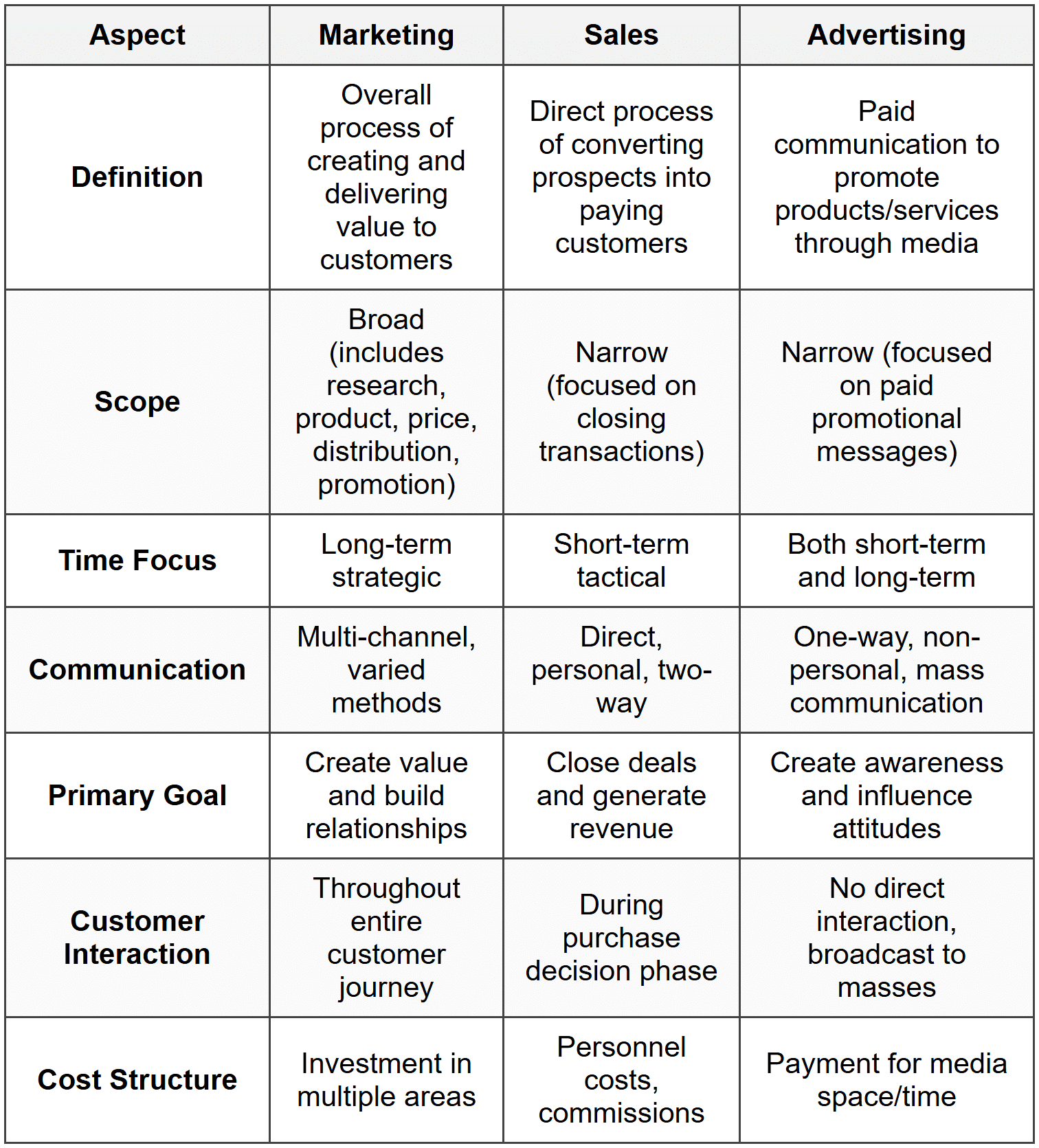
Summary Table: Marketing vs Sales vs Advertising
Why Understanding These Differences Matters
For students and professionals entering the business world, understanding the distinctions between marketing, sales, and advertising is essential for several reasons:
Conclusion
Marketing, sales, and advertising are three interconnected but distinct business functions. Marketing is the comprehensive process of understanding customers, creating value, and building relationships. Sales is the specific activity of converting prospects into customers through direct interaction and persuasion. Advertising is one promotional tool within marketing that uses paid media to communicate with mass audiences.
While each has its own purpose, methods, and metrics, all three must work together in an integrated manner to achieve business success. A strong marketing strategy provides direction, advertising creates awareness and interest, and sales converts that interest into revenue. Understanding these differences and their relationships is fundamental knowledge for anyone studying marketing or pursuing a career in business.