Major Types of Marketing Explained


Introduction to Marketing Types
Marketing is the process of promoting, selling, and distributing a product or service to customers. However, not all marketing is the same. Businesses use different types of marketing depending on their goals, target audience, and the nature of their products or services. Understanding these major types helps businesses choose the right strategies to reach their customers effectively.
In this guide, we will explore the major types of marketing that businesses commonly use. Each type has unique characteristics, advantages, and applications.
Traditional Marketing
Traditional marketing refers to any type of marketing that is not online. It uses conventional media channels to reach audiences and has been used for decades before the rise of the internet.
Characteristics of Traditional Marketing
- Uses offline channels and physical media
- Communication is typically one-way (from business to customer)
- Harder to measure exact results compared to digital methods
- Often involves higher costs for production and distribution
Common Forms of Traditional Marketing
- Print advertising: Newspapers, magazines, brochures, flyers, and posters
- Broadcast advertising: Television and radio commercials
- Direct mail: Catalogs, postcards, and promotional letters sent by mail
- Outdoor advertising: Billboards, banners, and transit advertisements
- Telemarketing: Phone calls to potential customers
Example
A local restaurant places an advertisement in the city newspaper offering a discount coupon. Readers see the ad, cut out the coupon, and visit the restaurant to redeem it.
Digital Marketing
Digital marketing involves promoting products or services using digital channels, primarily the internet and electronic devices. It has become essential in the modern business environment due to widespread internet usage.
Characteristics of Digital Marketing
- Uses online platforms and digital technologies
- Allows for two-way communication between businesses and customers
- Highly measurable with detailed analytics and data
- Often more cost-effective than traditional marketing
- Enables precise targeting of specific audiences
Common Forms of Digital Marketing
- Search engine marketing (SEM): Paid advertisements on search engines like Google
- Search engine optimization (SEO): Optimizing website content to rank higher in search results
- Social media marketing: Promoting through platforms like Facebook, Instagram, and Twitter
- Email marketing: Sending promotional messages directly to customer email inboxes
- Content marketing: Creating valuable content like blogs, videos, and infographics
- Display advertising: Banner ads on websites
- Affiliate marketing: Partnering with others who promote your products for a commission
Example
An online shoe store runs a Facebook ad campaign targeting women aged 25-40 who have shown interest in fashion. When users click the ad, they are taken directly to the store's website where they can make a purchase.
Content Marketing
Content marketing is a strategic approach focused on creating and distributing valuable, relevant, and consistent content to attract and retain a clearly defined audience. Rather than directly promoting products, it provides useful information to potential customers.
Characteristics of Content Marketing
- Focuses on providing value rather than direct selling
- Builds trust and credibility with the audience
- Content can take many forms: articles, videos, podcasts, ebooks, etc.
- Long-term strategy that builds relationships over time
Types of Content
- Blog posts and articles: Written content on websites addressing customer questions or interests
- Videos: Tutorials, product demonstrations, or educational content
- Infographics: Visual representations of data or processes
- Podcasts: Audio content on relevant topics
- Ebooks and whitepapers: In-depth guides on specific subjects
- Case studies: Success stories showing how products solved real problems
Example
A gardening tools company creates a blog with weekly articles on topics like "How to Grow Tomatoes in Small Spaces" and "5 Essential Tools for Beginner Gardeners." Readers find the information helpful and begin to trust the company as an expert, making them more likely to purchase tools from that brand.
Social Media Marketing
Social media marketing uses social networking platforms to connect with audiences, build brand awareness, and promote products or services. It is a subset of digital marketing but important enough to be considered separately.
Characteristics of Social Media Marketing
- Enables direct interaction and engagement with customers
- Facilitates sharing of content, allowing messages to spread quickly
- Can be organic (free posts) or paid (sponsored advertisements)
- Builds community and brand loyalty
- Provides real-time feedback from customers
Major Social Media Platforms
- Facebook: Broad demographic reach, good for community building
- Instagram: Visual content focused, popular with younger audiences
- Twitter: Real-time updates and customer service
- LinkedIn: Professional networking and B2B marketing
- YouTube: Video content and tutorials
- TikTok: Short-form video content, very popular with younger demographics
Example
A coffee shop posts photos of its daily specials on Instagram every morning. Followers engage by liking and commenting on the posts, and some share them with friends. This increases the shop's visibility and brings in new customers.
Influencer Marketing
Influencer marketing involves partnering with individuals who have a strong following on social media or other platforms to promote products or services. These influencers have built trust with their audience, which can transfer to the brands they endorse.
Characteristics of Influencer Marketing
- Leverages the credibility and reach of influential individuals
- Can target very specific niche audiences
- Often feels more authentic than traditional advertising
- Influencers can range from celebrities to micro-influencers with smaller, engaged followings
Types of Influencers
- Mega-influencers: Over 1 million followers (celebrities, famous personalities)
- Macro-influencers: 100,000 to 1 million followers (well-known experts or personalities)
- Micro-influencers: 10,000 to 100,000 followers (niche experts with engaged communities)
- Nano-influencers: Under 10,000 followers (everyday people with small but loyal followings)
Example
A fitness apparel brand partners with a popular fitness instructor who has 200,000 followers on Instagram. The instructor posts photos wearing the brand's clothing during workouts, and followers trust the recommendation because they respect the instructor's expertise.
Email Marketing
Email marketing involves sending commercial messages directly to a group of people via email. Despite being one of the oldest forms of digital marketing, it remains highly effective for maintaining customer relationships and driving sales.
Characteristics of Email Marketing
- Direct communication channel to customers
- Highly measurable (open rates, click rates, conversions)
- Can be personalized based on customer data
- Cost-effective with high return on investment
- Requires permission from recipients (opt-in)
Types of Email Marketing
- Newsletters: Regular updates with company news, tips, or content
- Promotional emails: Special offers, discounts, and sales announcements
- Transactional emails: Order confirmations, shipping notifications
- Welcome emails: Introduction messages for new subscribers
- Re-engagement emails: Messages to inactive customers encouraging them to return
Example
An online bookstore sends a weekly email newsletter to subscribers featuring new releases, book recommendations, and a special discount code. Subscribers who receive the email can click directly to the website and make purchases using their unique discount code.
Search Engine Marketing (SEM)
Search engine marketing is the practice of promoting websites by increasing their visibility in search engine results pages, primarily through paid advertising. It is often called pay-per-click (PPC) advertising because advertisers pay each time someone clicks their ad.
Characteristics of SEM
- Ads appear at the top or bottom of search engine results
- Advertisers bid on keywords relevant to their business
- Immediate visibility (unlike SEO which takes time)
- Highly targeted based on search terms, location, and other factors
- Costs are controlled through budgets and bidding strategies
Key Components
- Keywords: Words or phrases that trigger ads to appear
- Ad copy: The text of the advertisement that appears in search results
- Landing pages: The web pages users visit after clicking an ad
- Quality score: A rating that affects ad position and cost
- Bidding: The amount an advertiser is willing to pay per click
Example
A plumbing company creates a Google Ads campaign targeting the keyword "emergency plumber near me." When someone in their service area searches for this term, the company's ad appears at the top of the results. If the searcher clicks the ad, they are taken to the company's contact page, and the company pays a small fee for that click.
Search Engine Optimization (SEO)
Search engine optimization is the process of improving a website to increase its visibility in organic (non-paid) search engine results. Unlike SEM, SEO does not involve paying for placement but rather optimizing content and technical elements to rank higher naturally.
Characteristics of SEO
- Focuses on organic (unpaid) search results
- Long-term strategy requiring ongoing effort
- Improves website quality and user experience
- Builds credibility and authority
- Cost-effective over time compared to paid advertising
Key Elements of SEO
- On-page SEO: Optimizing individual web pages (content quality, keywords, titles, meta descriptions)
- Off-page SEO: Activities outside your website (backlinks from other sites)
- Technical SEO: Website structure, speed, mobile-friendliness
- Local SEO: Optimization for local search results (Google My Business)
- Content quality: Providing valuable, relevant information that answers user questions
Example
A bakery creates a website with detailed pages about each type of bread they make, including recipes and baking tips. They include relevant keywords naturally in their content. Over time, when people search for "artisan sourdough bread in [city name]," the bakery's website appears high in the organic search results, bringing in new customers without paying for ads.
Direct Marketing
Direct marketing is a form of advertising where businesses communicate directly with individual customers without intermediaries. It aims to prompt an immediate response or action from the recipient.
Characteristics of Direct Marketing
- Targeted communication to specific individuals
- Personalized messages based on customer data
- Includes a clear call to action
- Measurable responses and results
- Can be traditional or digital
Types of Direct Marketing
- Direct mail: Physical letters, catalogs, or postcards sent to homes
- Telemarketing: Phone calls to potential or existing customers
- Email marketing: Promotional messages sent to email addresses
- SMS/Text marketing: Marketing messages sent via text
- Direct response advertising: Ads with mechanisms for immediate response (call now, visit website)
Example
A car dealership sends a personalized letter to customers whose car leases are expiring within three months, offering them a special trade-in deal. The letter includes a phone number to call and schedule an appointment, creating a direct path for response.
Relationship Marketing
Relationship marketing focuses on building long-term relationships with customers rather than focusing solely on individual transactions. The goal is to create loyal customers who make repeat purchases and recommend the business to others.
Characteristics of Relationship Marketing
- Emphasizes customer retention over acquisition
- Builds emotional connections with customers
- Encourages two-way communication
- Focuses on customer satisfaction and lifetime value
- Uses personalization and customer service excellence
Strategies for Relationship Marketing
- Loyalty programs: Rewards for repeat customers
- Personalized communication: Tailored messages based on customer preferences
- Excellent customer service: Responsive, helpful support
- Customer feedback: Actively seeking and acting on customer opinions
- Exclusive offers: Special deals for existing customers
- Community building: Creating spaces for customers to connect with the brand and each other
Example
A coffee shop creates a loyalty card program where customers receive a free drink after purchasing ten drinks. The staff remembers regular customers' names and usual orders, creating a welcoming atmosphere. Customers feel valued and choose this coffee shop over competitors, even if prices are slightly higher.
Brand Marketing
Brand marketing promotes a company's overall brand rather than specific products or services. It focuses on building brand identity, awareness, and reputation to create long-term value and customer loyalty.
Characteristics of Brand Marketing
- Focuses on the brand's values, personality, and promise
- Builds emotional connections with audiences
- Creates consistent messaging across all channels
- Long-term strategy rather than immediate sales focus
- Differentiates the company from competitors
Key Elements of Brand Marketing
- Brand identity: Visual elements like logos, colors, and design
- Brand voice: The tone and style of communication
- Brand values: The principles the company stands for
- Brand story: The narrative about the company's origin and mission
- Brand positioning: How the brand is perceived relative to competitors
Example
A sportswear company doesn't just advertise shoes and clothing; it promotes a lifestyle of athletic achievement and personal empowerment. Their campaigns feature inspiring stories of athletes overcoming challenges, associating the brand with determination and success rather than just products.
Guerrilla Marketing
Guerrilla marketing uses unconventional, creative, and often low-cost tactics to promote products or services. It aims to create memorable experiences that generate buzz and word-of-mouth publicity.
Characteristics of Guerrilla Marketing
- Unconventional and unexpected approaches
- Often low budget but high impact
- Creates surprise and memorable experiences
- Relies on creativity rather than large advertising budgets
- Encourages viral sharing and word-of-mouth
Types of Guerrilla Marketing
- Ambient marketing: Placing ads in unexpected places
- Ambush marketing: Associating with an event without official sponsorship
- Experiential marketing: Creating interactive brand experiences
- Viral marketing: Creating content designed to spread rapidly
- Street marketing: Unconventional promotions in public spaces
Example
A movie studio promoting a horror film places life-sized, scary character figures at bus stops in the city overnight. In the morning, commuters are startled by the unexpected figures, take photos, and share them on social media. The campaign costs relatively little but generates significant attention and publicity for the film.
Outbound Marketing vs. Inbound Marketing
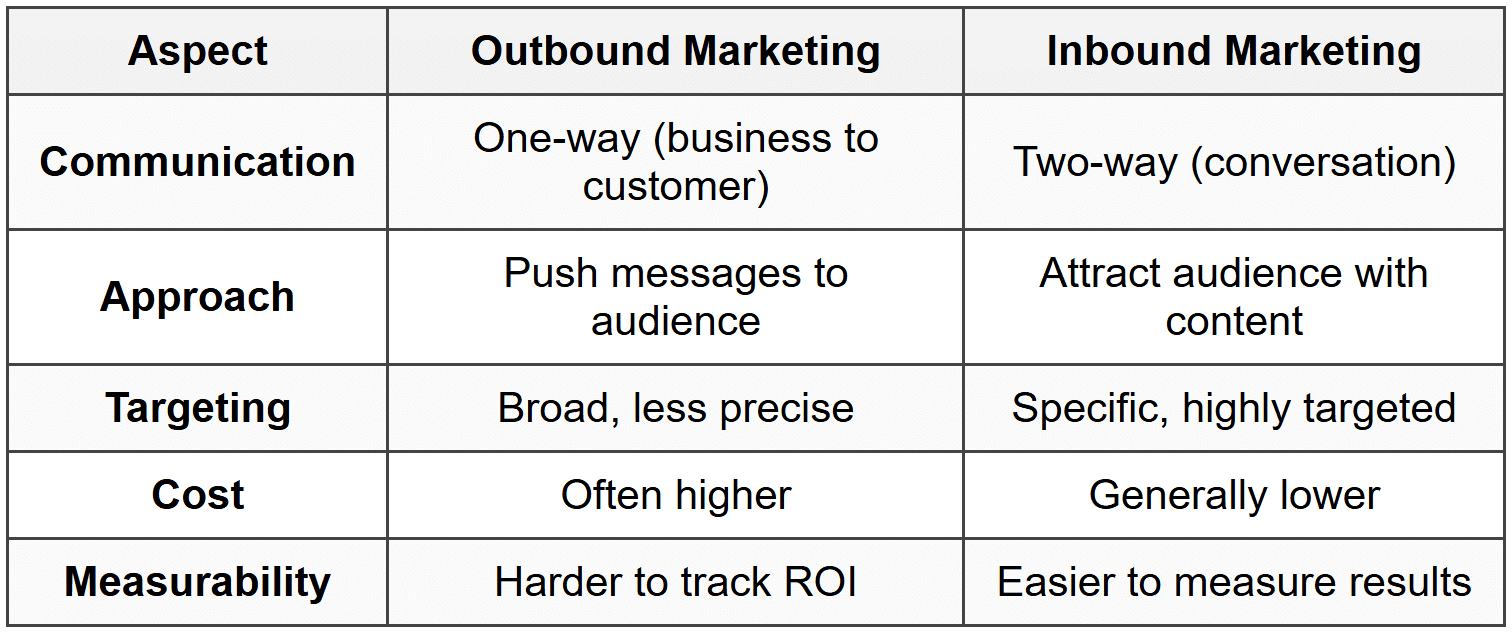
Marketing strategies can also be classified into two broad approaches based on how they reach customers: outbound marketing and inbound marketing.
Outbound Marketing
Outbound marketing involves pushing messages out to a broad audience, regardless of whether they have expressed interest. It interrupts people with promotional content.
Characteristics
- Proactive approach where businesses initiate contact
- Often involves interrupting people's activities
- Broad reach but less targeted
- Examples: TV commercials, radio ads, cold calling, direct mail, display ads
Inbound Marketing
Inbound marketing focuses on attracting customers by creating valuable content and experiences tailored to them. Customers find the business when searching for solutions to their problems.
Characteristics
- Customer-initiated contact
- Provides value before asking for anything in return
- Highly targeted to people already interested
- Examples: Blog posts, SEO, social media content, ebooks, webinars
Comparison
Business-to-Business (B2B) vs. Business-to-Consumer (B2C) Marketing
Marketing strategies also differ based on whether the target audience is other businesses or individual consumers.
B2B Marketing
Business-to-Business (B2B) marketing involves selling products or services to other businesses or organizations.
Characteristics
- Longer sales cycles with multiple decision-makers
- Rational, logic-based purchasing decisions
- Focuses on ROI and business benefits
- Relationship-building is critical
- Smaller, more targeted audiences
- Higher transaction values
Common B2B Marketing Channels
- LinkedIn and professional networks
- Industry trade shows and conferences
- Whitepapers and case studies
- Email marketing to business contacts
- Professional publications and websites
B2C Marketing
Business-to-Consumer (B2C) marketing involves selling products or services directly to individual consumers for personal use.
Characteristics
- Shorter sales cycles with quicker decisions
- Emotional and personal factors influence purchases
- Focuses on benefits, lifestyle, and experience
- Larger, broader audiences
- Lower transaction values (generally)
- One or few decision-makers (the consumer or family)
Common B2C Marketing Channels
- Social media platforms (Facebook, Instagram, TikTok)
- Television and radio advertising
- Retail stores and point-of-sale displays
- Consumer-focused websites and apps
- Influencer partnerships
Summary and Key Takeaways
Understanding the major types of marketing helps businesses select the most effective strategies for reaching their target audiences. Here are the key points to remember:
- Traditional marketing uses offline channels like print, broadcast, and direct mail
- Digital marketing leverages online platforms and technologies for promotion
- Content marketing provides valuable information to attract and retain customers
- Social media marketing uses social platforms to engage with audiences
- Influencer marketing partners with influential individuals to promote products
- Email marketing sends direct messages to customer inboxes
- SEM uses paid advertisements on search engines
- SEO optimizes websites for organic search visibility
- Direct marketing communicates directly with individual customers
- Relationship marketing focuses on building long-term customer loyalty
- Brand marketing promotes overall brand identity and values
- Guerrilla marketing uses creative, unconventional tactics
- Outbound marketing pushes messages to broad audiences
- Inbound marketing attracts customers with valuable content
- B2B marketing targets other businesses
- B2C marketing targets individual consumers
Most successful businesses use a combination of these marketing types, selecting the approaches that best fit their products, audiences, and goals. The marketing landscape continues to evolve, but these fundamental types provide a solid foundation for understanding how businesses connect with their customers.