Understanding Customer Needs and Wants


Introduction to Customer Needs and Wants
Understanding what customers need and want is the foundation of successful marketing. Before a business can create products, set prices, or design advertising campaigns, it must first understand the people it serves. This section will help you learn the difference between needs and wants, why they matter, and how marketers use this knowledge to create value.
In marketing, we often hear the terms needs and wants, but they are not the same thing. Recognizing the distinction is essential for anyone studying or working in marketing.
What Are Customer Needs?
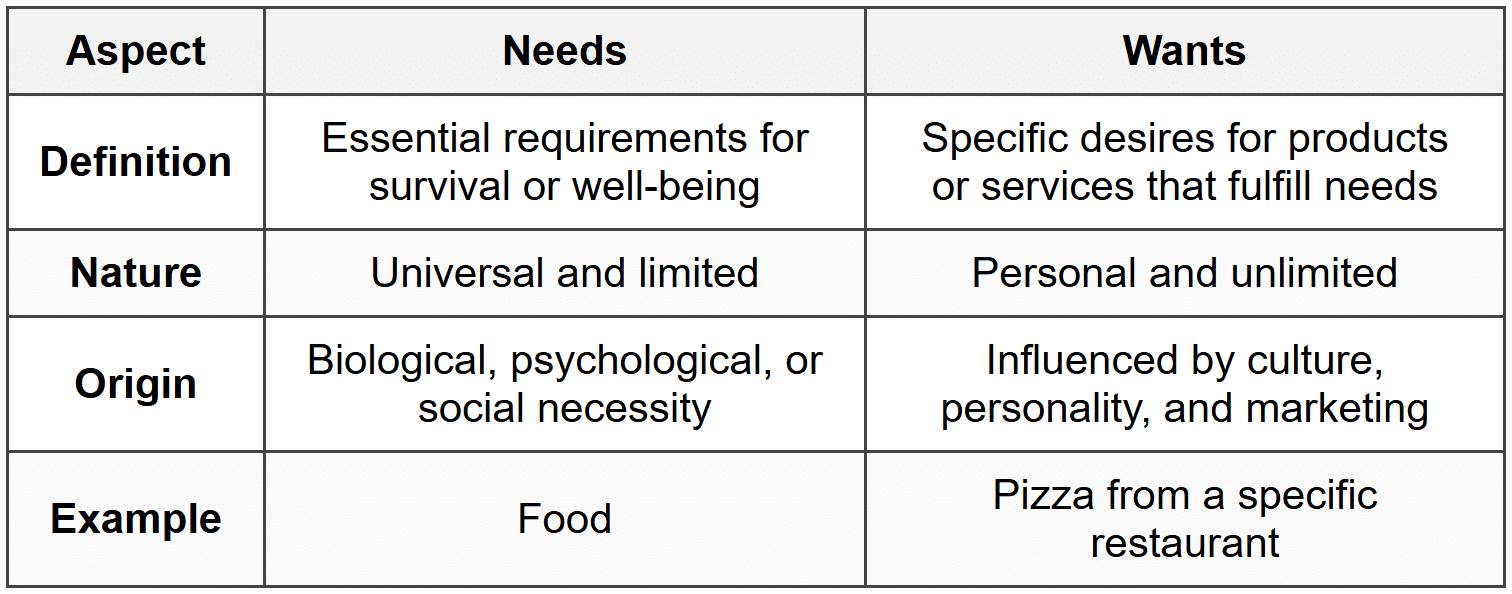
A need is a basic requirement that a person must have to survive or function properly. Needs are universal and often biological or psychological in nature. Without fulfilling these needs, a person experiences discomfort, harm, or inability to live a normal life.
Types of Needs
Needs can be categorized into several types:
- Physiological needs: Basic survival requirements such as food, water, shelter, and clothing.
- Safety needs: Security, protection from danger, and stability.
- Social needs: Belonging, love, friendship, and human connection.
- Esteem needs: Recognition, respect, achievement, and self-worth.
- Self-actualization needs: Personal growth, fulfillment, and realizing one's potential.
This classification is based on Maslow's Hierarchy of Needs, a well-known psychological theory used frequently in marketing to understand customer behavior.
Examples of Needs
Consider a person living in a cold climate. They need warm clothing to protect themselves from freezing temperatures. This is a physiological need tied to survival and safety.
Similarly, a new parent needs a safe car seat for their baby-this is a safety need.
What Are Customer Wants?
A want is a desire for a specific product or service that satisfies a need. Wants are shaped by culture, personality, preferences, and marketing influences. Unlike needs, wants are not essential for survival-they are specific choices people make based on their preferences and circumstances.
Wants are unlimited, meaning people can always desire more or different things, even if their basic needs are met.
Examples of Wants
Using the earlier example, while a person needs warm clothing, they might want a designer winter coat from a luxury brand. The need is warmth; the want is the specific brand and style.
Similarly, a parent might need a car seat for safety, but they might want a premium model with extra features like memory foam padding and adjustable recline positions.
Key Differences Between Needs and Wants
What Is Demand?
Understanding needs and wants leads us to a third critical concept: demand.
Demand occurs when a want is backed by the ability and willingness to pay for it. In other words, demand is a want that the customer can afford and is ready to purchase.
Relationship Between Needs, Wants, and Demand
The relationship can be summarized as follows:
- A person has a need (e.g., hunger).
- This need leads to a want (e.g., a burger from a specific restaurant).
- If the person has money and is willing to spend it, the want becomes demand.
Marketers are most interested in demand because it represents actual purchasing behavior, not just desire.
Example of Demand
A student may want the latest smartphone model (want), but if they do not have enough money to buy it, there is no demand. Once they save enough money and decide to make the purchase, their want becomes demand.
Why Understanding Needs and Wants Matters in Marketing
Marketers must understand customer needs and wants for several important reasons:
- Product development: Companies design products and services that satisfy real customer needs and appeal to their wants.
- Market segmentation: Different customer groups have different needs and wants. Understanding these helps marketers target the right audience.
- Positioning and messaging: Marketing messages are more effective when they speak directly to what customers need or want.
- Customer satisfaction: Meeting needs and wants leads to satisfied customers who are more likely to return and recommend the business.
- Competitive advantage: Companies that understand their customers better than competitors can create superior value and gain market share.
Identifying Customer Needs and Wants
Marketers use various methods to discover what customers need and want. These methods help businesses make informed decisions rather than guessing what might work.
Methods for Identifying Needs and Wants
- Surveys and questionnaires: Asking customers directly about their preferences, problems, and desires.
- Interviews and focus groups: Having in-depth conversations with customers to explore their thoughts and feelings.
- Observation: Watching how customers behave in real situations, such as how they shop or use products.
- Social media listening: Monitoring online conversations, reviews, and comments to understand customer opinions.
- Sales data analysis: Reviewing purchase history and trends to see what customers are buying.
- Customer feedback and complaints: Listening to what customers say about their experiences, both positive and negative.
Example of Identifying Needs
A coffee shop owner notices that many customers arrive early in the morning but often leave quickly. Through observation and brief surveys, the owner learns that customers need quick service because they are on their way to work. The owner responds by adding an express counter, meeting the customer's need for speed.
Stated vs. Real Needs
Not all customer needs are obvious. Marketers distinguish between different levels of customer needs:
- Stated needs: What the customer says they want (e.g., "I want an affordable car").
- Real needs: The underlying need behind the stated want (e.g., reliable transportation to get to work).
- Unstated needs: Expectations the customer does not mention but assumes will be met (e.g., the car will be safe).
- Delight needs: Unexpected features or benefits that exceed expectations (e.g., free roadside assistance).
- Secret needs: Deep personal motivations the customer may not openly share (e.g., wanting the car to impress friends).
Understanding these layers helps marketers create more complete solutions that truly satisfy customers.
The Role of Culture and Society
Customer wants are heavily influenced by the culture and society in which people live. Culture shapes values, beliefs, preferences, and behaviors.
For example, in some cultures, people want larger family vehicles because extended families often travel together. In other cultures, compact cars are preferred due to crowded cities and limited parking.
Marketers must be aware of cultural differences, especially when operating in multiple countries or diverse markets. What works in one culture may not appeal to another.
Creating Customer Value
Once marketers understand customer needs and wants, the next step is to create value. Value is the benefit customers receive from a product or service relative to its cost.
The basic formula for customer value is:
Customer Value = Benefits Received - Cost Paid
Customers are more likely to make a purchase when they perceive that the benefits outweigh the costs.
Example of Creating Value
A budget airline understands that many travelers need to fly but want to save money. The airline creates value by offering low ticket prices (reducing cost) while still providing safe, reliable transportation (meeting the need). Extra services like meals or seat selection are optional, allowing cost-conscious customers to pay only for what they truly want.
Common Mistakes in Understanding Customer Needs and Wants
Even experienced marketers can make errors when trying to understand their customers. Here are some common mistakes:
- Assuming everyone has the same needs and wants: Customers are diverse, and different segments have different priorities.
- Focusing only on what customers say: Customers may not always articulate their true needs or may not be aware of better solutions.
- Ignoring changes over time: Needs and wants evolve due to trends, technology, and life circumstances.
- Confusing needs with wants: Treating a luxury want as a basic need can lead to poor targeting and messaging.
- Overlooking emotional and psychological needs: Customers often buy based on feelings, status, or identity, not just functional benefits.
Summary
Understanding customer needs and wants is the cornerstone of effective marketing. Needs are essential requirements for survival and well-being, while wants are specific desires shaped by personal and cultural factors. When a want is supported by purchasing power, it becomes demand.
Marketers use various research methods to identify these needs and wants, and they must recognize that customers often have unstated or deeper motivations. By truly understanding what drives customer behavior, businesses can create products, services, and messages that deliver real value and build lasting relationships.
Mastering this knowledge allows marketers to design strategies that not only meet customer expectations but exceed them, leading to satisfaction, loyalty, and business success.