Primary vs Secondary Research Methods


Introduction to Market Research
Market research is the process of gathering, analyzing, and interpreting information about a market, product, or service. Businesses use market research to understand their customers, competitors, and the overall market environment. This helps them make informed decisions about pricing, product development, advertising, and more.
There are two main categories of market research methods: primary research and secondary research. Each method has its own advantages, disadvantages, and appropriate uses. Understanding when and how to use each type is essential for effective marketing decision-making.
Primary Research Methods
What is Primary Research?
Primary research (also called field research) involves collecting new data directly from original sources for a specific purpose. This means the business or researcher gathers information firsthand, rather than using existing data collected by someone else.
Primary research is conducted when:
- Specific information is needed that doesn't already exist
- Current, up-to-date data is required
- The business needs information tailored to its unique situation
- Confidential or competitive advantage is important
Types of Primary Research Methods
Surveys and Questionnaires
Surveys are structured sets of questions given to a group of people to collect their opinions, behaviors, or characteristics. They can be conducted online, by phone, by mail, or in person.
Example: A coffee shop creates an online survey asking customers about their favorite drinks, preferred visit times, and satisfaction with service.
Advantages:
- Can reach large numbers of people
- Relatively low cost per response
- Easy to analyze using statistical methods
- Respondents may feel more comfortable being honest
Disadvantages:
- Low response rates are common
- Questions must be carefully designed to avoid bias
- Limited depth of information
- Cannot probe deeper into interesting responses
Interviews
Interviews involve one-on-one conversations between a researcher and a respondent. They can be structured (following a set script), semi-structured (following a guide but allowing flexibility), or unstructured (open conversation).
Example: A smartphone company conducts face-to-face interviews with 30 customers to understand why they chose their current phone brand.
Advantages:
- Provides detailed, in-depth information
- Allows researcher to ask follow-up questions
- Can explore complex topics and motivations
- Body language and tone can provide additional insights
Disadvantages:
- Time-consuming and expensive
- Small sample sizes
- Interviewer bias may influence responses
- Difficult to analyze and compare responses
Focus Groups
Focus groups bring together a small group of people (typically 6-10) to discuss a topic, product, or service in a moderated discussion. A facilitator guides the conversation and encourages participants to share their views.
Example: A cosmetics brand invites eight women to discuss their skincare routines and reactions to a new product concept.
Advantages:
- Generates diverse perspectives and ideas
- Group interaction can spark new insights
- Observing group dynamics provides additional information
- More cost-effective than individual interviews
Disadvantages:
- Dominant personalities may influence the group
- Some participants may not speak honestly in group settings
- Results may not be representative of the broader population
- Requires skilled moderation
Observations
Observation involves watching and recording how people behave in natural or controlled settings without directly interacting with them. This can be done in person or using technology like cameras or tracking software.
Example: A supermarket observes customer movement patterns through the store to optimize product placement.
Advantages:
- Captures actual behavior rather than reported behavior
- Participants cannot provide false information
- Useful for studying behaviors people may not be aware of
- No interviewer bias
Disadvantages:
- Cannot understand motivations or thoughts
- Time-consuming to conduct and analyze
- Observer presence may change behavior
- Ethical concerns about privacy
Experiments and Testing
Experiments involve manipulating one or more variables to measure their effect on another variable. In marketing, this often includes product testing, price testing, or advertising testing.
Example: An online retailer shows two different website designs to random visitor groups and measures which generates more purchases.
Advantages:
- Can establish cause-and-effect relationships
- Provides measurable, quantifiable results
- Allows testing before full implementation
- Can control external variables
Disadvantages:
- Artificial settings may not reflect real-world conditions
- Can be expensive and complex to design
- Ethical limitations on what can be tested
- Time-consuming
Advantages of Primary Research
- Relevance: Data is collected specifically for your business needs and questions
- Currency: Information is up-to-date and reflects current conditions
- Ownership: Your business exclusively owns the data, which can provide competitive advantage
- Control: You control the research design, methodology, and data collection process
- Specificity: Can target exact populations or situations relevant to your business
Disadvantages of Primary Research
- Cost: Generally expensive, requiring budget for design, data collection, and analysis
- Time: Takes considerable time to plan, conduct, and analyze
- Expertise: Requires specialized skills in research methodology and analysis
- Resources: Demands significant human and technological resources
- Sample size limitations: May be difficult to reach large or diverse populations
Secondary Research Methods
What is Secondary Research?
Secondary research (also called desk research) involves using existing data that has already been collected by someone else for another purpose. Researchers analyze, interpret, and apply this existing information to answer their own research questions.
Secondary research is appropriate when:
- Background information is needed on a topic
- Budget or time is limited
- General market trends and statistics are sufficient
- Starting point information is needed before conducting primary research
Types of Secondary Research Sources
Internal Sources
Internal sources are data that already exists within the organization. This information was collected for other purposes but can be analyzed for new insights.
Examples include:
- Sales records and transaction data
- Customer databases and contact information
- Previous research reports
- Financial records
- Website analytics and social media metrics
- Customer service records and complaints
- Inventory and supply chain data
Example: A retail store analyzes its sales records from the past three years to identify seasonal buying patterns.
External Sources
External sources are data published by organizations outside your business. These can be free or paid sources.
Government Publications:
- Census data
- Economic reports and statistics
- Industry regulations and standards
- Trade statistics
- Demographic information
Commercial Sources:
- Market research reports from firms like Nielsen or Mintel
- Industry reports and forecasts
- Trade association publications
- Business databases and directories
- Financial analyst reports
Academic and Educational Sources:
- Academic journals and research papers
- University studies
- Books and textbooks
- Conference proceedings
Media and Online Sources:
- Newspapers and magazines
- Industry publications and trade journals
- Company websites and annual reports
- Online databases
- Social media trends and discussions
Example: A startup uses government census data and industry reports to understand the size and demographics of their target market.
Advantages of Secondary Research
- Cost-effective: Much less expensive than primary research, with many sources being free
- Quick: Data is immediately available without waiting for collection
- Easy to access: Many sources are readily available online or in libraries
- Large sample sizes: Often based on extensive data collection (like national surveys)
- Historical perspective: Can provide trends and comparisons over time
- Starting point: Helps identify gaps that require primary research
Disadvantages of Secondary Research
- Not specific: Data may not precisely match your research needs
- Outdated: Information may be old and no longer relevant
- Availability: Specific data you need may not exist
- Reliability concerns: Quality and accuracy depend on the original source
- Public access: Competitors have access to the same information
- Methodology unknown: May not know how data was collected or if it was biased
- Conflicting data: Different sources may provide contradictory information
Comparing Primary and Secondary Research
Key Differences
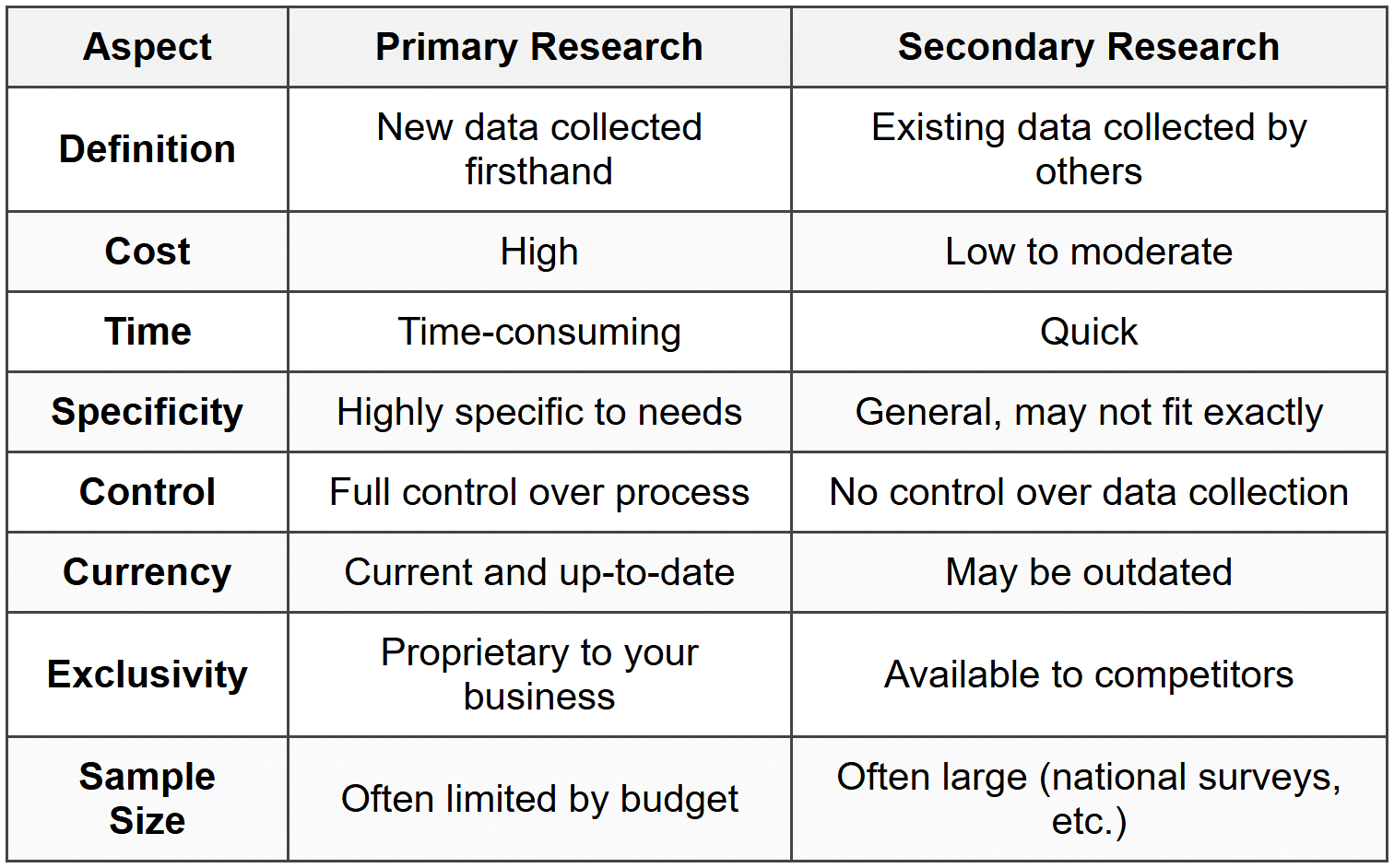
When to Use Each Method
Use Primary Research When:
- You need specific information not available elsewhere
- The data must be current and reflect today's conditions
- You need to understand specific customer behaviors or preferences
- Competitive advantage depends on exclusive information
- You need to test a specific product, concept, or strategy
- Budget and time allow for custom research
Use Secondary Research When:
- You need background information or context
- Budget is limited
- You need quick answers
- General market trends and statistics are sufficient
- You're in the early stages of understanding a market
- You want to identify what information gaps exist before conducting primary research
Combining Both Approaches
In practice, most effective market research projects use both primary and secondary research in a complementary way. A typical approach follows these steps:
- Start with secondary research to understand the general market context, identify trends, and determine what information already exists
- Identify gaps in the secondary research-questions that remain unanswered or need more specific information
- Design primary research to fill those specific gaps with targeted, custom data collection
- Analyze both together to get a complete picture combining broad context with specific insights
Example: A company launching a new energy drink might start by reviewing secondary research on beverage industry trends, competitor products, and consumer health preferences. They then conduct primary research through taste tests and surveys to understand reactions to their specific product formulation.
Choosing the Right Research Method
Factors to Consider
When deciding between primary and secondary research methods, consider:
- Research objectives: What specific questions do you need answered?
- Budget: How much money is available for research?
- Time constraints: How quickly do you need the information?
- Available expertise: Do you have staff skilled in research methodology?
- Information needs: How specific must the data be?
- Existing data: What information is already available?
- Competitive considerations: Do you need proprietary information?
- Target population: How easy is it to reach your research subjects?
Research Process Steps
Regardless of which method you choose, follow these general steps:
- Define the problem: Clearly state what you need to learn and why
- Determine research objectives: Specify what questions need answers
- Identify available secondary data: Search for existing information first
- Evaluate secondary data quality: Assess if it meets your needs
- Design primary research if needed: Create a plan for collecting new data
- Collect data: Gather information through chosen methods
- Analyze data: Process and interpret the information
- Present findings: Communicate results clearly to decision-makers
- Make decisions: Use insights to guide marketing strategy
Quality and Ethics in Research
Ensuring Research Quality
For research to be useful, it must be reliable and valid:
- Reliability: Research should produce consistent results if repeated
- Validity: Research should accurately measure what it claims to measure
- Representative samples: Research participants should reflect the target population
- Unbiased questions: Questions should not lead respondents toward particular answers
- Appropriate sample size: Large enough to draw meaningful conclusions
- Source credibility: For secondary research, use reputable, authoritative sources
Ethical Considerations
All market research must be conducted ethically:
- Informed consent: Participants should know they're being researched and agree to participate
- Privacy protection: Personal information must be kept confidential
- Honesty: Researchers must not deceive participants about the research purpose
- Voluntary participation: People should not be forced or pressured to participate
- Data security: Information collected must be stored securely
- Transparency: Research methods and limitations should be clearly reported
- Proper use: Data should only be used for the stated research purpose
Summary
Understanding primary and secondary research methods is fundamental to effective market research. Primary research involves collecting new, firsthand data specifically for your needs through methods like surveys, interviews, focus groups, observations, and experiments. While expensive and time-consuming, it provides specific, current, and proprietary information.
Secondary research uses existing data from internal records or external sources like government publications, commercial reports, and academic studies. It is faster and cheaper but may not perfectly match your specific needs and is available to competitors.
Most effective research strategies combine both approaches: starting with secondary research to understand the broader context, then using primary research to fill specific information gaps. The choice between methods depends on your research objectives, budget, time constraints, and information requirements. Regardless of method, quality and ethical considerations must guide all research activities to ensure reliable, valid, and responsible data collection.