RS Aggarwal Solutions: Fractions (Exercise 7I) MCQs

Solution 1: (d) 4/11
Among the given fractions with the same numerator, the one with the smallest denominator is the greatest.
Solution 2: (a) 6/11
If Denominators are same, then fraction with smallest numerator will be smallest.
Solution 3: (b) 3/5
∴ 3/5, 2/3, 5/6, 7/10
(LCM of 5, 3, 6, 10 = 30)
3/5 = 3×6/5×6 = 18/30, 2/3 = 2×10/3×10 = 20/30, 5/6 = 5×5/6×5 = 25/30, 7/10 = 7×3/10×3 = 21/30
Solution 4: (c) 7/12
L.C.M. of 4, 6, 12 and 3 = (2 × 2 × 3) = 12
Thus,
3/4 = 3×3/4×3 = 9/12, 5/6 = 5×2/6×2 = 10/12, 7/12 = 7×1/12×1 = 7/12, 2/3 = 2×4/3×4 = 8/12
Solution 5: (c) 
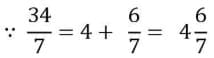
Solution 6: (b) 23/5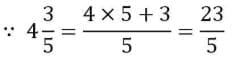
Solution 7: (d) 8/9
Solution 8: (b) 3/4 > 3/5
Between the two fractions with the same numerator, the one with the smaller denominator is the greater.
Solution 9: (b) 15
∴ 3/4 = x/20
⇒ 4x = 20 × 3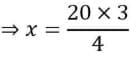
∴ x = 15
Solution 10: (a) 4
45/60 = 3/x
⇒ 45x = 3 × 60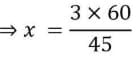
⇒ x = 4
Solution 11: (d) 1/7, 2/7, 3/7, 5/7
Solution 12: (d) 
5/6 + 7/8
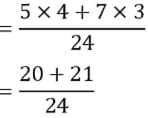
= 41/24

Solution 13: (b) 
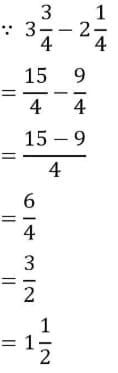
Solution 14: (d) 
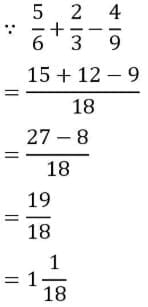
Solution 15: (a) 

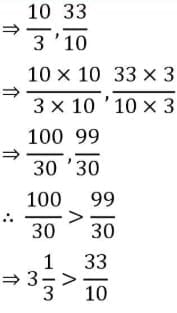
Solution 16: (c) 
Solution 17: (c) 
Solution 18: (b) 2/3
[2/3 = 2×12/3×12 = 24/36]
FAQs on RS Aggarwal Solutions: Fractions (Exercise 7I) MCQs
| 1. What are fractions? |  |
| 2. How do you add fractions with the same denominator? | |
| 3. What is the process for subtracting fractions? | |
| 4. How do you multiply fractions? | |
| 5. What is the method to divide one fraction by another? | |