Detailed Summary : The Pot Maker

Key Points of the Story
- This is an inspiring story by Temsula Ao about young Sentila who dreams of becoming a traditional pot maker like her mother and grandmother.
- Her mother, Arenla, wants her to learn weaving instead because pot making is extremely hard, tiring, low-paying and messy.
- Sentila secretly watches expert potters and later learns from her mother, but struggles for a whole year.
- A kind, middle-aged widow 'Onula' (Aunty), who supervises the girls' dormitory, guides Sentila on technique, especially shaping the mouth of the pot.
- One day Arenla pretends to be unwell and leaves Sentila to finish the batch alone; Sentila suddenly masters the skill and makes just one pot short of her mother's tally.
- Tragically, Arenla dies that very day. Sentila realises she has fulfilled her dream. Onula discovers two identical rows of pots and understands that "a new pot maker was born".
- The story celebrates the passing of traditional skills, perseverance, and the mother-daughter bond.
Detailed Summary
Sentila has always dreamed of becoming a pot maker like her mother Arenla and grandmother. But Arenla wants her to learn weaving because pot making involves back-breaking work - digging clay 16 km away, pounding it, carrying heavy loads uphill, and earning only a pittance. She tells Sentila, "Weaving is not messy... and the return is handsome."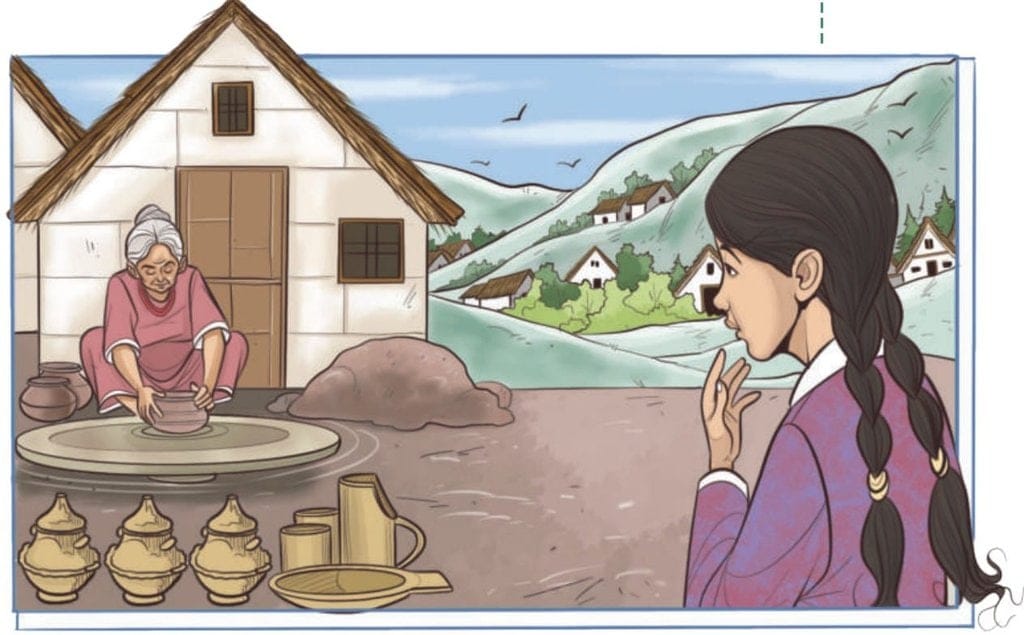
Sentila secretly watches expert potters and learns the process: mixing and pounding clay, shaping the rotating lump of clay with a spatula held in the right hand, drying in the sun, and firing in a kiln. The elders also told Mesoba that traditional skills like pot making do not belong to any individual and must be taught to anyone who wishes to learn.
Arenla finally begins teaching Sentila, but after a year the girl still cannot shape pots properly. Sentila is sent to the girls' dormitory where the kind widow Onula notices her tense, clumsy efforts. Onula gently teaches her the correct technique, especially how to shape the mouth of the pot. She advises, "When you work with your mother next time, watch her carefully."
One sunny day Arenla complains of headache and backache and leaves Sentila to finish the batch alone. Suddenly Sentila finds her rhythm and makes pot after pot with amazing speed and dexterity - only one short of her mother's tally. When she goes inside for lunch, she finds Arenla dead on the floor.
Sentila runs shouting, "Mother, I did not wish it to happen this way... Please forgive me." Later Onula enters the shed and sees two perfect identical rows of pots. She realises Sentila has mastered the craft. The story ends with the powerful line: "A new pot maker was born."
Let's Revise: Why did Arenla not want Sentila to learn pot making?
Let's Revise: What does the line "A new pot maker was born" signify?
Theme/Message
Theme
- The central theme is Perseverance, Tradition and Passing on Skills. The story shows how traditional crafts must be preserved and taught to the next generation.
- It also highlights the mother-daughter relationship, the dignity of labour, and the importance of determination in fulfilling one's dream.
Let's Revise: What message does the story give about traditional crafts?
Message
- Hard work and determination can help one overcome any obstacle.
- Traditional crafts and skills must be respected and passed onto future generations.
- Community pressure and social duty can sometimes compel a reluctant parent to pass on traditional skills.
- A true teacher (like Onula) can unlock hidden talent with patience and kindness.
- Even in grief, a person can discover their true calling.
Difficult Words
- Pittance - a very small amount of money
- Tedious - tiring and boring
- Deftly - skilfully and quickly
- Spatula - tool used by potters to shape clay
- Malleable - able to be shaped easily
- Dormitories - large rooms containing many beds, as in a hostel
- Wearily - in a tired way
- Slackened - made slower or relaxed
- Momentum - a driving force that keeps something moving forward
- Dexterity - great skill in using hands
- Threshold - entrance of a room
- Intuitively - by instinct or feeling
- Profound - very deep or powerful
- Revelation - a sudden realisation
FAQs on Detailed Summary : The Pot Maker
| 1. What is the main story of "The Pot Maker"? |  |
| 2. What themes are explored in "The Pot Maker"? | |
| 3. How does the potter's character contribute to the message of the story? | |
| 4. What challenges does the potter face in "The Pot Maker"? | |
| 5. Can you explain some difficult words found in "The Pot Maker"? | |