CBSE Class 6  >  Class 6 Notes  >  Mathematics  >  RS Aggarwal Solutions: Decimals (Exercise 8C)

RS Aggarwal Solutions: Decimals (Exercise 8C)

Solution 1:
(i) We know that 100 paise = ₹ 1
So, 1 paise = ₹ 1/100
∴ 8 paise = ₹ 8/100 = ₹0.08

(ii) We know that 100 paise = ₹ 1
So, 1 paise = ₹ 1/100
∴ 60 paise = ₹ 60/100 = ₹0.60

(iii) We know that 100 paise = ₹ 1
So, 1 paise = ₹ 1/100
∴ 36 paise = ₹ 36/100 = ₹ 0.36

(iv) We know that 100 paise = ₹ 1
So, 1 paise = ₹ 1/100
∴ 425 paise = ₹ 425/100 = ₹ 4.25

(v) 50 rupees 90 paise = ₹ 50 + ₹ 90/100
= ₹ 50 + ₹ 0.90
= ₹ 50.90

(vi) 5 rupees 6 paise = ₹ 5 + ₹ 6/100
= ₹ 5 + ₹ 0.06
= ₹ 5.06

Solution 2:
(i) We know that 10 mm = 1 cm
so, 1 mm = 1/10 cm
∴ 6 mm = 6/10 cm
= 0.6 cm

(ii) We know that 10 mm = 1 cm
so, 1 mm = 1/10 cm
∴ 28 mm = 28/10 cm
= 2.8 cm

(iii) We know that 10 mm = 1 cm
so, 1 mm = 1/10 cm
∴ 173 mm = 173/10 cm
= 17.3 cm

(iv) We know that 10 mm = 1 cm
so, 1 mm = 1/10 cm

RS Aggarwal Solutions: Decimals (Exercise 8C)
= 15 cm + 0.8 cm
= 15.08 cm

Solution 3:
(i) We know that 100 cm = 1 m
So, 1 cm = 1/100 m
∴ 35 cm = 35/100 m
= 0.35 m

(ii) We know that 100 cm = 1 m
So, 1 cm = 1/100 m
∴ 9 cm = 9/100 m
= 0.09 m

(iii) We know that 100 cm = 1 m
So, 1 cm = 1/100 m
∴ 256 cm = 256/100 m
= 2.56 m

(iv) 4 m 50 cm = 4 m + 50/100 m
= 4 m + 0.50 m
= 4.50 m

(v) 4 m 8 cm = 4 m + 8/100 m
= 4 m + 0.08 m
= 4.08 m

Solution 4:
(i) We know that 1000 m = 1 km
So, 1 m = 1/1000 km
∴ 8 m = 8/1000 km
= 0.008 km

(ii) We know that 1000 m = 1 km
So, 1 m = 1/1000 km
∴ 25 m = 25/1000 km
= 0.025 km

(iii) We know that 1000 m = 1 km
So, 1 m = 1/1000 km
∴ 750 m = 750/1000 km
= 0.750 km

(iv) We know that 1000 m = 1 km
So, 1 m = 1/1000 km
∴ 700 m = 700/1000 km
= 0.700 km

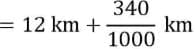
(v) 12 km 340 m
RS Aggarwal Solutions: Decimals (Exercise 8C)
= 12 km + 0.340 km
= 12.340 km

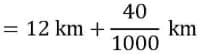
(vi) 12 km 40 m
RS Aggarwal Solutions: Decimals (Exercise 8C)
= 12 km + 0.040 km
= 12.040 km

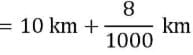
(vii) 10 km 8 m
RS Aggarwal Solutions: Decimals (Exercise 8C)
= 10 km + 0.008 km
= 10.008 km

Solution 5:
(i) We know that 1000 g = 1 kg
So, 1 g = 1/1000 kg
∴ 6 g = 6/1000 kg
= 0.006 kg

(ii) We know that 1000 g = 1 kg
So, 1 g = 1/1000 kg
∴ 100 g = 100/1000 kg
= 0.100 kg

(iii) We know that 1000 g = 1 kg
So, 1 g = 1/1000 kg
∴ 625 g = 625/1000 kg
= 0.625 kg

(iv) We know that 1000 g = 1 kg
So, 1 g = 1/1000 kg
∴ 3650 g = 3650/1000 kg
= 3.650 kg

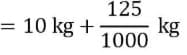
(v) 10 kg 125 g
RS Aggarwal Solutions: Decimals (Exercise 8C)
= 10 kg + 0.125 kg
= 10.125 kg

(vi) 10 kg 80 g
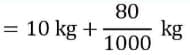
RS Aggarwal Solutions: Decimals (Exercise 8C)
= 10 kg + 0.080 kg
= 10.080 kg

(vii) 10 kg 8 g
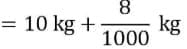
RS Aggarwal Solutions: Decimals (Exercise 8C)
= 10 kg + 0.008 kg
= 10.008 kg

The document RS Aggarwal Solutions: Decimals (Exercise 8C) is a part of the Class 6 Course Mathematics for Class 6.
All you need of Class 6 at this link: Class 6

FAQs on RS Aggarwal Solutions: Decimals (Exercise 8C)

1. What are decimals?
Ans. Decimals are numbers that are expressed in the base-10 system, which includes a whole number part and a fractional part separated by a decimal point. For example, in the number 3.75, 3 is the whole number and 0.75 is the decimal part.
2. How do you add decimal numbers?
Ans. To add decimal numbers, align the numbers by their decimal points and then add each column starting from the right. If the sum of a column is 10 or more, carry over the extra value to the next column on the left. For instance, to add 2.5 and 1.75, you would line them up as follows: 2.50 + 1.75 ------- 4.25
3. What is the process for subtracting decimals?
Ans. To subtract decimal numbers, first align the numbers by their decimal points. Then, subtract each column starting from the right. If the top number is smaller than the bottom number in any column, you may need to borrow from the next column to the left. For example, subtracting 5.2 from 7.5 would be done as follows: 7.50 - 5.20 ------- 2.30
4. How do you multiply decimals?
Ans. To multiply decimals, first ignore the decimal points and multiply the numbers as if they were whole numbers. Then, count the total number of decimal places in both numbers being multiplied and place the decimal point in the product accordingly. For instance, multiplying 0.4 by 0.3 involves calculating 4 × 3 = 12, and since there are two decimal places in total, the final answer is 0.12.
5. What is the importance of rounding decimals?
Ans. Rounding decimals is important because it simplifies numbers to make them easier to work with, especially in calculations and estimations. Rounding can help in approximating values without needing exact numbers, which is useful in everyday situations such as budgeting or measuring. For example, rounding 2.67 to 3 makes it simpler to use in calculations.
Explore Courses for Class 6 exam
Get EduRev Notes directly in your Google search
Related Searches
RS Aggarwal Solutions: Decimals (Exercise 8C), Previous Year Questions with Solutions, video lectures, ppt, RS Aggarwal Solutions: Decimals (Exercise 8C), shortcuts and tricks, Objective type Questions, Exam, MCQs, RS Aggarwal Solutions: Decimals (Exercise 8C), Extra Questions, Semester Notes, Summary, mock tests for examination, Viva Questions, Important questions, Free, study material, Sample Paper, practice quizzes, pdf , past year papers;