RS Aggarwal Solutions: Decimals (Exercise 8F)

Solution 1:
We know that by multiplying by 10, the decimal point is shifted one place to its right side.
(i) 73.92 × 10 = 739.2
(ii) 7.54 × 10 = 75.4
(iii) 84.003 × 10 = 840.03
(iv) 0.83 × 10 = 8.3
(v) 0.7 × 10 = 7.0
(vi) 0.032 × 10 = 0.32
Solution 2:
We know that by multiplying a decimal by 100, two decimal points are shifted to its right side.
(i) 2.397 × 100 = 239.7
(ii) 6.83 × 100 = 683.0
(iii) 2.9 × 100 = 290
(iv) 0.08 × 100 = 8
(v) 0.6 × 100 = 60
(vi) 0.003 × 100 = 0.3
Solution 3:
We know that by multiplying a decimal by 1000, three places of decimal are shifted to its right.
(i) 6.7314 × 1000 = 6731.4
(ii) 0.182 × 1000 = 182
(iii) 0.076 × 1000 = 76
(iv) 6.25 × 1000 = 6250
(v) 4.8 × 1000 = 4800
(vi) 0.06 × 1000 = 60
Solution 4:
(i) 5.4 × 16 = 86.4 (One place of decimal)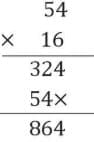
(ii) 3.65 × 19 = 69.35 (Two place of decimal)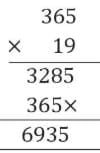
(iii) 0.854 × 12 = 10.248 (Three place of decimal)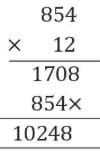 (iv) 36.73 × 48 = 1763.04 (Two places of decimal)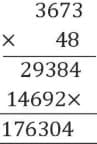
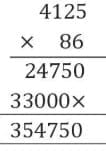
(v) 4.125 × 86 = 354.750 (Three places of decimal) = 354.75
(vi) 104.06 × 75 = 7804.50 (Two place of decimal)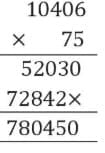
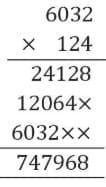
(vii) 6.032 × 124 = 747.968 (Three places of decimal)
(viii) 0.0146 × 69 = 1.0074 (Four places of decimal)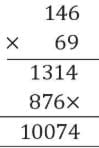
(ix) 0.00125 × 327 = 0.40875 (Five places of decimal)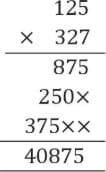
Solution 5:
(i) 7.6 × 2.4 = 18.24 {Sum of decimal places = 1 + 1 = 2}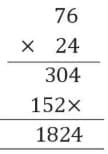
(ii) 3.45 × 6.3 = 21.735 {Sum of decimal places = 2 + 1 = 3}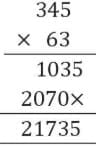
(iii) 0.54 × 0.27 = 0.1458 {Sum of decimal places = 2 + 2 = 4}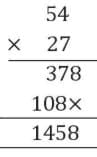
(iv) 0.568 × 4.9 = 2.7832 {Sum of decimal places = 3 + 1 = 4}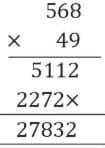
(v) 6.54 × 0.09 = 0.5886 {Sum of decimal places = 2 + 2 = 4}
(vi) 3.87 × 1.25 = 4.8375 {Sum of decimal places = 2 + 2 = 4}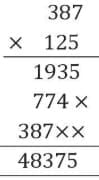
(vii) 0.06 × 0.38 = 0.0228 {Sum of decimal places = 2 + 2 = 4}
(viii) 0.623 × 0.75 = 0.46725 {Sum of decimal places = 3 + 2 = 5}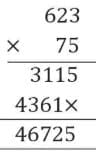
(ix) 0.014 × 0.46 = 0.00644 {Sum of decimal places = 3 + 2 = 5}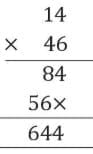
(x) 54.5 × 1.76 = 95.920 {Sum of decimal places = 1 + 2 = 3}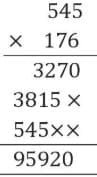
(xi) 0.045 × 2.4 = 0.1080 {Sum of decimal places = 3 + 1 = 4}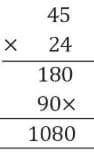
(xii) 1.245 × 6.4 = 7.9680 {Sum of decimal places = 3 + 1 = 4}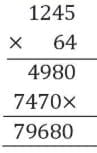
Solution 6:
(i) 13 × 1.3 × 0.13 = 2.197 {Sum of decimal places = 1 + 2 = 3}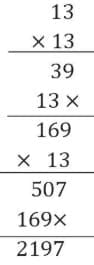
(ii) 2.4 × 1.5 × 2.5 = 9.000 = 9 {Sum of decimal places = 1 + 1 + 1 = 3}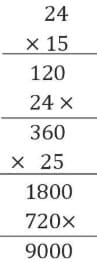
(iii) 0.8 × 3.5 × 0.05 = 0.1400 = 0.14 {Sum of decimal places = 1 + 1 + 2 = 4}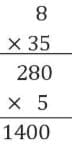
(iv) 0.2 × 0.02 × 0.002 = 0.000008 {Sum of decimal places = 1 + 2 + 3 = 6}
(v) 11.1 × 1.1 × 0.11 = 1.3431 {Sum of decimal places = 1 + 1 + 2 = 4}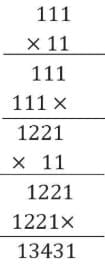
(vi) 2.1 × 0.21 × 0.021 = 0.009261 {Sum of decimal places = 1 + 2 + 3 = 6}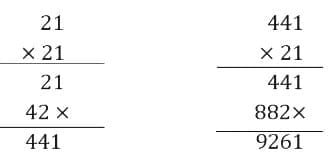
Solution 7:
(i) (1.2)² = 1.2 × 1.2 = 1.44 {Sum of decimal places = 1 + 1 = 2}
(ii) (0.7)² = 0.7 × 0.7 = 0.49 {Sum of decimal places = 1 + 1 = 2}
(iii) (0.04)² = 0.04 × 0.04 = 0.0016 {Sum of decimal places = 2 + 2 = 4}
(iv) (0.11)² = 0.11 × 0.11 = 0.0121 {Sum of decimal places = 2 + 2 = 4}
Solution 8:
(i) (0.3)³ = 0.3 × 0.3 × 0.3 = 0.027
(ii) (0.05)³ = 0.05 × 0.05 × 0.05 = 0.000125
(iii) (1.5)³ = 1.5 × 1.5 × 1.5 = 3.375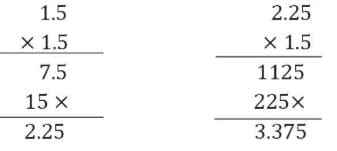
Solution 9:
Distance covered in one hour = 62.5 km
∴ Distance covered in 18 hours = 62.5 × 18 km = 1125.0 km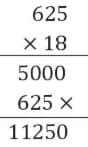
Solution 10:
Weight of one tin of oil = 16.8 kg
∴ Weight of 45 tins = (16.8 × 45) kg
= 756.0 kg
= 756 kg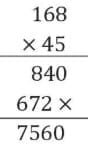
Solution 11:
Weight of wheat in one bag = 97.8 kg
∴ Weight of wheat in 500 bags
= 97.8 × 500 kg
= 48900.0 kg
= 48900 kg
Solution 12:
Weight of one bag = 48.450 kg
∴ Weight of 16 bags = 48.450 × 16
= 775.200 kg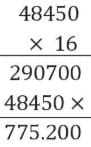
Solution 13:
Quantity of sauce in one bottle = 0.845 kg
Quantity of sauce in 72 bottles = 0.845 × 72 kg = 60.840 kg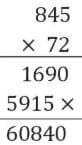
Solution 14:
Quantity of jam in one bottle = 925 g
∴ Quantity of jam in 25 bottles = 925 × 25 g
= 23125 g
= 23125/1000 kg
= 23.125 kg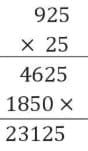
Solution 15:
Oil in one drum = 16.850 litres
∴ Oil in 48 drums = (16.850 × 48) litres
= 808.800 litres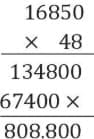
Solution 16:
Cost of 1 kg rice = ₹ 56.80
∴ Cost of 16.25 kg of rice = ₹ (56.80 × 16.25)
= ₹ 923.0000
= ₹ 923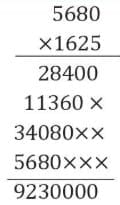
Solution 17:
Cost of one metre of cloth = ₹ 108.50
∴ Cost of 18.5 metres of cloth = ₹ 108.50 × 18.5
= ₹ 2007.250
= ₹ 2007.25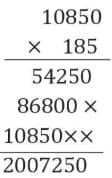
Solution 18:
Distance covered in one litre petrol = 8.6 km
∴ Distance covered in 36.5 litres petrol = (8.6 × 36.5) km
= 313.90 km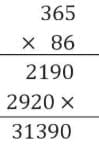
Solution 19:
Charges for 1 km = ₹ 9.80
∴ Charges for 106.5 km
= ₹ 9.80 × 106.5
= ₹ 1043.700
= ₹ 1043.7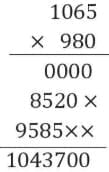
FAQs on RS Aggarwal Solutions: Decimals (Exercise 8F)
| 1. What are decimals and how are they used in everyday life? |  |
| 2. What is the place value system in decimals? | |
| 3. How do you convert a fraction to a decimal? | |
| 4. What are the rules for adding and subtracting decimals? | |
| 5. How do you multiply and divide decimals? | |