RS Aggarwal Solutions: Lines and Angles (Exercise 9B)

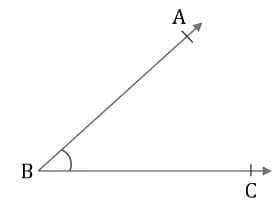
Solution 1: In the given angle ABC, the vertex is B and arms are 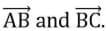
Solution 2: (i) In the given figure, three angles are formed.
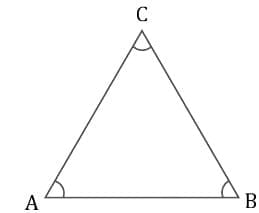
Names of the angles are:
∠ABC, ∠BAC and ∠ACB
(ii) In the given figure, four angles are formed.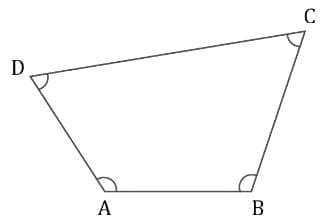
Names of the angles are:
∠ABC, ∠BCD, ∠CDA and ∠BAD
(iii) In the given figure, eight angles are formed.
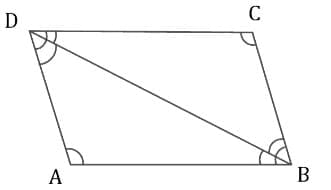
Names of the angles are:
∠ABC, ∠BCD, ∠CDA, ∠BAD, ∠ABD, ∠DCB, ∠ADB and ∠BDC
Solution 3: In the given figure, another name for: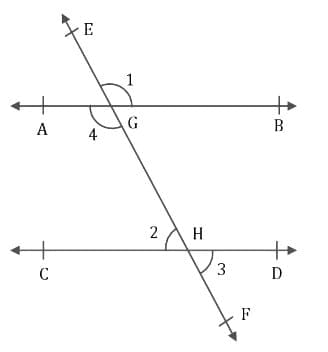
(i) ∠1 = ∠EGB
(ii) ∠2 = ∠CHG
(iii) ∠3 = ∠DHF
(iv) ∠4 = ∠AGH
Solution 4: In given figure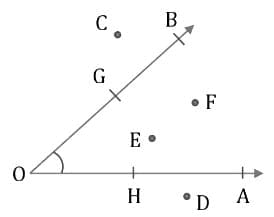
(i) Points E and F are in the interior of ∠AOB
(ii) Points C and D are in the exterior of ∠AOB.
(iii) Points A, B, O, G and H lie on ∠AOB.
Solution 5:
(i) False
(ii) True
(iii) False
(iv) True
(v) False
Solution 6: We know that
- an acute angle is less than 90°
- a right angle is equal to 90°
- an obtuse angle is greater than 90° but less than 180°
- an angle equal to 180° is a straight angle
- angle greater than 180° but less than 360° is called a reflex angle
- angle equal to 360° is called a complete angle
- angle equal to 0° is called a zero angle.
Now the angles are:
(i) 30° = acute angle
(ii) 85° = acute angle
(iii) 92° = obtuse angle
(iv) 90° = right angle
(v) 180° = straight angle
(vi) 210° = Reflex angle
(vii) 340° = Reflex angle
(viii) 360° = complete angle
Solution 7:
(i) Obtuse angle
(ii) Right angle
(iii) straight angle
(iv) Reflex angle
(v) Acute angle
(vi) Complete angle
Solution 8: (i) Take the ruler and draw any ray OA. Again using the ruler, starting from O, draw a ray OB in such a way that the angle formed is less than 90°. Then, ∠AOB is the required acute angle.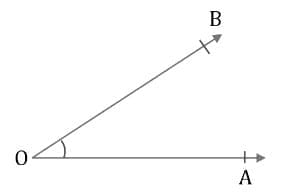
(ii) Take the ruler and draw any ray OA. Now, starting from O, draw another ray OB, with the help of the ruler, such that the angle formed is greater than a right angle.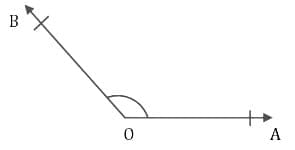
Then, ∠AOB is the required obtuse angle.
(iii) Take a ruler and draw any ray OA. Now, starting from O, draw ray OB in the opposite direction of the ray OA. Then ∠AOB is the required straight angle.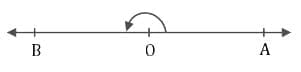
Solution 9:
(i) One right angle = 90°
(ii) Two right angles = (2 × 90)° = 180°
(iii) 4/5 of a right angle 
(iv) 3/5 of a straight angle 
Solution 10: A clock is a circle of 360°.
A clock is divided into 12 hours.
So the angle between each hour mark is = 360°/12 = 30°
At 1 o'clock, the hour hand is on 1 and the minute hand is on 12.
∴ The angle between the 12 and 1 marks = 30°.
Hence, the angle between the hands of a clock at 1 o'clock is 30°.
Solution 11:
(i) When it is 3 o' clock, the minute hand is at 12, and hour hand is at 3 as shown in the figure, clearly, the angle between the two hands 90°.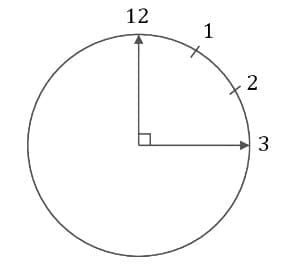 (ii) When it is 6 o' clock, the minute hand is at 12 and the hour hand is at 6 as shown in the figure. Clearly, the angle between the two hands of the clock is a straight angle i.e. 180°.
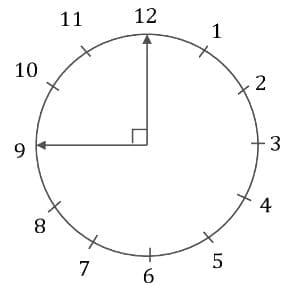
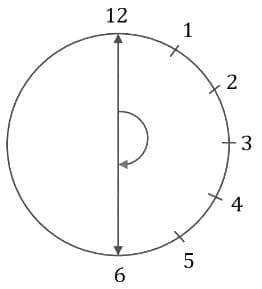 (iii) When it is 9 o' clock, the minute hand is at 12 and the hour hand is at 9 as shown in the figure. Clearly, the angle between the two hands = 90°.
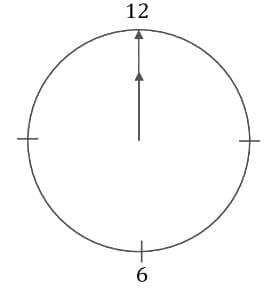
 (iv) When it is 12 o' clock, both the hands of the clock lie at 12 as shown in the figure. Clearly, the angle between the two hands = 0°.
Solution 12: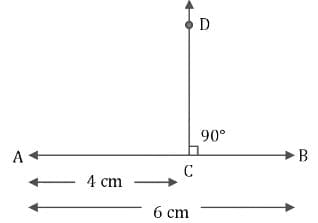
Steps of construction:
(i) Draw a line segment AB = 6 cm.
(ii) Take a point C on AB such that AC = 4 cm.
(iii) Place protractor with its centre at C and base along CB.
(iv) Mark a point D against 90°.
(v) Remove the protractor and join DC.
Then DC ⊥ AB.
Solution 13:
(i) Place the protractor in such a way that its centre is exactly at the vertex O of the given angle AOB and the base line lies along the arm OA. Read off the mark through which the arm OB passes, starting from 0° on the side A.
We find that ∠AOB = 45°.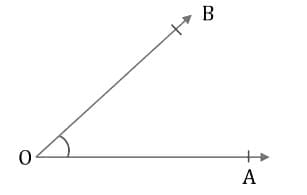
(ii) The given angle is ∠PQR. Place the protractor in such a way that its centre is exactly on the vertex Q of the given angle and the base line lies along the arm QR. Read off the mark through which the arm QP passes, starting from 0° on the side of R.
We find that ∠PQR = 75°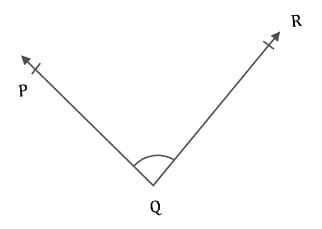
(iii) The given angle is ∠DEF. Place the protractor in such a way that its centre is exactly on the vertex E of the given angle and the base line lies along the arm ED. Read off the mark through which the arm EF passes, starting from 0° on the side of D.
We find that ∠DEF = 130°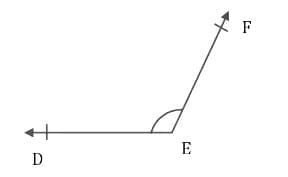
(iv) The given angle is ∠LMN. Place the protractor in such a way that its centre is exactly on the vertex M of the given angle and the base line lies along the arm ML. Read off the mark through which the arm MN passes, starting from 0° on the side of L.
We find that ∠LMN = 50°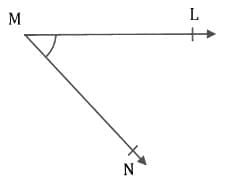
(v) The given angle is ∠RST. Place the protractor in such a way that its centre is exactly on the vertex S of the given angle and the base line lies along the arm SR. Read off the mark through which the arm ST passes, starting from 0° on the side of R.
We find that the ∠RST = 130°.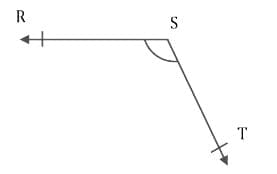
(vi) The given angle is ∠GHI. Place the protractor in such a way that its centre is exactly on the vertex H of the given angle and the base line lies along the arm HI. Read off the mark through which the arm HG passes, starting from 0° on the side of I.
We find that ∠GHI = 70°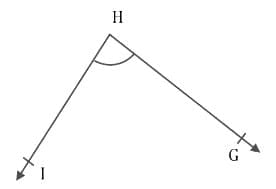
Solution 14: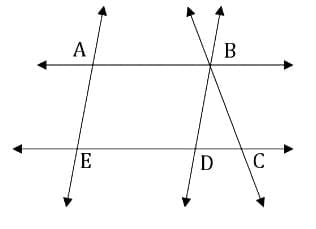
| S. No. | Angle | Measure | Acute/Obtuse |
|---|---|---|---|
| 1. | ∠AED | 70° | Acute |
| 2. | ∠ABC | 100° | Obtuse |
| 3. | ∠CDB | 70° | Acute |
| 4. | ∠BAE | 110° | Obtuse |
| 5. | ∠DBC | 30° | Acute |
Solution 15: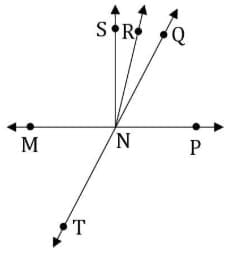
| S. No. | Angle | Measure | Classification |
|---|---|---|---|
| 1. | ∠PNQ | 70° | Acute |
| 2. | ∠PNR | 80° | Acute |
| 3. | ∠PNS | 90° | Right |
| 4. | ∠MNP | 180° | Straight |
| 5. | ∠MNT | 70° | Acute |
| 6. | ∠TNQ | 180° | Straight |
Solution 16: (Figure showing angles of 30°, 60°, 30°)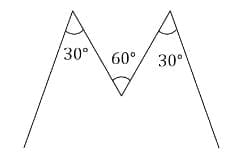
Solution 17: 
Ashok Chakra is in the shape of circle.
We know that total angle in a circle is 360°
Total spokes in the Ashok Chakra = 24
∴ Angle between adjacent spokes of an Ashok Charka = 360°/24 = 15°
A right angle is formed between 6 spokes as 6 × 15° = 90°
So, the largest acute angle will be formed between 5 spokes.
∴ The largest acute angle = 5 × 15° = 75°
A straight angle is formed between 12 spokes as 12 × 15° = 180°
So, the largest obtuse angle will be formed between 11 spokes.
∴ The largest acute angle = 11 × 15° = 165°
Solution 18: Let the acute angle be x
If it is tripled the angle will be = 3x
Now, according to the question
3x = 90°
⇒ x = 90°/3
⇒ x = 30°
Hence, the measure of the acute angle is 30°.
FAQs on RS Aggarwal Solutions: Lines and Angles (Exercise 9B)
| 1. What are complementary angles? |  |
| 2. How do we determine if two angles are supplementary? | |
| 3. What is the significance of a transversal in geometry? | |
| 4. What are vertical angles? | |
| 5. How can we identify corresponding angles? | |