RS Aggarwal Solutions: Lines and Angles (Exercise 9D)

Assertion-Reason Questions
Directions (Questions 1 to 9): Each question consists of two statements, namely, Assertion (A) and Reason (R).
Q1. Assertion (A): All concurrent lines have the same distance between them.
Reason (R): All concurrent lines pass through a common point.
(a) Both Assertion (A) and Reason (R) are true and Reason (R) is the correct explanation of Assertion (A).
(b) Both Assertion (A) and Reason (R) are true and Reason (R) is not the correct explanation of Assertion (A).
(c) Assertion (A) is true but Reason (R) is false.
(d) Assertion (A) is false but Reason (R) is true.
Answer: (d)
Assertion (A) is false because all concurrent lines do not have the same distance between them. This is true for parallel lines only.
Reason (R) is true: All concurrent lines pass through a common point.
Q2. Assertion (A): Only one line can be drawn passing through two distinct points.
Reason (R): An unlimited number of lines can be drawn passing through a given point.
(a) Both Assertion (A) and Reason (R) are true and Reason (R) is the correct explanation of Assertion (A).
(b) Both Assertion (A) and Reason (R) are true and Reason (R) is not the correct explanation of Assertion (A).
(c) Assertion (A) is true but Reason (R) is false.
(d) Assertion (A) is false but Reason (R) is true.
Answer: (b)
Assertion (A) is true: According to Euclidean geometry only one line can pass through two distinct points.
Reason (R) is true: According to Euclidean geometry unlimited lines can pass through a single point.
Although both statements are true, (R) does not explain (A).
(A) is about two distinct points determining only one line.
(R) talks about many lines through a single point, which is a separate idea.
Q3. Assertion (A): There are no points common between two parallel lines.
Reason (R): Two parallel lines always have the same distance between them.
(a) Both Assertion (A) and Reason (R) are true and Reason (R) is the correct explanation of Assertion (A).
(b) Both Assertion (A) and Reason (R) are true and Reason (R) is not the correct explanation of Assertion (A).
(c) Assertion (A) is true but Reason (R) is false.
(d) Assertion (A) is false but Reason (R) is true.
Answer: (a)
Assertion (A) is true: Parallel lines never intersect each other, so they don't have common points between them.
Reason (R) is true: All parallel lines always have the same distance between them.
Now, Reason (R) is the correct explanation of the Assertion (A). The reason why parallel lines do not intersect (i.e. have no common points) is because they are always the same distance apart - they never get closer or farther, so they can't meet.
Q4. Assertion (A): Ray  is the same as ray
Reason (R): An infinite number of rays can be drawn with a given point as the initial point.
(a) Both Assertion (A) and Reason (R) are true and Reason (R) is the correct explanation of Assertion (A).
(b) Both Assertion (A) and Reason (R) are true and Reason (R) is not the correct explanation of Assertion (A).
(c) Assertion (A) is true but Reason (R) is false.
(d) Assertion (A) is false but Reason (R) is true.
Answer: (d)
Assertion (A) is false: A ray has a starting point (called the initial point) and extends infinitely in one direction.
Ray (AB) starts at point A and passes through B, going infinitely in the direction from A to B.
Ray (BA) starts at point B and passes through A, going in the opposite direction.
So, 
Reason (R) is true: Infinite rays can start from one point.
Q5. Assertion (A): The vertex is the common initial point of the two rays forming the angle.
Reason (R): The two rays forming an angle are called the two legs of the angle.
(a) Both Assertion (A) and Reason (R) are true and Reason (R) is the correct explanation of Assertion (A).
(b) Both Assertion (A) and Reason (R) are true and Reason (R) is not the correct explanation of Assertion (A).
(c) Assertion (A) is true but Reason (R) is false.
(d) Assertion (A) is false but Reason (R) is true.
Answer: (c)
Assertion (A) is true: Vertex is the common initial point of the two rays forming the angle.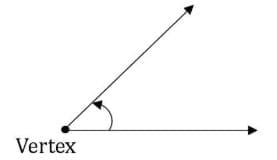 Reason (R) is false: Angle formed by two rays are called arms not legs.
Q6. Assertion (A): The standard unit of measuring an angle is degree.
Reason (R): A straight angle is equal to 180°.
(a) Both Assertion (A) and Reason (R) are true and Reason (R) is the correct explanation of Assertion (A).
(b) Both Assertion (A) and Reason (R) are true and Reason (R) is not the correct explanation of Assertion (A).
(c) Assertion (A) is true but Reason (R) is false.
(d) Assertion (A) is false but Reason (R) is true.
Answer: (b)
Assertion (A) is true: Degree is the standard unit of angle.
Reason (R) is true: A straight angle = 180°
While both statements are true, the fact that a straight angle is 180° does not explain why a degree is the standard unit of measurement.
Q7. Assertion (A): An angle measuring 360° is called a reflex angle.
Reason (R): A reflex angle measures more than 180°.
(a) Both Assertion (A) and Reason (R) are true and Reason (R) is the correct explanation of Assertion (A).
(b) Both Assertion (A) and Reason (R) are true and Reason (R) is not the correct explanation of Assertion (A).
(c) Assertion (A) is true but Reason (R) is false.
(d) Assertion (A) is false but Reason (R) is true.
Answer: (d)
Assertion (A) is false: An angle measuring 360° is called a complete angle not a reflex angle.
Reason (R) is true: A reflex angle is any angle greater than 180° but less than 360°.
Q8. Assertion (A): The sum of an acute angle and an obtuse angle can be equal to a straight angle.
Reason (R): Two obtuse angles together can make a complete angle.
(a) Both Assertion (A) and Reason (R) are true and Reason (R) is the correct explanation of Assertion (A).
(b) Both Assertion (A) and Reason (R) are true and Reason (R) is not the correct explanation of Assertion (A).
(c) Assertion (A) is true but Reason (R) is false.
(d) Assertion (A) is false but Reason (R) is true.
Answer: (c)
Assertion (A) is true: An acute angle is less than 90°. An obtuse angle is more than 90° but less than 180°.
Acute angle + obtuse angle = straight angle
e.g. 70° + 110° = 180°
Reason (R) is false: An obtuse angle is greater than 90° but less than 180°.
Since each obtuse angle is less than 180°, their sum will always be less than 360°.
Q9. Assertion (A): An angle measuring 270° is a reflex angle.
Reason (R): An angle measuring more than 180° but less than 360° is called a reflex angle.
(a) Both Assertion (A) and Reason (R) are true and Reason (R) is the correct explanation of Assertion (A).
(b) Both Assertion (A) and Reason (R) are true and Reason (R) is not the correct explanation of Assertion (A).
(c) Assertion (A) is true but Reason (R) is false.
(d) Assertion (A) is false but Reason (R) is true.
Answer: (a)
Assertion (A) is true: An angle greater than 180° and less than 360° is called a reflex angle.
∴ 180° < 270° > 360°
∴ 270° is a reflex angle.
Reason (R) is true: Reflex angle is between 180° and 360°.
So, Reason (R) exactly explains the Assertion (A) why 270° is a reflex angle.
Case-Based Questions
Directions (Questions 10 to 13): Examine the following case study carefully and answer the questions that follow.
Priya drew a figure in his notebook. The figure is shown below.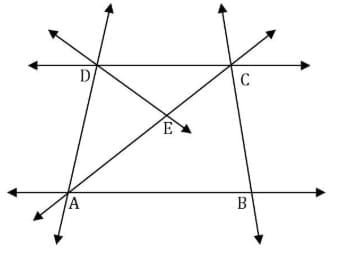
Q10. Which of the following points are collinear?
(a) A, B, C
(b) B, C, D
(c) E, A, C
(d) D, E, B
Answer: (c)
Collinear means points lying on same line.
∴ E, A, C are on the same line.
Q11. Which of the following is a set of concurrent lines?
(a) 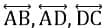
(b) 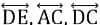
(c) 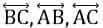
(d) 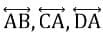
Answer: (d)
Concurrent means meeting at a single point.
∴ 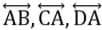 all intersect at point A.
Q12. How many lines are concurrent at point D?
(a) 2
(b) 3
(c) 4
(d) 5
Answer: (b)
Three lines 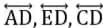 intersecting at D.
Q13. Which lines have A as the point of intersection?
(a) 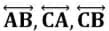
(b) 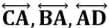
(c) 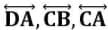
(d) 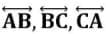
Answer: (b)
Three lines 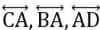 have A as the common point of intersection.
FAQs on RS Aggarwal Solutions: Lines and Angles (Exercise 9D)
| 1. What are the basic concepts of lines and angles? |  |
| 2. What are complementary and supplementary angles? | |
| 3. How can we classify angles based on their measures? | |
| 4. What is the significance of parallel lines in relation to angles? | |
| 5. How can we use the properties of angles to solve problems in geometry? | |