CBSE Class 6 > Class 6 Notes > Mathematics > RS Aggarwal Solutions: Constructions (Exercise 10C)
RS Aggarwal Solutions: Constructions (Exercise 10C)

Solution 1: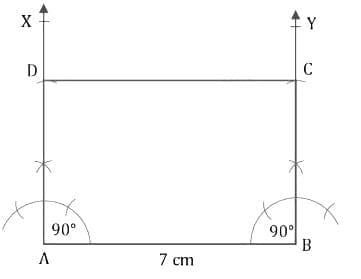
Steps of Construction:
- Draw a line-segment AB = 7 cm with the help of a ruler.
- At A, construct ∠BAX = 90°.
- At B, construct ∠ABY = 90°.
- With A as centre and radius 4 cm, draw an arc cutting AX at D.
- With B as centre and radius 4 cm, draw an arc cutting BY at C.
- Join AC, BD and DC.
Then, ABCD is the required rectangle in which AB = DC = 7 cm and AD = BC = 3 cm.
Solution 2:
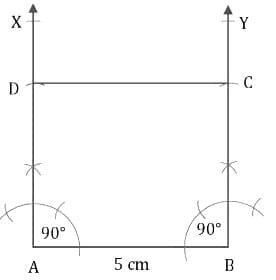
Steps of Construction:
- With the help of a ruler draw a line segment AB = 5 cm.
- At A, construct ∠BAX = 90°.
- At B, construct ∠ABY = 90°.
- With A as centre and radius 5 cm, draw an arc cutting AX at D.
- With B as centre and radius 5 cm, draw an arc cutting BY at C.
- Join AC, BD and DC.
Then, ABCD is the required square in which AB = BC = CD = DA = 6 cm.
Solution 3: In a rectangle, the diagonals are equal in length and each angle is a right angle.
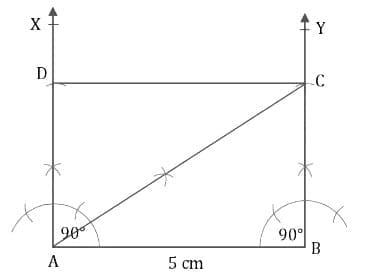
Steps of construction:
- Draw line segment AB = 5 cm.
- At A, construct ∠BAX = 90°.
- At B, construct ∠ABY = 90°.
- With A as centre and radius 6.5 cm, draw an arc cutting BY at C.
- With B as centre and radius 6.5 cm, draw an arc cutting AX at D.
- Join AC, BD and DC.
Then, ABCD is the required rectangle in which AB = DC = 5 cm and diag. AC = diag. BD = 6.5 cm.
Solution 4:
In a rectangle, the diagonals are equal in length and each angle is a right angle.
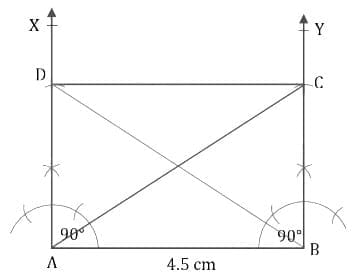
Steps of construction:
- Draw line segment AB = 4.5 cm.
- At A, construct ∠BAX = 90°.
- At B, construct ∠ABY = 90°.
- With A as centre and radius 5.4 cm, draw an arc cutting BY at C.
- With B as centre and radius 5.4 cm, draw an arc cutting AX at D.
- Join AC, BD and DC.
Then, ABCD is the required rectangle in which AB = DC = 4.5 cm and diag. AC = diag. BD = 5.4 cm.
Solution 5:
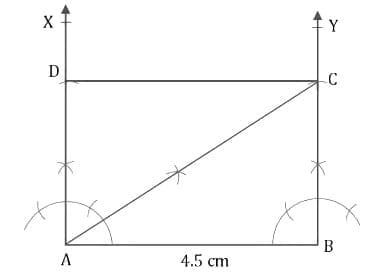
Steps of construction:
- Draw line segment AB = 4.5 cm.
- At A, construct ∠BAX = 90°.
- At B, construct ∠ABY = 90°.
- At A, construct ∠BAC = 30° such that AC meets BY at C.
- With A as centre and radius equal to BC, draw an arc cutting AX at D.
- Join AC, BD and DC.
Then, ABCD is the required rectangle.
The document RS Aggarwal Solutions: Constructions (Exercise 10C) is a part of the Class 6 Course Mathematics for Class 6.
All you need of Class 6 at this link: Class 6
FAQs on RS Aggarwal Solutions: Constructions (Exercise 10C)
| 1. What are constructions in geometry? |  |
Ans. Constructions in geometry refer to the methods of drawing shapes, angles, and other geometric figures using only a compass and a straightedge. These constructions help in understanding the properties of geometric figures and their relationships.
| 2. What are the basic tools used for constructions? | |
Ans. The basic tools used for constructions are a compass and a straightedge. The compass is used to draw circles and arcs, while the straightedge is used to draw straight lines. These tools are essential for performing accurate geometric constructions.
| 3. How can one construct a perpendicular bisector of a line segment? | |
Ans. To construct a perpendicular bisector of a line segment, follow these steps: First, draw the line segment. Then, place the compass at one endpoint and draw arcs above and below the segment. Repeat this from the other endpoint, ensuring the arcs intersect. Finally, draw a straight line through the intersection points; this line is the perpendicular bisector.
| 4. What is the significance of constructing angles in geometry? | |
Ans. Constructing angles in geometry is significant as it helps to create precise geometric shapes and figures. It also aids in understanding the properties of angles, such as congruence and supplementary relationships, which are foundational concepts in geometry.
| 5. Can constructions be used to solve real-life problems? | |
Ans. Yes, constructions can be used to solve real-life problems, such as in architecture for designing buildings, in engineering for creating blueprints, and in various fields where precision in measurements and angles is crucial. They provide a systematic way to create accurate geometric representations that can be applied in practical scenarios.
About this Document

4.81/5 Rating

Apr 29, 2026 Last updated
Related Exams
Document Description: RS Aggarwal Solutions: Constructions (Exercise 10C) for Class 6 2026 is part of Mathematics for Class 6 preparation. The notes and questions for RS Aggarwal Solutions: Constructions (Exercise 10C) have been prepared according to the Class 6 exam syllabus. Information about RS Aggarwal Solutions: Constructions (Exercise 10C) covers topics like and RS Aggarwal Solutions: Constructions (Exercise 10C) Example, for Class 6 2026 Exam. Find important definitions, questions, notes, meanings, examples, exercises and tests below for RS Aggarwal Solutions: Constructions (Exercise 10C).
Introduction of RS Aggarwal Solutions: Constructions (Exercise 10C) in English is available as part of our Mathematics for Class 6 for Class 6 & RS Aggarwal Solutions: Constructions (Exercise 10C) in Hindi for Mathematics for Class 6 course. Download more important topics related with notes, lectures and mock test series for Class 6 Exam by signing up for free. Class 6: RS Aggarwal Solutions: Constructions (Exercise 10C)
Description
RS Aggarwal Solutions: Constructions (Exercise 10C) of Mathematics on EduRev - covers important questions, MCQs with answers. Helps you prepare for exam.
Information about RS Aggarwal Solutions: Constructions (Exercise 10C)
In this doc you can find the meaning of RS Aggarwal Solutions: Constructions (Exercise 10C) defined & explained in the simplest way possible. Besides explaining types of RS Aggarwal Solutions: Constructions (Exercise 10C) theory, EduRev gives you an ample number of questions to practice RS Aggarwal Solutions: Constructions (Exercise 10C) tests, examples and also practice Class 6 tests



Related Searches
practice quizzes, RS Aggarwal Solutions: Constructions (Exercise 10C), shortcuts and tricks, Exam, Extra Questions, Semester Notes, past year papers, Previous Year Questions with Solutions, Summary, Free, ppt, video lectures, Sample Paper, Viva Questions, study material, mock tests for examination, RS Aggarwal Solutions: Constructions (Exercise 10C), pdf , Important questions, MCQs, Objective type Questions, RS Aggarwal Solutions: Constructions (Exercise 10C);