NCERT Solutions: The Story of Indian Farming

The Big Questions?
(Page 1)
Q1: What are the main characteristics of Indian agriculture?
Ans: The main Characteristics of Indian Agriculture are:
(i) Deep Cultural Roots: The word agriculture comes from Latin words 'agri' means 'field' and 'culture' means 'to cultivate'. Indian agriculture is not limited to growing crops; it includes livestock rearing, beekeeping (apiculture), fisheries, silkworm rearing, silk production, and fibre production like cotton and hemp. This shows how rich and diverse India's farming traditions are.
(ii) Strong Economic Importance: Agriculture and allied activities contribute more than 18% to India's GDP (2022-23). Nearly 46% of India's working population is engaged in farming and related activities, making it a major source of livelihood and national development.
(iii) Traditional Family Connection: Most Indian families have been connected to farming for generations. This long association shows the deep cultural, emotional, and economic bond between people and the land.
(iv) Diverse Crops Across Regions: India has a wide range of climates and soils. This allows farmers to grow many crops-like rice in wetter regions, wheat in cooler areas, and cotton, sugarcane, and millets in warmer places.
(v) Different Farming Practices in Different Areas: Because soils, temperatures, and rainfall vary across India, each region follows unique farming practices and grows crops suited to local conditions. This makes Indian agriculture highly adaptable.
(vi) Labour-Rich Agriculture: Farming involves many activities like sowing, weeding, and harvesting. These tasks give work to many people and strengthen rural communities.
(vii) Balanced Use of Traditional and Modern Methods: Indian farmers use both traditional tools and modern machines. This combination helps maintain cultural practices while also improving productivity.
Q2: How are farming, climate, soil, and water interrelated?
Ans: Farming in any region depends mainly on its climate, which decides the temperature and rainfall a place receives. Different climates support different kinds of crops. For example, rice grows well in warm areas with plenty of rain, while wheat grows best in cooler places with moderate rainfall. Some crops like millets and pulses thrive even in dry climates, whereas tea and coffee grow beautifully in hilly regions with cool weather. Thus, the climate of a place guides farmers in choosing the right crops.
Soil also plays a very important role in farming because it provides plants with nutrients. Different soils grow different crops. For instance, alluvial soil is very fertile and supports rice, wheat, sugarcane, and jute. Black soil holds moisture and is ideal for cotton, while red soil is good for groundnut, millets, and pulses. When the soil is rich and healthy, crops grow better and give higher yields. Wherever the soil needs support, farmers improve it using compost and fertilisers.
Water availability further influences farming practices. Crops need the right amount of water to grow, and farmers use rivers, canals, tube wells, and tanks to irrigate their fields where rainfall is not enough. Some crops like sugarcane and paddy need more water, whereas others like bajra or ragi require very little. With the right balance of climate, soil, and water, farmers are able to grow suitable crops and ensure healthy, productive agriculture.
Q3: How can traditional practices and contemporary ones complement each other?
Ans: Traditional practices and contemporary ones complement each other in the following ways:
Traditional practices use natural methods like mixed farming, organic manure, and crop rotation. While, contemporary (modern) practices use machines, HYV (High Yielding Variety) seeds, fertilisers, and latest irrigation technology. When both are used together, farming becomes more efficient and ecofriendly. Traditional methods protect the soil and environment, while modern methods increase production. By combining both, farmers can grow healthier crops in a faster and safer way.
Let's Explore
Q4:
(a) Create a list of the foods you typically eat.
(b) Identify the grains, pulses, oils, vegetables, and fruits in them.
(c) Now locate where you live on a physical map of India. (You may refer to the political map of India at the end of the book if you wish.)
(d) Which of the food items do you think grow in and around where you live?
(e) What do you think are the reasons that they are cultivated in your region?
(f) Which of them comes from other places?
(g) Why do you think they are not grown in your area? (Page 3)
Ans:
(a) The foods I usually eat are:
- For Breakfast: Roti, dal, poha, idli, eggs.
- For Lunch: Rice, dal, sabzi (potato, brinjal, beans), curd.
- For Snacks: Fruits (banana, apple), chana, biscuits.
- For Dinner: Rice/roti, vegetables, pulses.
(b) The following foods are made from:
(i) Grains:
- Rice
- Wheat (used to make roti)
- Poha (flattened rice)
- Idli (made from rice and lentils)
(ii) Pulses:
- Arhar dal
- Moong dal
- Chana (gram)
(iii) Oils:
- Mustard oil
- Refined oil (sunflower/soybean)
(iv) Vegetables:
- Potato
- Beans
- Tomato
- Brinjal
- Lady's finger
- Spinach
- Cauliflower
(v) Fruits:
- Banana
- Apple
- Mango (seasonal)
- Guava
(c) I live in Muzaffarpur, which is located in north-central Bihar.
(d) Food items that grow in and around my area are:
- Rice, wheat, maize, chickpea, pigeon pea and foxtail millet is grown as the land is fertile and gets good rainfall.
- Fruits like litchi, banana, guava, mango - grow well in warm climates.
(e) These food items are cultivated in my area because of the following reasons.
- Fertile soil (alluvial soil in many areas)
- Good rainfall during monsoon
- Suitable temperature for rice, wheat, and vegetables
- Plenty of water sources like rivers and ponds
- Traditional farming knowledge in the region
(f) The food items that come from other places are:
- Apples - usually come from Himachal Pradesh or Kashmir.
- Sunflower oil or soybean oil produced in other states.
- Idli rice/dosa rice - often supplied from South India.
(g) They are not grown in my area because:
- Apples need a cold climate, which is not found in the plains.
- Sunflower and soybean grow better in drier regions like Maharashtra and Madhya Pradesh.
Some crops need specific soil or water conditions that are not available locally.
Q5: Imagine that your state received less than normal monsoon rains for two consecutive years. Which items are likely to disappear from your meals, or are likely to become difficult to access? (Page 7)
Ans: If the rainfall is very low for two years, many crops may not grow properly because they need enough water. As a result, some food items may be not available or become costly and may disappear from our meals. Items that are likely to disappear or become costly in meals due to less than normal rains, are:
- Rice as it needs a lot of water during cultivation, therefore the production will fall.
- Wheat production will also be affected due to poor soil moisture.
- Pulses (dal) like arhar, moong, and urad need good rainfall so, their production will also get affected.
- Green vegetables like spinach, cauliflower, cabbage, beans will also be affected.
- Fruits especially those needing more water, like bananas and papayas.
- Sugarcane is a water-intensive crop therefore if it receives less water its production will fall and as a result sugar may become costly.
Q6: Prepare a list of the crops that are cultivated in your state or union territory in a year and classify them into kharif, rabi, and zaid. (Page 9)
Ans:
- Crops Cultivated in my area (Classified into Kharif, Rabi, and Zaid)
- Kharif Crops (Grown in monsoon: June- October)
- Cereals: Rice, Maize, Jowar, Bajra
- Pulses: Arhar (Tur), Moong, Urad
- Oilseeds: Groundnut, Soybean, Sesame (Til), Castor
- Vegetables: Brinjal, Tomato, Okra (Lady's finger), Pumpkin
- Rabi Crops (Grown in winter: NovemberApril)
- Cereals: Wheat, Barley, Oats
- Pulses: Gram (Chana), Masoor, Peas
- Oilseeds: Mustard, Linseed, Sunflower
- Vegetables: Cauliflower, Cabbage, Carrot, Spinach
- Zaid Crops (Summer crops: March-June)
- Cereals: Maize (summer variety)
- Pulses: Moong (summer variety)
- Oilseeds: Sunflower (summer variety), Sesame (summer)
- Vegetables: Cucumber, Watermelon, Muskmelon, Bitter gourd
Q7: Try to name at least two states in each of the zones mentioned above. (Page 11)
Ans: Two states that fall under the following agroclimatic zones are:
- Upper Gangetic Plain Region: Uttar Pradesh and Bihar
- Southern Plateau Region: Maharashtra and Karnataka
- Hill Region: Himachal and Uttarakhand
- Western Dry Region: Rajasthan and Gujarat (Northern part)
Q8: Which type of soil is predominantly found in your state or union territory? (Page 11)
Ans: Type of soil predominantly found in Bihar.
Alluvial Soil is the most common soil in Bihar. It is found in almost the entire state because Bihar lies in the Gangetic plain. This soil is fertile, rich in minerals, and very good for growing rice, wheat, maize, pulses, sugarcane, and vegetables.
Q9: Soils tell us stories about places - what might have happened over thousands of years during which the soils were being formed. Take a few samples of soil from your neighbourhood. Look carefully at them. (Examine the soil using a magnifying glass or microscope if you have access to either.) What do the samples consist of? What might be the origins of the soil? Are there signs of human activity that you notice? What might happen to the soil over time on account of this? (Page 11)
Ans: After collecting soil from my neighbourhood and observing it closely, I found that it is made up of different materials. The soil has small grains of sand, fine silt, and clay mixed together. I also noticed a few tiny pebbles and small pieces of dry leaves. Along with these, there were some thin roots and bits of organic matter. All these things together make up the soil in my area.
The soil in my area has several possible origins. It is likely formed from river deposits, as rivers bring silt and sand from the mountains and spread them over the land, creating alluvial soil. Over thousands of years, rocks have also broken down into smaller particles through weathering, adding to the soil. Along with this, the remains of dead plants and animals have decomposed and formed humus, which improves the soil's fertility. All these processes show that the soil has been shaped by water, wind, and natural decay over a very long period of time.
Over time, the soil may change because of continuous human activities. If too many chemical fertilisers are used, the soil may lose its natural nutrients and become less fertile. Plastic and other waste materials can pollute the soil and harm the environment. Heavy use of land may also make the soil hard and compacted. Cutting down trees can lead to soil erosion, where the top layer of soil is washed away by rain. However, adding compost, reducing waste, and planting more trees can help protect the soil and keep it healthy.
Q10: Take up a small group project. Identify the types of vegetables, fruits, and trees that grow in the different soil types. (Page 11)
Ans: For our small group project, we studied different' soil types and learnt that each one supports different vegetables, fruits, and trees.
- Alluvial soil grows vegetables like onions and brinjals, and fruits such as guavas and papayas.
- Black soil is good for crops like chillies and soybeans, and fruits like grapes.
- Red soil supports maize, groundnuts, and fruits like pomegranates.
- Laterite soil grows pineapples, cashews, and rubber trees.
- Alpine soil supports apple, strawberry, cashew nuts, almonds etc.
- Sandy soil is suitable for carrots, cucumbers, and date palms.
Q11: Create a family food flowchart that connects your favourite dishes to the different crops they are prepared from and the corresponding soil types in which they are cultivated. (Page 11)
Ans: Here is the flow chart of the food items we eat and the soil types they are cultivated in.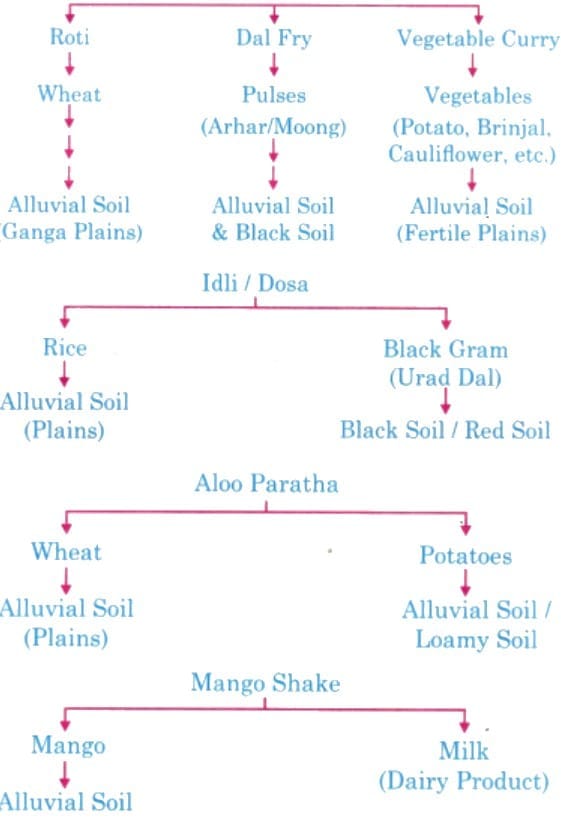
Q12: Identify modern agricultural solutions inspired by traditional practices (for example, neem-based practices). (Page 22)
Ans: Some Modern Agricultural Solutions Inspired by Traditional Practices are as follows:
- Neem-based pesticides: Farmers traditionally use neem leaves to keep insects away. Today, modern neem-based biopesticides are made using the same idea and are used to control pests naturally.
- Organic manure/compost: Earlier, farmers used cow dung and plant waste to improve soil quality. Modern organic farming still uses compost and bio-fertilisers to keep the soil healthy without chemicals.
- Crop rotation: Traditional farmers grew different crops in different seasons to keep the soil fertile. Today, scientists recommend systematic crop rotation as a modern soil management technique.
- Mixed cropping: Earlier, farmers grew more than one crop on the same field. Now, this idea is used in modern intercropping systems to reduce pests and increase productivity.
- Rainwater harvesting: People traditionally stored rainwater in ponds or tanks. Today, improved techniques like check-dams and groundwater recharge systems follow the same principle.
- Mulching: Farmers once covered soil with dry leaves or straw to retain moisture. Modern mulching uses plastic sheets or organic materials to reduce evaporation and protect the soil.
Q13: Listen to the special programmes for farmers on the radio or watch a programme on television for a few days. Write down carefully the information that is shared through these mediums. Make a short report on the categories of information you gathered as well as questions that came to your mind during this activity. (Page 25)
Ans: I watched Krishi Darshan, a programme on agriculture telecasted daily on DD Kisan channel and also on DD National. I was able to gather the following information.
(a) Weather and Climate Updates
- Daily and weekly weather predictions
- Chances of rainfall or drought
- Advice on protecting crops during extreme weather
(b) Crop-Related Guidance
- Best time for sowing seeds
- Techniques for improving soil quality
- Tips for increasing crop yield
- Information on pest and disease control
(c) Modern Farming Techniques
- Use of drip irrigation and sprinklers
- Benefits of organic farming
- Use of improved seeds and fertilisers
(d) Government Schemes and Support
- New subsidies for seeds and fertilisers
- Crop insurance schemes
- Information about loans for farmers
(e) Market and Price Information
- Current rates of major crops
- Advice on where farmers can sell their produce at better prices
(f) Success Stories
- Interviews with farmers who used new techniques
- Examples of best farming practices
The questions that came to my mind after listening to programmes for farmers are:
- How can small farmers afford modern machines and irrigation systems?
- What can farmers do if their crops fail due to unexpected weather changes?
- How do scientists test new seed varieties before releasing them?
- Can organic farming replace chemical farming completely?
- What steps can the government take to support farmers during drought years?
Don't Miss Out
Q14: The Arthashastra contains sections on agriculture, including the preparation of land and seeds, as well as payment to farmers and other relevant topics. "A good rainy season is one when one-third of the annual rainfall occurs at the beginning (shravaa - July-August) and at the end of the season (Kartika - OctoberNovember), and two-thirds in the middle (Prauşhţhapada - August-September and Ashvayuja - September-October)." Why do you think this statement was made? (Hint: Did it have anything to do with the crop cycle?) (Page 10)
Ans: The statement in the Arthashastra about how rainfall should be spread across the season was made because the timing of rain was very important for the traditional crop cycle. Farmers needed the right amount of water at the right time for crops to grow properly.
- Rain at the beginning of the season helped to soften the soil and prepare the land for sowing seeds.
- More rain in the middle of the season was needed because this is when the crops were growing the most and required plenty of water.
- Rain at the end of the season helped the crops finish growing and mature before harvest.
Q15: Why do farmers in Kerala grow rice while farmers in Punjab grow mostly wheat? What would happen if they swapped?
Ans: Rice in Kerala and wheat in Punjab aren't just habits; they're the botanical equivalent of "right crop at right home." Each crop has its own favourite climate, soil, and water needs, and the two states sit at opposite ends of India's environmental chessboard.
Kerala is warm, wet, and humid for most of the year. Monsoon rains soak the fields, rivers recharge quickly, and the soil is perfectly suited for rice, a plant that thrives with its feet happily submerged in water. Rice is basically an amphibian among crops.
Punjab, on the other hand, is cooler and much drier. Its winters drop the temperature just the way wheat likes it-wheat needs a cool growing season followed by a warm, dry harvest. The plains there are the grain bowls of India precisely because wheat sits comfortably in that rhythm. Wheat does not grow well in too much water and cannot tolerate standing water, while rice grows easily in flooding fields.
If the two swapped crops, things would turn messy.
In Kerala, wheat would struggle. The climate stays too warm and too humid during the wheat-growing season, which invites diseases and ruins the grain. Heavy rains would flatten the crop or rot it outright. Kerala's soil and weather simply don't give wheat the cool, dry window it needs.
In Punjab, rice would guzzle groundwater at an alarming rate. Rice needs a huge amount of standing water, and Punjab doesn't naturally get that much rainfall. Farmers there already strain their aquifers when they grow rice in the kharif season. A full-scale shift to rice would drain underground water even faster and risk turning fertile land into a cracked, thirsty plain during the off-season.
So the crops stay where they are because each state has evolved its own quiet partnership with climate and soil. It's a reminder that agriculture is basically ecological matchmaking, and when the partners fit, the harvest sings.
Q16: Match the following:
| Column A | Column B |
|---|---|
| (a) Kharif crops | (i) Crops during the winter |
| (b) Rabi crops | (ii) Crops grown during the monsoon |
| (c) Alluvial soil | (iii) Thin, rough, and rocky soil in mountains |
| (d) Terrace farming | (iv) Crops grown in summer |
| (e) Alpine soil | (v) Soil rich in nutrients deposited by rivers |
| (f) Zaid crops | (iv) Crops grown in summer |
Ans:
| Column A | Column B |
|---|---|
| (a) Kharif crops | (ii) Crops grown during the monsoon |
| (b) Rabi crops | (i) Crops during the winter |
| (c) Alluvial soil | (v) Soil rich in nutrients deposited by rivers |
| (d) Terrace farming | (vi) Method of farming on hillsides |
| (e) Alpine soil | (iii) Thin, rough, and rocky soil in mountains |
| (f) Zaid crops | (iv) Crops grown in summer |
Q17: Why do certain crops thrive in specific regions?
Ans: Crops thrive in specific regions because each crop needs certain conditions to grow well, and different places provide different climate, soil, and water conditions.
- Climate plays an important role in how crops thrive. Every crop needs a particular temperature, rainfall, and sunlight.
Example: Tea grows in cool, wet hills; cotton needs hot, dry weather. - Soil type is as important as climate. Different soils contain different nutrients and have different textures.
Example: Wheat grows best in alluvial soil, while bajra grows well in sandy soil. - Availability of water is also important for a crop to thrive. Some crops require a lot of water (like rice), while others need very little (like millets).
Areas with heavy rainfall naturally support water-loving crops. - Another important condition for crops to thrive is its Topography (landform). Hills, plains, and plateaus all support different kinds of farming.
Example: Terrace farming in hills helps grow crops in steps to prevent soil erosion. - Length of growing season is also a factor for crops to thrive. Some crops need a long warm season; others grow in cooler months.
- Traditional practices and local knowledge also helps crops to thrive. Farmers grow what has been successful for generations in their region.
Crops grow best where the climate, soil, and water supply match their needs. That's why each region has its own typical crops.
Q18: How has modern technology helped farmers?
Ans: Modern technology has helped farmers in many powerful ways, making farming faster, easier, and more productive. Some of them are as follows:
- Improved irrigation: Drip and sprinkler systems help farmers save water and irrigate fields more efficiently.
- Better seeds: High-yielding Varieties (HYV) and disease-resistant seeds increase production and reduce crop loss.
- Use of machines: Tractors, harvesters, threshers, and seed-drills make farming quicker and reduce manual labour.
- Weather forecasting: Farmers can plan sowing, irrigation, and harvesting by using accurate weather updates.
- Fertilisers and pesticides: Help protect crops from pests and increase soil nutrients for better growth.
- Cold storage and better transport: Reduces spoilage and helps farmers sell crops in distant markets for better prices.
- Mobile apps and digital tools: Provide information about crop prices, weather, soil health, and modern techniques directly to farmers.
Q19: Why is sustainable agriculture important? Write a short note on this.
Ans: Sustainable agriculture is important because it protects soil, saves water, and reduces pollution while producing healthy food. It helps farmers maintain long-term productivity, supports biodiversity, and ensures future generations can meet their food needs without harming the environment.
Q20: Name some challenges that farmers face today. What might be their impact for people?
Ans: Challenges farmers face today and their impacts are:
- Irregular rainfall and climate change due to global warming- leads to crop failure and food shortage.
- High input costs - increases prices of food items for consumers.
- Pests and diseases-reduces production, causing lower supply.
- Lack of modern tools - slows work and reduces efficiency.
- Market instability - farmers earn less; people may face fluctuating food prices.
Impact on people: These challenges can reduce food production, increase food prices, cause economic hardship for farming families, and affect the overall food security of the country.
Q21: Have a debate in class on the topic "Traditional irrigation methods are better than modern ones."
Ans: Debate For and Against the motion on "Traditional irrigation methods are better than modern ones.
For the Motion
- Traditional irrigation methods are better because they are simple, low-cost, and suitable for small farmers. Techniques like canals, tanks, and wells use locally available resources and do not require expensive machinery. They also help recharge groundwater and support sustainable farming practices that have been used for centuries.
Against the Motion
- Modern irrigation methods are more efficient and save water. Drip and sprinkler systems deliver water directly to plants, reducing wastage and increasing crop yield. They work well even in areas with limited water. Although they require investment, modern methods support higher productivity and meet the needs of today's agriculture.
Q22: Write a short essay describing what farming might be like when you are 60 years old. You could also draw/paint a picture to illustrate what you envision.
Ans: Farming in the Future
When I will be 60 years old, I imagine farming will look very different from today. Fields will have smart sensors to monitor soil, water, and crop health. Robots and drones will plant seeds, spray fertilisers, and harvest crops efficiently. Water will be saved using advanced drip and sprinkler systems, and crops will grow with organic and eco-friendly methods.
Farmers will use satellite weather forecasts to plan sowing and harvesting, reducing losses. Despite technology, I hope farmers will still value traditional knowledge, like crop rotation and natural pest control. Farming will be clean, efficient, and sustainable, producing enough food for everyone while keeping the earth healthy.
Q23: Form small groups and discuss the issues affecting the Ganga basin. Prepare a presentation proposing your solutions and their rationale (your reasons). Share and discuss in class. Your teacher will guide you in this exercise.
Ans: For our group project, we studied the Ganga basin and the problems it faces. The main issues include water pollution from sewage and industrial waste, deforestation along the riverbanks causing soil erosion, overfishing that reduces fish populations, and floods during heavy rains due to poor water management.
Global warming reduces water flow because higher temperatures increase evaporation and melt glaciers faster. It also causes irregular rainfall, leading to floods in some seasons and drought in others. To address these problems, sewage and industrial waste should be treated before being released into the river to keep the water clean and safe.
Trees should be planted along the riverbanks to prevent soil erosion, and fishing should be regulated to maintain healthy fish populations. Reduce the use of fossil fuels, use public transport, avoid burning crop residue and use energy-efficient appliances. Additionally, building embankments and improving water management will help control floods. Implementing these solutions will protect the Ganga and support the people, animals, and plants that depend on it.
Q24: Looking at the crops listed in the section 'Echoes from the Past', which ones do you find in use in your home? What conclusion can you draw from your observations?
Ans: When I look at the crops mentioned in 'Echoes from the Past', I find that many are still used in my home. These include rice, wheat, barley, millets, pulses like green gram and black gram, oilseeds such as sesame and mustard, and fruits like mango and jackfruit.
Many crops cultivated thousands of years ago are still part of our daily diet. This shows that traditional crops were nutritious, well-suited to the local soil and climate, and important for sustaining communities. It also reflects how Indian agriculture has preserved knowledge from the past while continuing to grow a variety of crops today.
FAQs on NCERT Solutions: The Story of Indian Farming
| 1. What are the main features of Indian farming? |  |
| 2. How does the monsoon affect Indian agriculture? | |
| 3. What are the challenges faced by Indian farmers? | |
| 4. What role do government policies play in Indian farming? | |
| 5. How has technology impacted Indian agriculture? | |