NCERT Solutions: Turning Tides- 11th and 12th Centuries

The Big Questions
(Page 97)
Q1: Why are the 11th and 12th centuries seen as a period of transition in Indian history?
Ans: The 11th and 12th centuries are considered a transitional period in Indian history because India experienced major changes in political power and society.
- Deeper Invasions: In contrast to the earlier Arab attempts, the Turkic armies pushed far further into northern India, even after local rules put up strong resistance.
- Start of Foreign Rule: The period saw the decisive defeat of the Chahamanas by Muhammad Ghuri in 1192 CE at the Second Battle of Tarain, which marked the beginning of foreign rule in parts of north India and laid the foundation for the Delhi Sultanate.
- Power Shift: These invasions changed who held power and encouraged the wider presence of Islam in India.
- Internal Flourishing: Despite conflicts, many rulers in other parts of Indian subcontinent, poets, philosophers, saints, and scientists flourished during this time, engaging in naval expeditions, creating astonishing monuments, and producing remarkable literary and scientific works, demonstrating resilience and continuity.
Q2: Which new powers emerged during this period? What were the essential features of their economic, military and administrative systems?
Ans: Several new kingdoms and dynasties gained prominence during this period:
- North, East and Central India: The Ghurids established authority over Delhi and nearby regions. The Chahamanas controlled Rajasthan and Haryana. The Paramaras ruled Malwa, and the Senas held power in Bengal. The Eastern Gangas ruled southward coastal areas into Kalinga and were one of the stable power.
- South India: The Hoysalas expanded across Karnataka, while the Kakatiyas governed much of Telangana and Andhra Pradesh. The Cholas were powerful rulers who ruled Tamil Nadu and expanded their territory into parts of Karnataka and Andhra Pradesh.
The essential features of their economic, military and administrative systems are:
- Military: These states maintained large armies with infantry, cavalry and war elephants, which required careful organisation and considerable resources. The Ghurids were known for their fast-moving cavalry that helped them secure quick victories.
- Administration: Most kingdoms followed structured systems to collect taxes from cultivators and tributes from smaller regions. The Ghurids introduced a more centralised arrangement by giving officers temporary land assignments in return for collecting revenue and providing military service. This approach later influenced the governing style in Delhi.
- Economy: Agriculture was the main source of income, and many rulers supported irrigation works to increase productivity. Internal and overseas trade with regions such as China and Southeast Asia also continued to grow, helped by active merchant guilds.
Q3: What high accomplishments in art, architecture, literature, science, etc., do we come across during this period?
Ans: This period, witnessed remarkable achievements across many fields:
- Science and Mathematics: Scholars like Bhaskaracharya made major contributions to mathematics and astronomy, writing works on Bijaganita (algebra), Lilavati (arithmetic), and Siddhantasiromani (celestial calculations).
- Architecture and Art: Temples and forts displayed extraordinary craftsmanship, including intricately carved stone temples in Khajuraho,forts with impressive gateways built by the Kakatiyas, and the Hoysala temples with detailed sculptures. The Jagannatha and Sun temples in Odisha also began construction during this time.
- Literature and Philosophy: Writers and thinkers flourished. King Bhoja wrote extensively on governance, arts, and poetry. Someshvara III compiled an encyclopaedia covering many aspects of life. Saints like Ramanujacharya and Basava promoted devotion, ethical living, and social reform, emphasising equality and personal spiritual practice.
- Cultural Influence: Indian ideas spread abroad, shaping architecture and religious practices in Southeast Asia, exemplified by Angkor Wat in Cambodia.
Let's Explore
Q4: (a) Observe the sketch of the Khyber Pass (Fig. 4.3). What kind of terrain does it depict? (Page 100)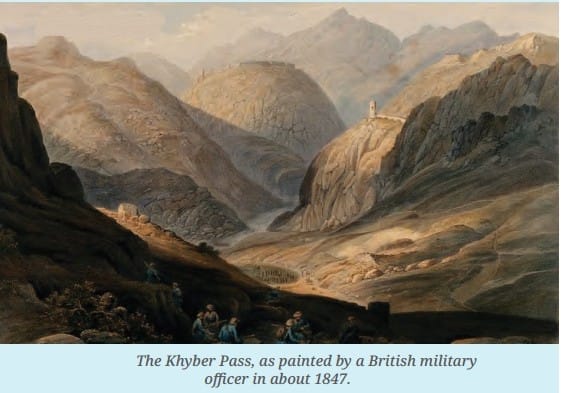 Ans: The sketch of the Khyber Pass depicts a rugged, mountainous terrain, characterised by steep slopes, deep ravines, and narrow valleys, and is one of the main mountain passes through the Hindu Kush range. This challenging environment meant that passage was limited to specific, confined routes. The pass's strategic significance lies precisely in the fact that it provided a crucial, though difficult, gateway between Central Asia and the Indian Subcontinent.
(b) What advantages would it offer to an army trying to reach the Indus plains? But also, what dangers?
Ans: For an army attempting to reach the Indus plains, the Khyber Pass offered the advantage of a direct route into the Subcontinent. However, the same environment also posed serious risks. Being a narrow choke point, movement would be slow and confined, making the army highly vulnerable to attack.
This danger was proven by the Hindu Shahis, who successfully resisted several attempted invasions largely because they controlled the pass. The rugged terrain, thus gave defending forces a significant edge for ambushes and strong resistance.
(c) Thinking of the caravans of traders that passed through the Khyber Pass for many centuries, let's ask the same questions about the advantages as well as dangers.
Ans: For caravans of traders passing through the Khyber Pass over many centuries, the key advantage was its function as a major trade route. For at least 2,500 years, it served as a vital link, connecting the Subcontinent to Central Asia and beyond, facilitating immense commerce and the exchange of cultures and scholars.
Conversely, the dangers for traders were primarily the natural obstacles of the mountainous terrain itself, which made travel slow and arduous. Furthermore, due to the immense wealth being transported along such a vital route, caravans would have faced the constant danger of being plundered or raided, especially in times of political instability or during the numerous military campaigns by powers like the Ghaznavids.
Q5: In later centuries, the Somanatha temple was rebuilt and destroyed again several times; the existing temple was built in 1950 and inaugurated the next year by the then President of India, Rajendra Prasad. Why do you think it was decided to fund the construction entirely from public donations? (Page 103)
Ans:
- The decision to fund the construction of the Somanatha temple entirely from public donations was a deliberate and strategic choice that transformed the rebuilding effort into a national, people-led initiative.
- Because the temple had been repeatedly destroyed and plundered by foreign invaders-most famously by Mahmud of Ghazni in 1026 CE-relying on the public's contributions emphasised that the site's significance transcended political or state funding and affirmed its enduring importance as a symbol of cultural and spiritual resilience for the Indian populace.
- This approach allowed every citizen and devotee to actively participate in the restoration, fostering a deep sense of collective ownership and validating the belief that Indian culture "stands firmer than any rock in the world, with its undying vigour, indestructible life".
Q6: In the painting below can you make out who is the king and who is the guru? What does the king's posture and general attitude express? (Page 112)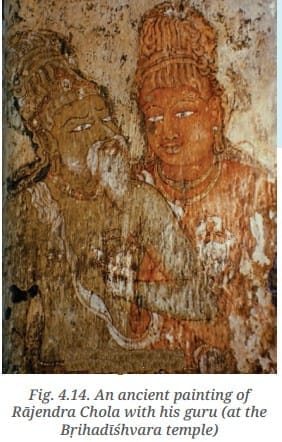
Ans:
- The figure on the left, typically placed in a position of reverence or seniority, is the Guru (spiritual teacher), while the figure on the right, identified by the caption, is the King, Rajendra Chola I.
- The king's posture and expression in the painting clearly express humility and deep reverence towards his Guru. He holds his hands which are in anjali mudra (prayer or greeting gesture), a gesture of profound respect and devotion. His slightly lowered head and gaze directed towards the Guru, showing attentiveness and submission to his Guru, who is seated and instructing him.
Q7: Writing some 60 years after Bakhtiyar Khilji's campaign through Bihar, the historian Minhaj al-Siraj Juzjani, recorded in his Tabakat-iNasiri how Bakhtiyar's forces captured a 'fortress' and "acquired great booty." He adds, "The greater number of the inhabitants of that place were Brahmans, and all those Brahmans had their heads shaven; and they were all slain. There were a great number of books there. ... It was found that the whole of that fortress and city was a college, and in [their] tongue, they call a college bihar."
Remembering the meaning of vihara and noting that Nälanda was known in ancient inscriptions as 'Nalanda Mahavihara', can you find two more clues in the above passage to identify the 'fortress' near the Nalanda university? (Hint: Who do you think these 'Brahmans' actually were?) (Page 117)
Ans:
- The first clue that the passage mentions is that "the greater number of the inhabitants of that place were Brahmans, and all those Brahmans had their heads shaven". Given that Nälanda was an enormous, world-renowned Buddhist monastery and university, and Buddhist monks shave their heads as part of their monastic vows, these individuals referred to as "Brahmans" were in reality Buddhist monks and scholars.
- The term "Brahman" may have been used loosely by the foreign historian to refer to Hindu or religious scholars/priests in general, mistakenly applying it to the shaven-headed Buddhist monks who were the primary residents and victims of the attack.
- Secondly "There were a great number of books in the place." Nalanda Mahavihara was famous for its vast library and collections of manuscripts. These clues clearly point to the fact that the "fortress" mentioned was actually Nalanda University (Nalanda Mahavihara).
Q8: In Kalyani, Basavanna established an anubhava mandapa (literally, 'pavilion of experience'), where men and women from every social, economic, religious or linguistic background, including saints and philosophers, could assemble to discuss all aspects of life, including moral values and religion. (Page 121)
(a) Why, in your opinion, did Basava want people from all backgrounds to come together and exchange ideas?
Ans:
- Basava's primary motivation for establishing the anubhava mandapa (pavilion of experience) was to enact radical social and spiritual reform by directly challenging the oppressive caste system and traditional ritualism. By insisting that people of all social, economic, and gender backgrounds gather and exchange ideas, he aimed to prove the equal spiritual potential of every individual, thereby undercutting the authority of existing hierarchies.
- The mandapa served as a revolutionary, inclusive platform for the democratisation of spiritual knowledge, fostering a new path of personal devotion (bhakti) and ethical conduct, and ensuring that the fundamental principles of equality within the Lingayat movement were collectively developed and embraced by the people it sought to liberate.
(b) If something like an anubhava mandapa existed today, what important topics do you think people ought to discuss there?
Ans: If something like the anubhava mandapaa highly inclusive, non-hierarchical forum for ethical and spiritual debate-were to exist today, participants would likely focus on addressing the most pressing social, ethical, and existential challenges facing the world.
The anubhava mandapa offers profound lessons for creating a just and civil society today, primarily by championing inclusive dialogue and radical equality.
(c) What lessons can we draw from the anubhava mandapa spirit to create a just and civil society today?
Ans:
The most crucial lesson is the principle of radical inclusion, which Basava enacted by gathering people from all backgrounds, including those marginalised by caste and gender. This teaches us that true societal progress can only occur when all voices are heard and equally validated, regardless of social status, wealth, or identity.
By making the mandapa a forum for ethical exchange, Basava demonstrated that collective wisdom is superior to hierarchical, top-down dogma. Today, this translates to establishing truly accessible public spheres where policy and community ethics are debated openly, ensuring that the experiences of the vulnerable actively inform decision-making, rather than being dictated by privileged elites.
Think About It
Q9: We will meet later in this chapter the Persian scholar al-Buruni, who accompanied Mahmud in some of his campaigns. He wrote in his memoirs on India, "The Hindu Shahiya dynasty is now extinct, and of the whole house there is no longer the slightest remnant in existence. We must say that, in all their grandeur, they never slackened in the ardent desire of doing that which is good and right, that they were men of noble sentiment and noble bearing." What conclusions can we draw from this remark by, someone in Mahmud's entourage? (Page 101)
Ans:
From Al-Biruni's remark, we can conclude that even though Mahmud's forces defeated the Hindu Shahiya dynasty, the Persians accompanying him recognised the moral and ethical qualities of these rulers. The Shahiyas were seen as principled, just, and honourable leaders who upheld high standards of conduct. This shows that outsiders could acknowledge the nobility and virtue of a defeated people, separating military conquest from personal admiration of character.
(Exercise)
Q10: Why is the period under consideration in this chapter regarded as a major transition in Indian history? Give two examples each of change and continuity from this period.
Ans: The 11th and 12th centuries were a time of major transition in India because new powers from Central Asia, like the Ghurids, began establishing control over parts of the north, marking the start of foreign influence in the region. Two clear changes during this period were the beginning of Muslim rule in Delhi and the destruction of important centres of learning such as Nalanda. At the same time, there was continuity in Indian society, with culture, literature, and scientific knowledge continuing to flourish, as seen in the works of scholars like Bhaskaracharya, and trade, both within India and with regions like China and Southeast Asia, remained strong.
Q11: Observe Fig. 3.27 in the previous chapter and draw a similar 'star of dynasties' gathering all or most of the dynasties that appear in this chapter.
Ans: 'Star of dynasties'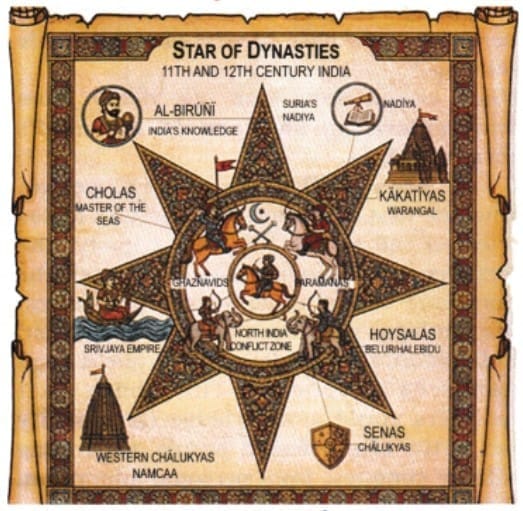
Q12: Taking a map of the Subcontinent, draw a geographical tour that covers all or most dynasties in this chapter (you may draw inspiration from some of the 'travels' the chapter's narration follows).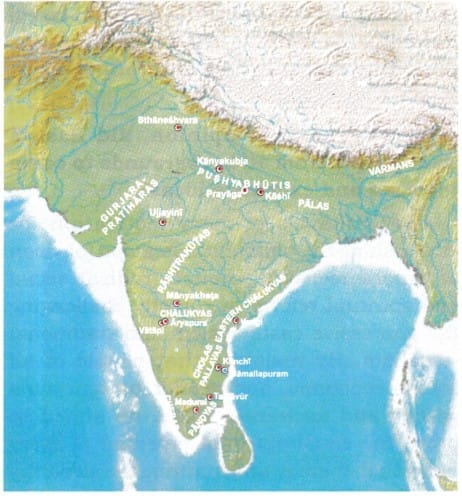
Ans: Take a map of the subcontinent and mark as follows.
- Northwest (Entry Point): Show the Ghaznavid capital (Ghazna) and the path through the Hindu Shahi territory and the Khyber Pass into the Indus plains.
- North India (The Contested Zone): Highlight the territory of the Chahamanas (centred at Ajmer/Delhi) and the region of the Paramaras (centred at Dhara in Malwa). This zone would show the Ghurid advance post Tarain.
- East India: Mark the kingdom of the Senas (Bengal) and the Eastern Gangas (Odisha coast).
- The Deccan: Cover the area of the Kakatiyas (Warangal) and the rising power of the Hoysalas (Belur/Halebidu) in Karnataka.
- Far South: Dominantly feature the Chola Empire (centred at Thanjavur and Gangaikondacholapuram), illustrate their coastal control and potential naval reach into Southeast Asia (Shrivijaya).
Q13: With the help of a map of India and Southeast Asia, can you calculate the approximate distance that Rajendra I's fleet of ships had to navigate to reach their objective?
Ans:
- The approximate distance that Rajendra Chola I's fleet had to navigate to reach the Shrivijaya Empire (centred at Palembang on Sumatra) was vast for pre-modern naval warfare, covering over 2,500 nautical miles (approximately 4,630 kilometres).
- The expedition would have launched from major Chola ports like Nagapattinam on the Coromandel Coast (Tamil Nadu). The primary route involved crossing the Bay of Bengal for several weeks, past the Andaman and Nicobar Islands. The fleet then had to navigate the highly strategic and volatile waters around the Strait of Malacca, using ports on the Malay Peninsula (like Kedah) or the west coast of Sumatra (like Barus) resupply before attacking the Shrivijaya capital and other key ports.
Q14: Match these two pairs:
| Dynasty/Kingdom | Temple (Match) |
|---|---|
| (a) Eastern Gangas | (i) Belur |
| (b) Chandellas | (ii) Bṛihadīśvara Temple |
| (c) Paramāras | (iii) Konark Sun Temple |
| (d) Hoysalas | (iv) Kandāriyā Mahādeva Temple |
| (e) Cholas | (v) Bhojeshwar Temple |
Ans:
| Dynasty/Kingdom | Temple (Match) |
|---|---|
| (a) Eastern Gangas | (iii) Konark Sun Temple |
| (b) Chandellas | (iv) Kandāriyā Mahādeva Temple |
| (c) Paramāras | (v) Bhojeshwar Temple |
| (d) Hoysalas | (i) Belur |
| (e) Cholas | (ii) Bṛihadīśvara Temple |
Q15: Working in groups, compare the dynasties in this chapter and in the preceding one; create a table to list the dynasties present in both, those that disappear from the preceding period, and those that appear in this chapter's period.
Ans: During the 11th and 12th centuries, the political landscape of India witnessed continuity, decline, and the emergence of new powers. The dynasties can be grouped as follows:
| Category | Dynasties |
| Dynasties present in both periods | Pratiharas, Rashtrakutas |
| Dynasties that disappeared from the preceding period | Pratiharas,Rashtrakutas |
| Dynasties that appear or rise to prominence in this chapter | Ghaznavids, Ghurids, Chahamanas, Kakatiyas, Hoysalas, Senas |
Q16: Using the chapter and any additional reading, prepare a short note explaining (1) why centres of learning like Nalanda were important; (2) how their destruction may have affected education and culture in India.
Ans:
- Nalanda was one of the greatest centres of learning in ancient India. It was like a big university where thousands of students and teachers lived and studied together. People came from many countries such as China, Tibet, and Korea to learn subjects like medicine, mathematics, astronomy, literature, and especially Buddhism. Nalanda showed how India was a land of wisdom and knowledge, and it became famous all over the world for its libraries and teaching methods.
- When Nalanda was destroyed in the 12th century, its huge libraries and classrooms were burnt down. This meant that many valuable books and ideas collected over hundreds of years were lost forever. The destruction also weakened Buddhism in India and broke the chain of organised higher education. As a result, India lost its position as a global centre of learning, and the flow of knowledge to other countries slowed down.
Q17: Why do you think Mahmud of Ghazni carry out repeated raids from Afghanistan into India, while Muhammad Ghuri sought territorial expansion into India and long-term control? Write a short note on how their motives shaped the outcomes of their campaigns.
Ans:
- Mahmud of Ghazni's repeated campaigns were primarily characterised by plunder, driven by the need to loot the immense wealth from temples (like Somnath) to finance his large army and build his capital in Ghazni. He did not seek to establish a permanent base beyond Punjab, so his motive shaped the outcome as a series of destructive raids that only weakened existing Indian kingdoms.
- Conversely, Muhammad Ghuri was motivated by territorial expansion and longterm control. After his decisive victory at the Second Battle of Tarain, he left his general Qutb-ud-din Aibak to consolidate the gains and establish control over Delhi and the Gangetic plains. Thus, Ghuri's motive directly shaped the outcome of his campaigns to establish a new, enduring political authority the foundation of the Delhi Sultanate.
FAQs on NCERT Solutions: Turning Tides- 11th and 12th Centuries
| 1. What were the main factors that led to the expansion of trade in the 11th and 12th centuries? |  |
| 2. How did the social structure change during the 11th and 12th centuries? | |
| 3. What role did the Crusades play in the economic development of Europe during this period? | |
| 4. Describe the impact of maritime advancements on trade during the 11th and 12th centuries. | |
| 5. What were some of the key commodities traded during the 11th and 12th centuries? | |