NCERT Solutions: India, a Home to Many

The Big Questions
(Page 125)
Q1: What has made India a home for people from different parts of the world?
Ans: India's long tradition of tolerance and acceptance has made it a safe home for many people. Its location on ancient trade routes attracted traders and settlers. Indian values like vasudhaiva kutumbakam promote unity and brotherhood. People of different cultures felt welcomed and secure in India.
Q2: Why did oppressed or persecuted people from other countries seek refuge in India?
Ans: Many people were persecuted for their religion or beliefs in their own countries. They were denied freedom of worship and basic rights. India offered them safety, dignity, and religious freedom. So, they came to India to live peacefully without fear.
Q3: What is it about the nature of Indian society that enables people to assimilate here?
Ans: Indian society is inclusive and respectful of different cultures and religions. It teaches values of kindness, tolerance, and compassion. People are accepted without forcing them to give up their identity. This helps newcomers mix easily while keeping their traditions alive.
Let's Explore
Q4: Look at the two pictures below. Is the place shown in both the photographs the same? Why is the Maharaja of Travancore (the name of the kingdom in and around Kochi at that time) giving such an expensive gift to the Jewish synagogue for the Torah (religious book of the Jews)? (Page 128)
Ans: Yes, both photographs show the same place - the Jewish Synagogue at Kochi (Kerala). The Maharaja of Travancore gave such an expensive gift because the Jews were respected members of his kingdom. It shows the kindness and religious tolerance of Indian rulers. It also proves that Jews lived peacefully and freely in India.
Q5: Observe the picture Fig. 5.4. What clues do you get about the integration of the Jewish community into Indian society over time? (Page 129)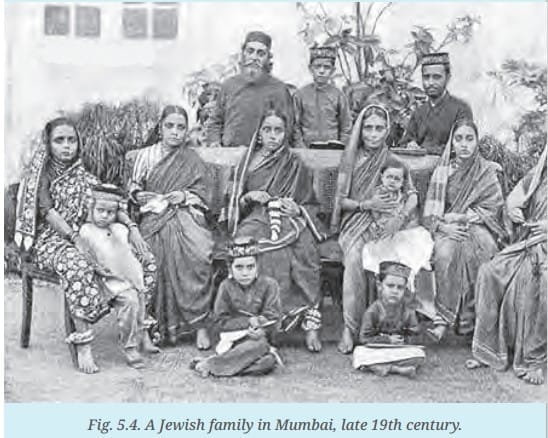
Ans: The picture shows a Jewish family wearing Indian-style clothes and living in an Indian setting. This shows that the Jewish community adopted Indian customs and lifestyle over time. It proves that they mixed well with Indian society while still following their own religion. This reflects peaceful cultural integration and harmony.
Q6: Observe the pictures below. What are the clues you get about the integration of the Syriac Christian community into Indian society? (Page 130)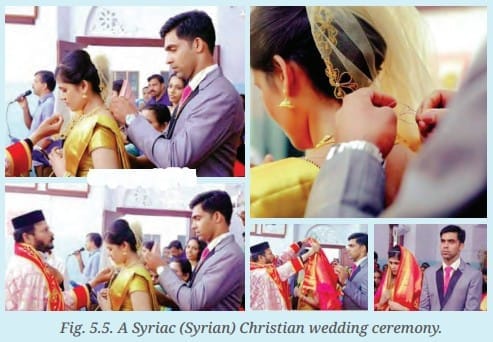 Ans: The wedding shows Indian-style clothing and customs along with Christian rituals. This shows that the Syriac Christians adopted local traditions over time. They kept their religion but blended with Indian culture. This proves successful cultural integration into Indian society.
Q7: This painting of a Parsi bride getting ready for her wedding shows many aspects of Indian culture. Do any of them seem familiar to you? Based on what you see, can you draw any conclusions about the integration of Parsi culture in India? (Page 132)
Ans: 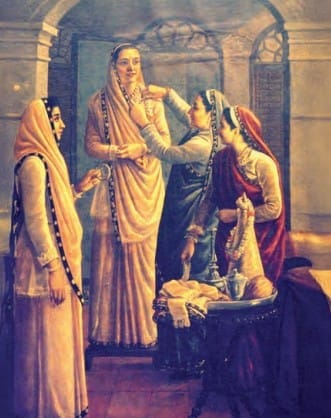
Yes, several aspects in the painting seem familiar, like the bride is wearing Indian jewellery, dress and makeup. The wedding rituals also look similar to Indian ceremonies. This shows that Parsis adopted many Indian traditions. It proves that Parsi culture is well integrated into Indian society.
Q8: What clues do you get about African and Indian cultural integration from the pictures here and above? Identify and name a few features that are distinctly Indian. (Page 134)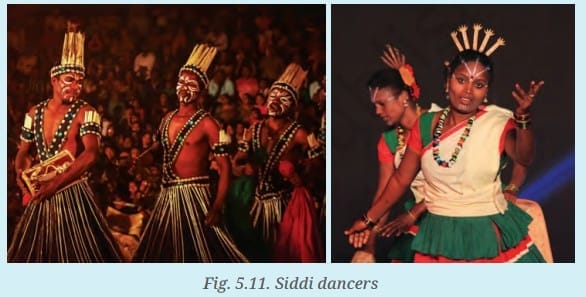
Ans: The pictures show a clear blending of African and Indian cultures among the Siddis. The Siddis wear Indian-style clothes and ornaments. Their dances use African style drums with Indian influence. Their life shows a mix of African and Indian culture. This shows how they adapted and became part of India.
Q9: Are there communities in your neighbourhood whose ancestors might have come to India centuries ago and made it their home? Have a class discussion on what their experience may have been. (Page 140)
Ans: Yes, in my neighbourhood, there are communities whose ancestors came to India centuries ago and made it their home. Over time, they adapted to local customs and languages while keeping their over traditions. Their experiences have generally been shaped by acceptance, peaceful coexistence, and a sense of belonging in Indian society.
Q10: Identify similar values in any story or local tradition etc. known to you. You could ask your guardians or relatives too. Collect these stories and create a class manuscript. You could include illustrations. (Page 140)
Ans: One story that reflects similar values of kindness and acceptance is the story of Sudama and Krishna.
In this story, Krishna welcomes his childhood friend Sudama with great love and respect, even though Sudama was very poor. Krishna treats him with honour, showing that friendship, compassion, and treating everyone equally are important values. This reflects the idea of "atithi devo bhava"-a guest is like God.
Another example from local tradition is the custom of Langar in Sikhism. In a Gurudwara, everyone-rich or poor, from any religion or community, sits together and eats the same food. This shows the values of equality, sharing, kindness, and caring for all.
Think About it
Q11: Imagine this scenario - A stranger knocks at your door at midnight. It is raining heavily outside, and the stranger seeks shelter for the night claiming that his car broke down while he was driving in the vicinity. Your family goes into a huddle to discuss the pros and cons of letting a stranger into the house at night. Form two groups to discuss the arguments for and against in this scenario. Now extend this scenario to a country like India - when refugees seek shelter in India, will similar arguments apply? (Page 126)
Ans:
- If a stranger knock at our door at midnight during heavy rain, our family may debate whether to let him in. On one hand, helping someone in distress shows kindness and humanity, but on the other hand, there are concerns about safety and trust.
- In the same way, when refugees seek shelter in India, similar arguments arise. Welcoming them reflects compassion, cultural values, and the spirit of Vasudhaiva Kutumbakamthe world is one family-yet challenges such as security, resources, and adjustment must also be considered. Thus, both at the level of a family and a nation, decisions about giving shelter involve balancing humanity with caution.
Q12: What do you think dissolving the sugar in the milk without spilling it meant? (Page 131)
Ans: Dissolving the sugar in the milk without spilling it" suggests blending something sweet and valuable into life or society quietly and carefully, without waste or harm.
Exercise
Q13: On the outline of a world map, try to trace the routes that the communities mentioned in this chapter may have used to reach India. What types of physical geographies did they have to negotiate?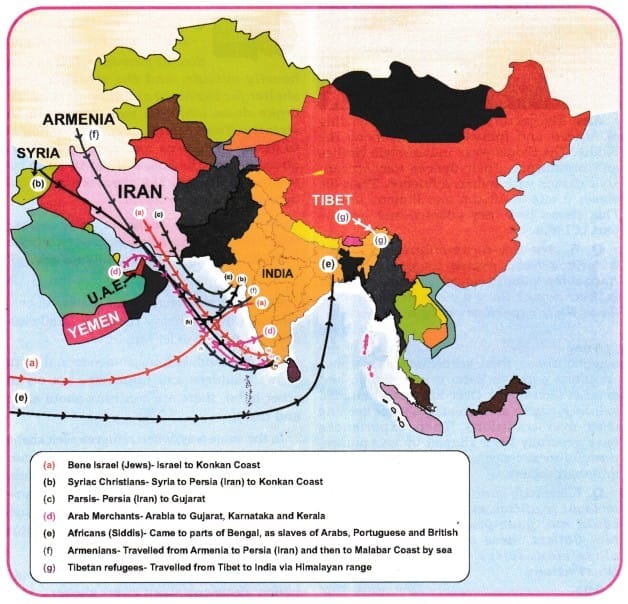 Ans:
Ans:
- Different communities used land and sea routes to reach India. The Jews, Parsis, Arabs, Armenians and Baha is travelled mainly across the Arabian Sea. The Syriac Christians came through West Asian land and sea routes. The Tibetans crossed the Himalayan mountains, which are very difficult to cross due to extreme cold and high altitude.
- The physical geographies all these communities had to negotiate were to cross different physical landscapes-deserts, seas, mountains, and long sea routes-depending on where they came from.
Q14: What are the key values intrinsic to Indian culture that enable it to welcome people of different backgrounds?
Ans: The key Indian values are tolerance, compassion, and respect for all religions. Ideas like vasudhaiva kutumbakam (the world is one family) promote unity. Atithi devo bhava (guest is equal to God) teaches hospitality. These values helped India welcome people from all backgrounds.
Q15: Homi Bhabha, Sam Maneckshaw, Ratan Tata, Fali Nariman, Nani Palkivala, and Cornelia Sorabji are a few names of Parsis who excelled in their respective fields. Find out more about people from other communities that made India their home and their contributions.
Ans: People from other communities that made India their home and contributed are:
- Mother Teresa (Albanian origin) - Served the poor in India.
- Dalai Lama (Tibetan) - Promoted peace and compassion worldwide.
- Annie Besant (British) - Freedom fighter and educationist.
- Sister Nivedita (Ireland)- A disciple of Swami Vivekanand, she worked for women's education and social upliftment in India.
Q16: Take up a class project. Divide the class into groups. Each group takes up a small project to study a little more about the communities that we have been listed here. Share what you have gathered with your classmates through one of these ways - drama, posters, song, painting, etc.
Ans: One group can study the Parsi community and find out about their migration from Persia to India. They can also learn about their peaceful settlement in Gujarat. Their contributions to industry, education, and social service can be studied. The project can be presented through a poster, chart, or role-play in the class.
FAQs on NCERT Solutions: India, a Home to Many
| 1. What is the significance of India being home to many cultures? |  |
| 2. How does India's geographical diversity influence its culture? | |
| 3. What role do festivals play in Indian culture? | |
| 4. How does language diversity reflect the cultural richness of India? | |
| 5. What are some examples of traditional Indian art forms? | |




