Product Benchmarking and Competitive Differentiation


What is Product Benchmarking?
Imagine you're planning to open a café in your neighborhood. Before you decide on your menu, pricing, or even the type of coffee beans you'll use, wouldn't you want to visit other cafés nearby? You'd probably check out what drinks they offer, how much they charge, how quickly they serve customers, and what their seating arrangements look like. That's exactly what product benchmarking is-but in a more structured, systematic way.
Product benchmarking is the process of measuring your product's features, performance, quality, and processes against those of your competitors or industry leaders. It's about understanding where you stand in the market and identifying what you need to improve, match, or exceed to win customers.
Think of benchmarking as holding up a mirror to your product alongside your competitors' products. You're asking: "How do we compare?" The goal isn't just to copy what others are doing-it's to learn from the best practices in your industry and find opportunities to do things better or differently.
Why Benchmarking Matters
In today's competitive markets, companies can't afford to operate in isolation. Customers constantly compare products before making purchase decisions. If your smartphone has a 5-hour battery life while your competitor's lasts 12 hours, customers will notice-and they'll probably choose the competitor. Benchmarking helps you:
- Identify gaps between your product and market leaders
- Set realistic yet ambitious performance targets
- Discover industry best practices you can adapt
- Understand customer expectations based on what's already available
- Make data-driven decisions rather than guessing what improvements to prioritize
Types of Benchmarking
Not all benchmarking is created equal. Different situations call for different approaches:
Competitive benchmarking compares your product directly against your main competitors. If you're Pepsi, you're looking at Coca-Cola. If you're Samsung, you're studying Apple's iPhone. This is the most common type because it focuses on the companies fighting for the same customers you are.
Functional benchmarking looks at similar processes or functions across different industries. For example, a hospital might study how Amazon manages its logistics to improve how it handles medical supplies. The industries are different, but the underlying process (efficient inventory management and delivery) is comparable.
Internal benchmarking compares performance across different departments, teams, or branches within the same organization. A retail chain might compare sales performance across its 50 stores to identify which locations are doing things exceptionally well and why.
Generic benchmarking studies fundamental business processes that are universal, like customer service response times or employee onboarding procedures, regardless of industry.
The Benchmarking Process: How to Actually Do It
Benchmarking isn't just casual competitor-watching. It's a disciplined, methodical process that follows clear steps:
Step 1: Identify What to Benchmark
You can't benchmark everything-that would be overwhelming and wasteful. Start by identifying the critical success factors that matter most in your industry and to your customers.
For a food delivery app, you might benchmark:
- Average delivery time
- Restaurant selection (number of partner restaurants)
- App loading speed and ease of use
- Delivery fee structure
- Customer support response time
- Order accuracy rate
For an online learning platform, relevant benchmarks might include:
- Course completion rates
- Video streaming quality and buffering time
- Number of courses available
- Instructor credentials and ratings
- Pricing per course or subscription
- Mobile app functionality
Step 2: Select Comparison Targets
Choose 3-5 competitors or market leaders to benchmark against. Include a mix of:
- Direct competitors-companies offering similar products to the same customer segment
- Aspirational benchmarks-industry leaders you want to emulate, even if they're currently ahead of you
- Emerging competitors-newer companies that might be doing something innovative
Don't just pick the biggest names. A scrappy startup might be outperforming established players in specific areas like mobile app design or customer engagement.
Step 3: Collect Data
This is where benchmarking becomes detective work. You'll gather information through multiple channels:
Public sources: Company websites, annual reports, press releases, product specifications, pricing pages, and customer reviews on platforms like Amazon, Google Reviews, or Trustpilot provide valuable publicly available data.
Mystery shopping: Actually purchase and use competitor products. Sign up for their services. Experience their customer journey firsthand. You'll discover things that aren't visible from the outside-like how intuitive their onboarding process is or how responsive their customer service team is.
Industry reports: Research firms like Gartner, Forrester, and IDC publish detailed analyses comparing products across various dimensions. These reports often include performance metrics, market share data, and expert assessments.
Customer feedback: What are customers saying about competitors on social media, forums, or review sites? Their complaints and praises reveal what matters most to them.
Trade shows and conferences: Industry events let you see competitor products up close and talk to their representatives.
Step 4: Analyze the Data
Raw data means nothing until you organize and interpret it. Create a competitive matrix or comparison table that displays your product and competitors side by side across all the metrics you've identified.
For example, here's what a simplified benchmarking matrix for project management software might look like:
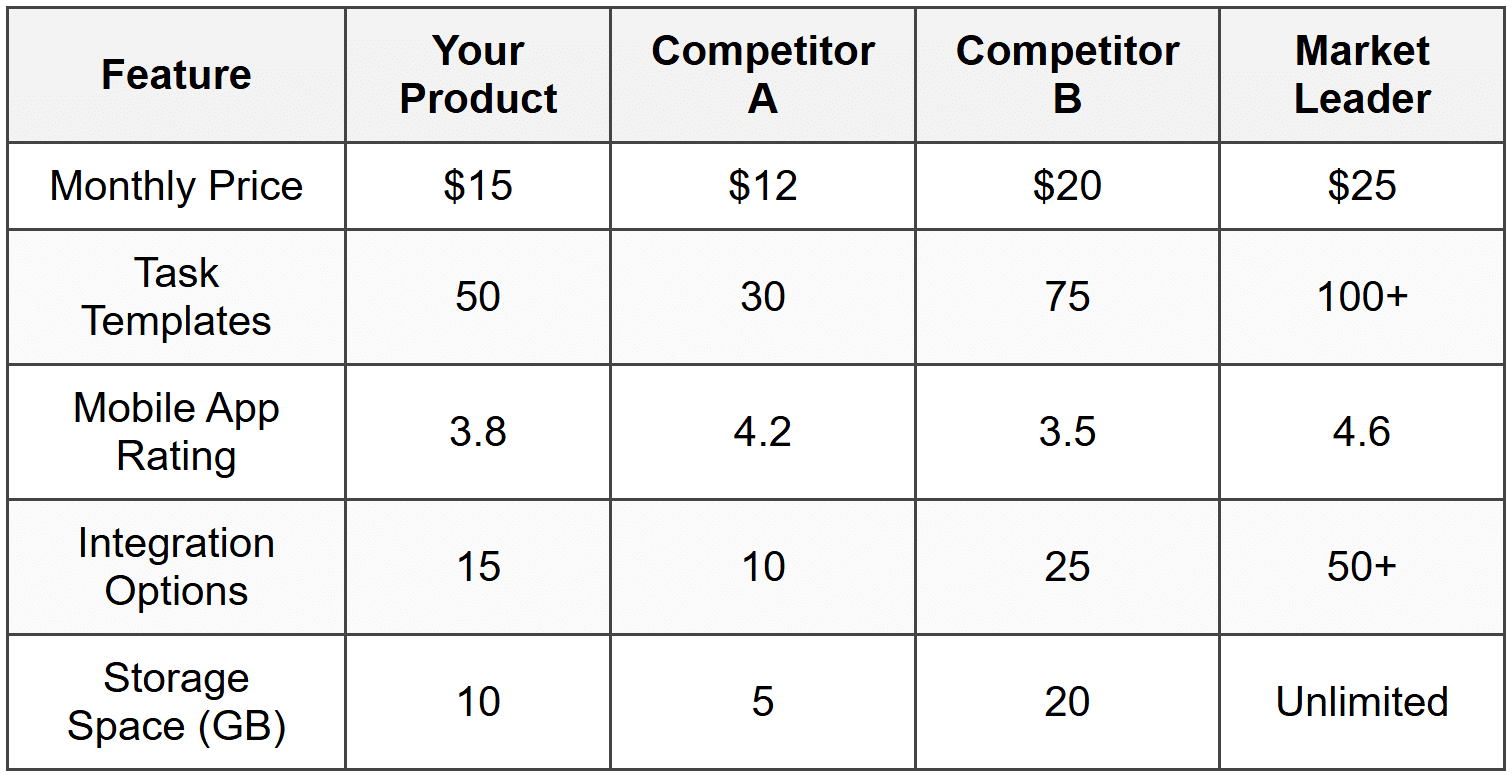
Looking at this table, you can immediately spot where you're strong (decent pricing, reasonable storage) and where you're falling behind (mobile app experience, integrations).
Step 5: Identify Gaps and Opportunities
The analysis should reveal three types of findings:
Performance gaps: Areas where you're significantly behind competitors. These are urgent priorities that might be costing you customers right now.
Parity areas: Features where you're roughly equal to competitors. You need to maintain these but they're not necessarily differentiators.
Strengths: Areas where you outperform the competition. These are potential differentiators you should emphasize in your marketing and product positioning.
Step 6: Take Action
Benchmarking without action is just expensive research. Based on your analysis:
- Set specific, measurable improvement targets (e.g., "Improve mobile app rating from 3.8 to 4.3 within 6 months")
- Prioritize improvements based on impact and feasibility
- Allocate resources to close critical gaps
- Create action plans with clear owners and timelines
- Monitor progress regularly and re-benchmark periodically to track improvements
What is Competitive Differentiation?
While benchmarking helps you understand where you stand, competitive differentiation is about deliberately creating space between you and your competitors. It's the art and science of making your product meaningfully different-and better-in ways that matter to customers.
Here's a critical insight: being "a little bit better" at everything rarely works. Markets are crowded, and customers' attention spans are short. The most successful products don't try to win on every dimension-they choose specific areas where they'll be remarkably superior, and they're okay with being average or even below average in less critical areas.
Take Dollar Shave Club, which disrupted the razor market dominated by Gillette and Schick. They didn't try to create technologically superior razors with more blades or better engineering. Instead, they differentiated on:
- Convenience: Razors delivered directly to your door on a subscription basis
- Price: Dramatically cheaper than premium brands
- Brand personality: Irreverent, funny marketing that made razors entertaining
- Simplicity: No overwhelming choices-just a few straightforward options
Their famous launch video cost just $4,500 to make and went viral, fundamentally challenging the idea that razor companies needed massive advertising budgets and complex product lines. Within 5 years, they had captured 15% of the U.S. razor market and were acquired by Unilever for $1 billion.
Types of Differentiation Strategies
There are several proven pathways to differentiation, and the best one depends on your market, capabilities, and customer needs:
Product Differentiation
Product differentiation focuses on tangible features, functionality, design, or performance that set your offering apart. This is what most people think of first when they hear "differentiation."
The Dyson vacuum cleaner differentiated through revolutionary cyclonic technology that maintained suction power without needing bags-solving a genuine customer pain point that traditional vacuums ignored. The product's transparent design also let customers actually see the technology working, reinforcing the innovation message.
Tesla differentiated electric vehicles not just through environmental benefits, but by making them faster, more technologically advanced (with over-the-air software updates and autopilot features), and more desirable than traditional luxury cars. They transformed electric vehicles from a compromise into an aspiration.
Service Differentiation
Service differentiation centers on how you deliver, support, or enhance the product experience through superior service elements.
Zappos, the online shoe retailer, differentiated almost entirely through service: free shipping both ways, a 365-day return policy, and legendary customer service representatives empowered to spend hours on the phone with customers and send flowers or surprise upgrades when appropriate. The shoes themselves were the same brands available elsewhere-the service experience was what set them apart.
Apple's Genius Bar transformed computer repair from a frustrating, impersonal experience into something approachable and almost enjoyable, helping differentiate Apple's entire ecosystem.
Price Differentiation
Price differentiation positions your product at a notably different price point-either significantly cheaper or more expensive-than alternatives.
IKEA differentiated through systematically low prices enabled by flat-pack furniture, self-service warehouses, and customer assembly. They weren't just cheaper-they reimagined the entire furniture retail model to make low prices sustainable.
On the opposite end, Supreme, the streetwear brand, differentiates through artificial scarcity and premium pricing. They produce limited quantities, creating lines around their stores and resale markets where items sell for many times their original price. The high price and exclusivity are part of the appeal.
Experience Differentiation
Experience differentiation creates memorable, emotional connections that go beyond functional benefits.
Starbucks didn't just sell coffee-they created the "third place" concept, positioning their stores as comfortable spaces between home and work where you could relax, work, or meet friends. The experience of ordering your drink exactly how you want it, having your name on the cup, and sitting in a consistent, comfortable environment became as important as the coffee itself.
Disney theme parks obsess over every detail of the guest experience, from "cast members" (not employees) staying in character to careful management of queue experiences and cleanliness standards. People pay premium prices not just for rides, but for the complete, immersive experience.
Brand/Image Differentiation
Brand differentiation builds a distinct identity, personality, or set of associations that resonate emotionally with customers.
Nike doesn't differentiate primarily on shoe technology (though they invest heavily in it). Their core differentiation is the brand's association with athletic achievement, determination, and the "Just Do It" ethos. People buy Nike to be part of that identity.
Patagonia differentiates through authentic environmental activism, even running ads telling customers "Don't Buy This Jacket" to encourage conscious consumption. Their brand stands for environmental responsibility, quality that lasts, and opposition to disposable consumer culture-and customers pay premium prices to align themselves with those values.
Building Your Differentiation Strategy
Creating meaningful differentiation requires strategic thinking, not just tactical product tweaks. Here's how to develop a differentiation strategy that actually works:
Start With Customer Insights
Effective differentiation always begins with understanding what customers truly value-not what you assume they value. This requires going beyond basic market research to uncover unmet needs and underserved segments.
Ask questions like:
- What problems do existing solutions fail to solve completely?
- What frustrates customers about current options?
- What compromises do customers currently accept?
- Are there customer segments whose needs aren't being addressed?
- What do customers care about that companies in this space ignore?
When Slack entered the crowded business communication market, they identified that existing tools (email, Skype, enterprise messaging systems) created frustration through poor search functionality, lack of integration with other tools, and formal, stiff interfaces. Slack differentiated by emphasizing searchability ("make work-related communication searchable"), seamless integrations with hundreds of tools, and a casual, emoji-friendly interface that made work communication feel less formal and more enjoyable.
Assess Your Capabilities and Assets
Sustainable differentiation must be rooted in something you can actually deliver better than competitors. What unique capabilities, resources, technology, expertise, or relationships does your organization have?
Amazon could build Amazon Web Services (AWS) because they had already developed massive infrastructure and expertise managing servers and databases to run their e-commerce platform. They turned an internal capability into a differentiated service offering that revolutionized how companies access computing power.
Your differentiation should ideally be:
- Valuable to customers-addressing needs they actually care about
- Unique or rare-not easily found in competitor offerings
- Difficult to imitate-requiring resources, time, or expertise competitors can't quickly replicate
- Sustainable-defensible over time through continuous improvement or inherent barriers
Choose Your Battlefield
You can't be everything to everyone. Strategic differentiation requires making deliberate choices about where you'll compete-and where you won't.
Consider the strategic trade-off: What will you deliberately choose not to do or not to be good at, in order to excel in your chosen differentiation area?
Southwest Airlines chose to differentiate on low fares and high frequency to secondary airports. To make this work, they deliberately chose not to offer:
- Assigned seating
- Meal service
- First-class cabins
- Connections to partner airlines
- Service to major international destinations
These weren't oversights-they were strategic decisions that enabled Southwest to turn planes around faster, operate more efficiently, and keep fares low. Trying to add these features would undermine their core differentiation.
Communicate Your Difference Clearly
Even brilliant differentiation fails if customers don't understand or notice it. Your differentiation must be:
Visible: Make your differences obvious through product design, packaging, marketing, and customer experience. Dyson's transparent vacuum chambers make the technology visible. Apple's minimalist design makes their aesthetic differentiation immediately apparent.
Understandable: Customers should grasp your differentiation quickly without extensive explanation. Domino's Pizza built their brand on "30 minutes or it's free"-instantly understandable differentiation on delivery speed.
Credible: Support your differentiation claims with evidence, demonstrations, guarantees, or third-party validation. Mattress companies like Casper offer 100-night trials to make their comfort claims credible and risk-free.
Consistent: Reinforce your differentiation across every touchpoint. If you differentiate on premium quality, everything from your website design to your packaging to your customer service must reflect that positioning.
Combining Benchmarking and Differentiation
Here's where it gets interesting: benchmarking and differentiation aren't opposing forces-they're complementary tools that work together in a strategic cycle.
Benchmarking tells you where you are relative to competitors and industry standards. It reveals gaps you need to close to be credible in the market. If every competitor offers mobile apps but you don't, that's probably a gap you can't ignore.
Differentiation tells you where you want to be different-the specific dimensions where you'll deliberately outperform competitors and create unique value.
The strategic process looks like this:
- Benchmark to understand the competitive landscape and current standards
- Identify minimum performance thresholds-the basics you must match to be considered by customers at all (often called "table stakes")
- Achieve parity on these table stakes through rapid improvement
- Simultaneously identify potential differentiation opportunities-areas where you can create distinctive superiority
- Invest disproportionately in your chosen differentiation dimensions
- Regularly re-benchmark to ensure you're maintaining parity on table stakes while extending your lead in differentiation areas
Consider Spotify when they entered the music streaming market:
Benchmarking revealed: Apple Music and Pandora had established expectations around music quality, library size, mobile apps, and offline listening. These were table stakes Spotify needed to match.
Differentiation opportunities: Spotify identified social features (seeing what friends listen to, collaborative playlists), superior algorithmic recommendations (Discover Weekly), and a freemium model that let users try before subscribing as potential differentiators.
They achieved parity on the basics while investing heavily in playlist algorithms and social features-creating differentiation that established them as leaders despite entering the market later than competitors.
The Competitive Positioning Map
A powerful tool for visualizing how benchmarking and differentiation work together is the competitive positioning map (also called a perceptual map). This plots your product and competitors along two key dimensions that matter to customers.
For example, in the automobile market, you might create a map with:
- X-axis: Price (affordable → premium)
- Y-axis: Performance (practical → sporty)
Plotting brands on this map would show:
- Toyota → affordable, practical
- Porsche → premium, sporty
- Tesla → premium, innovative/high-tech (requiring a third dimension or different axis)
- Ford → mid-price, practical
This visualization helps you see:
- Where competitors cluster (indicating crowded positioning)
- Where gaps exist (potential differentiation opportunities)
- Whether your intended positioning is distinct or too close to competitors
- How customer perceptions align with your intended position
Dynamic Competition: When Differentiation Becomes Table Stakes
Here's an uncomfortable truth: successful differentiation attracts imitation. Today's competitive advantage often becomes tomorrow's minimum requirement.
When Amazon introduced free two-day shipping with Prime membership in 2005, it was revolutionary differentiation. Today, fast, free shipping is expected from most online retailers-it's become a table stake rather than a differentiator. Amazon responded by pushing further with same-day and even two-hour delivery in some markets, constantly moving the goalposts.
This phenomenon-where differentiation erodes into parity-drives the need for continuous innovation and re-differentiation. Markets don't stand still. What makes you special today won't necessarily keep you special tomorrow.
Defending Your Differentiation
Some forms of differentiation are easier to protect than others:
Easily copied differentiation: Product features, pricing strategies, and service policies can often be replicated quickly by competitors with sufficient resources. If your main differentiation is offering 24/7 customer support, competitors can hire support teams too.
Defensible differentiation: Brand identity, proprietary technology, exclusive partnerships, network effects, and complex operational capabilities are harder to replicate.
Network effects create particularly strong differentiation. Facebook's value increases with each additional user because there are more people to connect with. A competing social network can't just copy Facebook's features-they'd need to convince hundreds of millions of users to switch simultaneously, which is nearly impossible.
Operational excellence accumulated over years, like Toyota's manufacturing efficiency or Zara's fast-fashion supply chain, creates differentiation that competitors understand but can't easily replicate because it's embedded in organizational culture, relationships, and countless process refinements.
Common Pitfalls in Benchmarking and Differentiation
The Imitation Trap
Benchmarking sometimes leads companies to simply copy what market leaders do. This creates several problems:
- You're always following, never leading
- You're competing on the leader's chosen battlefield, where they have advantages
- You create no distinctive reason for customers to choose you over the established leader
- The market becomes commoditized, with no clear differentiation
Remember: the goal of benchmarking is to learn and identify opportunities, not to create a photocopy of competitor products.
Differentiation Without Value
Being different isn't enough-you must be different in ways customers actually care about. Companies sometimes differentiate on dimensions that seem impressive internally but don't matter to customers.
During the "megapixel wars" in digital cameras, manufacturers competed intensely on megapixel count, assuming more was always better. But beyond a certain point, most consumers couldn't perceive the difference in image quality, and higher megapixels created bigger file sizes that were inconvenient. Features like image stabilization, low-light performance, and ease of sharing photos were often more valuable but received less attention.
Too Many Differences
Trying to differentiate on too many dimensions dilutes your message and your resources. Customers can typically remember and value only a few key differentiators. Companies that try to be "the best" at everything often end up being remembered for nothing in particular.
Strong brands typically own one or two clear differentiators in customers' minds: Volvo owns safety, FedEx owns reliability ("When it absolutely, positively has to be there overnight"), BMW owns driving performance ("The Ultimate Driving Machine").
Ignoring the Cost of Differentiation
Differentiation often costs money-in development, in delivery, in communication. The differentiation must create enough customer value that they're willing to pay prices that cover these costs and generate acceptable margins.
Superior service differentiation requires hiring and training excellent staff. Technological differentiation requires R&D investment. Product quality differentiation may require premium materials or manufacturing processes. Make sure your differentiation strategy is economically viable, not just creatively appealing.
Static Benchmarking
Markets evolve, competitors improve, customer expectations rise, and new technologies emerge. Benchmarking once and considering the job done is a recipe for obsolescence.
BlackBerry dominated the smartphone market for business users in the mid-2000s, differentiated by their physical keyboards, secure email, and long battery life. They benchmarked against other business phone providers. When the iPhone launched in 2007, BlackBerry didn't immediately recognize it as a competitive threat-they saw it as a consumer device, not a business tool. By the time they realized smartphones were converging consumer and business needs, and that touchscreens and app ecosystems were becoming table stakes, it was too late to catch up. They had stopped benchmarking the right competitors at the right time.
Key Terms Recap
- Product Benchmarking - The systematic process of measuring your product's features, performance, quality, and processes against competitors or industry leaders to understand your relative position and identify improvement opportunities.
- Competitive Benchmarking - Directly comparing your product against main competitors who target the same customers.
- Functional Benchmarking - Comparing similar processes or functions across different industries to learn best practices.
- Internal Benchmarking - Comparing performance across different units, departments, or teams within the same organization.
- Generic Benchmarking - Studying fundamental business processes that are universal across industries.
- Critical Success Factors - The essential areas of activity or performance that must be done well for a business or product to succeed in its market.
- Competitive Matrix - A table or chart that displays your product and competitors side by side across multiple dimensions for easy comparison.
- Performance Gap - An area where your product significantly underperforms compared to competitors, representing a weakness that needs attention.
- Competitive Differentiation - The process of making your product meaningfully different from and superior to competitors in ways that matter to customers.
- Product Differentiation - Creating distinction through tangible features, functionality, design, or performance characteristics.
- Service Differentiation - Creating distinction through how you deliver, support, or enhance the product experience.
- Price Differentiation - Positioning your product at a notably different price point (higher or lower) than alternatives.
- Experience Differentiation - Creating memorable emotional connections and superior customer experiences beyond functional benefits.
- Brand Differentiation - Building a distinct identity, personality, or set of associations that resonate emotionally with customers.
- Table Stakes - The minimum features, performance levels, or capabilities a product must have to be seriously considered by customers; basic requirements for market entry.
- Parity - Performance or features that are roughly equal to competitors; meeting the standard without exceeding it.
- Competitive Positioning Map - A visual tool that plots your product and competitors along two key dimensions to reveal positioning, gaps, and opportunities.
- Strategic Trade-off - A deliberate decision to not serve certain customer needs or not excel in certain areas, in order to focus resources on chosen differentiation dimensions.
- Network Effects - The phenomenon where a product or service becomes more valuable as more people use it, creating a defensible competitive advantage.
- Unmet Needs - Customer problems or desires that existing products fail to adequately address, representing opportunities for differentiation.
- Underserved Segments - Groups of potential customers whose specific needs are not being well addressed by current market offerings.
Common Mistakes and Misconceptions
- Misconception: "Benchmarking means copying our competitors."
Reality: Benchmarking is about learning and understanding standards, not imitation. The goal is to identify where you need parity and where you can differentiate, not to create a clone of competitor products. - Misconception: "We should only benchmark against direct competitors in our industry."
Reality: Some of the most valuable insights come from functional benchmarking across industries. A healthcare provider might learn appointment scheduling practices from restaurants. A B2B software company might study customer onboarding from consumer apps. - Misconception: "Differentiation means being better at everything."
Reality: Effective differentiation requires strategic choices-being dramatically better at a few things that really matter, even if it means being average or below average at others. Trying to excel everywhere typically results in being memorable for nothing. - Misconception: "If we differentiate successfully, we don't need to benchmark anymore."
Reality: Markets are dynamic. Competitors improve, new entrants emerge, and customer expectations evolve. Regular benchmarking ensures you maintain parity on table stakes while staying ahead on your differentiation dimensions. - Misconception: "Our product is so unique that benchmarking doesn't apply."
Reality: Even truly innovative products compete for customer time, attention, and budget. Benchmarking helps you understand what customers currently use to solve the problem you're addressing and what expectations they'll bring to your product. - Mistake: Benchmarking obvious, easily measurable features while ignoring intangible factors like user experience, brand perception, or emotional connection.
Better approach: Include both quantitative metrics (speed, price, features) and qualitative factors (ease of use, aesthetic appeal, customer satisfaction) in your benchmarking framework. - Mistake: Choosing differentiation based on what you're good at rather than what customers value.
Better approach: Start with customer research to understand unmet needs and valued attributes, then assess whether you can build capabilities to deliver on those dimensions. - Mistake: Treating benchmarking as a one-time project rather than an ongoing process.
Better approach: Establish regular benchmarking cycles (quarterly or semi-annually) to track changes in competitive landscape and your relative position over time. - Mistake: Differentiating on features that are easily copied, without considering defensibility.
Better approach: Layer multiple sources of differentiation, including some that are hard to replicate (brand, operational capabilities, network effects, ecosystem integration). - Mistake: Assuming customers automatically recognize and value your differentiation.
Better approach: Test whether customers actually perceive your intended differentiation and find it valuable. Make your differences visible and communicable.
Summary
- Product benchmarking is the systematic process of measuring your product against competitors and industry leaders across features, performance, quality, and processes. It reveals where you stand in the market and identifies gaps to close and opportunities to exploit.
- Different types of benchmarking serve different purposes: competitive benchmarking focuses on direct rivals; functional benchmarking looks across industries for best practices; internal benchmarking compares within your organization; and generic benchmarking studies universal business processes.
- Effective benchmarking follows a structured process: identify what to measure, select comparison targets, collect data through multiple sources, analyze findings in a competitive matrix, identify gaps and opportunities, and take concrete action based on insights.
- Competitive differentiation is about deliberately creating meaningful differences from competitors in ways that matter to customers. It requires strategic choices about where you'll excel and what trade-offs you'll accept in other areas.
- Differentiation can focus on product features, service delivery, pricing, customer experience, or brand identity. The most effective differentiation strategies often combine multiple dimensions and are rooted in genuine organizational capabilities.
- Sustainable differentiation must be valuable to customers, unique or rare, difficult to imitate, and defensible over time. Features and prices are easily copied; operational capabilities, brand identity, and network effects provide stronger protection.
- Benchmarking and differentiation work together: benchmarking reveals table stakes you must match to be considered credible, while differentiation identifies where you'll deliberately outperform to win customers. Achieving parity on basics while excelling in chosen areas creates effective positioning.
- Markets are dynamic-today's differentiation often becomes tomorrow's table stakes as competitors catch up. This requires continuous innovation and re-benchmarking to maintain competitive advantage over time.
- Competitive positioning maps visualize how products relate to each other across key dimensions, revealing crowded spaces to avoid and gaps that represent differentiation opportunities.
- Common pitfalls include copying instead of learning from benchmarking, differentiating on dimensions customers don't value, trying to be different in too many ways, ignoring the economic costs of differentiation, and treating competitive analysis as a one-time event rather than an ongoing discipline.
Practice Questions
Question 1 (Recall)
What are the four main types of benchmarking, and how does each differ in terms of what it compares?
Question 2 (Application)
You're launching a new meal kit delivery service in a market with established competitors like HelloFresh and Blue Apron. Create a list of at least six specific metrics or features you should benchmark against these competitors. Explain why each metric matters to customers.
Question 3 (Analytical)
Explain why Dollar Shave Club's differentiation strategy was successful despite entering a market dominated by much larger, well-established brands. What made their differentiation defensible, and what made it valuable to customers?
Question 4 (Application)
Imagine you're developing a new project management software tool. After benchmarking competitors, you discover that you're behind on number of integrations (you have 10, market leaders have 50+) and mobile app quality (yours is rated 3.5, leaders are 4.5+), but your task automation features are more sophisticated than anyone else's. Given limited resources, how would you decide what to prioritize and why? What's the risk in each approach?
Question 5 (Analytical)
A coffee shop owner benchmarks against Starbucks and decides to copy everything: similar menu, similar prices, similar store layout, even similar logo colors. Explain why this strategy is likely to fail using concepts from this document. What alternative approach would you recommend?
Question 6 (Application)
Create a simple competitive positioning map for the smartphone market. Choose two axes that represent important dimensions customers care about, then plot approximately where you would position iPhone, Samsung Galaxy, Google Pixel, and a budget brand like Xiaomi. Based on your map, identify one potential gap in the market that could represent a differentiation opportunity.
Question 7 (Analytical)
Why did BlackBerry's failure to adapt illustrate the danger of static benchmarking? What specifically should they have done differently in terms of competitive analysis when the iPhone launched?

 | Explore Courses for Product & Project Management exam |  |
 | Get EduRev Notes directly in your Google search | |