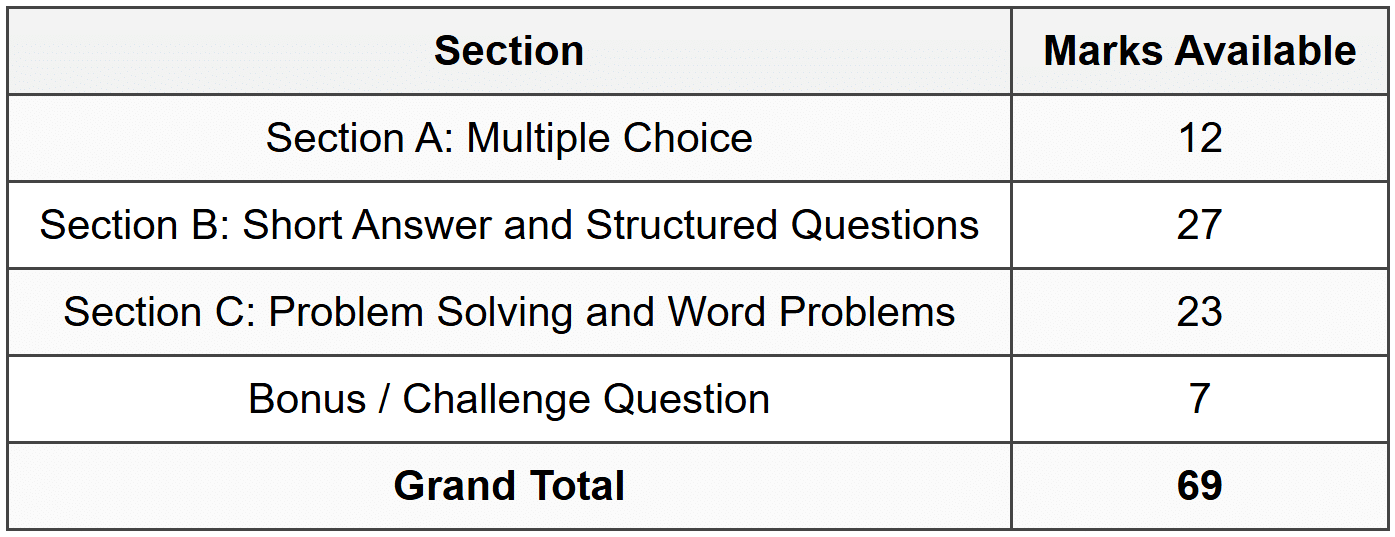
Worksheet - Faces, edges, and vertices of Prisms and Pyramids


Instructions to the Learner
- Read all questions carefully before answering.
- Answer all questions in the spaces provided.
- Show all working where required. Marks may be awarded for correct methods even if the final answer is incorrect.
- Diagrams are not drawn to scale unless otherwise stated.
- Write neatly and clearly. Illegible answers may not be marked.
- Check your work before submitting.
Section A: Multiple Choice
Q1. How many faces does a triangular prism have? [2 marks]
- 3
- 4
- 5
- 6
Q2. A square pyramid has how many vertices? [2 marks]
- 4
- 5
- 6
- 8
Q3. Which three-dimensional shape has 12 edges? [2 marks]
- Triangular pyramid
- Rectangular prism
- Triangular prism
- Square pyramid
Q4. How many edges does a pentagonal pyramid have? [2 marks]
- 5
- 6
- 10
- 15
Q5. A hexagonal prism has how many faces? [2 marks]
- 6
- 7
- 8
- 12
Q6. Which of the following is true about all pyramids? [2 marks]
- They have the same number of faces and vertices
- They have twice as many edges as the number of sides on the base
- They always have 5 faces
- They have rectangular faces only
Section B: Short Answer and Structured Questions
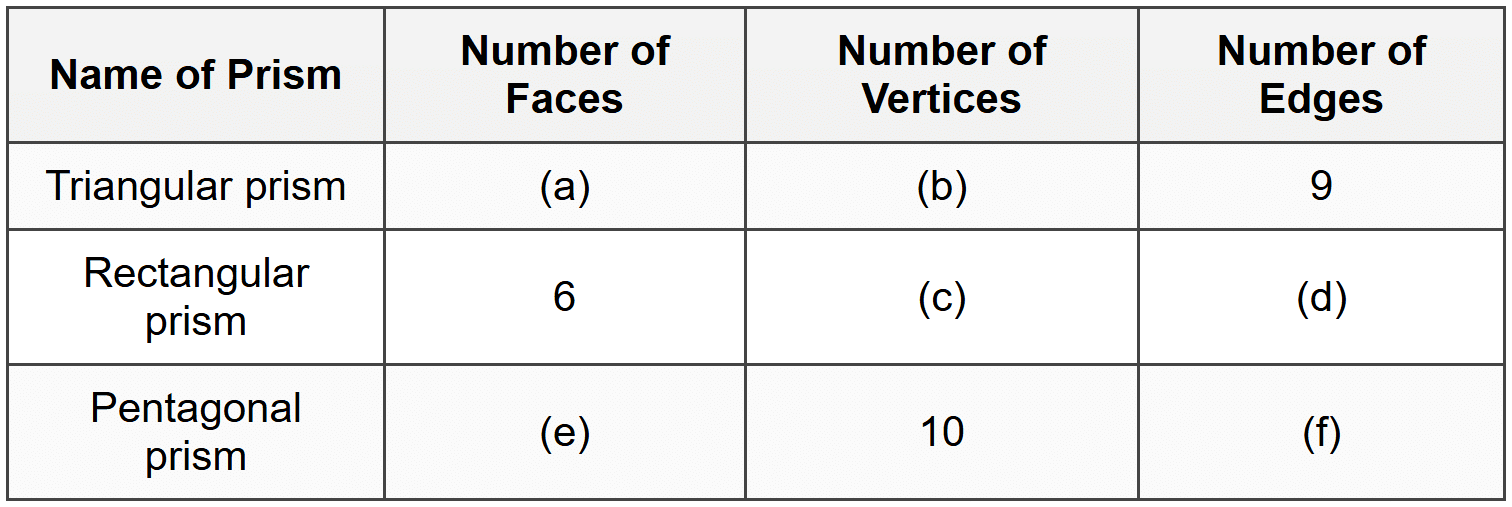
Q1. Complete the table below for prisms: [6 marks]
Q2. Answer the following questions about pyramids:
(a) How many faces does a triangular pyramid have? [1 mark]
(b) How many vertices does a hexagonal pyramid have? [1 mark]
(c) How many edges does an octagonal pyramid have? [2 marks]
Q3. A prism has 18 edges.
(a) How many sides does the base of this prism have? [2 marks]
(b) How many vertices does this prism have? [2 marks]
(c) How many faces does this prism have? [2 marks]
Q4. Consider a square pyramid.
(a) Draw a neat sketch of a square pyramid and label one face, one edge, and one vertex. [3 marks]
(b) Write down the number of faces, edges, and vertices of a square pyramid. [3 marks]
(c) How many of the faces are triangular? [1 mark]
Section C: Problem Solving and Word Problems
Q1. Thabo is building a model of a triangular prism for his mathematics project.
(a) He needs to paint all the faces of his model. How many faces will he need to paint? [2 marks]
(b) He uses toothpicks to represent the edges. How many toothpicks will he need? [2 marks]
(c) He uses small clay balls to represent the vertices. How many clay balls will he need? [2 marks]
Q2. Nomsa is comparing two three-dimensional shapes for her art project: a rectangular prism and a rectangular pyramid.
(a) How many more edges does the rectangular prism have than the rectangular pyramid? [3 marks]
(b) How many more vertices does the rectangular prism have than the rectangular pyramid? [3 marks]
(c) Both shapes have rectangular bases. Explain why the prism has more faces than the pyramid. [2 marks]
Q3. Lerato notices a pattern when studying pyramids. She observes that for any pyramid, if the base has n sides, then certain properties follow.
(a) If the base of a pyramid has 7 sides, how many edges does the pyramid have? [3 marks]
(b) If a pyramid has 9 vertices, how many sides does its base have? [3 marks]
Bonus / Challenge Question
This question is optional and is intended for fast finishers.
Q1. Sipho is investigating the relationship between faces (F), vertices (V), and edges (E) of prisms and pyramids.
(a) Complete the table below: [4 marks]
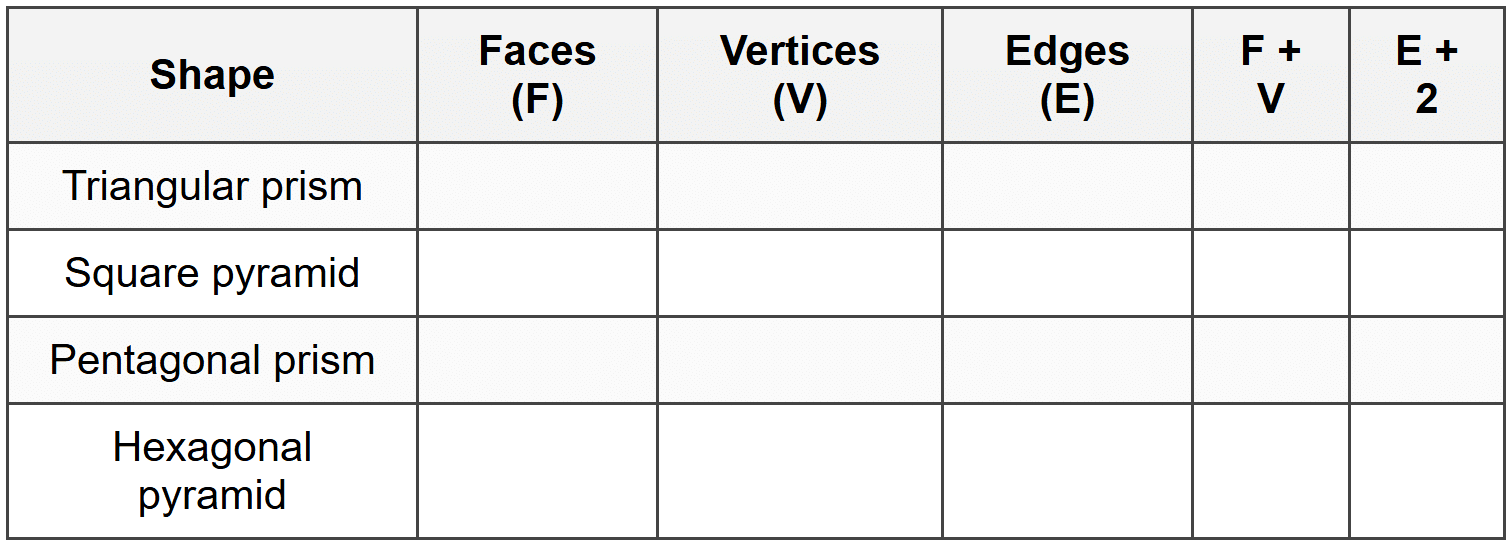
(b) What do you notice about the values in the last two columns (F + V and E + 2)? Write down the relationship. [3 marks]
Answer Key
Section A: Multiple Choice
Q1. C (5)
Explanation: A triangular prism has 5 faces: 2 triangular faces (the bases) and 3 rectangular faces (the lateral faces). Option A (3) is incorrect as it only counts the rectangular faces. Option B (4) is incorrect as it undercounts by one. Option D (6) is incorrect as that is the number of vertices, not faces.
Q2. B (5)
Explanation: A square pyramid has 5 vertices: 4 vertices at the corners of the square base and 1 vertex at the apex (top point). Option A (4) is incorrect as it only counts the base vertices. Option C (6) is too many. Option D (8) is incorrect as that would be the vertices of a rectangular prism.
Q3. B (Rectangular prism)
Explanation: A rectangular prism has 12 edges. Option A (triangular pyramid) has 6 edges. Option C (triangular prism) has 9 edges. Option D (square pyramid) has 8 edges.
Q4. C (10)
Explanation: A pentagonal pyramid has a pentagon base with 5 sides, giving 5 edges around the base. From each of the 5 base vertices, an edge goes up to the apex, giving another 5 edges. Total = 5 + 5 = 10 edges. Option A (5) only counts the base edges. Option B (6) is incorrect. Option D (15) is too many.
Q5. C (8)
Explanation: A hexagonal prism has 8 faces: 2 hexagonal faces (top and bottom bases) and 6 rectangular faces (lateral faces). Option A (6) only counts the lateral faces. Option B (7) is one short. Option D (12) is the number of vertices, not faces.
Q6. B (They have twice as many edges as the number of sides on the base)
Explanation: For any pyramid with an n-sided base, there are n edges around the base and n edges going up to the apex, giving 2n edges total. Option A is incorrect (faces and vertices are not equal for pyramids). Option C is incorrect as pyramids can have different numbers of faces depending on the base. Option D is incorrect as pyramids have triangular lateral faces, not rectangular.
Section B: Short Answer and Structured Questions
Q1.
(a) 5 faces [1 mark]
(b) 6 vertices [1 mark]
(c) 8 vertices [1 mark]
(d) 12 edges [1 mark]
(e) 7 faces [1 mark]
(f) 15 edges [1 mark]
Working:
(a) Triangular prism: 2 triangular bases + 3 rectangular faces = 5 faces
(b) Triangular prism: 3 vertices on top triangle + 3 vertices on bottom triangle = 6 vertices
(c) Rectangular prism: 4 vertices on top + 4 vertices on bottom = 8 vertices
(d) Rectangular prism: 4 edges on top + 4 edges on bottom + 4 vertical edges = 12 edges
(e) Pentagonal prism: 2 pentagonal bases + 5 rectangular faces = 7 faces
(f) Pentagonal prism: 5 edges on top + 5 edges on bottom + 5 vertical edges = 15 edges
Q2.
(a) 4 faces [1 mark]
A triangular pyramid has 1 triangular base + 3 triangular lateral faces = 4 faces
(b) 7 vertices [1 mark]
A hexagonal pyramid has 6 vertices around the hexagonal base + 1 apex vertex = 7 vertices
(c) 16 edges [2 marks]
An octagonal pyramid has 8 edges around the octagonal base + 8 edges going up to the apex = 16 edges
[1 mark for method, 1 mark for correct answer]
Q3.
(a) For a prism with n-sided base: number of edges = 3n
3n = 18
n = 18 ÷ 3
n = 6
The base has 6 sides [1 mark for method, 1 mark for answer]
(b) For a hexagonal prism: vertices = 2n where n = 6
Vertices = 2 × 6
Vertices = 12
The prism has 12 vertices [1 mark for method, 1 mark for answer]
(c) For a hexagonal prism: faces = n + 2 where n = 6
Faces = 6 + 2
Faces = 8
The prism has 8 faces [1 mark for method, 1 mark for answer]
Q4.
(a) [3 marks: 1 mark for correct shape, 1 mark for correctly labeled face, 1 mark for correctly labeled edge and vertex]
Sketch should show a square base with 4 triangular faces meeting at an apex point, with appropriate labels.
(b) Faces: 5, Edges: 8, Vertices: 5
[1 mark for each correct value]
Faces: 1 square base + 4 triangular faces = 5
Edges: 4 edges around the base + 4 edges to apex = 8
Vertices: 4 corners of square base + 1 apex = 5
(c) 4 triangular faces [1 mark]
All the lateral faces of a square pyramid are triangular.
Section C: Problem Solving and Word Problems
Q1.
(a) A triangular prism has 5 faces
Thabo will need to paint 5 faces [2 marks]
(b) A triangular prism has 9 edges
(3 edges on top triangle + 3 edges on bottom triangle + 3 vertical edges)
He will need 9 toothpicks [2 marks]
(c) A triangular prism has 6 vertices
(3 vertices on top triangle + 3 vertices on bottom triangle)
He will need 6 clay balls [2 marks]
Q2.
(a) Rectangular prism edges: 12
Rectangular pyramid edges: 8
Difference: 12 - 8 = 4
The rectangular prism has 4 more edges than the rectangular pyramid [1 mark for identifying both values, 1 mark for subtraction, 1 mark for answer]
(b) Rectangular prism vertices: 8
Rectangular pyramid vertices: 5
Difference: 8 - 5 = 3
The rectangular prism has 3 more vertices than the rectangular pyramid [1 mark for identifying both values, 1 mark for subtraction, 1 mark for answer]
(c) The prism has more faces because it has two parallel rectangular bases (top and bottom), whereas the pyramid has only one rectangular base and comes to a point at the apex. The prism has 6 faces while the pyramid has 5 faces.
[1 mark for explaining the two bases of the prism, 1 mark for explaining the pyramid's single base and apex]
Q3.
(a) For a pyramid with n-sided base: edges = 2n
n = 7
Edges = 2 × 7
Edges = 14
The pyramid has 14 edges [1 mark for formula/method, 1 mark for working, 1 mark for answer]
(b) For a pyramid: vertices = n + 1, where n is the number of sides on the base
n + 1 = 9
n = 9 - 1
n = 8
The base has 8 sides [1 mark for formula/method, 1 mark for working, 1 mark for answer]
Bonus / Challenge Question
Q1.
(a) [4 marks - 1 mark per complete row]
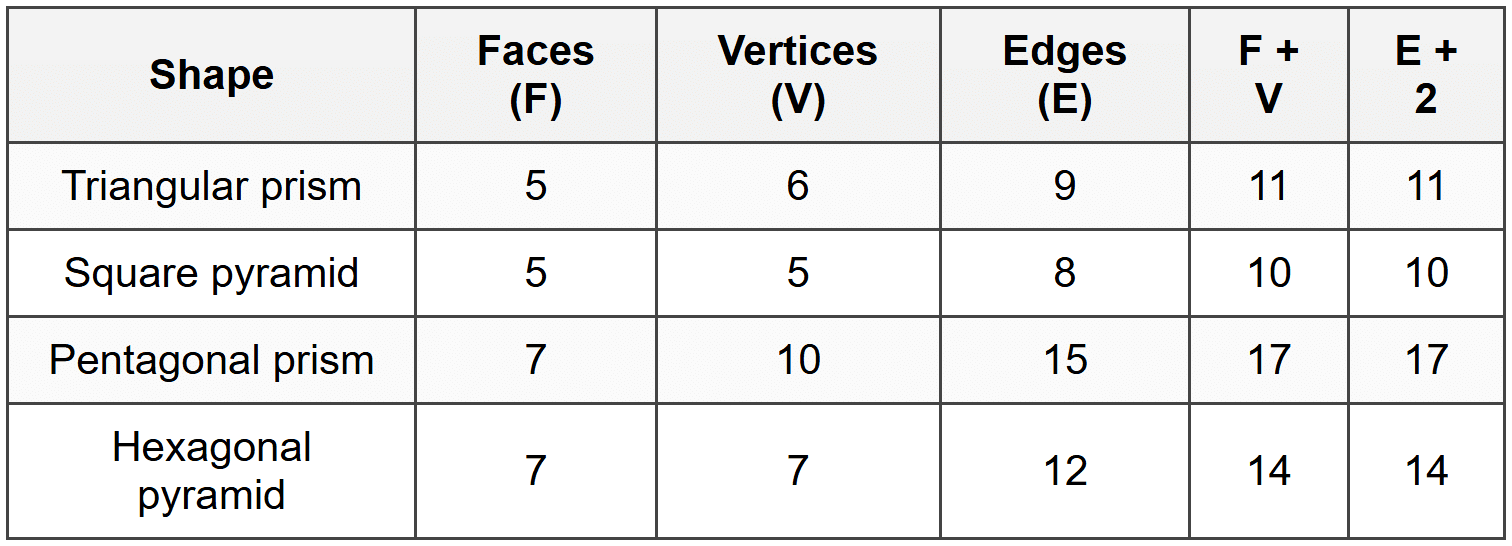
(b) The values in the last two columns are equal. This shows that F + V = E + 2, which is Euler's formula for polyhedra.
[2 marks for observing they are equal, 1 mark for stating the relationship F + V = E + 2]
This question tests understanding of patterns and the ability to discover mathematical relationships-Euler's formula is a fundamental property of three-dimensional shapes.
Total Marks Summary