Music Fundamentals Exam > Music Fundamentals Notes > Music Theory - Fundamentals for Composition in Any Genre > CheatSheet:Introduction to Key Signatures & The Circle of Fifths
CheatSheet:Introduction to Key Signatures & The Circle of Fifths

1. Key Signatures
1.1 Core Concepts
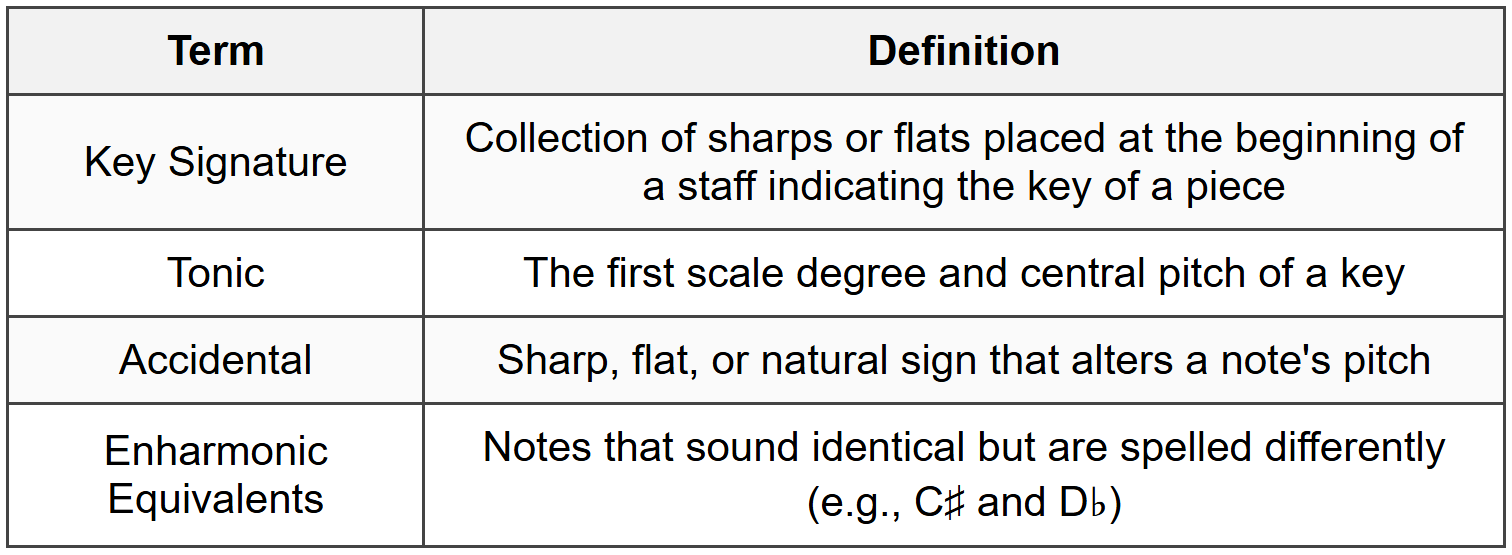
1.2 Order of Sharps and Flats

- Mnemonic for sharps: "Fat Cats Go Down Alleys Eating Birds"
- Mnemonic for flats: "BEAD Greatest Common Factor" or reverse of sharps
- Sharp and flat orders are reverse of each other
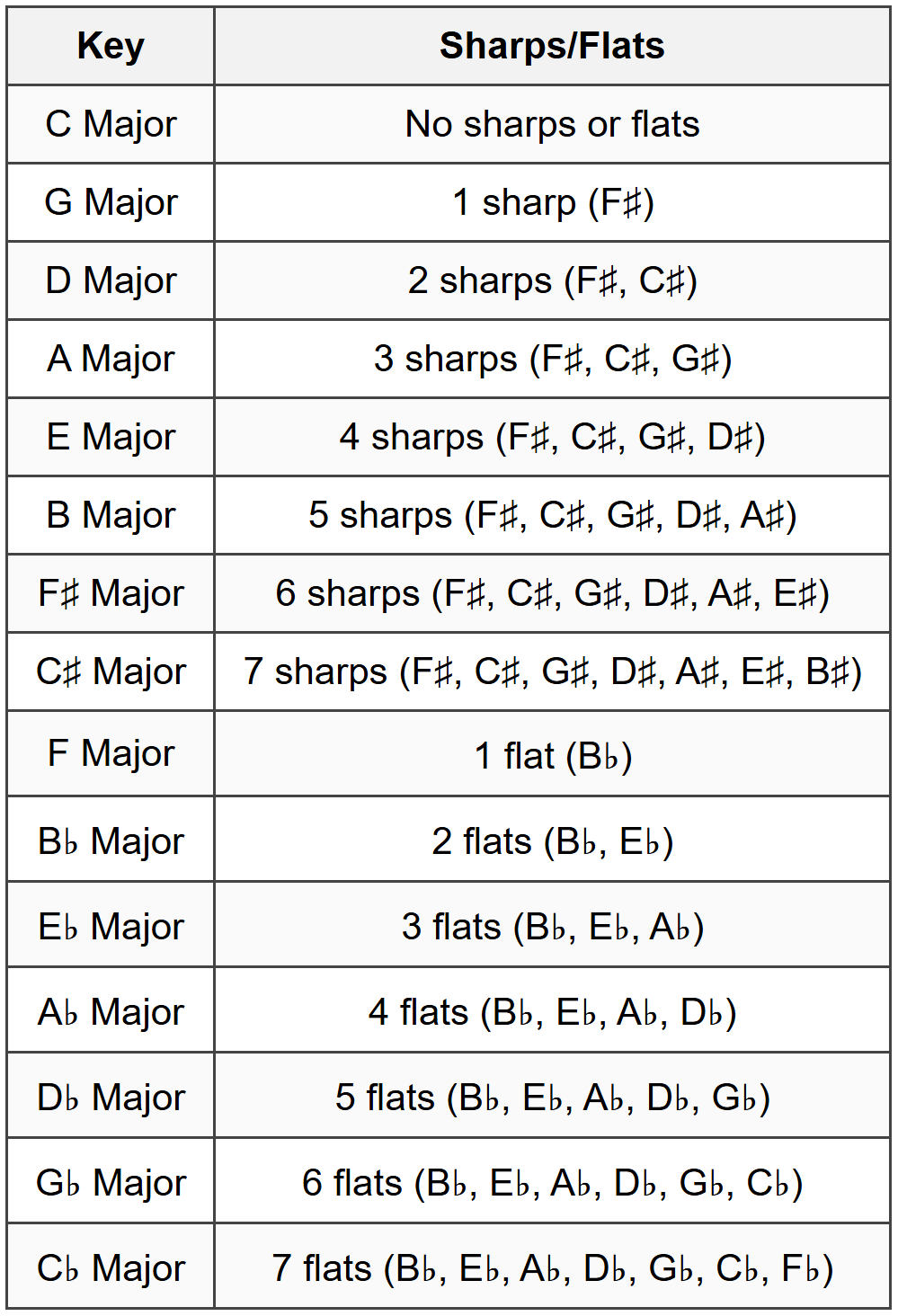
1.3 Major Key Signatures
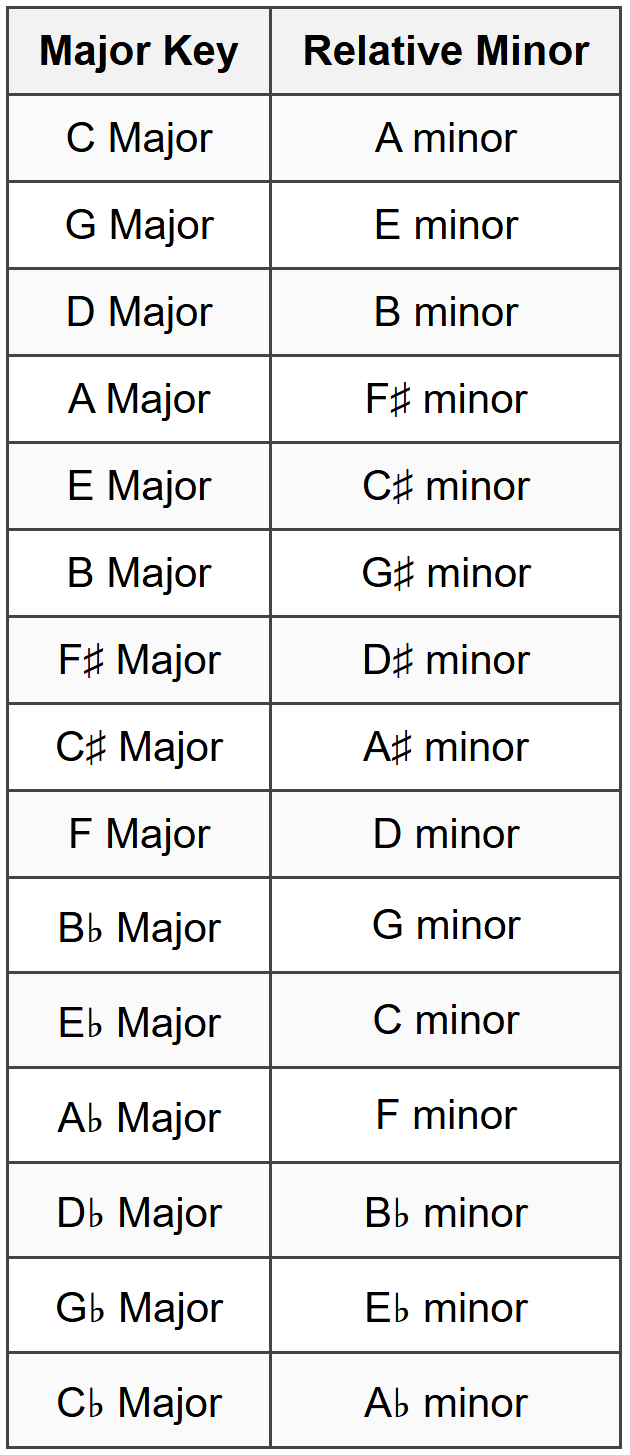
1.4 Minor Key Signatures
- Each major key has a relative minor that shares the same key signature
- Relative minor is built on the 6th scale degree of the major scale
- Relative minor is a minor 3rd (3 half steps) below the major key
1.5 Identifying Key from Key Signature
1.5.1 Major Keys with Sharps
- The last sharp in the key signature is the 7th scale degree (leading tone)
- Go up one half step from the last sharp to find the tonic
- Example: Last sharp is C♯ → Major key is D
1.5.2 Major Keys with Flats
- The second-to-last flat is the tonic (works for 2+ flats)
- For one flat (B♭), the key is F Major
- Example: Last two flats are A♭ and D♭ → Major key is A♭
1.5.3 Minor Keys
- Find the major key first using the methods above
- Go down a minor 3rd (3 half steps) to find the relative minor
2. The Circle of Fifths
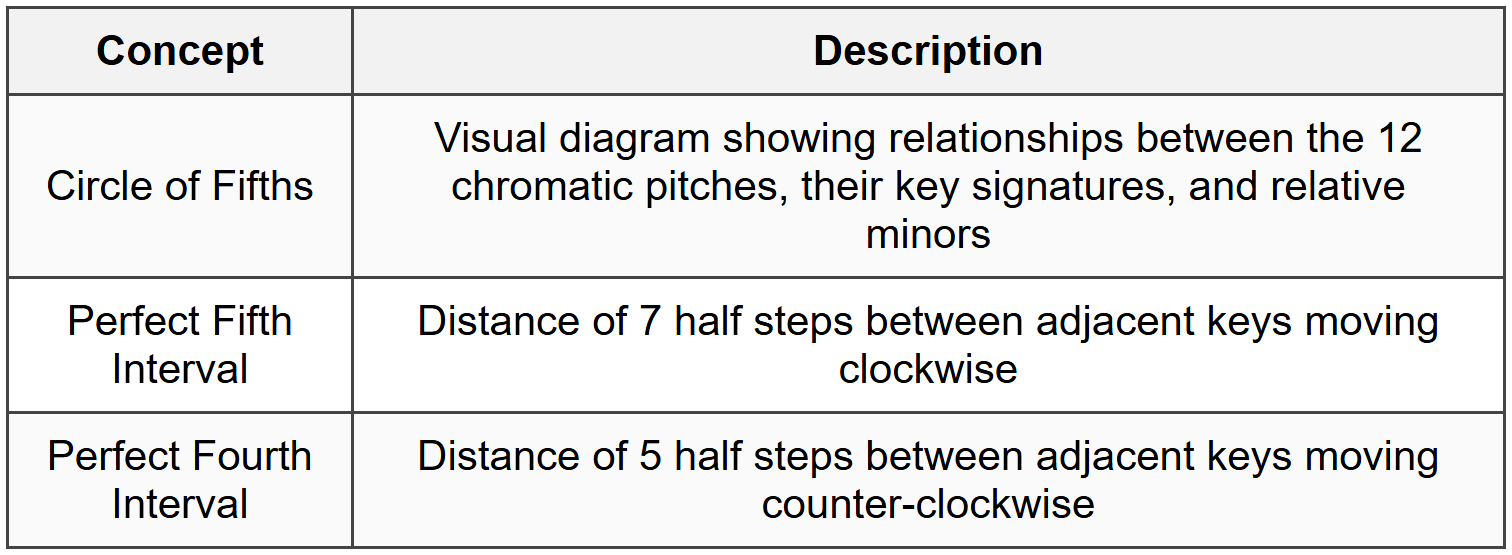
2.1 Structure and Organization
2.2 Clockwise Movement (Sharps)
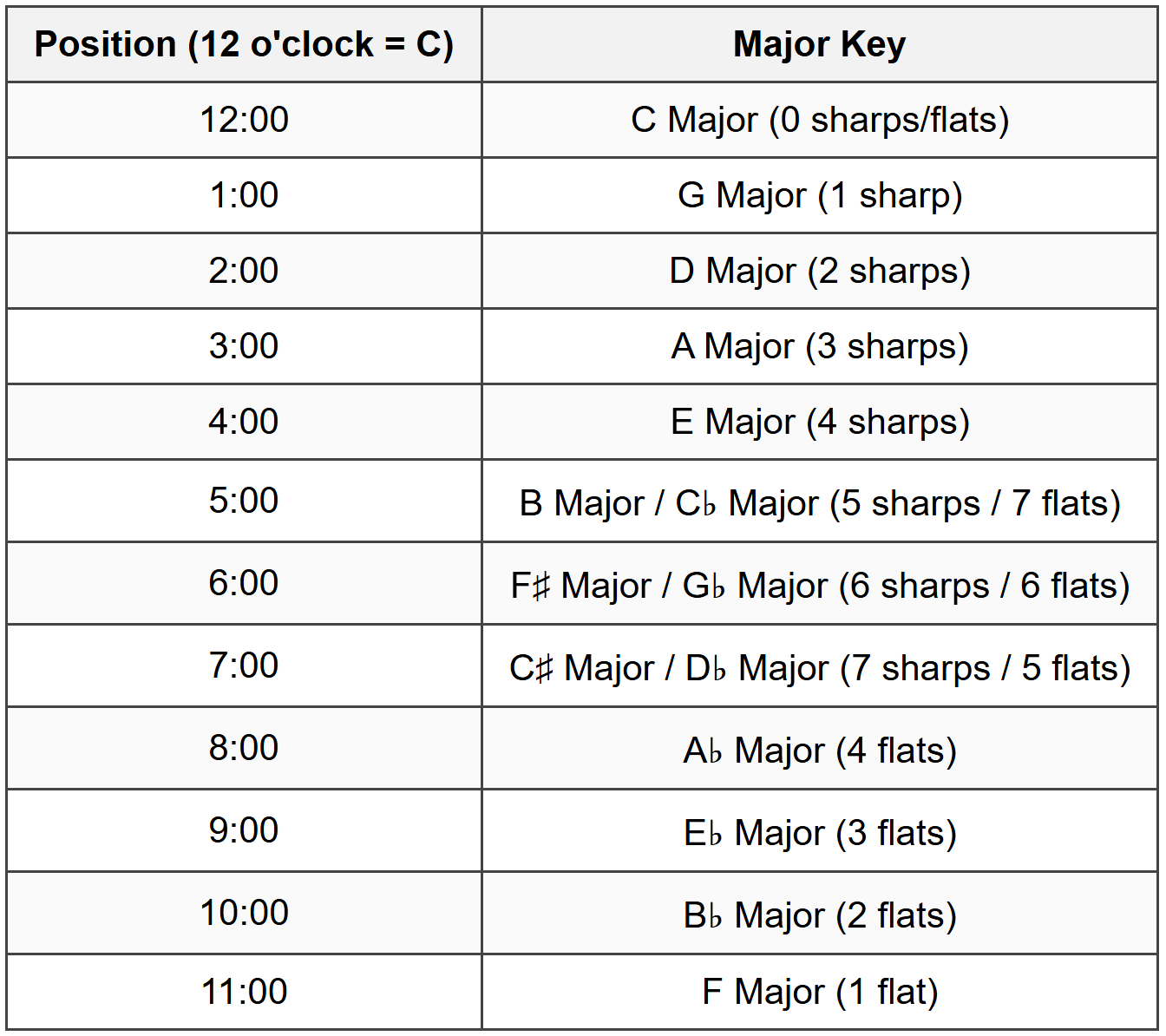
- Starting at C (top), moving clockwise adds one sharp each step
- Sequence: C → G → D → A → E → B → F♯ → C♯
- Each key is a perfect fifth above the previous
- Number of sharps increases by one: 0, 1, 2, 3, 4, 5, 6, 7
2.3 Counter-Clockwise Movement (Flats)
- Starting at C (top), moving counter-clockwise adds one flat each step
- Sequence: C → F → B♭ → E♭ → A♭ → D♭ → G♭ → C♭
- Each key is a perfect fourth above (or perfect fifth below) the previous
- Number of flats increases by one: 0, 1, 2, 3, 4, 5, 6, 7
2.4 Complete Circle Layout
2.5 Relative Minors on the Circle
- Relative minor keys are placed inside or adjacent to their major counterparts
- Each minor key shares identical key signature with its relative major
- Minor keys follow same fifth relationships as major keys
- Clockwise minor sequence: A → E → B → F♯ → C♯ → G♯ → D♯ → A♯
- Counter-clockwise minor sequence: A → D → G → C → F → B♭ → E♭ → A♭
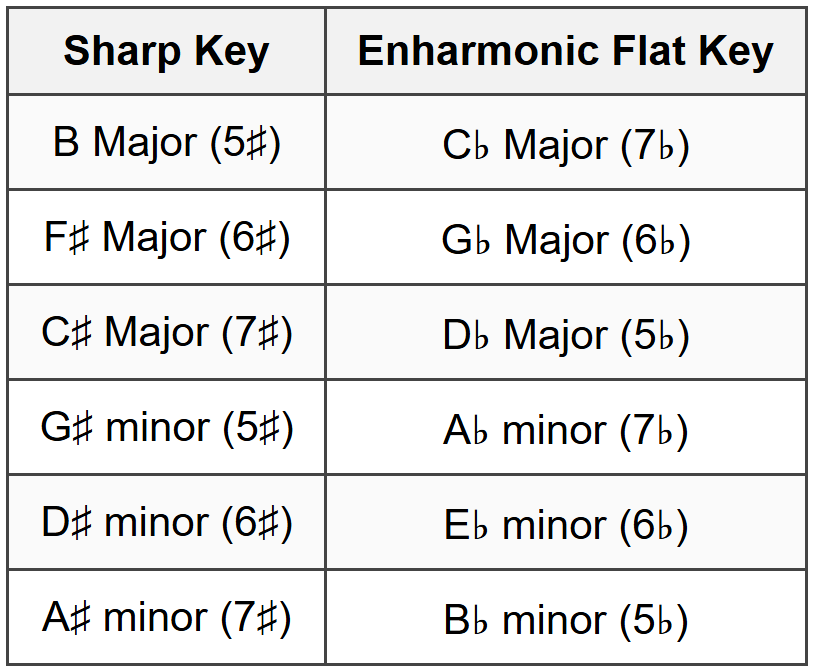
2.6 Enharmonic Equivalents
3. Applications for Composition
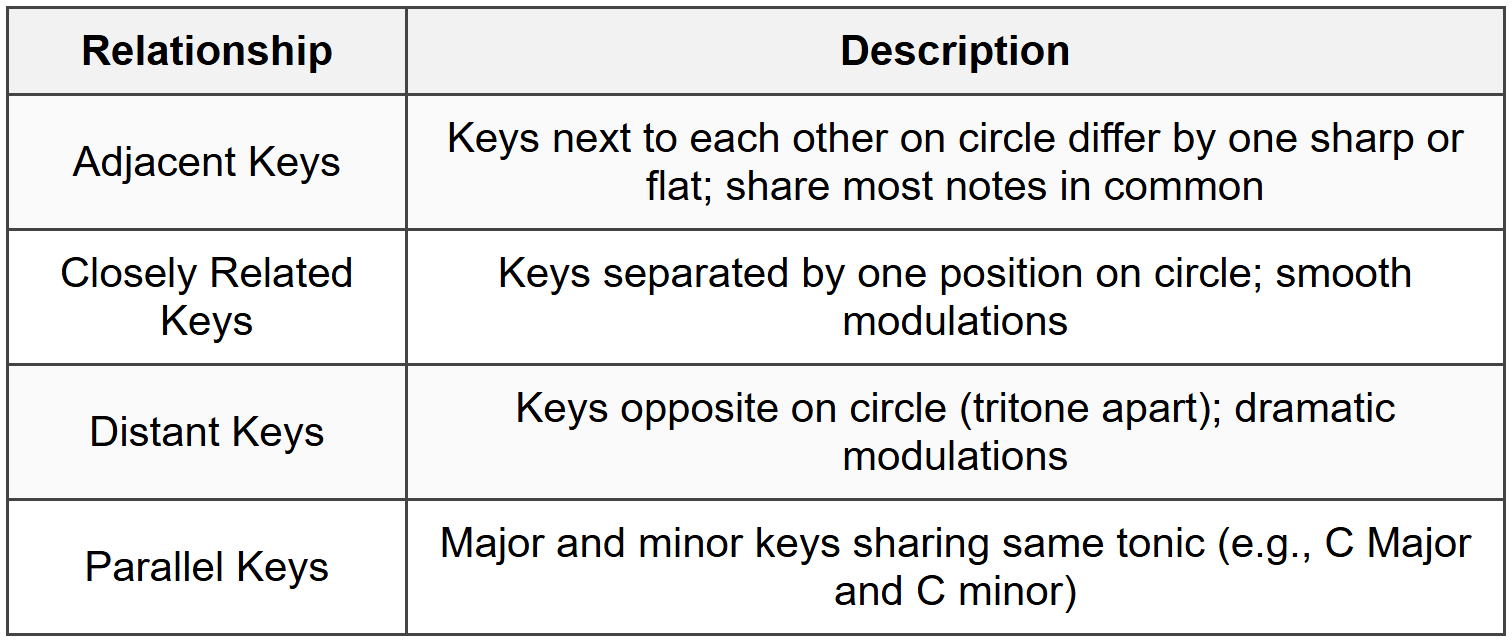
3.1 Key Relationships
3.2 Common Modulation Patterns
- To dominant key: Move one position clockwise (adds 1 sharp or removes 1 flat)
- To subdominant key: Move one position counter-clockwise (adds 1 flat or removes 1 sharp)
- To relative minor/major: Same key signature, different tonal center
- To parallel minor/major: Same tonic, different key signature
3.3 Diatonic Chords and the Circle
- Primary chords (I, IV, V) are adjacent on the circle
- In C Major: F (IV) - C (I) - G (V) appear consecutively
- Moving by fifths creates strong harmonic progressions
- Root movement by fifth is strongest harmonic motion
3.4 Practical Uses
- Transposing: Count positions on circle to determine new key signature
- Chord progressions: Use fifth relationships for strong resolutions
- Modulation planning: Visualize distance between keys
- Scale construction: Quickly identify sharps/flats needed
- Song analysis: Identify key centers and key changes
3.5 Modal Considerations
- Modes share same principle of fifth relationships
- Each mode can be mapped to circle using its characteristic notes
- Parallel modes share tonic but have different key signatures
- Relative modes share key signature but have different tonics
4. Quick Reference Tables
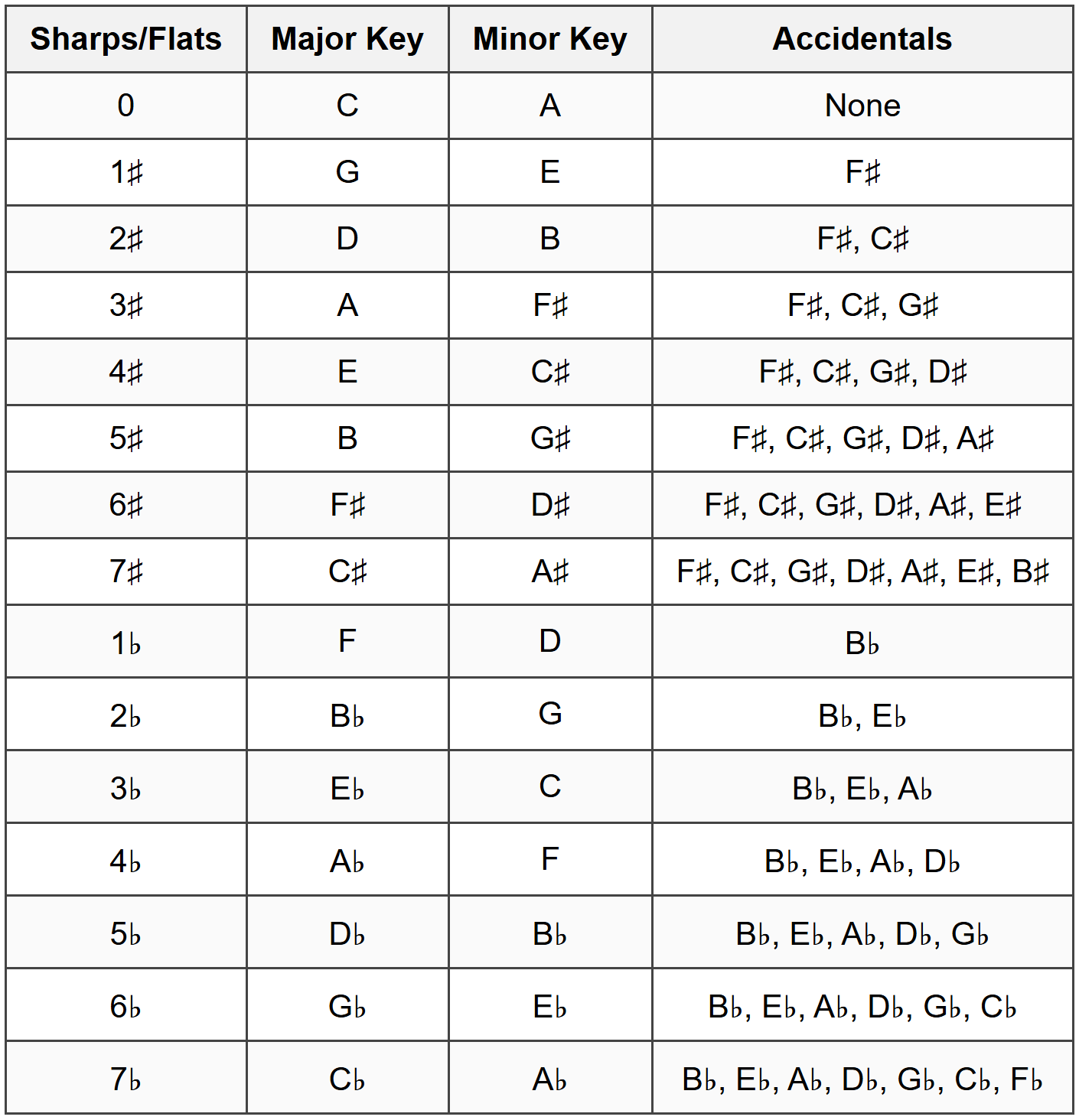
4.1 All Major and Minor Keys
4.2 Key Signature Shortcuts
- Sharps: Last sharp + half step up = major key
- Flats: Second-to-last flat = major key (or memorize F for one flat)
- Minor: Major key down minor 3rd (3 half steps) = relative minor
- Fifths up = add sharp; Fifths down = add flat
- Fourths up = add flat; Fourths down = add sharp
The document CheatSheet:Introduction to Key Signatures & The Circle of Fifths is a part of the Music Fundamentals Course Music Theory - Fundamentals for Composition in Any Genre.
All you need of Music Fundamentals at this link: Music Fundamentals
About this Document

4.80/5 Rating

Apr 20, 2026 Last updated
Related Exams
Document Description: CheatSheet:Introduction to Key Signatures & The Circle of Fifths for Music Fundamentals 2026 is part of Music Theory - Fundamentals for Composition in Any Genre preparation. The notes and questions for CheatSheet:Introduction to Key Signatures & The Circle of Fifths have been prepared according to the Music Fundamentals exam syllabus. Information about CheatSheet:Introduction to Key Signatures & The Circle of Fifths covers topics like and CheatSheet:Introduction to Key Signatures & The Circle of Fifths Example, for Music Fundamentals 2026 Exam. Find important definitions, questions, notes, meanings, examples, exercises and tests below for CheatSheet:Introduction to Key Signatures & The Circle of Fifths.
Introduction of CheatSheet:Introduction to Key Signatures & The Circle of Fifths in English is available as part of our Music Theory - Fundamentals for Composition in Any Genre for Music Fundamentals & CheatSheet:Introduction to Key Signatures & The Circle of Fifths in Hindi for Music Theory - Fundamentals for Composition in Any Genre course. Download more important topics related with notes, lectures and mock test series for Music Fundamentals Exam by signing up for free. Music Fundamentals: CheatSheet:Introduction to Key Signatures & The Circle of Fifths
Description
CheatSheet:Introduction to Key Signatures & The Circle of Fifths of Music Theory to help you remember important concepts with short tricks. Start learning for Music Fundamentals exam & improve retention with EduRev.
Information about CheatSheet:Introduction to Key Signatures & The Circle of Fifths
In this doc you can find the meaning of CheatSheet:Introduction to Key Signatures & The Circle of Fifths defined & explained in the simplest way possible. Besides explaining types of CheatSheet:Introduction to Key Signatures & The Circle of Fifths theory, EduRev gives you an ample number of questions to practice CheatSheet:Introduction to Key Signatures & The Circle of Fifths tests, examples and also practice Music Fundamentals tests



Related Searches
Previous Year Questions with Solutions, mock tests for examination, Exam, Semester Notes, practice quizzes, study material, CheatSheet:Introduction to Key Signatures & The Circle of Fifths, Objective type Questions, Sample Paper, ppt, past year papers, shortcuts and tricks, video lectures, Extra Questions, MCQs, Free, Summary, Important questions, Viva Questions, CheatSheet:Introduction to Key Signatures & The Circle of Fifths, CheatSheet:Introduction to Key Signatures & The Circle of Fifths, pdf ;