Structure of Popular Hit Songs


Structure of Popular Hit Songs
1. Why Song Structure Matters
Think about the last song you couldn't get out of your head. Chances are, you remembered it not just because of a catchy melody, but because it had a predictable shape that your brain could latch onto. Song structure is the blueprint that tells listeners when to expect something familiar and when to anticipate something new.
When you listen to a pop song on the radio, you're experiencing a carefully designed journey. The songwriter has created sections that serve different purposes: some sections establish the mood, others deliver the main message, and still others provide contrast or release. Understanding these sections helps you both appreciate the songs you love and craft your own music with intention.
Let's explore the building blocks that songwriters use to create hit songs. These aren't rigid rules-they're flexible tools that work because they tap into how humans naturally process and remember music.
2. The Basic Building Blocks
Every popular song is built from a handful of essential sections. Let's look at each one and understand what it does.
The Verse
Picture the verse as the storyteller of your song. This is where you set the scene, introduce characters, or describe feelings that change from verse to verse. The melody usually stays the same for each verse, but the lyrics change to move the narrative forward.
Listen to Billie Jean by Michael Jackson. Notice how each verse has the same melody and groove, but the words tell different parts of the story-first about meeting someone, then about the accusation, then about the denial. That's the verse doing its job: advancing the plot while maintaining musical consistency.
Try this: Pick any song you know well and sing just the verses. Notice how the music feels like it's building toward something, not quite complete on its own. That's intentional.
The Chorus
The chorus is your song's main message-the part everyone remembers and sings along to. Unlike verses, the chorus typically has the same melody and same lyrics every time it appears. It's often louder, higher, and more energetically intense than the verse.
Think of Rolling in the Deep by Adele. When she hits "We could have had it all," that's the chorus-the emotional peak, the line that defines the entire song. You could hear just that section and know exactly what song you're listening to.
The chorus usually contains the song title or hook-the most memorable phrase. It's designed to be repetitive because repetition creates familiarity, and familiarity creates hits.
The Pre-Chorus
Sometimes called the lift or build, the pre-chorus is an optional section that sits between the verse and chorus. Its job is to create tension and anticipation, making the chorus feel even more satisfying when it arrives.
Listen to Shake It Off by Taylor Swift. After the verse, there's a distinct section where she sings "I'm lightning on my feet"-that's the pre-chorus. Notice how it feels like climbing a staircase, preparing you for the explosive "shake it off" chorus that follows.
Not every song needs a pre-chorus, but when used well, it creates a powerful sense of momentum.
The Bridge
The bridge provides contrast. After you've heard the verse and chorus a couple of times, the song risks becoming predictable. The bridge breaks the pattern with new melody, new chords, or a new perspective on the lyrics.
Check out Blank Space by Taylor Swift. Around two-thirds through the song, there's a section that goes "Boys only want love if it's torture"-the melody shifts, the energy changes, and suddenly you're hearing something fresh. That's the bridge offering relief from repetition.
Bridges typically appear once in a song, usually after the second chorus. They often lead back to a final chorus with renewed energy.
The Intro
The introduction is your song's first impression. It establishes the groove, mood, and sonic world before the vocals begin. Intros can be short (a few seconds) or extended (15-20 seconds), depending on the song's style.
Billie Jean has one of the most recognizable intros in pop history-that distinctive bass line and drum pattern play for nearly 10 seconds before Michael Jackson starts singing. By the time he does, you're already locked into the groove.
The Outro
The outro, or conclusion, is how your song says goodbye. Some songs fade out gradually (common in older pop music), others end with a definitive final chord, and some repeat the chorus with variations until they conclude.
Hey Jude by The Beatles has one of the most famous outros ever: the "na na na" section repeats for over four minutes, creating a communal, singalong ending.
3. Common Song Structures in Popular Music
Now that you know the building blocks, let's see how songwriters arrange them into complete songs. These are the most common templates you'll encounter across pop, rock, country, and R&B.
Verse-Chorus Form
This is the most common structure in popular music today. The pattern alternates between verses and choruses, creating a predictable but effective framework:
Intro → Verse 1 → Chorus → Verse 2 → Chorus → Bridge → Chorus → Outro
Songs like Someone Like You by Adele and Shape of You by Ed Sheeran follow this template. The repetition of the chorus ensures the main hook gets stuck in your head, while the verses keep the song from feeling static.
Try this: Map out your favorite song by listening and noting when each section occurs. Write down something like "0:00 Intro, 0:15 Verse 1, 0:45 Chorus..." You'll likely find it matches one of these common forms.
Verse-Chorus with Pre-Chorus
Many modern pop songs add a pre-chorus to build extra tension:
Intro → Verse 1 → Pre-Chorus → Chorus → Verse 2 → Pre-Chorus → Chorus → Bridge → Chorus → Outro
Teenage Dream by Katy Perry uses this structure perfectly. The pre-chorus ("I'ma get your heart racing") creates anticipation before the explosive "You make me feel like I'm living a teenage dream" chorus.
AABA Form (32-Bar Form)
This classic structure dominated popular music from the 1920s through the 1950s and still appears occasionally today. The "A" sections present the main musical idea, while the "B" section (called the middle eight or bridge) provides contrast:
A → A → B → A
Each section is typically eight measures long, giving you 32 total measures-hence the name "32-bar form."
I Want to Hold Your Hand by The Beatles follows this pattern. The "A" sections contain "Oh yeah, I'll tell you something," while the "B" section shifts to "And when I touch you I feel happy inside."
Verse-Verse-Bridge-Verse (AAA Form)
In this structure, there's no distinct chorus. Instead, the same melody repeats with different lyrics, occasionally interrupted by a bridge or instrumental break. This form is common in folk music and storytelling songs.
Blowin' in the Wind by Bob Dylan uses this approach. Each verse has the same melody, but the questions change: "How many roads...", "How many times...", "How many years..." The lack of a chorus keeps the focus on the evolving lyrics.
Modified and Hybrid Structures
Professional songwriters often bend these templates to serve their creative vision. You might encounter:
- Double chorus: The chorus repeats twice before moving to the next section (Good 4 U by Olivia Rodrigo)
- Pre-chorus only before some choruses: Creates surprise by changing the approach pattern
- Multiple bridges: Rare, but used for extended artistic statements
- Chorus-first songs: Starting with the chorus immediately grabs attention (She Loves You by The Beatles)
4. How Sections Create Contrast and Balance
Great song structure isn't just about arranging sections-it's about creating the right tension and release, repetition and variety. Let's explore how these forces work together.
Energy and Dynamics
Think of your song as having an energy contour-a shape that rises and falls across its duration. Verses typically have lower energy (quieter, fewer instruments, lower vocal range), while choruses have higher energy (louder, fuller arrangement, higher vocals).
In Don't Stop Believin' by Journey, notice how the verses start relatively sparse with piano and vocals, then the pre-chorus ("Streetlights, people") builds intensity, and finally the chorus explodes with full band and Steve Perry's soaring vocals. That's deliberate energy management.
Try this: Draw a simple line graph while listening to a favorite song. When the energy feels low, draw the line low; when it peaks, draw it high. You'll see the song's structure emerge visually.
Melodic Range and Contour
Verses often sit in a comfortable, conversational range where the singer can deliver lyrics clearly. Choruses typically jump to a higher, more dramatic range to create emotional impact and memorability.
In Bad Guy by Billie Eilish, the verses are deliberately low and almost whispered, making the slightly higher, punchier chorus ("I'm a bad guy... duh") feel more assertive by contrast, even though it's not traditionally "soaring."
Harmonic Movement
Sections also differ in their chord progressions. Verses might use more varied or unexpected chords to maintain interest during the storytelling, while choruses often use strong, simple progressions that feel inevitable and satisfying.
The bridge frequently introduces chords you haven't heard yet in the song, creating freshness and making the return to the final chorus feel like coming home.
Repetition as a Tool
Here's something crucial: repetition isn't boring-it's necessary. Your brain needs to hear something multiple times to remember it. That's why the chorus repeats with identical music and lyrics.
But too much repetition without contrast becomes monotonous. That's why you don't hear the same verse four times in a row-you get verses with changing lyrics, alternating with the repeating chorus, occasionally interrupted by a contrasting bridge.
The magic ratio? Most hit songs repeat their chorus three to four times. That's enough to cement it in memory without exhausting the listener.
5. Length and Timing Conventions
While creativity is paramount, popular music has developed some practical conventions around section length and total song duration. Understanding these helps you work within-or deliberately against-listener expectations.
Total Song Length
Most popular songs clock in between 2:30 and 4:00 (two and a half to four minutes). This isn't arbitrary-it's based on radio programming needs, streaming economics, and human attention spans.
In recent years, songs have trended shorter. Many current hits are around 2:30 to 3:00, partly because streaming platforms count a play after 30 seconds, incentivizing concise, immediate impact. Old Town Road by Lil Nas X runs just 1:53 in its original form.
Section Lengths
While there's flexibility, typical section lengths create familiar pacing:
- Intro: 4-8 bars (often 8-15 seconds)
- Verse: 8-16 bars (usually 16-30 seconds)
- Pre-Chorus: 4-8 bars (8-15 seconds)
- Chorus: 8-16 bars (15-30 seconds)
- Bridge: 8-16 bars (15-30 seconds)
These durations assume a moderate tempo (around 120 beats per minute). Faster songs cover more bars in less time; slower songs take longer per bar.
The "Rule" of Four
Popular music has a strong tendency toward four-bar phrases and sections in multiples of four (4, 8, 16 bars). This comes from the underlying 4/4 time signature that dominates pop music, creating nested layers of symmetry.
When you clap along to a song, you often naturally clap every four beats-that's one bar. Count to four twice and you've got a two-bar phrase. Count to four eight times and you've completed an eight-bar section.
Try this: Listen to Uptown Funk by Mark Ronson featuring Bruno Mars. Count "1, 2, 3, 4" repeatedly along with the beat. Notice how major changes in the music-new sections starting-almost always land when you're starting a new count of "1."
6. The Hook: What Makes Sections Memorable
You've probably heard the term hook applied to catchy songs, but what exactly is it? A hook is any memorable musical element that "hooks" the listener's attention and memory. It could be melodic, lyrical, rhythmic, or even a distinctive sound.
Melodic Hooks
These are singable, memorable tunes that stick in your head. The chorus melody is typically the primary melodic hook, but verses and even instrumental riffs can hook you.
The "dun dun dun" melody in the chorus of Sweet Child O' Mine by Guns N' Roses is pure melodic hook-simple enough to remember instantly, distinctive enough to be unmistakable.
Lyrical Hooks
A short, punchy phrase that encapsulates the song's message and is easy to remember. Usually found in the chorus and often includes the song title.
"Shake it off" in Taylor Swift's song of the same name is a perfect lyrical hook-simple, conversational, immediately clear, and fun to say (and sing).
Rhythmic Hooks
Sometimes the hook is a rhythm pattern that defines the song. The opening drum pattern of We Will Rock You by Queen is one of the most recognizable rhythmic hooks ever created: stomp-stomp-CLAP, stomp-stomp-CLAP.
Instrumental Hooks
A catchy instrumental line or riff can serve as the song's defining hook. The guitar riff in Smoke on the Water by Deep Purple or the bass line in Another One Bites the Dust by Queen are hooks as memorable as any chorus.
Placement and Repetition of Hooks
Effective songs place hooks strategically. The strongest hook usually appears in the chorus, but smart songwriters scatter smaller hooks throughout:
- A catchy instrumental riff in the intro (grabs attention immediately)
- A memorable phrase or melodic turn in the verse (keeps you engaged)
- The main hook in the chorus (delivers the payoff)
- A variation or extension of the hook in the outro (leaves a lasting impression)
7. Creating Movement Through Your Song
Understanding structure isn't just about knowing what sections exist-it's about creating a journey that feels purposeful and satisfying. Let's explore how to build momentum and guide your listener through the song.
The Setup-Payoff Dynamic
Great songs create expectation and then fulfill it. The verse sets up a question or situation; the chorus pays it off with an answer or emotional release. The pre-chorus heightens the expectation, making the payoff even sweeter.
In Someone Like You by Adele, the verses describe seeing an ex-lover with someone new-they create emotional tension. When the chorus arrives with "Never mind, I'll find someone like you," it releases that tension with acceptance and resolve.
Building Intensity Across Repetitions
Even though the chorus repeats with the same melody and lyrics, the arrangement often intensifies with each repetition:
- First chorus: Moderate energy, some instruments
- Second chorus: Fuller arrangement, backing vocals added
- Final chorus (after bridge): Maximum energy, all instruments, vocal ad-libs, maybe a key change
Listen to I Will Always Love You by Whitney Houston. The first chorus is relatively restrained. By the final chorus, Houston is belting with the full power of her voice over a massive arrangement-same melody, same lyrics, completely different emotional impact.
The Power of the Bridge Placement
Bridges typically appear around the two-thirds mark of a song. This timing is crucial-it's the moment when repetition risks becoming stale, so the bridge arrives with fresh material to re-engage attention.
After the bridge creates contrast, returning to the familiar chorus feels both satisfying (you're back in comfortable territory) and renewed (the bridge made you appreciate it more).
When to Break the Rules
All these structures are tools, not laws. Once you understand the conventions, you can deliberately break them for artistic effect:
- Bohemian Rhapsody by Queen ignores traditional structure entirely, creating a six-minute suite of distinct sections
- Seven Nation Army by The White Stripes has no chorus in the traditional sense-just repeating verses
- Bad Guy by Billie Eilish subverts pop conventions with an unexpected quiet bridge that completely changes the vibe
The key is to break rules intentionally, understanding what effect you're creating and why.
8. Analyzing Structure in Practice
Let's put everything together by analyzing the structure of a well-known hit song in detail. We'll use Shape of You by Ed Sheeran, one of the most-streamed songs ever.
Section-by-Section Breakdown
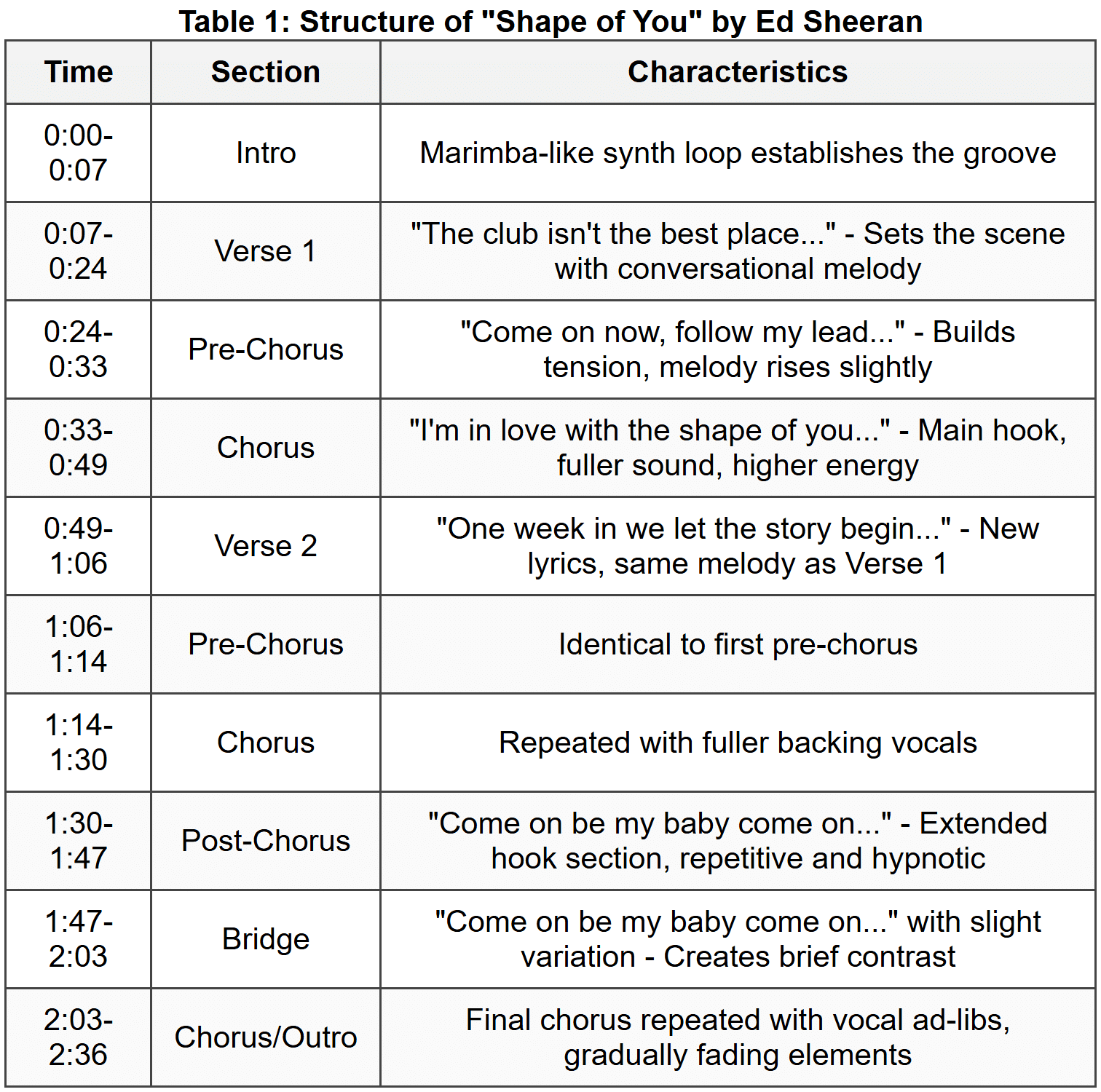
What Makes This Structure Work
Notice several effective choices Sheeran made:
- The immediate groove in the intro hooks you before vocals even start
- The pre-chorus creates anticipation before each chorus
- The chorus appears four times, cementing the hook in memory
- A post-chorus extends the most memorable section
- The total length is 3:53-radio-friendly and well-paced
- The structure is predictable but effective, following verse-pre-chorus-chorus convention
Your turn: Choose a current hit song and map out its structure like we did above. You'll start recognizing patterns across different songs and artists.
9. Practical Tips for Crafting Your Own Song Structures
Now that you understand how professional songwriters structure hits, let's talk about how to apply this knowledge to your own songwriting.
Start with the Chorus
Many successful songwriters write the chorus first because it's the song's centerpiece. Once you have a strong chorus, you can craft verses that lead logically toward it.
Ask yourself: What's the main message? What do I want people to remember and sing along with? Write that first, then build everything else to support it.
Make Each Section Distinct
Your sections should be clearly different from each other. If your verse and chorus sound too similar, listeners won't feel the payoff when the chorus arrives. Consider changing:
- Melodic range (verse lower, chorus higher)
- Rhythm (verse syncopated, chorus straightforward)
- Dynamics (verse quieter, chorus louder)
- Instrumentation (verse sparse, chorus full)
Use Contrast Purposefully
If your verse is busy and wordy, try a simple, repetitive chorus. If your verse is mellow, make the chorus energetic. Contrast creates impact.
Counting Stars by OneRepublic exemplifies this: the verses have intricate, rapid-fire lyrics over a restrained arrangement, while the chorus opens up with sustained notes and a fuller sound.
Don't Overthink Section Labels
Sometimes you'll write something that doesn't fit neatly into "verse" or "chorus" categories. That's fine. The labels are descriptive tools, not requirements. What matters is whether each section serves a clear purpose in your song's journey.
Test the Structure by Recording a Demo
Even a rough recording on your phone reveals structural issues. Listen back and ask:
- Does the song feel too long or too short anywhere?
- Do I get bored before something new happens?
- Does the chorus feel satisfying when it arrives?
- Is there enough repetition to remember the hook?
- Is there enough variety to maintain interest?
Study Songs in Your Genre
Different genres favor different structures. Hip-hop songs might have longer verses with shorter choruses. EDM tracks might have extended instrumental sections. Country songs often tell linear stories across multiple verses.
Analyze five hit songs in your target genre and note their structures. You'll discover the conventions that listeners in that genre expect.
10. Common Structural Problems and How to Fix Them
Even experienced songwriters encounter structural challenges. Let's identify common issues and their solutions.
Problem: The Song Feels Repetitive and Boring
Diagnosis: Likely too much repetition without enough contrast, or sections that are too long.
Solutions:
- Add a bridge to break up the verse-chorus pattern
- Vary the arrangement on repeated choruses (more instruments, different rhythms)
- Shorten sections-cut verses from 16 bars to 8
- Add a pre-chorus to create more dynamic variation
Problem: The Chorus Doesn't Feel Impactful
Diagnosis: The chorus might not be different enough from the verse, or the setup doesn't create sufficient tension.
Solutions:
- Raise the melody-make the chorus sit higher in your vocal range
- Simplify the chorus rhythm to make it more singable
- Add a pre-chorus that builds energy leading to the chorus
- Strip down the verse arrangement so the chorus can be fuller by contrast
Problem: The Song Loses Energy in the Middle
Diagnosis: The second verse might be redundant, or you're missing a bridge to create renewed interest.
Solutions:
- Make the second verse shorter than the first
- Add new instrumental elements in the second verse to maintain freshness
- Write a bridge that offers new melodic and lyrical perspective
- Consider cutting to the bridge sooner-maybe after only one verse-chorus cycle
Problem: The Song Feels Rushed or Incomplete
Diagnosis: Sections might be too short, or the chorus doesn't repeat enough to establish itself.
Solutions:
- Extend sections to standard lengths (8 or 16 bars)
- Repeat the chorus at least three times
- Add an intro to establish the mood before diving in
- Create a proper outro instead of ending abruptly
Key Terms
- Verse
- A section of a song that typically has the same melody each time but different lyrics, used to advance the narrative or develop ideas. Usually lower in energy and vocal range than the chorus.
- Chorus
- The main section of a song that repeats with the same melody and lyrics, containing the central message or hook. Typically the most memorable and energetic part of the song.
- Pre-Chorus
- An optional section between the verse and chorus that builds tension and anticipation, making the arrival of the chorus more impactful. Also called a "lift" or "build."
- Bridge
- A contrasting section, usually appearing once in a song after the second chorus, that provides new melodic, harmonic, or lyrical material to break up repetition and refresh listener interest.
- Hook
- A memorable musical element-melodic, lyrical, rhythmic, or instrumental-that catches the listener's attention and sticks in memory. Often the most recognizable part of a song.
- Intro
- The opening section of a song that establishes the mood, groove, and sonic character before the main vocals begin.
- Outro
- The concluding section of a song that brings it to an end, either through a fade-out, definitive ending, or repeated elements from earlier sections.
- AABA Form
- A classic song structure consisting of two identical "A" sections, a contrasting "B" section (bridge or middle eight), and a return to the "A" section. Common in early 20th-century popular music and jazz standards.
- 32-Bar Form
- A specific application of AABA form where each section is eight measures long, totaling 32 measures. Widely used in American popular song from the 1920s-1950s.
- Middle Eight
- British term for a bridge section, often (though not always) eight bars in length, that appears in the middle of a song to provide contrast.
- Post-Chorus
- A short section immediately following the chorus that extends or reinforces the hook with repetitive, often rhythmic or chant-like material. Common in modern pop music.
- Verse-Chorus Form
- The most common song structure in contemporary popular music, alternating between verses that tell a story and choruses that deliver the main message.
- Lift
- Another term for pre-chorus, emphasizing its function of lifting or elevating the energy from verse to chorus.
- Song Contour
- The overall shape of a song's energy, dynamics, and emotional intensity across its duration, typically visualized as rises and falls.