Writing Strong Song Titles


Writing Strong Song Titles
1. Why Song Titles Matter
Think about the last time you scrolled through a playlist or searched for a song online. What made you click? What caught your eye? More often than not, it was the title. Your song title is the first handshake between you and your listener-it's the gateway to everything you've poured into your lyrics, melody, and arrangement.
A strong song title does three essential things: it captures attention, it hints at the song's emotional core, and it sticks in memory. When Adele titled her song Someone Like You, those three words immediately suggested longing, loss, and the universal ache of remembering a past relationship. The title alone makes you feel something before you've heard a single note.
Consider these iconic titles and what they accomplish:
- Smells Like Teen Spirit by Nirvana-mysterious, evocative, impossible to forget
- I Will Always Love You by Whitney Houston-emotionally direct, a complete statement
- Billie Jean by Michael Jackson-a character name that creates instant intrigue
- Bohemian Rhapsody by Queen-grand, unusual, promises something extraordinary
Your title is also a practical tool. It's how people will find your song in streaming services, how they'll request it, how they'll recommend it to friends. A vague or forgettable title means your song might get lost, even if the music itself is brilliant.
Let's learn how to craft titles that do justice to your songs.
2. The Hook-as-Title Approach
The most common and effective strategy in popular songwriting is to use your song's main hook as the title. The hook is that memorable phrase or line that listeners can't get out of their heads-the bit they'll sing in the shower the next day.
Listen to Shake It Off by Taylor Swift. The phrase "shake it off" repeats throughout the chorus and becomes the emotional centre of the song. It's simple, active, and tells you exactly what the song is about: brushing off negativity. The title is the hook, and the hook is the title.
This approach works because of reinforcement. Every time the listener hears that phrase in the song, the title gets stronger in their memory. By the end of three minutes, they know exactly what your song is called because they've heard it multiple times.
Where to Find Your Hook
In most songs, the main hook appears in one of these places:
- The chorus opening-like Don't Stop Believin' by Journey
- The chorus ending-like Hey Jude by The Beatles
- Repeated throughout the chorus-like Rolling in the Deep by Adele
- A post-chorus phrase-like the "na na na" section given words in some songs
Try this exercise: Take a song you're working on and circle every repeated phrase. Which one appears most often? Which one carries the biggest emotional weight? That's likely your title waiting to be discovered.
When the Hook Is the Whole Chorus
Sometimes your chorus is just one powerful line repeated, and that line naturally becomes the title. Think of Let It Be by The Beatles or Respect by Aretha Franklin. The entire chorus is built around a single phrase that gets hammered home with different melodies or arrangements.
This approach creates unity between your title and your song's core message. There's no confusion about what the song is called or what it's trying to say.
3. The Title That's Never Sung
Here's a fascinating alternative: some of the most memorable song titles never actually appear in the lyrics. This technique creates mystery and requires the listener to interpret the connection between the title and the song's content.
Consider Bohemian Rhapsody by Queen. Those words never appear in the song, but the title perfectly captures the theatrical, free-flowing, operatic quality of the music. Freddie Mercury chose a title that described the feeling and style rather than quoting a lyric.
Another example: Champagne Supernova by Oasis. The title is surreal and poetic, setting up the dreamlike, questioning mood of the song without being literally sung. The phrase creates an image in the listener's mind before they've heard anything.
Why Choose This Approach?
A title that's never sung can work beautifully when:
- Your lyrics are narrative or story-driven and don't have an obvious repeating hook
- You want to create an artistic or mysterious impression
- The title provides context or interpretation that enriches the song's meaning
- You're working in genres like folk, indie, or progressive rock where unconventional structures are welcomed
The risk here is memorability. If listeners love your song but can't remember what it's called, they might struggle to find it again. Use this technique when the title is distinctive enough to stick on its own merit.
4. Character Names and Storytelling Titles
Using a character name as your title immediately signals that you're telling a story. The listener knows there's a person at the centre of this song, and they're curious to learn more about them.
Think of Billie Jean by Michael Jackson. The name itself is simple, but it promises a story-and the song delivers a tale of obsession, accusation, and denial. Or consider Sweet Caroline by Neil Diamond, where the name becomes a singalong moment that everyone knows.
Character-name titles work across genres:
- Jolene by Dolly Parton-country storytelling at its finest
- Stan by Eminem-a dark narrative about an obsessed fan
- Eleanor Rigby by The Beatles-a portrait of loneliness
- Roxanne by The Police-a plea to a specific person
Using Names Effectively
When you use a name as your title, you're making a promise. The song needs to deliver on that promise by giving us insight into who this person is, what they mean to the narrator, or what story they're part of.
The name should be:
- Memorable-choose a name that's distinctive or sounds musical when sung
- Specific-"Jenny" is more evocative than "The Girl"
- Central to the narrative-the person should matter to the song's emotional arc
Try this: If you're writing a story song, say the character's name out loud with your melody. Does it fit naturally? Does it have rhythmic interest? The name needs to work as both a word and a musical phrase.
5. Question Titles
A title phrased as a question immediately engages the listener's curiosity. Questions create tension-our minds instinctively want answers, so we lean in to hear what the song has to say.
What's Going On by Marvin Gaye poses a question that resonates on personal and social levels. The song explores that question through its verses, building a picture of confusion and concern about the state of the world. The question invites the listener to wonder alongside the singer.
More examples of powerful question titles:
- Where Is the Love? by The Black Eyed Peas
- How Will I Know by Whitney Houston
- Should I Stay or Should I Go by The Clash
- Can You Feel the Love Tonight by Elton John
Types of Questions
Different questions create different emotional tones:
- Yes/no questions create urgency and choice-Will You Still Love Me Tomorrow by The Shirelles
- "Why" questions express confusion or protest-Why Don't We Do It in the Road? by The Beatles
- "How" questions explore process or method-How Deep Is Your Love by Bee Gees
- "What" questions seek definition or understanding-What Is Life by George Harrison
The beauty of a question title is that your song can either answer the question or explore the uncertainty. Both approaches are valid. Sometimes the power lies in admitting you don't have the answer.
6. Single-Word Titles
There's something powerful about a one-word title. It's bold, direct, and impossible to forget. A single word can carry enormous emotional weight when it's the right word.
Think of Landslide by Fleetwood Mac. That one word conjures images of change, loss, and the passage of time-everything the song explores in its lyrics. Or consider Creep by Radiohead, where a single word captures self-loathing and alienation perfectly.
Single-word titles that have become iconic:
- Imagine by John Lennon-an invitation and a concept
- Yesterday by The Beatles-nostalgia in seven letters
- Respect by Aretha Franklin-a demand and a statement
- Hallelujah by Leonard Cohen-spiritual weight and musical tradition
- Wonderwall by Oasis-mysterious and evocative
Choosing Your Word
Not every word works as a title. The word needs to be:
- Emotionally resonant-it should carry feeling, not just definition
- Central to your song's meaning-it should capture the essence, not just one detail
- Distinctive-"Love" is harder to make memorable than "Landslide"
- Musically satisfying-say it aloud; does it have a nice sound and rhythm?
Here's an exercise: Write down the five most important words from your song's lyrics. Say each one as a standalone title. Which feels most complete? Which makes you curious to hear more?
7. Phrase Titles and Imagery
Some of the most evocative titles are phrases that create a vivid image or capture a specific moment. These titles often use figurative language-metaphors, similes, or poetic descriptions that paint a picture in the listener's mind.
A Hard Rain's A-Gonna Fall by Bob Dylan isn't about weather-it's a prophetic statement about social and political turmoil. The phrase is poetic, rhythmic, and carries weight beyond its literal meaning.
Consider these image-rich titles:
- Purple Haze by Jimi Hendrix-synaesthetic and psychedelic
- Bridge Over Troubled Water by Simon & Garfunkel-a metaphor for support and comfort
- Paint It Black by The Rolling Stones-darkness and emotional colour
- Stairway to Heaven by Led Zeppelin-spiritual journey as architecture
Building a Strong Phrase Title
Effective phrase titles often use:
- Concrete nouns with abstract meaning-like "bridge," "stairway," or "rain"
- Unexpected word combinations-"purple haze" surprises us
- Action words-"paint it," "shake it," "rolling in"
- Sensory details-something you can see, hear, or feel
Try this: Take an abstract emotion from your song-say, "heartbreak." Now find a concrete image that represents it. "Broken glass"? "Empty chair"? "Fading photograph"? Sometimes the image makes a stronger title than the emotion itself.
8. The Conversational Title
Some titles work because they sound like something a real person would actually say. These conversational titles feel natural, intimate, and relatable-like the opening line of a text message or something overheard in a café.
I Want to Hold Your Hand by The Beatles is perfect in its simplicity. It's exactly what a young person in love might say, and that directness is part of its charm. The title doesn't try to be poetic or clever-it just expresses a genuine feeling in plain language.
More conversational titles:
- I Will Survive by Gloria Gaynor-a personal declaration
- Oops!... I Did It Again by Britney Spears-playful and self-aware
- I Gotta Feeling by The Black Eyed Peas-casual and contemporary
- We Are Never Getting Back Together by Taylor Swift-sounds like a breakup conversation
Making Conversation Work
Conversational titles succeed when they:
- Sound natural-use contractions, casual grammar, everyday vocabulary
- Express a complete thought-the listener understands the statement immediately
- Capture a specific moment or feeling-they're not vague generalities
- Reflect how people actually talk-listen to real conversations for inspiration
Here's a useful exercise: Record yourself talking about what your song is about. Then transcribe it. Often, buried in your natural speech, is a phrase that's more authentic and compelling than any "poetic" title you've been trying to write.
9. Abstract and Poetic Titles
On the opposite end of the spectrum from conversational titles are abstract or poetic titles that create mood and atmosphere without being immediately literal. These titles ask the listener to interpret, to feel rather than understand right away.
Karma Police by Radiohead is abstract-there's no actual karma police force, but the phrase captures something about moral accountability and paranoia. It's evocative without being explicit.
Similarly, Black Hole Sun by Soundgarden uses cosmic imagery to suggest something dark and consuming. You don't need to understand exactly what a "black hole sun" is to feel the ominous mood it creates.
Other abstract titles that work:
- Smells Like Teen Spirit by Nirvana-mysterious and rebellious
- Electric Feel by MGMT-synaesthetic and modern
- Paranoid Android by Radiohead-sci-fi meets anxiety
- Dream On by Aerosmith-open to multiple interpretations
When to Use Abstract Titles
Abstract titles work particularly well when:
- Your song's lyrics are impressionistic rather than narrative
- You're creating a mood or atmosphere more than telling a story
- You want to leave room for listener interpretation
- Your genre rewards artistic or unconventional approaches
The risk with abstract titles is that they can feel pretentious or empty if the song doesn't support them. Make sure your abstract title genuinely connects to something in the song-whether it's a lyrical image, an emotional tone, or a conceptual thread.
10. Title Length and Memorability
Let's talk about the practical side of titles: length. While there's no hard rule, title length affects memorability, searchability, and impact.
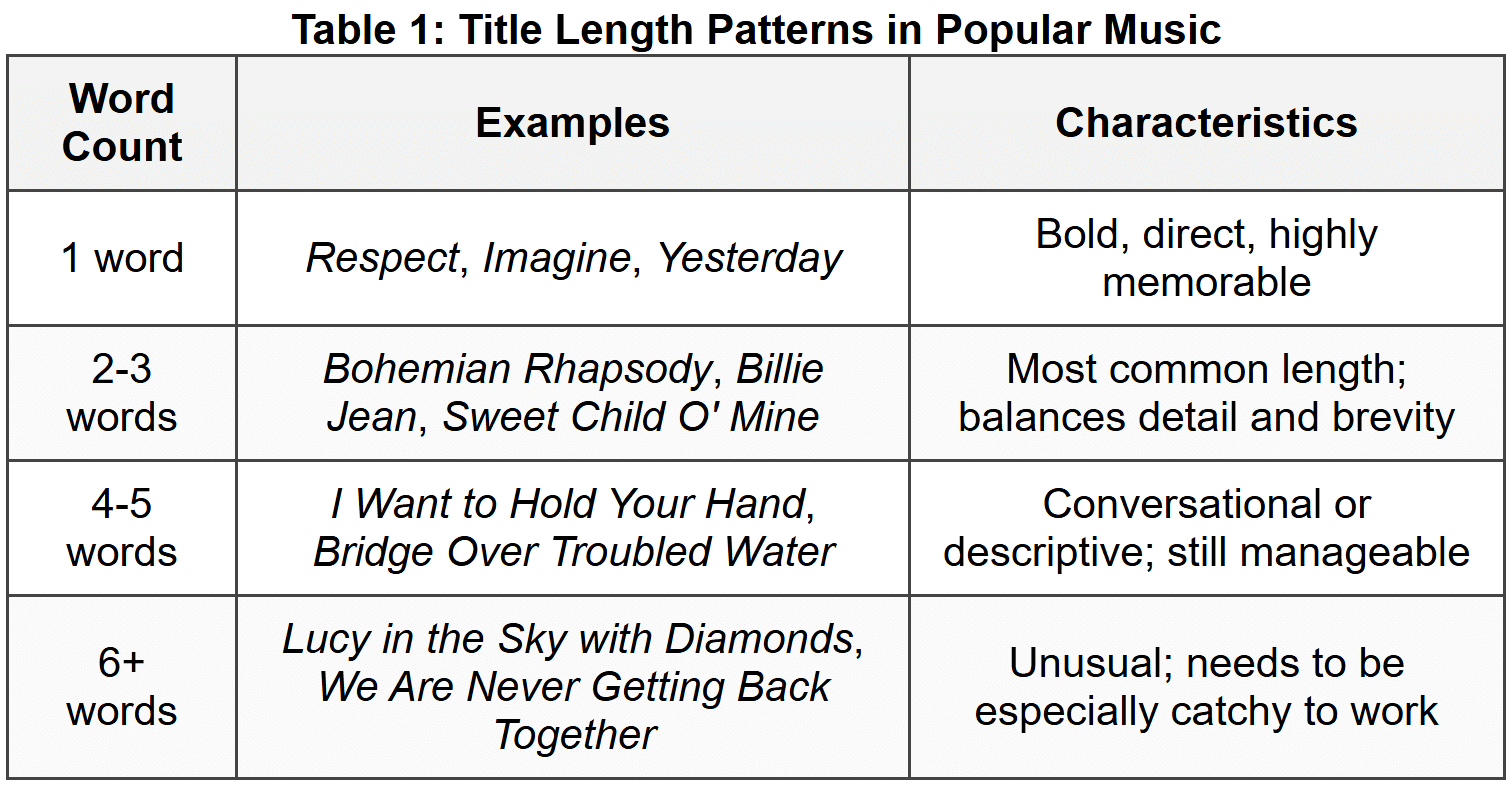
Most hit songs have titles between one and five words. Look through any year-end Top 40 chart and you'll see this pattern. Short titles are easier to remember, easier to say, and easier to search for online.
The Case for Shorter Titles
Shorter titles have several advantages:
- Easier to remember-listeners can recall and request them more easily
- Better for streaming-they display fully on small screens
- More impactful-brevity creates emphasis
- Faster recognition-people can identify them quickly in playlists
When Longer Titles Work
That said, longer titles can succeed when:
- They're the song's main hook and get repeated frequently
- They tell a mini-story or paint a vivid picture
- They're conversational and flow naturally
- They're so unusual they become memorable because of their length
If you're choosing between a longer phrase and a shorter excerpt from that phrase, ask yourself: which part carries the most emotional weight? Often you can trim "I Just Called to Say I Love You" down to something punchier-or you might find that the whole phrase is the point.
11. Avoiding Common Title Pitfalls
Now let's look at what not to do. Even experienced songwriters sometimes fall into these traps.
The Generic Title
Titles like "Love Song," "Heart," "Dream," or "Tonight" have been used hundreds of times. Unless you have a compelling reason to use a generic word-or you're subverting it somehow-choose something more distinctive.
Try this test: Search your proposed title in a streaming service. If dozens of other songs have the exact same title, ask yourself what will make yours stand out. Sometimes adding one more word changes everything: not just "Beautiful," but "Beautiful Disaster" or "Beautiful Day."
The Confusing Title
Some titles try so hard to be clever or poetic that they lose all meaning. If your title requires a lengthy explanation, it's probably not serving its purpose. The listener should get something from the title, even if they don't immediately understand everything.
Smells Like Teen Spirit is abstract, but it's evocative. "Amorphous Gestalt of Adolescent Ennui" would be confusing.
The Mismatched Title
Your title should reflect your song's actual content and tone. If you write an upbeat, danceable track and call it "Melancholy Tuesday," you're creating cognitive dissonance-and not the interesting kind.
Unless you're deliberately being ironic (like Randy Newman's Short People, which is satirical), your title should give the listener accurate expectations about what they're about to hear.
The Title That's Too Similar to Something Famous
Be aware of major songs that already exist. If you title your song Stairway to Hell or Billie Joe, listeners will immediately think of the famous songs and judge yours by comparison. That's a tough position to be in.
Do a quick search before you commit. It's fine to share a title with an obscure album track from 1973, but avoid titles of massive hits unless you're deliberately referencing them.
12. Testing and Refining Your Title
You've written your song and chosen a title. Before you consider it finished, let's test whether it's really working.
The Twenty-Four Hour Test
Write your title down and walk away for a full day. Come back to it fresh. Does it still excite you? Does it still fit? Sometimes titles that seem brilliant at midnight feel forced in daylight. Trust your instinct after some distance.
The Conversation Test
Imagine telling a friend about your new song. What would you naturally call it? If you find yourself saying, "Well, the title is X, but it's really about Y," that's a red flag. Your title should align with how you'd describe the song in conversation.
The Search Test
Type your title into a search engine or streaming service. Is it so generic that you'd be buried under hundreds of results? Is it so obscure that people couldn't spell it? Find the sweet spot where it's distinctive but accessible.
The Singalong Test
If your title appears in the song (and most should), sing it out loud. Does it feel natural in the melody? Does it have rhythmic interest? Some phrases look good on paper but feel awkward when sung. The title needs to work as music, not just words.
The Gut Test
Finally, trust your emotional response. When you say the title, does it give you a little thrill? Does it capture something essential about what you're trying to express? Your title should feel right-you'll know it when you've got it.
13. Genre Considerations
Different musical genres have different title conventions. Understanding these patterns helps you meet listener expectations-or deliberately break them for effect.
Pop Music
Pop titles tend to be short, catchy, and often come from the chorus hook. They're optimized for memorability and radio play. Think Shake It Off, Uptown Funk, Bad Guy. Pop rewards simplicity and immediate impact.
Country Music
Country titles often tell mini-stories or use conversational language. They might be longer and more specific: Before He Cheats by Carrie Underwood, Friends in Low Places by Garth Brooks. Country audiences appreciate titles that hint at narrative detail.
Rock Music
Rock titles span the full spectrum-from simple and direct (Back in Black) to abstract and poetic (Kashmir). Rock gives you more freedom to be unconventional or mysterious. Progressive rock especially embraces unusual titles like 2112 or Thick as a Brick.
Hip-Hop and R&B
These genres often use conversational titles, cultural references, or slang. Titles might include parenthetical additions like No Scrubs (TLC) or feature artist names. Contemporary R&B also uses mood-based titles: Climax, Crew, Boo'd Up.
Folk and Singer-Songwriter
Folk titles often come from the first line of the song or describe a character or place. They can be longer and more literary: The Times They Are A-Changin', The Sound of Silence. This genre rewards thoughtful, poetic titles that reflect the lyrical depth of the song.
Understanding these patterns doesn't mean you must follow them-but knowing the conventions of your genre helps you make informed choices about when to align with expectations and when to surprise your audience.
14. Practical Exercise: Finding Your Title
Let's put all this into practice. Here's a step-by-step process to find or refine the title for a song you're working on.
Step 1: List Your Options
Write down at least five possible titles. Include:
- The most repeated phrase in your song
- A character name (if applicable)
- The emotional core in one or two words
- The main image or metaphor
- A line you haven't used yet but that describes the song
Step 2: Evaluate Each One
For each potential title, ask:
- Is it memorable?
- Does it capture the song's emotional essence?
- Is it the right length (not too short, not too long)?
- Does it sound good when you say it out loud?
- Does it work within your genre's conventions (or break them intentionally)?
- Would it look good in a playlist?
Step 3: Test the Top Contenders
Narrow down to your top two or three choices. For each one:
- Sing it with your melody (if it appears in the song)
- Search for it online to check for conflicts
- Imagine it as a single cover or playlist entry
- Say it to an imaginary friend: "I just wrote a song called..."
Step 4: Make Your Choice
Trust your gut. The title that keeps coming back to you, the one that feels most natural when you talk about your song-that's probably the right one.
Remember: you can always change a title, especially before releasing the song. But once it's out in the world, your title becomes permanent. Give it the attention it deserves.
Key Terms
- Hook
- The most memorable and repeated musical or lyrical phrase in a song, often used as the title. The hook is designed to catch the listener's attention and remain in their memory.
- Hook-as-title approach
- A songwriting strategy where the main hook phrase becomes the song's title, creating strong reinforcement between what listeners hear repeatedly and what the song is called.
- Character name title
- A title that uses a person's name (real or fictional) to signal that the song tells a story or focuses on a specific individual, such as Billie Jean or Eleanor Rigby.
- Question title
- A title phrased as a question, which creates curiosity and engagement by prompting the listener to seek an answer, such as What's Going On or How Will I Know.
- Conversational title
- A title that uses natural, everyday language as if spoken in real conversation, making the song feel intimate and relatable, such as I Want to Hold Your Hand.
- Abstract title
- A title that uses poetic, metaphorical, or non-literal language to create mood and atmosphere rather than direct description, such as Karma Police or Black Hole Sun.
- Single-word title
- A title consisting of just one word that carries significant emotional or conceptual weight, such as Respect, Imagine, or Yesterday.
- Phrase title
- A title that uses a distinctive phrase-often containing imagery or figurative language-to capture the essence of the song, such as Bridge Over Troubled Water or Purple Haze.
- Genre conventions
- The typical patterns and expectations for song titles within a specific musical genre, such as story-driven titles in country music or short, catchy titles in pop music.
- Memorability
- The quality of being easily remembered and recalled; a crucial characteristic of effective song titles that helps listeners find, request, and share songs.