Assignment : Verbal Communication Excellence


Verbal communication refers to the exchange of information, ideas, and emotions through spoken words. In business contexts, verbal communication excellence means delivering messages clearly, persuasively, and appropriately to achieve professional objectives. Mastering verbal communication enhances workplace relationships, improves meeting effectiveness, strengthens presentations, and builds credibility with colleagues, clients, and stakeholders.
1. Fundamentals of Verbal Communication
Verbal communication involves two key dimensions: what you say (content) and how you say it (delivery). Both elements work together to create meaning and impact.
1.1 Core Components
- Words and Language: The specific vocabulary, terminology, and phrases chosen to convey your message accurately and appropriately.
- Tone: The emotional quality or attitude expressed through your voice, which conveys feelings like confidence, concern, or enthusiasm.
- Pitch: The highness or lowness of your voice; varying pitch prevents monotony and emphasizes important points.
- Volume: The loudness or softness of speech; appropriate volume ensures audibility without overwhelming listeners.
- Pace: The speed at which you speak; moderate pace allows comprehension while too fast causes confusion and too slow loses attention.
- Clarity: Pronouncing words distinctly and articulating sounds properly so listeners understand each word easily.
- Pauses: Strategic silence between words or sentences that allows processing time and creates emphasis.
1.2 Types of Verbal Communication in Business
- Intrapersonal Communication: Internal dialogue or self-talk that helps organize thoughts before speaking externally.
- Interpersonal Communication: Direct one-on-one or small group conversations between two or more people.
- Public Speaking: Formal presentations, speeches, or addresses delivered to larger audiences.
- Group Communication: Discussions, meetings, brainstorming sessions involving multiple participants with shared objectives.
2. Principles of Effective Verbal Communication
These foundational principles guide professional verbal exchanges and ensure messages achieve their intended purpose.
2.1 The 7 Cs of Communication
- Clarity: Messages should be clear and easily understood. Avoid ambiguous words or vague statements. Use precise language that leaves no room for misinterpretation.
- Conciseness: Express ideas briefly using minimum words without sacrificing completeness. Eliminate redundancy, filler words, and unnecessary details.
- Concreteness: Use specific facts, figures, and examples rather than abstract generalizations. Concrete communication builds credibility and understanding.
- Correctness: Ensure grammatical accuracy, proper pronunciation, and factual precision. Errors undermine credibility and professionalism.
- Coherence: Ideas should flow logically with clear connections between points. Each statement should relate to the overall message theme.
- Completeness: Provide all necessary information the audience needs to understand and act. Answer potential questions preemptively.
- Courtesy: Maintain respectful, polite, and considerate language. Acknowledge others' perspectives and avoid offensive or dismissive tones.
2.2 Audience-Centric Approach
- Audience Analysis: Understand listeners' knowledge level, interests, expectations, and cultural backgrounds before communicating.
- Language Adaptation: Adjust vocabulary, technical jargon, and complexity to match audience comprehension levels.
- Purpose Alignment: Frame messages to address audience needs, concerns, or interests rather than solely focusing on your perspective.
- Context Awareness: Consider the situation, timing, and environment when choosing verbal communication style and content.
3. Voice Modulation and Paralinguistics
How you say something often matters as much as what you say. Voice characteristics and vocal variety significantly impact message reception and listener engagement.
3.1 Voice Quality Elements
- Pitch Variation: Varying vocal pitch prevents monotone delivery. Rising pitch can indicate questions or enthusiasm; falling pitch conveys finality or seriousness.
- Volume Control: Adjust loudness based on room size, audience distance, and emphasis needs. Increase volume for key points; decrease for confidential or sensitive information.
- Speed Regulation: Optimal speaking speed ranges between 140-160 words per minute for comprehension. Slow down for complex information; maintain steady pace for narratives.
- Emphasis and Stress: Highlight important words by increasing volume, changing pitch, or slowing pace to draw attention to critical concepts.
- Rhythm and Cadence: Natural flow patterns in speech that create pleasing auditory experiences and maintain listener interest.
3.2 Strategic Use of Pauses
- Processing Pauses: Brief silence after presenting complex information allows audience members to absorb and understand content.
- Emphasis Pauses: Stopping before or after important points creates anticipation and highlights significance.
- Transitional Pauses: Silence between topics or sections signals shift in discussion and helps organize information mentally.
- Dramatic Pauses: Intentional silence to create suspense, emotional impact, or encourage reflection during presentations.
3.3 Articulation and Pronunciation
- Clear Enunciation: Pronounce each syllable distinctly, especially word endings. Avoid mumbling or slurring sounds together.
- Correct Pronunciation: Learn proper pronunciation of technical terms, names, and commonly mispronounced words to maintain credibility.
- Accent Neutralization: While regional accents are natural, ensure they don't hinder comprehension in diverse professional settings.
- Avoiding Fillers: Eliminate verbal crutches like "um," "ah," "like," "you know" that distract listeners and reduce professionalism.
4. Listening as Foundation of Verbal Excellence
Effective verbal communication requires exceptional listening skills. Speaking and listening form an inseparable dyad in professional interactions.
4.1 Types of Listening
- Active Listening: Fully concentrating on speaker's words, understanding their message, and providing appropriate responses. Shows engagement through verbal acknowledgments.
- Empathetic Listening: Understanding speaker's emotions, perspective, and feelings beyond literal words. Demonstrates genuine care and builds trust.
- Critical Listening: Analyzing and evaluating information, identifying logic, assessing evidence, and questioning assumptions before accepting messages.
- Appreciative Listening: Engaging with content for enjoyment, inspiration, or motivation while respecting speaker's presentation style.
4.2 Active Listening Techniques
- Maintain Eye Contact: Shows attention and interest; avoid staring but maintain comfortable visual connection with speaker.
- Provide Verbal Acknowledgments: Use brief responses like "I see," "I understand," "Yes," to signal engagement without interrupting.
- Ask Clarifying Questions: Seek explanation when unclear rather than making assumptions. Use questions like "Could you elaborate on..." or "Do you mean..."
- Paraphrase and Summarize: Restate speaker's points in your own words to confirm understanding and show attentiveness.
- Avoid Interruptions: Let speakers complete thoughts before responding. Interrupting signals disrespect and causes miscommunication.
- Manage Internal Distractions: Focus on speaker rather than formulating responses while they're still talking. Resist mental wandering or prejudgment.
- Observe Non-verbal Cues: Pay attention to speaker's body language, facial expressions, and gestures that complement or contradict words.
4.3 Barriers to Effective Listening
- Preoccupation: Mental distractions, personal concerns, or multitasking prevent full attention to speaker's message.
- Prejudgment: Forming opinions or responses before hearing complete message based on biases or assumptions.
- Emotional Reactions: Strong feelings triggered by certain words or topics that block objective reception of information.
- Environmental Noise: Physical distractions like sounds, temperature, or visual interruptions that interfere with concentration.
- Selective Listening: Hearing only parts that interest you while ignoring other important information.
5. Conversation Management Skills
Professional conversations require strategic management to achieve objectives while maintaining positive relationships.
5.1 Initiating Conversations
- Opening Statements: Begin with appropriate greetings, introductions, or context-setting remarks that establish rapport and purpose.
- Ice-Breakers: Use neutral, positive topics or shared experiences to create comfortable atmosphere before addressing main subjects.
- Purpose Declaration: Clearly state conversation objectives early, especially in formal business settings, to align expectations.
- Attention-Getters: Use relevant questions, interesting facts, or brief anecdotes to engage listener interest immediately.
5.2 Maintaining Conversation Flow
- Turn-Taking: Balance speaking and listening time. Allow others to contribute without dominating or monopolizing discussions.
- Topic Transitions: Move between subjects smoothly using linking phrases like "Speaking of which," "That reminds me," or "On a related note."
- Probing Questions: Use open-ended questions (What, How, Why) to encourage detailed responses and deeper exploration of topics.
- Feedback Loops: Regularly check understanding through phrases like "Does that make sense?" or "What are your thoughts on this?"
- Energy Management: Vary tone, pace, and engagement level to maintain interest throughout extended conversations.
5.3 Concluding Conversations Effectively
- Summary Statements: Recap key points, decisions, or action items before ending to ensure shared understanding.
- Future Planning: Establish next steps, follow-up actions, or subsequent meeting times when appropriate.
- Polite Closings: Use courteous phrases like "Thank you for your time," "I appreciate your insights," to end positively.
- Exit Strategies: Gracefully end conversations without abruptness using transitional phrases that signal conclusion naturally.
6. Business-Specific Verbal Communication Contexts
Different professional situations demand tailored verbal communication approaches and strategies.
6.1 Meetings and Discussions
- Preparation: Review agenda, anticipate discussion points, and organize thoughts before speaking in meetings.
- Concise Contributions: Present ideas briefly and directly. Respect others' time by avoiding long-winded explanations.
- Evidence-Based Arguments: Support opinions with data, examples, or logical reasoning rather than making unsupported claims.
- Constructive Disagreement: Express differing views respectfully using phrases like "I see it differently because..." or "Have we considered..."
- Meeting Etiquette: Wait for appropriate moments to speak, avoid side conversations, and stay on topic throughout discussions.
6.2 Presentations and Public Speaking
- Opening Impact: Start with attention-grabbing hook, clear objective statement, and preview of main points to engage audience immediately.
- Structured Content: Organize information into clear introduction, body with 3-5 main points, and memorable conclusion.
- Audience Engagement: Use rhetorical questions, interactive elements, or direct address to maintain involvement throughout presentation.
- Visual Support: Coordinate verbal explanation with visual aids, ensuring spoken words complement rather than repeat slide content.
- Handling Questions: Listen fully to questions, clarify if needed, answer directly, and admit when you don't know rather than fabricating responses.
- Confident Delivery: Stand tall, project voice, maintain eye contact, and display enthusiasm for subject to enhance credibility.
6.3 Telephone and Video Communication
- Professional Greetings: Answer calls with company name, your name, and helpful greeting like "How may I assist you?"
- Voice Clarity: Speak directly into phone/microphone, enunciate carefully since non-verbal cues are limited or absent.
- Active Confirmation: Verify understanding frequently since you cannot observe listener's non-verbal feedback easily.
- Message Documentation: Take notes during calls and confirm action items verbally before ending conversations.
- Video Etiquette: Dress professionally, check background, ensure proper lighting, and minimize distractions during video calls.
- Technical Preparation: Test equipment beforehand, use mute when not speaking in group calls, and have backup communication method ready.
6.4 Difficult Conversations
- Preparation and Timing: Choose appropriate time and private location. Plan key points but remain flexible during discussion.
- Objective Language: Focus on specific behaviors or situations rather than personal attacks or character judgments.
- I-Statements: Express concerns using "I feel..." or "I observed..." rather than accusatory "You always..." statements.
- Emotional Control: Maintain calm tone even when discussing sensitive topics. Pause if emotions escalate to regain composure.
- Solution Focus: Emphasize finding resolutions rather than dwelling on problems or assigning blame.
- Empathy Expression: Acknowledge other person's perspective and feelings even when disagreeing with their position.
7. Persuasive Verbal Communication
Persuasion involves influencing others' attitudes, beliefs, or behaviors through strategic verbal communication techniques.
7.1 Persuasion Principles
- Ethos (Credibility): Establish trustworthiness through expertise, reliability, and ethical character. Cite qualifications, experience, or authoritative sources.
- Pathos (Emotional Appeal): Connect with audience emotions through stories, vivid language, or examples that resonate personally.
- Logos (Logical Appeal): Present rational arguments supported by facts, statistics, logical reasoning, and cause-effect relationships.
- Reciprocity: Offer value, concessions, or benefits first to create obligation and willingness to respond favorably.
- Social Proof: Reference what others (especially similar people or respected figures) have done to validate your position.
- Scarcity: Emphasize limited availability, time sensitivity, or unique opportunities to increase perceived value and urgency.
7.2 Persuasive Language Techniques
- Power Words: Use impactful vocabulary like "proven," "guaranteed," "exclusive," "transform" that trigger positive responses and action.
- Benefit-Focused Language: Frame messages around "you" and advantages to listener rather than self-centered "we" or "I" statements.
- Storytelling: Illustrate points through compelling narratives that make abstract concepts concrete and memorable.
- Analogies and Metaphors: Explain complex ideas by comparing them to familiar concepts that audience already understands.
- Rule of Three: Present information in groups of three (points, examples, benefits) for maximum impact and memorability.
- Contrast and Comparison: Highlight advantages by comparing your proposal against alternatives or showing before-after scenarios.
7.3 Handling Objections
- Acknowledge Concerns: Validate objections rather than dismissing them. Show you've heard and understood reservations.
- Clarify Objections: Ask questions to understand root cause of resistance before attempting to address it.
- Provide Evidence: Counter objections with specific facts, testimonials, case studies, or demonstrations that resolve concerns.
- Reframe Perspective: Present objections from different angle that transforms perceived disadvantages into neutral or positive points.
- Offer Alternatives: When direct objection cannot be overcome, suggest modified approaches that address core concerns.
8. Assertive Communication
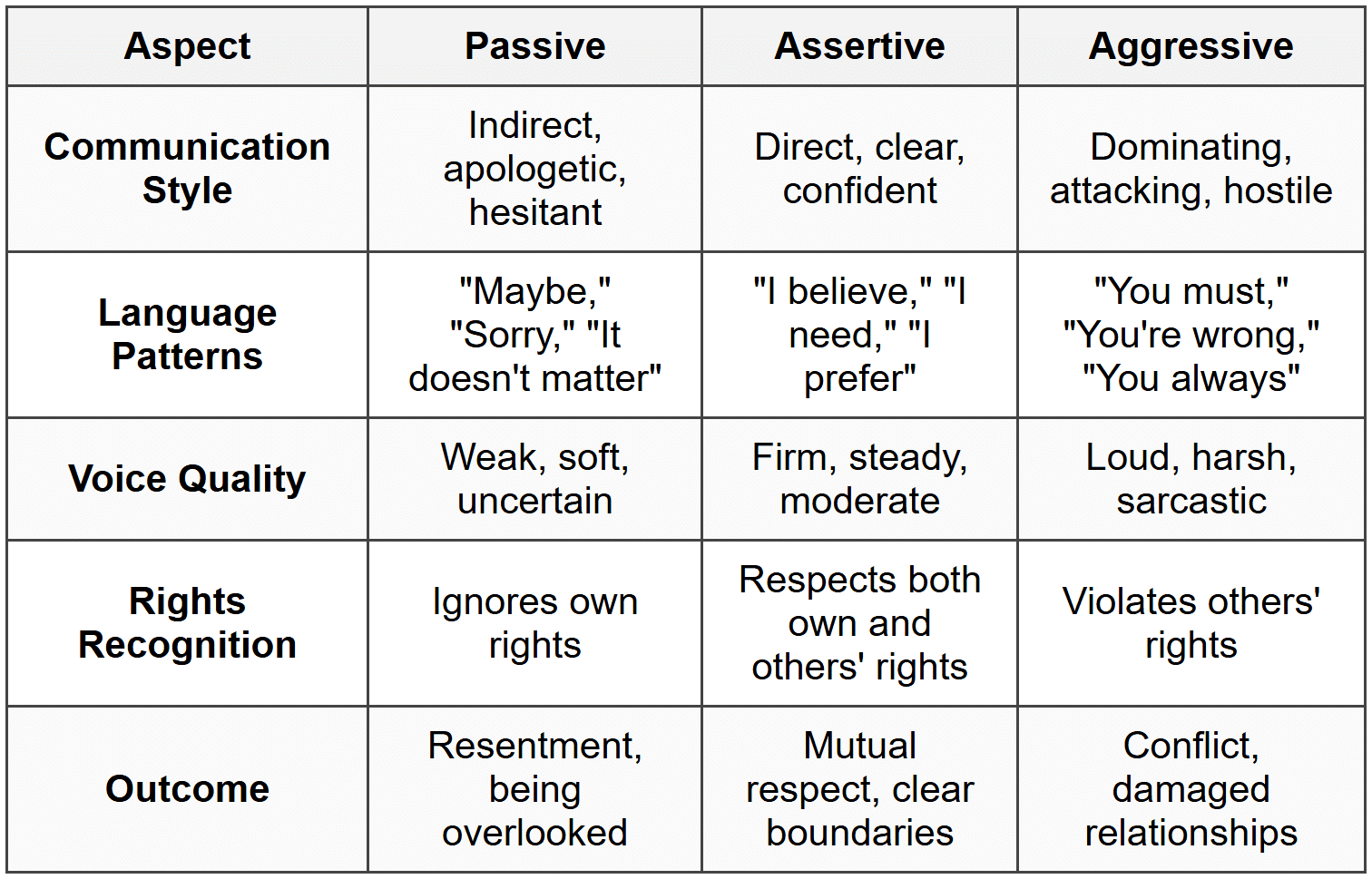
Assertiveness means expressing thoughts, feelings, and needs directly, honestly, and respectfully while respecting others' rights.
8.1 Assertive vs. Aggressive vs. Passive
8.2 Assertive Language Techniques
- I-Statements: Own your feelings and opinions using "I think," "I feel," "I would like" rather than blaming others.
- Clear Requests: State needs directly and specifically instead of expecting others to guess or hint indirectly.
- Boundary Setting: Say "no" when necessary using firm but polite language like "I'm unable to commit to that."
- Factual Descriptions: Describe situations objectively without exaggeration, judgment, or emotional loading.
- Broken Record Technique: Calmly repeat your position consistently when facing persistent pressure without becoming argumentative.
- Fogging: Acknowledge truth in criticism without accepting unwarranted blame or becoming defensive.
8.3 Rights and Responsibilities
- Right to Express Opinions: You may state views even when others disagree, but must respect differing perspectives.
- Right to Say No: You can decline requests without guilt, but should provide brief, honest reason when appropriate.
- Right to Make Mistakes: Errors are acceptable as learning opportunities, but require acknowledgment and correction efforts.
- Right to Change Mind: You may revise positions based on new information without being labeled inconsistent or unreliable.
- Responsibility for Impact: While expressing yourself honestly, consider how words affect others and communicate respectfully.
9. Cross-Cultural Verbal Communication
Global business requires adapting verbal communication to respect diverse cultural norms, values, and communication styles.
9.1 Cultural Dimensions Affecting Communication
- High-Context vs. Low-Context: High-context cultures (Asian, Middle Eastern) rely on implicit meaning and shared understanding; low-context cultures (Western) prefer explicit, direct verbal messages.
- Direct vs. Indirect: Direct cultures value straightforward expression; indirect cultures use subtle language to maintain harmony and avoid confrontation.
- Formal vs. Informal: Some cultures emphasize titles, honorifics, and formal address; others prefer casual, first-name interactions even professionally.
- Silence Interpretation: Western cultures often view silence as awkward; Eastern cultures see it as thoughtful, respectful, or contemplative.
- Emotional Expression: Expressive cultures encourage showing feelings verbally; reserved cultures value emotional restraint and control in professional settings.
9.2 Adapting Verbal Communication
- Language Simplification: Use clear, simple vocabulary when communicating with non-native speakers. Avoid idioms, slang, or culturally-specific references.
- Speed Adjustment: Speak slower and pause more frequently to allow comprehension and mental translation time.
- Verification Practices: Check understanding regularly without being condescending. Encourage questions and clarification requests.
- Honorific Usage: Learn and use appropriate titles, forms of address, and respect markers valued in specific cultures.
- Listening Patience: Allow extra time for responses. Silence may indicate thought processing rather than agreement or confusion.
- Cultural Research: Study communication norms, taboo topics, and valued conversation styles before engaging with unfamiliar cultures.
10. Common Mistakes and Trap Alerts
Awareness of frequent verbal communication errors helps avoid undermining professional effectiveness.
10.1 Student Confusion Points
- Trap: Believing communication is only about speaking. Reality: Listening constitutes minimum 50% of effective verbal communication; speaking excellence without listening fails.
- Trap: Assuming assertiveness equals aggression. Reality: Assertive communication respects both parties; aggressive communication violates others' rights and damages relationships.
- Trap: Thinking formal language always equals professionalism. Reality: Context determines appropriateness; overly formal language can create distance when warmth is needed.
- Trap: Focusing solely on content while ignoring delivery. Reality: Voice tone, pace, and modulation significantly impact message reception and persuasiveness.
- Trap: Using complex vocabulary to appear intelligent. Reality: Clarity through simple language demonstrates stronger communication competence than unnecessary jargon.
10.2 Frequently Made Errors
- Overusing Filler Words: Excessive "um," "like," "basically," "actually" reduces credibility and distracts listeners from core message.
- Interrupting Speakers: Cutting others off signals disrespect and prevents understanding their complete thoughts before responding.
- Monotone Delivery: Lack of vocal variety causes listener disengagement regardless of content quality or importance.
- Failing to Pause: Speaking without strategic pauses prevents audience processing and creates impression of nervousness or lack of confidence.
- Ignoring Audience Feedback: Not adjusting based on listener confusion signals, questions, or non-verbal cues leads to communication failure.
- Over-explaining: Providing excessive detail when brief response suffices wastes time and loses listener attention.
- Under-preparing: Attempting important conversations without organizing thoughts results in rambling, incomplete, or confusing messages.
10.3 Language Pitfalls to Avoid
- Absolute Language: Words like "always," "never," "everyone," "nobody" create defensiveness and are factually inaccurate in most situations.
- Ambiguous Pronouns: Using "it," "they," "this" without clear antecedents causes confusion about reference points.
- Negative Framing: Focusing on what cannot be done rather than available alternatives or solutions.
- Jargon Overload: Using technical terminology or acronyms without explanation when audience lacks specialized knowledge.
- Weak Qualifiers: Excessive use of "kind of," "sort of," "maybe," "I think" undermines authority and confidence in message.
11. Developing Verbal Communication Excellence
Continuous improvement through deliberate practice and feedback transforms adequate verbal skills into professional excellence.
11.1 Self-Assessment Strategies
- Recording Analysis: Audio or video record presentations and conversations to identify voice quality issues, filler words, and delivery patterns.
- Feedback Collection: Actively seek specific input from trusted colleagues about strengths and improvement areas in your verbal communication.
- Reflection Practice: After important conversations or presentations, analyze what worked well and what could improve for future interactions.
- Metrics Tracking: Monitor measurable indicators like meeting participation frequency, persuasion success rates, or presentation evaluations over time.
11.2 Practice Techniques
- Daily Conversation Mindfulness: Consciously apply techniques during routine interactions to build habits before high-stakes situations.
- Mock Presentations: Rehearse important communications with colleagues who provide constructive criticism before actual delivery.
- Voice Exercises: Practice breathing techniques, vocal warm-ups, tongue twisters, and pitch variation to improve voice control.
- Reading Aloud: Read articles, books, or speeches verbally to develop fluency, pacing, and expressive delivery skills.
- Join Speaking Groups: Participate in organizations like Toastmasters or professional speaking clubs for structured practice and expert feedback.
- Observe Excellence: Study effective communicators in your field, noting specific techniques they use and adapting them to your style.
11.3 Continuous Learning Resources
- Communication Workshops: Attend training sessions on specific skills like presentation delivery, difficult conversations, or persuasive speaking.
- Professional Coaching: Work with communication coaches for personalized guidance on individual improvement areas and advanced techniques.
- Literature Study: Read books on rhetoric, persuasion, conversation skills, and verbal communication strategies by recognized experts.
- Skill Integration: Connect verbal communication learning with emotional intelligence, cultural awareness, and leadership development for comprehensive growth.
Verbal communication excellence is not an innate talent but a developable skill requiring conscious practice, continuous feedback, and persistent improvement. Mastering the elements of effective speaking, strategic listening, audience adaptation, and contextual appropriateness creates professional advantage in all business interactions. Success depends on integrating technical communication principles with authentic expression of ideas, building genuine connections with diverse audiences, and maintaining commitment to lifelong learning in this foundational professional competency.