Practice Questions :Cognition

SECTION I: MULTIPLE CHOICE
Directions
Each of the questions or incomplete statements below is followed by four suggested answers or completions. Select the one that is best in each case and then record your choice on the answer sheet provided.
Questions 1-3 refer to the following research scenario:
Dr. Martinez conducted a study on working memory capacity. Participants were shown sequences of letters (e.g., K-R-T-M-P) for 2 seconds, then asked to recall them in order after a 10-second delay filled with a distractor task (counting backward by threes). The number of letters in each sequence varied from 3 to 9. Each participant completed 20 trials. The researcher measured the average number of letters correctly recalled in sequence.
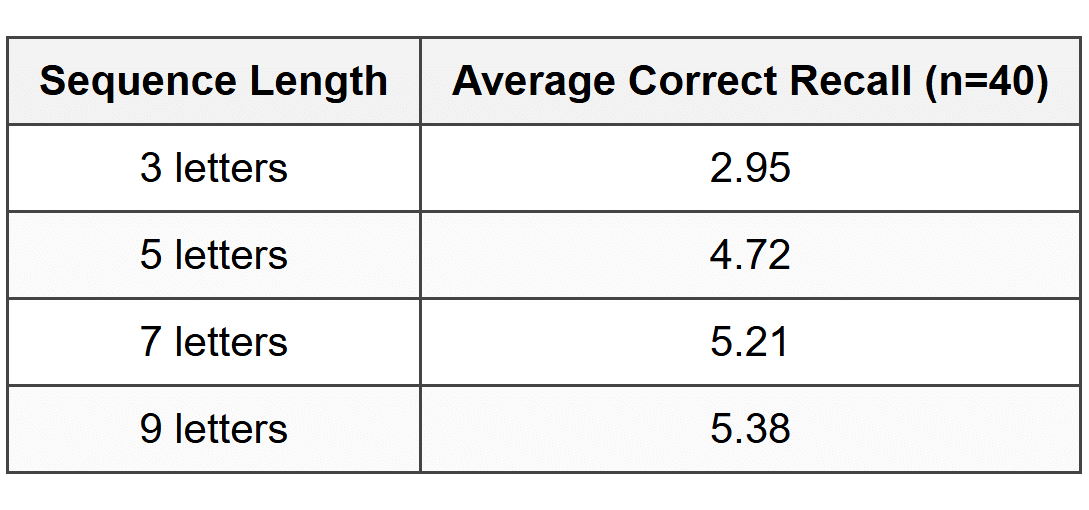
1. The data from Dr. Martinez's study most directly support which conclusion about working memory?
- Working memory capacity is unlimited when participants are given adequate encoding time
- Working memory has a limited capacity that plateaus around 5-7 items regardless of the length of the original sequence
- The distractor task eliminated participants' ability to use long-term memory for the letter sequences
- Counting backward by threes enhances working memory performance through dual-task training
2. The distractor task (counting backward by threes) in Dr. Martinez's study primarily served to prevent which memory process?
- Encoding the letters into sensory memory
- Rehearsing the letters in the phonological loop to maintain them in working memory
- Consolidating the letters from short-term memory into long-term memory
- Retrieving previously learned letter sequences from episodic memory
3. According to Baddeley's model of working memory, the component most directly involved in maintaining the letter sequences in Dr. Martinez's study is the
- central executive, which allocates attention between the letters and the counting task
- phonological loop, which temporarily stores verbal and acoustic information
- visuospatial sketchpad, which maintains visual images of the letter shapes
- episodic buffer, which integrates information from multiple sources into coherent sequences
Questions 4-5 refer to the following research scenario:
A cognitive psychologist studied the effects of sleep on memory consolidation. Participants studied a list of 50 word pairs (e.g., TABLE-FOREST) at 9:00 PM. Half of the participants (Group A) were tested on recall at 9:00 AM the next morning after a full night's sleep. The other half (Group B) stayed awake overnight and were tested at 9:00 AM after 12 hours of wakefulness. Both groups had the same 12-hour retention interval.
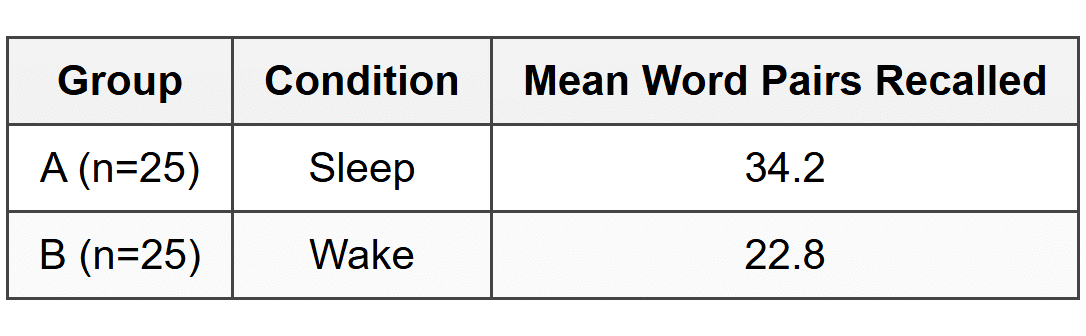
4. The independent variable in this study is
- the number of word pairs recalled at 9:00 AM
- whether participants slept or remained awake during the retention interval
- the 12-hour time interval between studying and testing
- the total of 50 word pairs that participants studied
5. The results of this study provide the strongest support for which explanation of forgetting?
- Encoding failure: Group B did not adequately encode the word pairs because they were anticipating sleep deprivation
- Interference: Group B experienced more interference from ongoing mental activity during wakefulness that disrupted the word pair memories
- Motivated forgetting: Group B unconsciously repressed the word pairs due to the stress of sleep deprivation
- Decay: The word pair memories in both groups weakened automatically over the 12-hour interval due to the passage of time alone
6. A person who experiences damage to Broca's area would most likely demonstrate which pattern of language impairment?
- Fluent speech with normal grammar but great difficulty understanding spoken language
- Inability to recognize previously familiar faces but intact ability to produce and comprehend speech
- Difficulty producing speech with labored, telegraphic output but relatively intact comprehension
- Complete loss of both speech production and comprehension with no ability to process any linguistic information
Questions 7-8 refer to the following research scenario:
Researchers investigated confirmation bias in reasoning. Participants were given the following rule: "If a card has a vowel on one side, then it has an even number on the other side." They were then shown four cards displaying: E, K, 4, and 7. Participants were asked which card(s) must be turned over to determine whether the rule is being followed.
The logically correct answer is to turn over E (to verify it has an even number) and 7 (to verify it does not have a vowel). However, 89% of participants selected E and 4, while only 4% selected the logically correct combination.
7. The tendency for most participants to select the "4" card demonstrates
- confirmation bias, because participants sought evidence that confirmed the rule rather than evidence that could falsify it
- functional fixedness, because participants were unable to see the cards as serving multiple purposes
- the representativeness heuristic, because participants judged the "4" card as representative of even numbers
- mental set, because participants approached the problem using a previously learned solution strategy
8. The failure to select the "7" card most clearly illustrates a breakdown in which type of reasoning?
- Inductive reasoning, because participants did not generate a general rule from specific instances
- Deductive reasoning, because participants failed to recognize that an odd number with a vowel would violate the conditional rule
- Divergent thinking, because participants did not generate multiple possible solutions
- Heuristic reasoning, because participants relied too heavily on mental shortcuts rather than systematic analysis
9. A student studies vocabulary words for a French exam by creating vivid mental images linking each French word to an English word that sounds similar. This memory strategy is best identified as
- the method of loci
- the keyword method
- maintenance rehearsal
- the spacing effect
Questions 10-11 refer to the following scenario:
Emma is trying to remember her friend's new phone number: 5-5-5-2-7-1-8. She repeats it to herself as "555" (the area code prefix she's familiar with), "27" (her age), and "18" (her brother's age). When tested 30 minutes later, she successfully recalls the entire number.
10. Emma's strategy of grouping the phone number into meaningful units demonstrates the memory process called
- chunking
- priming
- automatic processing
- echoic memory
11. The fact that Emma connected the digits to personally meaningful information (her age and her brother's age) is most likely to enhance memory through
- shallow processing focused on the physical features of the numbers
- deep processing that creates semantic connections and elaborative encoding
- state-dependent memory that links recall to her current emotional state
- implicit memory that operates without conscious awareness
12. A researcher presents participants with a list of words including "bed," "rest," "awake," "tired," "dream," and "snooze." Later, many participants falsely recall that the word "sleep" was on the original list. This phenomenon is best explained by
- the serial position effect, in which words at the beginning and end of lists are recalled better than middle items
- source amnesia, in which participants remember the information but forget where they learned it
- the misinformation effect, in which exposure to misleading information after an event distorts memory
- schema-driven memory reconstruction, in which participants create false memories based on semantic associations and expectations
Questions 13-14 refer to the following research data:
A cognitive neuroscientist used fMRI to measure brain activity while participants performed different language tasks. The data show relative activation levels in two brain regions:
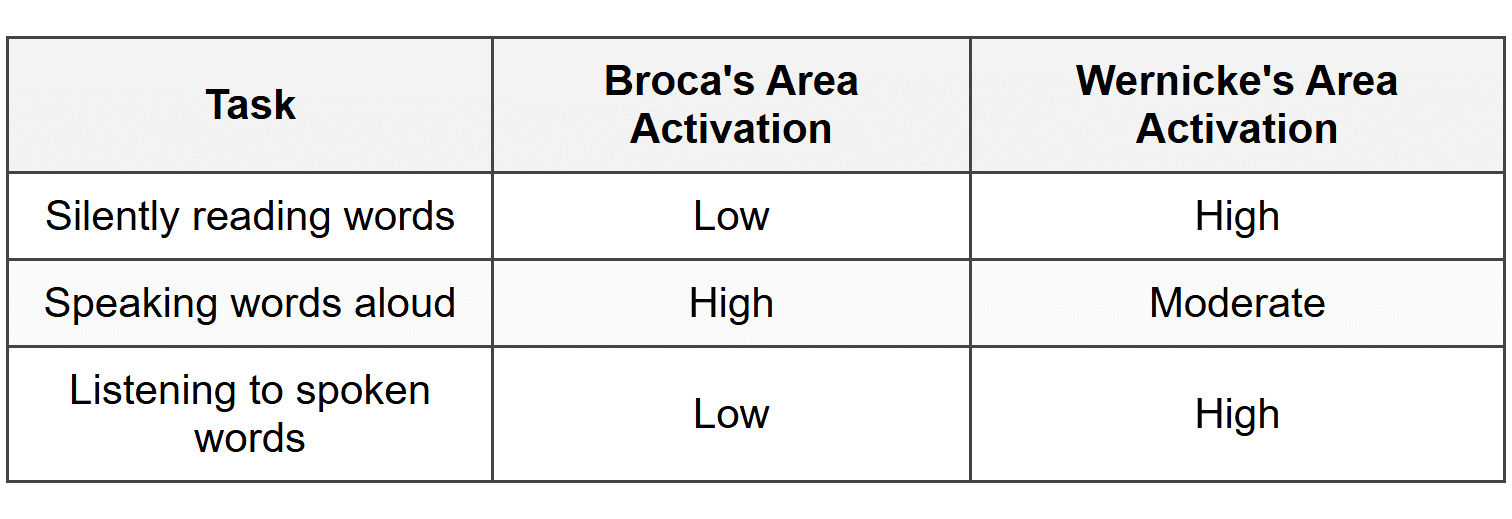
13. Based on these data, which conclusion about the functional specialization of these brain areas is most justified?
- Broca's area is primarily involved in language comprehension while Wernicke's area controls speech production
- Broca's area is primarily involved in speech production while Wernicke's area is more involved in language comprehension
- Both areas are equally involved in all aspects of language processing with no functional differentiation
- Wernicke's area only processes auditory information while Broca's area only processes visual information
14. The pattern of activation during the "speaking words aloud" task, which shows high Broca's area activation and moderate Wernicke's area activation, suggests that
- speech production requires only motor planning without any comprehension component
- speech production involves primarily motor execution (Broca's area) but also requires some comprehension and monitoring (Wernicke's area)
- the participant was simultaneously listening to someone else speak while producing their own speech
- damage to either area would have identical effects on speech production abilities
15. A chess master can recall the positions of all pieces on a chessboard after viewing it for only 5 seconds, but only when the pieces are arranged in legal game positions. When pieces are randomly arranged, the chess master's recall is no better than a beginner's. This finding best demonstrates the role of
- eidetic imagery in creating photographic memories
- schemas and expertise in organizing information into meaningful chunks
- the spacing effect in distributing practice over time
- flashbulb memory in encoding emotionally significant events
Questions 16-17 refer to the following scenario:
Dr. Chen conducted a study on problem-solving. Participants were given this problem: "A man has a tumor that cannot be operated on. A special ray can destroy the tumor, but at high intensity the ray will also destroy healthy tissue. At low intensity, the ray is harmless to healthy tissue but will not affect the tumor. How can the ray be used to destroy the tumor without harming healthy tissue?"
Before attempting this problem, half the participants read a story about a general who needed to capture a fortress. The general divided his army into small groups that approached the fortress simultaneously from different roads, converging at the fortress. The other half of participants read an unrelated story.
Results: 72% of participants who read the general story solved the tumor problem (using multiple low-intensity rays from different angles converging on the tumor), compared to 18% of participants who read the unrelated story.
16. The difficulty that participants in the control group had in solving the tumor problem most likely resulted from
- functional fixedness preventing them from seeing the rays in a new way
- confirmation bias causing them to seek only evidence supporting high-intensity rays
- the representativeness heuristic leading them to misjudge the probability of success
- lack of analogical transfer because they did not spontaneously recognize the structural similarity to a known solution
17. The improved performance of participants who read the general story demonstrates that problem-solving can be enhanced by
- providing a surface-level hint that directly mentions the solution method
- presenting an analogous problem with similar structural features that can be mapped onto the target problem
- reducing cognitive load by eliminating irrelevant information from working memory
- activating the availability heuristic to make the correct solution more mentally accessible
18. A person who has suffered damage to the hippocampus would be most likely to experience difficulty with
- recalling childhood memories that were formed many years before the injury
- forming new explicit long-term memories after the injury
- performing previously learned motor skills such as riding a bicycle
- maintaining information in working memory for a few seconds
Questions 19-20 refer to the following research scenario:
Researchers examined context-dependent memory. Scuba divers studied a list of 40 words either on land or underwater (10 feet below the surface). Half of each group was tested on land; the other half was tested underwater. Testing occurred 4 hours after initial study.
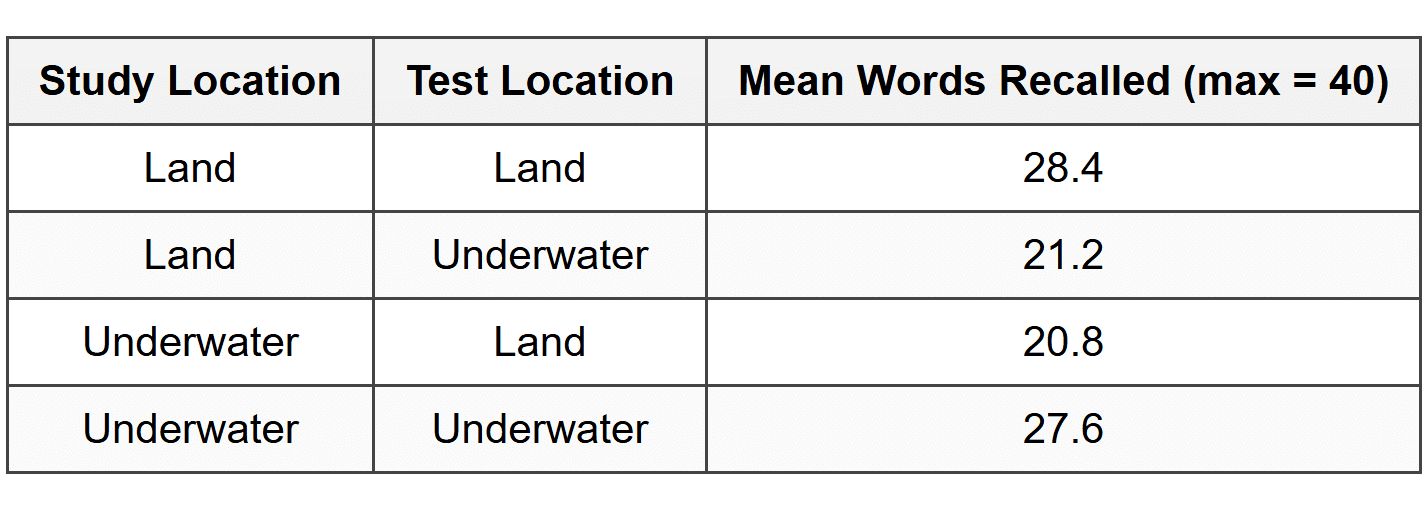
19. These data provide the strongest support for which explanation of memory retrieval?
- Memory retrieval is enhanced when the testing context matches the encoding context
- Underwater environments impair memory encoding but do not affect memory retrieval
- Recognition memory is more accurate than recall memory regardless of context
- Emotional arousal during encoding improves subsequent memory recall
20. The practical application of these findings would most clearly support which study recommendation for students?
- Study all material in one long session immediately before the exam to maximize recency effects
- Study in an environment that is as similar as possible to the environment where the exam will be administered
- Use mnemonic devices to create bizarre and unusual associations with study material
- Focus on shallow processing of material by reading it multiple times without elaboration
SECTION II: FREE RESPONSE
Directions
Answer each of the following questions. It is suggested that you spend approximately 25 minutes on each question. Your response to each question should be in essay form and written in complete sentences using appropriate psychological terminology. You are expected to use substantive information from psychological research and theory to support your answers.
Question 1: Article Analysis Question (AAQ)
Read the research summary below and answer all parts of the question that follows.
Study Summary: Effects of Retrieval Practice on Long-Term Retention
Dr. Karpicke and Dr. Roediger conducted an experimental study examining the effectiveness of different study strategies on long-term memory retention. The researchers recruited 120 undergraduate students from a university participant pool (ages 18-22, 58% female, 42% male). All participants provided informed consent and were told they could withdraw at any time without penalty.
Participants were randomly assigned to one of four study conditions for learning Swahili-English word pairs (40 pairs total). Each condition differed in how material was reviewed during the initial study session:
- Condition 1 (Standard Study): Participants studied all 40 word pairs repeatedly until the session ended
- Condition 2 (Dropped Study): Participants studied word pairs, but once a pair was recalled correctly once, it was dropped from further study trials
- Condition 3 (Standard Test): Participants alternated between studying all 40 pairs and being tested on all 40 pairs
- Condition 4 (Dropped Test): Participants alternated between studying and testing, but word pairs were dropped from further testing once recalled correctly (they continued to be studied)
The operational definition of the dependent variable was the percentage of Swahili words for which participants could correctly produce the English translation on a surprise final test administered one week after the initial study session.
Participants were debriefed after the final test and informed about the purpose of the study. The researchers followed APA ethical guidelines, including protecting participant confidentiality by assigning code numbers rather than using names.
Results:
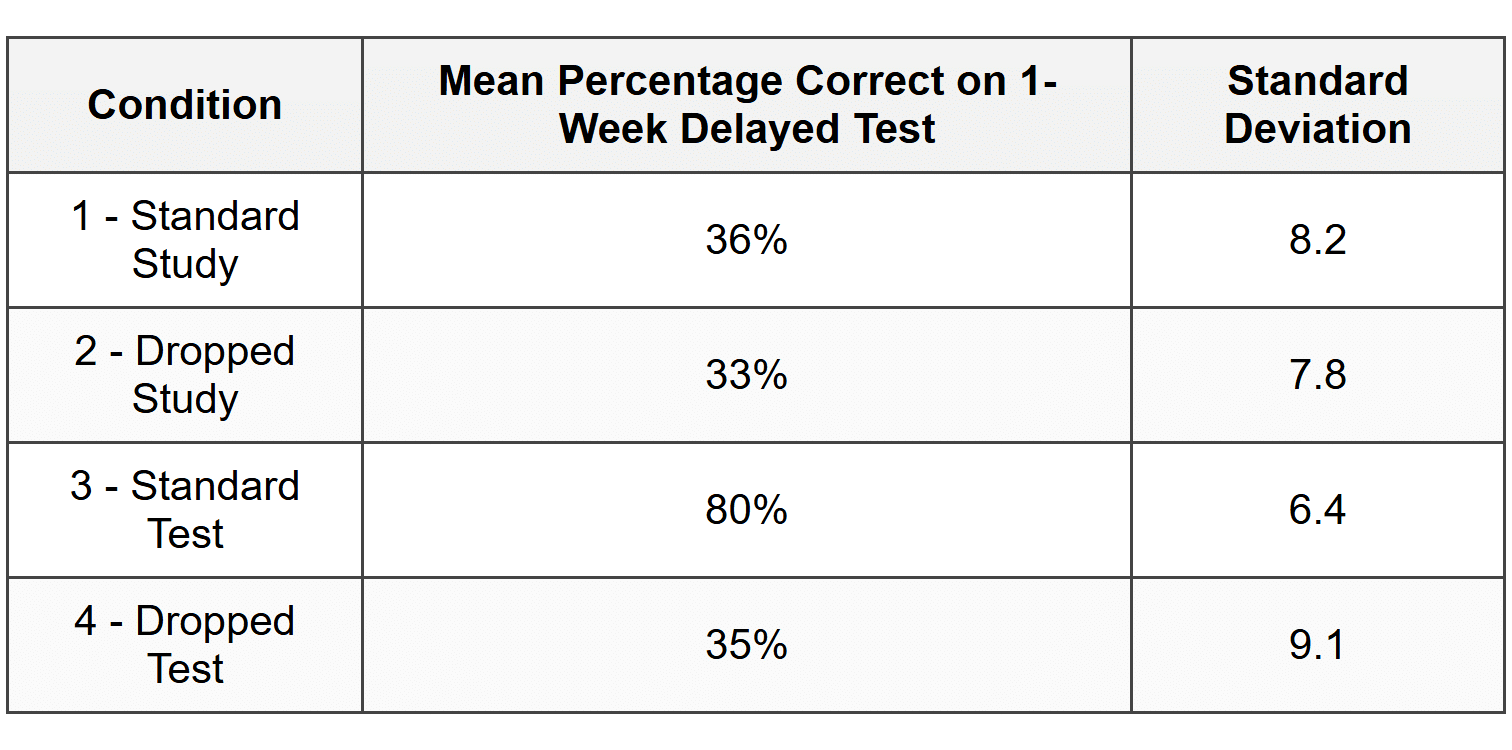
Statistical analysis revealed that Condition 3 (Standard Test) produced significantly higher retention than all other conditions (p < 0.001).
Answer all of the following:
- Identify the research method used in this study.
- State the operational definition of the dependent variable in this study.
- Describe what the data indicate about the effect of repeated retrieval practice on long-term retention.
- Identify one ethical guideline that the researchers applied in this study.
- Explain how the sampling method and participant characteristics affect the generalizability of these findings.
- Explain how the findings from Condition 3 compared to Condition 4 support or refute the importance of continued retrieval practice for items that have already been recalled correctly once.
Question 2: Evidence-Based Question (EBQ)
Read the three study summaries below and answer all parts of the question that follows.
Study A: Levels of Processing
Craik and Tulving (1975) presented participants with a series of words. For each word, participants answered one of three types of questions: structural (e.g., "Is the word in capital letters?"), phonemic (e.g., "Does the word rhyme with 'train'?"), or semantic (e.g., "Does the word fit in the sentence: 'The ____ is on the table'?"). On a surprise recall test administered afterward, participants recalled significantly more words that had been processed semantically (65% recalled) compared to phonemically (37% recalled) or structurally (15% recalled). The researchers concluded that deeper, meaning-based processing produces superior memory compared to shallow, surface-level processing.
Study B: Self-Reference Effect
Rogers, Kuiper, and Kirker (1977) investigated how relating information to oneself affects memory. Participants rated adjectives according to different criteria: structural (font type), phonemic (rhyming), semantic (synonyms), or self-referent (describes you). On a subsequent unexpected recall test, words processed in the self-referent condition were recalled significantly better (77% recalled) than words in the semantic condition (63% recalled), phonemic condition (42% recalled), or structural condition (19% recalled). The researchers suggested that self-referential processing creates particularly distinctive and elaborate memory traces by connecting new information to the rich network of existing self-knowledge.
Study C: Generation Effect
Slamecka and Graf (1978) examined the generation effect in memory. Participants were presented with word pairs. In the "read" condition, participants simply read both words in each pair (e.g., "rapid-fast"). In the "generate" condition, participants were given the first word and the first letter of the second word and had to generate the associate (e.g., "rapid-f___"). On a later memory test, participants showed significantly better recall for words they had generated themselves (72% recalled) compared to words they had merely read (51% recalled). The researchers argued that actively generating information during encoding requires deeper semantic processing and creates more distinctive memory traces than passive reading.
Answer all of the following:
- Identify one commonality in the methodology or procedure across all three studies.
- Evaluate the consistency of findings across these three studies regarding what type of encoding produces the best memory.
- Apply the concept of elaborative rehearsal to explain the pattern of results observed across all three studies.
ANSWER KEY
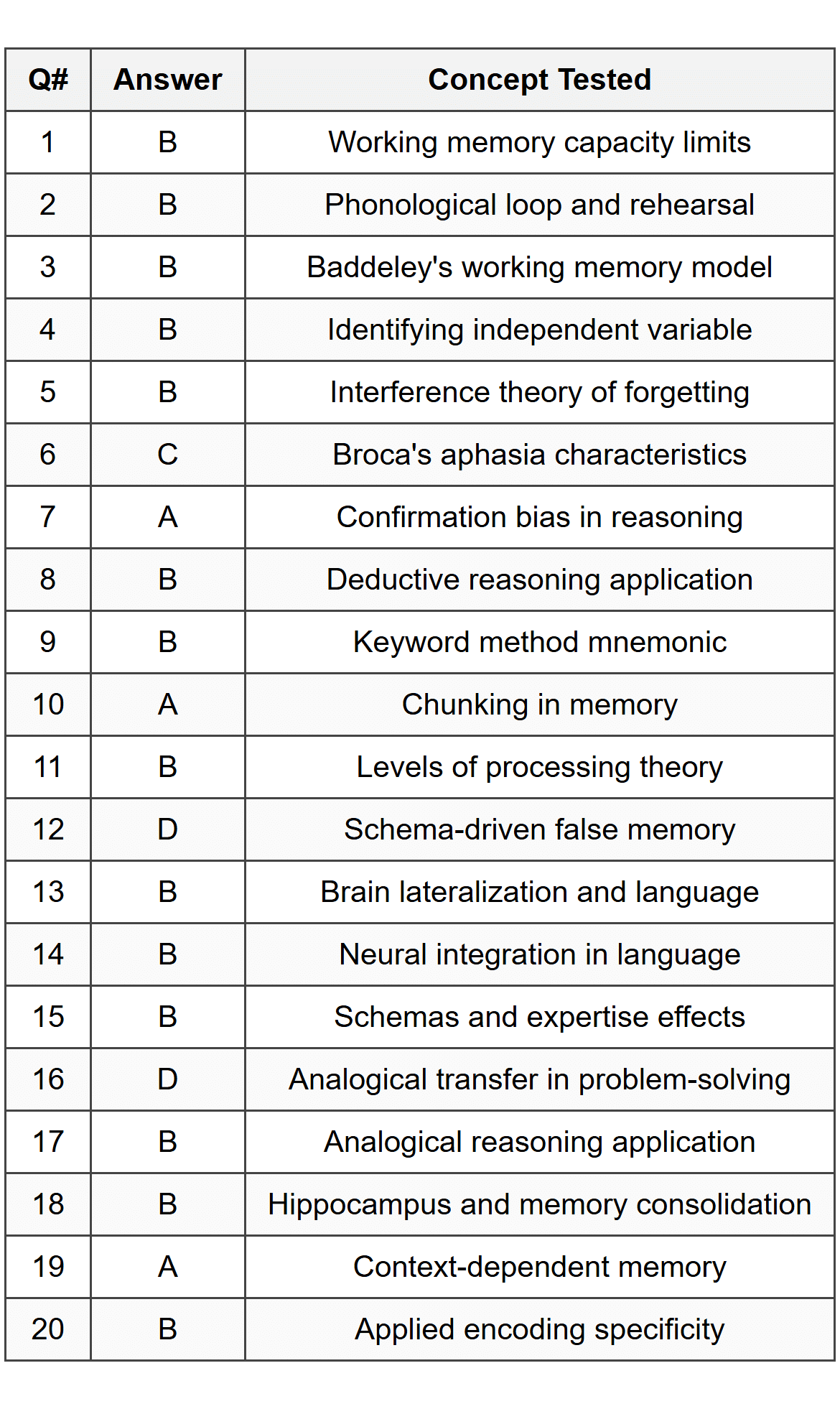
Part A: Multiple Choice Answer Table
Part B: Free Response Detailed Answers
FRQ 1 - Answer Key (Article Analysis Question)
Part A: Identify the research method used in this study.
The research method used in this study is a laboratory experiment (or simply "experiment"). This is identified by the random assignment of participants to different conditions and the manipulation of the independent variable (study strategy) while controlling other variables, with the purpose of establishing cause-and-effect relationships between study methods and memory retention.
Part B: State the operational definition of the dependent variable in this study.
The operational definition of the dependent variable is the percentage of Swahili words for which participants could correctly produce the English translation on a surprise final test administered one week after the initial study session. This precisely defines how "memory retention" was measured in observable and quantifiable terms.
Part C: Describe what the data indicate about the effect of repeated retrieval practice on long-term retention.
The data indicate that repeated retrieval practice (testing) dramatically improves long-term retention compared to repeated studying alone. Specifically, Condition 3 (Standard Test), in which participants repeatedly tested themselves on all word pairs throughout the study session, produced an 80% retention rate after one week. This was more than double the retention rate of Condition 1 (Standard Study) at 36%, which involved only repeated studying without testing. The statistical significance (p < 0.001) indicates this difference is highly unlikely to have occurred by chance. This demonstrates that actively retrieving information from memory is far more effective for long-term retention than passive restudying.
Part D: Identify one ethical guideline that the researchers applied in this study.
One ethical guideline applied was informed consent. The study summary states that "all participants provided informed consent and were told they could withdraw at any time without penalty," which ensures participants voluntarily agreed to participate with knowledge of their rights. (Alternative acceptable answers: confidentiality - researchers protected participant privacy by using code numbers rather than names; debriefing - participants were informed about the study's purpose after completion; right to withdraw - participants were told they could withdraw without penalty.)
Part E: Explain how the sampling method and participant characteristics affect the generalizability of these findings.
The generalizability of these findings is somewhat limited by the sampling method and participant characteristics. The sample consisted entirely of undergraduate students (ages 18-22) recruited from a university participant pool, which represents a relatively narrow demographic that may not be representative of the general population. University students typically have more recent academic experience and may employ different learning strategies than older adults, children, or individuals with less formal education. Additionally, the use of a convenience sample (university participant pool) rather than random sampling from the broader population limits the ability to generalize these findings to all age groups and educational backgrounds. However, the findings may generalize well to other college students learning foreign language vocabulary in similar academic contexts. The balanced gender distribution (58% female, 42% male) strengthens generalizability across gender, though this was not the primary limiting factor.
Part F: Explain how the findings from Condition 3 compared to Condition 4 support or refute the importance of continued retrieval practice for items that have already been recalled correctly once.
The comparison between Condition 3 and Condition 4 strongly supports the importance of continued retrieval practice even for items already recalled correctly. Condition 3 (Standard Test), which continued testing all word pairs throughout the session regardless of whether they had been recalled correctly, yielded 80% retention after one week. In contrast, Condition 4 (Dropped Test), which eliminated word pairs from further testing once they were recalled correctly once, produced only 35% retention - nearly identical to the study-only conditions and drastically lower than Condition 3. This finding refutes the intuitive belief that items recalled correctly once no longer need practice, and instead supports the principle that continued retrieval attempts strengthen memory consolidation. The dramatic difference (80% versus 35%) demonstrates that repeated successful retrieval creates stronger, more durable memory traces, which is the theoretical basis for the testing effect in cognitive psychology.
FRQ 2 - Answer Key (Evidence-Based Question)
Part A: Identify one commonality in the methodology or procedure across all three studies.
One key methodological commonality across all three studies is that they all used incidental learning with surprise recall tests. In each study, participants were given orienting tasks (answering questions about words, rating adjectives, or reading/generating word pairs) without being told in advance that their memory would be tested, and then were given an unexpected recall test afterward. This procedure ensures that differences in recall reflect the depth or quality of encoding during the orienting task rather than differences in intentional memorization strategies. (Alternative acceptable answers: All three studies manipulated the type of cognitive processing during encoding; all three studies used within-subjects or between-subjects comparisons of different encoding conditions; all three studies measured memory through recall performance as the dependent variable.)
Part B: Evaluate the consistency of findings across these three studies regarding what type of encoding produces the best memory.
The findings across all three studies are highly consistent in demonstrating that deeper, more meaningful, and more elaborative encoding produces superior memory retention. Study A showed that semantic processing (65% recall) produced better memory than phonemic (37%) or structural processing (15%). Study B found that self-referent processing (77%) produced the best recall, followed by semantic (63%), phonemic (42%), and structural (19%). Study C demonstrated that generating words (72%) led to better recall than simply reading them (51%). All three studies show the same hierarchical pattern: surface-level, shallow processing produces the poorest memory, while processing that engages meaning, personal relevance, or active construction produces the strongest memory. The self-reference effect (Study B) showed even stronger memory than basic semantic processing, and the generation effect (Study C) similarly enhanced memory beyond passive semantic processing, suggesting that the most effective encoding involves both semantic meaning and active, personalized engagement with the material.
Part C: Apply the concept of elaborative rehearsal to explain the pattern of results observed across all three studies.
Elaborative rehearsal is the process of encoding information by connecting it to existing knowledge, creating meaningful associations, and thinking about the information in deeper, more analytical ways. This concept explains the pattern of results across all three studies. In Study A, semantic processing required elaborative rehearsal by having participants think about meaning and make connections to existing concepts (e.g., "Does 'chair' fit in 'The ___ is on the table?'" requires thinking about the meaning of "chair" and its relationship to tables and typical contexts). In contrast, structural and phonemic processing involved only shallow, surface-level maintenance rehearsal focused on appearance or sound rather than meaning. Study B extended this principle by showing that self-referential processing creates the most elaborate encoding of all, because relating information to oneself connects new information to the extensive, well-organized network of self-knowledge and personal experiences in long-term memory. Study C demonstrates that generating information requires more elaborative processing than passive reading because generation forces learners to actively search semantic memory for meaningful connections (e.g., "rapid-f___" requires thinking about the meaning of "rapid" and retrieving a semantically related word). Together, these studies show that elaborative rehearsal - connecting new information to existing knowledge networks through meaningful processing - is the key mechanism that produces durable, retrievable memories, and that the depth and personal relevance of these elaborations directly predicts memory strength.