Practice Questions :Development and Learning

SECTION I: MULTIPLE CHOICE
Directions
Each of the questions or incomplete statements below is followed by four suggested answers or completions. Select the one that is best in each case and write the letter of your choice on your answer sheet.
Question 1
Research Scenario: Dr. Martinez conducts a study examining motor development in infants. She observes 60 infants at 6, 9, and 12 months of age, recording the age at which each infant first demonstrates crawling behavior. She finds that 10% of infants crawl by 6 months, 55% by 9 months, and 90% by 12 months.
Dr. Martinez's findings best illustrate which concept in developmental psychology?
- Critical periods determine the exact age at which motor milestones must occur
- Maturation follows a predictable sequence with individual variation in timing
- Environmental enrichment is the primary determinant of motor development
- Sensitive periods require specific environmental triggers for development to proceed
Question 2
Vignette: A researcher presents 4-year-old children with two identical glasses containing equal amounts of juice. After a child confirms the amounts are the same, the researcher pours one glass into a taller, thinner container. When asked which container has more juice, most children point to the taller container.
This scenario best demonstrates a limitation characteristic of Piaget's:
- Sensorimotor stage, specifically object permanence
- Preoperational stage, specifically conservation
- Concrete operational stage, specifically reversibility
- Formal operational stage, specifically abstract reasoning
Question 3
Study Summary: Researchers examined attachment patterns in 100 infants using the Strange Situation procedure. They recorded infant behaviors during maternal separation and reunion. Results showed: 65% demonstrated secure attachment, 20% avoidant attachment, 10% resistant attachment, and 5% disorganized attachment.
An infant who shows little distress when the mother leaves, and actively avoids or ignores the mother upon reunion, would most likely be classified as having which attachment pattern?
- Secure attachment, indicating healthy emotional regulation
- Avoidant attachment, possibly reflecting consistent unresponsiveness from caregivers
- Resistant attachment, indicating inconsistent caregiving
- Disorganized attachment, reflecting traumatic caregiving experiences
Question 4
A developmental psychologist finds that children who are read to daily during their preschool years demonstrate stronger reading skills in third grade compared to children who were rarely read to. However, the researcher also discovers that families who read daily tend to have higher incomes and more educational resources. This scenario best illustrates the challenge of:
- Establishing temporal precedence in correlational research
- Controlling for confounding variables in developmental studies
- Achieving random assignment in experimental designs
- Measuring dependent variables with operational definitions
Question 5
Data Table:
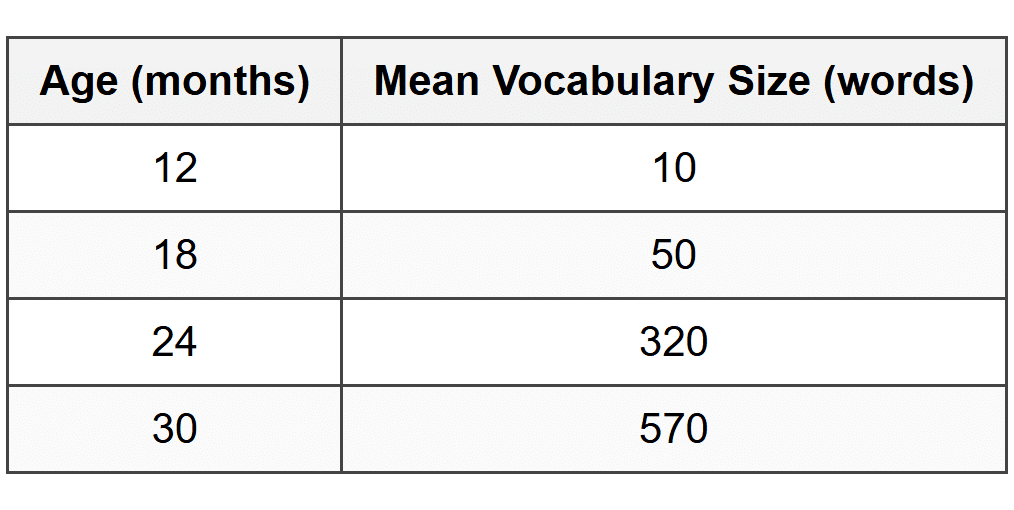
The dramatic increase in vocabulary between 18 and 24 months shown in the data is commonly referred to as:
- The language acquisition device, demonstrating innate grammatical knowledge
- Telegraphic speech, showing simplified sentence construction
- The vocabulary explosion, reflecting rapid word learning during this period
- Overgeneralization, indicating rule application in language development
Question 6
A child calls all four-legged animals "doggie," including cats, horses, and cows. According to Piaget's theory of cognitive development, this child is demonstrating:
- Accommodation, by modifying existing schemas to fit new information
- Assimilation, by incorporating new experiences into existing schemas
- Equilibration, by balancing assimilation and accommodation
- Conservation, by recognizing that properties remain constant despite changes
Question 7
Scenario: In a study of moral development, researchers present adolescents with the following dilemma: "A woman is dying from cancer. A druggist has discovered a medication that could save her, but he is charging ten times what it costs him to make. The woman's husband cannot afford it and the druggist refuses to lower the price. Should the husband steal the drug?"
One participant responds: "The husband should steal the drug because saving a human life is more important than the druggist's property rights. Human life has inherent value that transcends legal rules."
According to Kohlberg's theory of moral development, this reasoning best exemplifies which stage?
- Preconventional morality, focused on avoiding punishment
- Conventional morality, emphasizing social rules and laws
- Postconventional morality, based on abstract ethical principles
- Autonomous morality, distinguishing between moral and conventional rules
Question 8
Research Finding: A longitudinal study tracked 200 children from birth to age 5. Researchers measured stress hormone levels (cortisol) in children exposed to various levels of caregiver responsiveness. Children with consistently responsive caregivers showed cortisol levels averaging 8.2 μg/dL, while children with inconsistent or unresponsive caregivers showed levels averaging 14.7 μg/dL.
This finding best supports which concept regarding early childhood development?
- Instinct theory, showing biological drives shape early behavior
- Critical period hypothesis, demonstrating language must be acquired early
- Neuroplasticity, illustrating how early experiences influence brain development
- Behavioral shaping, showing reinforcement patterns affect responses
Question 9
A 9-month-old infant looks under a blanket to find a toy that was hidden while the infant watched. This behavior demonstrates the infant has acquired:
- Object permanence, understanding that objects continue to exist when out of sight
- Conservation, recognizing that quantity remains constant despite appearance changes
- Theory of mind, attributing mental states to others
- Reversibility, understanding that actions can be mentally reversed
Question 10
Experimental Design: Dr. Chen randomly assigns 80 preschool children to one of two conditions. In Condition A, children observe an adult model behaving aggressively toward a large inflatable doll, hitting and kicking it. In Condition B, children observe an adult model playing quietly with toys. Children are then individually allowed to play in a room containing the same doll and toys. Trained observers record the number of aggressive acts each child displays.
Results: Children in Condition A displayed an average of 12.3 aggressive acts (SD = 3.2), while children in Condition B displayed an average of 2.1 aggressive acts (SD = 1.8).
This study design and findings best support which theory of learning?
- Classical conditioning, demonstrating learned associations between stimuli
- Operant conditioning, showing the effects of reinforcement on behavior
- Observational learning, illustrating modeling and imitation of behavior
- Latent learning, revealing cognitive maps formed without reinforcement
Question 11
Which of the following scenarios best illustrates Vygotsky's concept of the zone of proximal development?
- A child independently solves math problems she has previously mastered
- A child completes a puzzle with guidance from a teacher, which she could not complete alone
- A child reads the same book repeatedly to develop fluency
- A child discovers object permanence through spontaneous exploration
Question 12
Study Scenario: Researchers studied executive function development in children ages 3-5. They used a task where children were shown a series of cards with colored shapes and asked to sort them first by color, then by shape. Performance data:
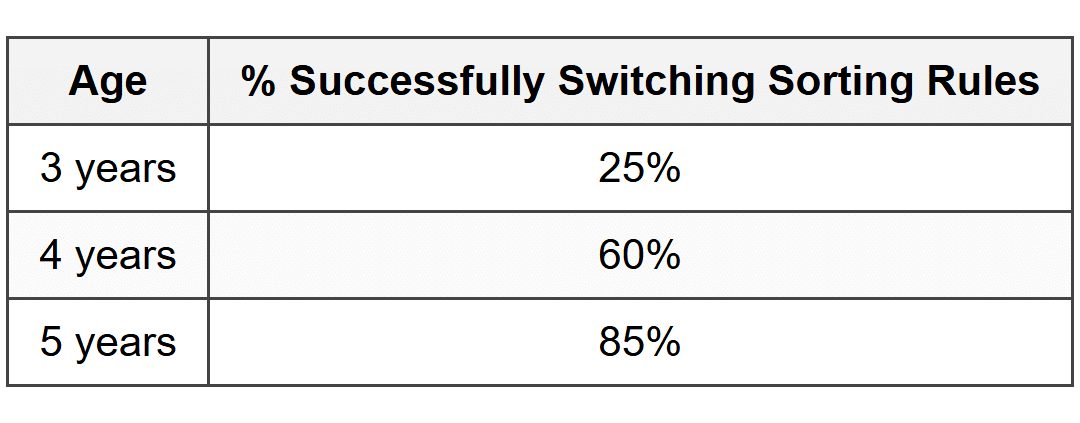
The progressive improvement in task performance with age primarily reflects development of which cognitive ability?
- Egocentrism, the ability to take another's perspective
- Cognitive flexibility, the ability to shift attention and adapt to new rules
- Centration, the tendency to focus on one aspect of a situation
- Symbolic thinking, the ability to use mental representations
Question 13
A researcher examines the role of teratogens in prenatal development by comparing birth outcomes of mothers exposed to various substances during pregnancy. This research design would be classified as:
- Experimental, because the researcher manipulates the independent variable
- Quasi-experimental, because participants cannot be randomly assigned to exposure conditions
- Longitudinal correlational, because the same participants are measured over time
- Cross-sectional experimental, because different age groups are compared
Question 14
Scenario: A 4-year-old boy watches his father hide a toy car in the kitchen cupboard. When asked where his mother (who was not present) will look for the car when she comes home, the child responds, "In the kitchen cupboard."
This child's response suggests he has not yet fully developed:
- Object permanence, understanding objects exist when not visible
- Theory of mind, understanding that others have different knowledge states
- Conservation, recognizing quantity remains constant
- Concrete operational thinking, applying logic to physical objects
Question 15
Research Data: A study examined the timing of pubertal development and self-esteem in adolescents. Results showed:
- Early-maturing girls: Mean self-esteem score = 62 (scale 0-100)
- On-time girls: Mean self-esteem score = 74
- Late-maturing girls: Mean self-esteem score = 71
- Early-maturing boys: Mean self-esteem score = 78
- On-time boys: Mean self-esteem score = 73
- Late-maturing boys: Mean self-esteem score = 64
These data suggest that the psychological impact of pubertal timing:
- Is identical for males and females across all timing conditions
- Shows an interaction effect, with early maturation affecting girls and boys differently
- Demonstrates that late maturation is universally associated with lower self-esteem
- Indicates that pubertal timing has no measurable effect on self-esteem
Question 16
A parent consistently responds to an infant's cries by providing food when the infant is hungry, changing diapers when wet, and offering comfort when distressed. According to Erikson's theory of psychosocial development, this pattern of caregiving is most likely to promote the developmental outcome of:
- Autonomy vs. shame and doubt, by encouraging independent exploration
- Trust vs. mistrust, by establishing reliability in the caregiving relationship
- Initiative vs. guilt, by supporting goal-directed behavior
- Industry vs. inferiority, by reinforcing competence and skill development
Question 17
Study Description: Researchers investigated the development of working memory capacity across childhood. Participants were asked to remember increasingly long strings of numbers. Results:
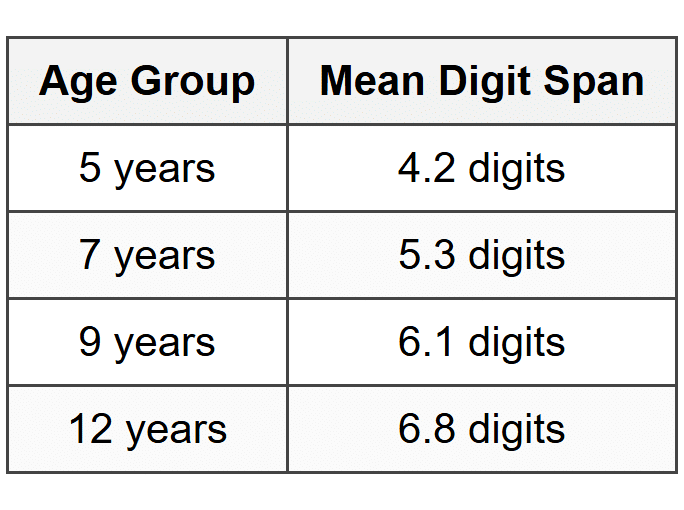
The pattern shown in the data best supports the conclusion that:
- Working memory capacity remains constant throughout childhood
- Working memory capacity increases gradually with age during childhood
- Working memory capacity decreases as children develop
- Working memory capacity shows no relationship to age
Question 18
A researcher studying language development finds that children who learn two languages simultaneously from birth show initial delays in vocabulary size in each language compared to monolingual children, but by age 5, their combined vocabulary across both languages exceeds that of monolingual children. This finding best illustrates:
- A critical period effect, showing language must be learned early or not at all
- Cognitive interference, demonstrating that learning multiple languages impairs development
- A temporary developmental pattern that resolves with maturation
- Linguistic determinism, showing language shapes cognitive abilities
Question 19
Vignette: A teacher provides students with increasingly challenging reading materials, offering support and guidance that is gradually reduced as students become more proficient. Students are encouraged to use strategies modeled by the teacher until they can apply them independently.
This instructional approach best exemplifies Vygotsky's concept of:
- Assimilation, integrating new information into existing schemas
- Discovery learning, allowing students to construct knowledge independently
- Scaffolding, providing temporary support within the zone of proximal development
- Shaping, reinforcing successive approximations toward a target behavior
Question 20
Research Scenario: Dr. Williams conducts a longitudinal study tracking cognitive development from age 2 to age 12 in the same group of 100 children. She assesses problem-solving abilities every two years using standardized measures. By age 12, only 64 of the original participants remain in the study due to families moving away or declining to continue participation.
The loss of participants over time represents which methodological concern?
- Cohort effects, where historical events influence specific age groups
- Attrition bias, which may affect the representativeness of the final sample
- Cross-sectional limitations, preventing conclusions about change over time
- Experimenter bias, where researcher expectations influence results
SECTION II: FREE RESPONSE
Directions
Answer both questions in this section. The Article Analysis Question (AAQ) requires you to integrate your knowledge of psychological concepts and research methods. The Evidence-Based Question (EBQ) requires you to analyze and synthesize information from multiple studies. Write your responses on separate sheets of paper. Your responses should demonstrate your understanding of psychological terminology and your ability to apply psychological concepts.
FRQ 1: Article Analysis Question (AAQ)
Suggested Time: 25 minutes
Study Summary
Title: Effects of Parent-Child Reading Interactions on Language Development in Preschool Children
Researchers: Dr. Elena Rodriguez and colleagues conducted a study investigating how different styles of parent-child book reading influence vocabulary development in preschool-aged children.
Method: The researchers recruited 120 parent-child dyads from community preschools. Children were between 36 and 48 months old at the start of the study. Parents were randomly assigned to one of three conditions: (1) Dialogic Reading, where parents were trained to ask open-ended questions, expand on children's responses, and encourage verbal participation during reading; (2) Standard Reading, where parents read books aloud in their typical manner without special training; or (3) Control Group, where families engaged in typical home activities without structured reading sessions. Each condition involved 40 dyads.
The study lasted 8 weeks. Parents in the Dialogic and Standard Reading groups were asked to read with their children for 20 minutes daily, 5 days per week. Researchers provided age-appropriate books to families in both reading groups.
The researchers operationally defined vocabulary development as children's scores on the Peabody Picture Vocabulary Test (PPVT-4), a standardized assessment where children point to pictures that match vocabulary words spoken by the examiner. Children were tested at the beginning (pretest) and end (posttest) of the 8-week period.
Researchers obtained informed consent from all parents and assent from children when possible. The study was approved by the university's Institutional Review Board. Families were compensated $50 for their participation and were offered books to keep.
Results: The following table shows mean vocabulary gains (posttest minus pretest scores) for each group:
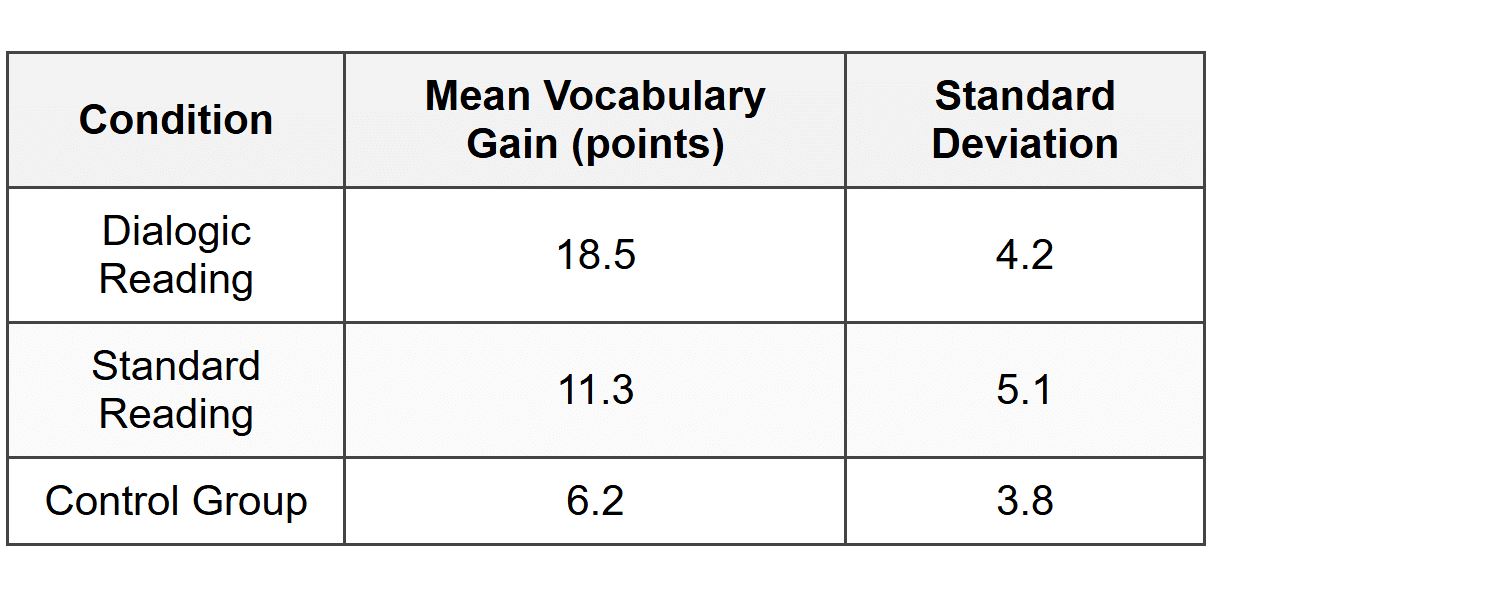
Statistical analysis revealed that the Dialogic Reading group showed significantly greater vocabulary gains than both the Standard Reading group and the Control group. The Standard Reading group also showed significantly greater gains than the Control group.
Use the study summary above to answer the following questions:
- Identify the research method used in this study.
- State the operational definition of the dependent variable in this study.
- Describe what the data in the table indicate about the relationship between reading interaction style and vocabulary development.
- Identify one ethical guideline that the researchers followed in conducting this study.
- Explain one limitation to the generalizability of this study's findings, using specific evidence from the study summary.
- Explain how the findings of this study support Vygotsky's sociocultural theory of cognitive development.
FRQ 2: Evidence-Based Question (EBQ)
Suggested Time: 20 minutes
Study A: Attachment Security and Academic Performance
Researchers assessed attachment security in 200 infants at 18 months using the Strange Situation procedure. They classified 130 infants as securely attached and 70 as insecurely attached. The researchers followed these children longitudinally and measured their academic performance using standardized achievement tests at age 10. Results showed that children classified as securely attached in infancy had significantly higher mean achievement scores (M = 112, SD = 12) compared to children classified as insecurely attached (M = 98, SD = 15). Regression analysis indicated that attachment security at 18 months predicted approximately 22% of the variance in academic achievement at age 10, even after controlling for parental education level and family income.
Study B: Quality of Infant Care and Social Competence
A team of developmental psychologists examined the relationship between early childcare quality and later social competence. They observed 180 infants in various childcare settings, rating caregiver responsiveness, child-to-caregiver ratios, and educational programming. Children were categorized into high-quality care (n = 90) and low-quality care (n = 90) groups. At age 4, researchers assessed social competence using teacher ratings and peer interaction observations. Children who had experienced high-quality infant care demonstrated significantly higher social competence scores (M = 78, SD = 9) compared to those in low-quality care (M = 64, SD = 11). The effect remained significant after controlling for maternal education and temperament ratings.
Study C: Parental Sensitivity Training and Child Cognitive Development
Investigators conducted a randomized controlled trial with 150 first-time mothers and their newborns. Half of the mothers (n = 75) received training in responsive caregiving, which taught them to recognize and appropriately respond to infant cues related to hunger, distress, and engagement. The control group (n = 75) received standard informational materials about infant development. When children reached 36 months, researchers administered cognitive assessments measuring language, problem-solving, and memory. Children whose mothers received sensitivity training scored significantly higher on cognitive assessments (M = 108, SD = 10) compared to control group children (M = 98, SD = 12). Observational data confirmed that trained mothers showed higher levels of contingent responding to infant signals during free-play sessions.
Based on the three study summaries above, answer the following questions:
- Identify one commonality in the methodological approach or research design across all three studies.
- Evaluate the consistency of the findings across the three studies regarding the relationship between early caregiving experiences and child developmental outcomes.
- Explain how Erikson's theory of psychosocial development could account for the pattern of results observed across these three studies.
ANSWER KEY
Part A: Multiple Choice Answer Table
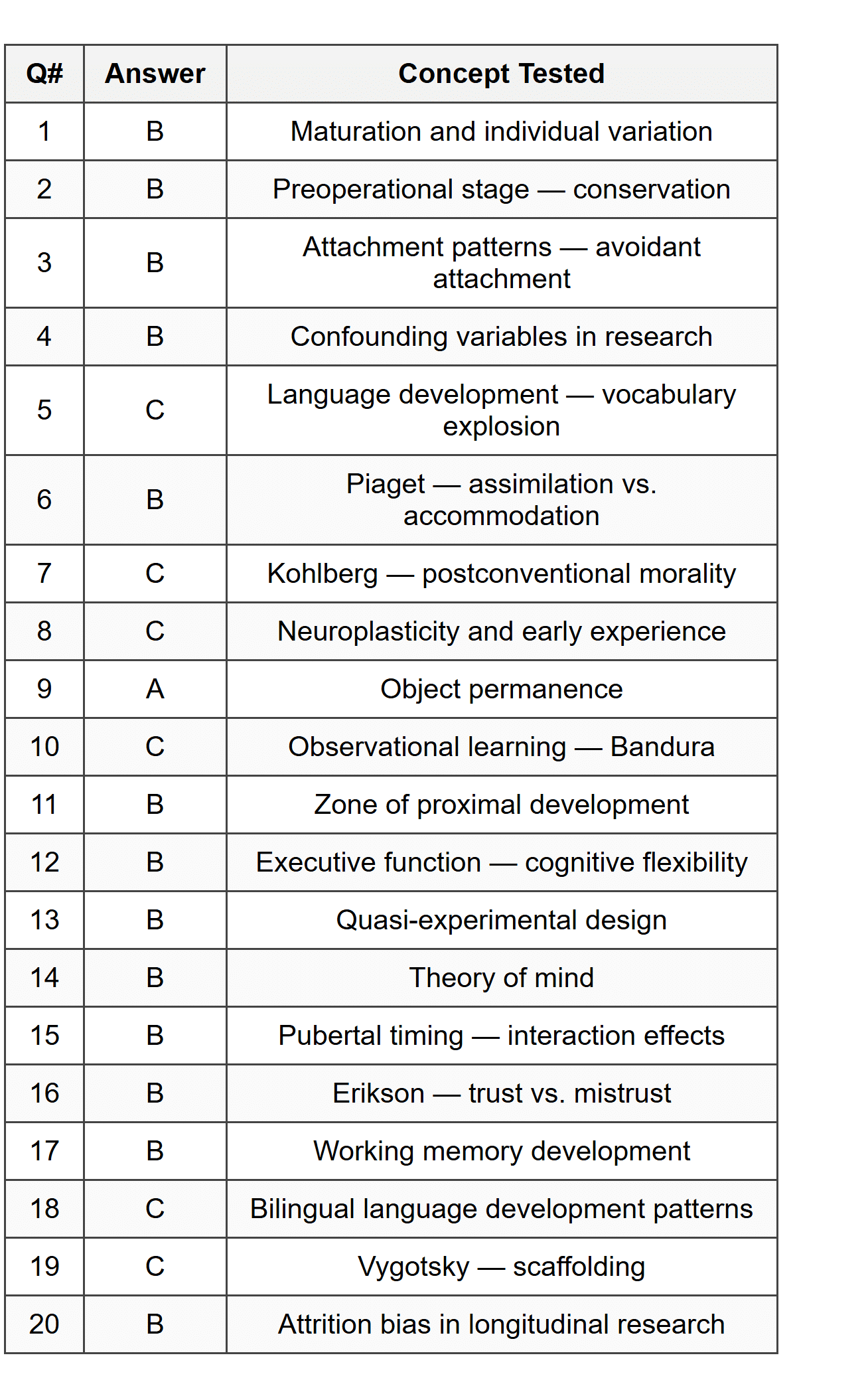
Part B: Free Response Detailed Answers
FRQ 1 - Answer Key (Article Analysis Question)
Part A: Identify the research method
The research method used in this study is the experimental method (or true experiment). This is evidenced by the researchers' use of random assignment to allocate parent-child dyads to one of three conditions (Dialogic Reading, Standard Reading, or Control Group) and the manipulation of the independent variable (type of reading interaction or no structured reading).
Part B: State the operational definition of the dependent variable
The operational definition of the dependent variable (vocabulary development) is children's scores on the Peabody Picture Vocabulary Test (PPVT-4), specifically measured as the gain scores calculated by subtracting pretest scores from posttest scores after the 8-week intervention period. The PPVT-4 is administered by having children point to pictures that match vocabulary words spoken by an examiner.
Part C: Describe what the data indicate
The data indicate that interactive reading style is positively associated with greater vocabulary gains in preschool children. Specifically, children in the Dialogic Reading condition (where parents asked open-ended questions and encouraged participation) showed the largest mean vocabulary gain of 18.5 points. Children in the Standard Reading condition showed moderate gains of 11.3 points, and children in the Control Group (no structured reading) showed the smallest gains of 6.2 points. This pattern demonstrates a dose-response relationship, where more interactive and engaging reading practices produced larger vocabulary improvements.
Part D: Identify an ethical guideline
The researchers followed the ethical guideline of informed consent by obtaining consent from all parents (and assent from children when possible) before participation. Additional acceptable answers include: obtaining IRB approval before conducting the study, providing compensation for participants' time ($50 and books to keep), or ensuring beneficence by allowing families to keep educational materials.
Part E: Explain a limitation to generalizability
One limitation to generalizability is that the sample consisted of children recruited from community preschools, which means the findings may not generalize to children who do not attend preschool or who come from families without access to early childhood education programs. Families who enroll their children in preschool may differ systematically from other families in terms of parental education, income, or value placed on early learning, which could limit the extent to which these findings apply to the broader population of preschool-aged children. Another acceptable answer: the narrow age range (36-48 months) limits generalizability to younger or older children, as the effectiveness of dialogic reading may vary with developmental stage.
Part F: Explain how findings support Vygotsky's sociocultural theory
The findings support Vygotsky's sociocultural theory of cognitive development, which emphasizes that children's cognitive development occurs through social interaction with more knowledgeable others. In the Dialogic Reading condition, parents acted as guides within the child's zone of proximal development by asking open-ended questions, expanding on children's responses, and providing scaffolding during reading activities. This interactive approach allowed children to accomplish vocabulary learning tasks with adult support that they could not accomplish independently, which aligns with Vygotsky's emphasis on the social construction of knowledge. The significantly greater vocabulary gains in the Dialogic Reading group compared to the Control Group demonstrate that active social engagement and guided participation facilitate language development more effectively than independent or passive experiences, consistent with Vygotsky's theoretical predictions.
FRQ 2 - Answer Key (Evidence-Based Question)
Part A: Identify a commonality across studies
One methodological commonality across all three studies is that they are longitudinal in design, measuring early caregiving variables in infancy or early childhood and then assessing developmental outcomes at a later time point. Study A measured attachment at 18 months and academic performance at age 10; Study B assessed childcare quality in infancy and social competence at age 4; and Study C involved an intervention with newborns and measured cognitive outcomes at 36 months. Another acceptable answer: all three studies controlled for potential confounding variables such as parental education, family income, or child temperament to isolate the effect of early caregiving experiences.
Part B: Evaluate consistency of findings
The findings across the three studies are highly consistent, all demonstrating that higher-quality early caregiving experiences predict more positive child developmental outcomes. Study A found that secure attachment in infancy predicted better academic achievement; Study B found that high-quality childcare predicted greater social competence; and Study C found that parental sensitivity training led to improved cognitive development. In all three studies, children who experienced more responsive, sensitive, and nurturing early care showed superior developmental outcomes across multiple domains (academic, social, and cognitive), even after controlling for socioeconomic factors. The consistency across different aspects of early care (attachment security, childcare quality, and parental sensitivity) and different outcome measures strengthens the conclusion that responsive early caregiving is foundational for healthy child development.
Part C: Explain using Erikson's theory
The pattern of results across these three studies can be explained through Erikson's theory of psychosocial development, specifically the first stage of trust versus mistrust, which occurs during infancy. According to Erikson, when infants receive consistent, responsive, and sensitive care from their caregivers, they develop a sense of basic trust - the belief that the world is safe and that their needs will be met. This foundational sense of trust serves as the psychological basis for all later development, enabling children to confidently explore their environment, form healthy relationships, and engage in learning. In all three studies, children who experienced responsive early caregiving (secure attachment, high-quality childcare, or sensitivity-trained parents) successfully resolved the trust versus mistrust crisis in a positive direction. This early trust then manifested as better developmental outcomes later in childhood - academic achievement requires trust in teachers and confidence in one's abilities; social competence requires trust in peers and secure relationship formation; and cognitive development requires the confidence to explore and learn. The consistent positive effects of responsive early care across multiple developmental domains support Erikson's claim that successful resolution of the first psychosocial crisis creates a foundation for competence across the lifespan.